How Stacking Machines Improve Throughput in End-of-Line Packaging
Throughput problems at the end of a packaging line usually appear before anyone labels them as stacking problems. Bundles begin to queue after the die-cutter, folder gluer, printer slotter, or finishing section. Operators slow the upstream machine to avoid unstable piles. Conveyors stop briefly while stacks are squared by hand. Product edges get damaged during transfer, and palletizing receives irregular loads that reduce robot speed or create unstable pallet patterns. In many corrugated and paper-based packaging plants, a well-configured stacking machine removes these interruptions by turning fast but irregular product discharge into controlled, repeatable stack formation.
That improvement comes from rhythm control. End-of-line packaging equipment rarely runs at a perfectly steady output. Sheet length changes, bundle counts vary by order, board stiffness shifts with flute profile and paper grade, and discharge spacing can change during acceleration or order changeover. A stacking machine absorbs these small variations and presents downstream equipment with a consistent unit load. When that buffering and alignment function is missing, every minor fluctuation travels directly into manual handling, machine waiting time, or product rework.
Where throughput is usually lost
In corrugated converting, the final discharge zone often looks simple because the main production value appears to come from printing, die-cutting, gluing, or coding. In practice, the last meters of the line decide whether rated machine speed can be sustained for a full shift. If sheets arrive faster than they can be separated, counted, rotated, jogged, or stacked, the line no longer runs according to the capability of the core machine. It runs according to the physical limits of the discharge area.
Common loss points include poor sheet deceleration, inconsistent overlap at the delivery section, insufficient side jog alignment, stack height variation, and delayed transfer from finished stack to takeaway conveyor or palletizing cell. These issues are especially visible on mixed-order production where short runs, quick size changes, and varied board combinations prevent stable manual routines. A stacking machine improves throughput when it addresses those specific loss points rather than simply adding automation for its own sake.
How stack formation changes line behavior
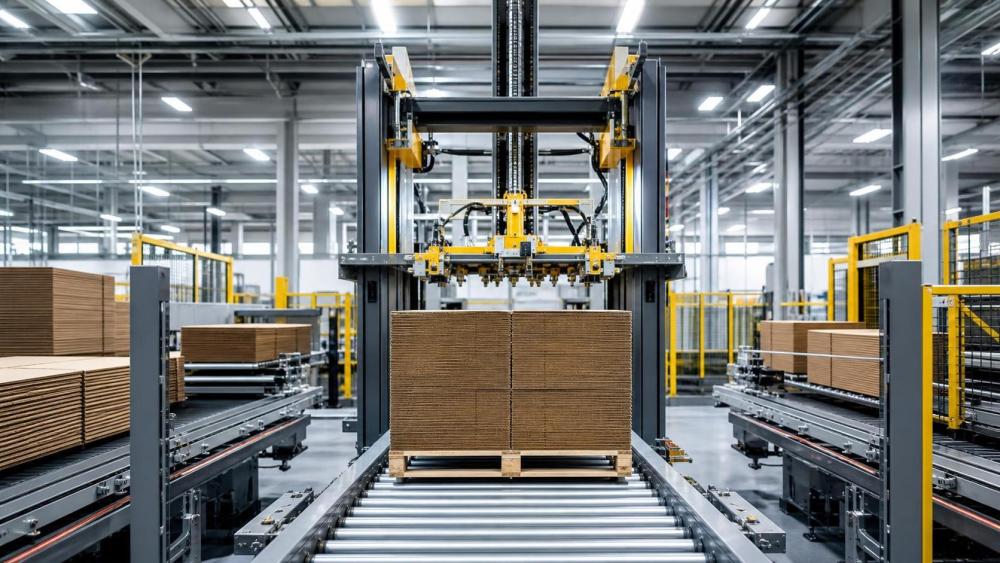
The most direct contribution is controlled accumulation. Instead of allowing finished sheets or bundles to fall into a loose pile, the machine builds the stack through timed receiving, alignment, compression if required, and discharge at a defined height or count. This reduces micro-stoppages caused by pile collapse, leaning stacks, or misaligned transfer. On high-speed corrugated lines, even short interruptions can propagate backward into slitter-scorer timing, cross-cutter delivery, or folder gluer batching. A stable stacking cycle isolates those disturbances.
Equally important is geometry control. Throughput depends on whether each stack can move immediately into the next process without correction. If a stack exits with uneven edges, variable top flatness, or poor squareness, it often requires manual intervention before strapping, palletizing, wrapping, or warehouse transfer. The production line may still count those units as completed, but real throughput has already fallen because labor and time were added outside the nominal machine cycle.
For paper-based packaging, stack quality is linked to material behavior. Lightweight liner and recycled grades may curl or fan at the delivery. Heavier board grades can land with higher impact energy, causing bounce and offset if deceleration is not controlled. Printed surfaces with fresh ink, coating, or varnish may be vulnerable to marking if stack pressure is uneven. A suitable stacking system manages these material responses through belt speed coordination, drop height control, side tamping pressure, and stack support design.
Application details that matter during equipment selection
Stacking performance cannot be judged by nominal speed alone. The first practical question is what unit the machine is stacking: individual corrugated sheets, folded cartons, glued boxes, bundled blanks, or counted packs. Each requires a different discharge logic. Sheet stacking may emphasize overlap control and smooth vertical accumulation. Folded carton stacking may depend more on counting accuracy, compression stability, and transfer timing into bundling or palletizing.
Product size range also affects throughput more than headline speed. A machine that handles large regular shipping cases well may lose stability on small display packaging formats. Long sheet lengths can bridge during transfer if support spacing is wrong. Narrow formats may twist unless side guides react quickly enough. When frequent order changes are expected, format adjustment time at side guides, stops, separators, and discharge conveyors becomes part of the throughput equation.
Another practical parameter is acceptable stack height. Taller stacks reduce transfer frequency, but they can also increase the risk of leaning, edge crush, or unstable robot pickup depending on board grade and downstream handling. Lower stacks move faster through transfer points but may create excessive cycling on lift tables and takeaway conveyors. The right setting depends on compression resistance, pallet pattern, and whether the next step is manual bundling, strapping, or fully automatic palletizing.
In integrated lines, communication between the stacking machine and upstream equipment is often more valuable than standalone mechanical speed. If order data, bundle count targets, and discharge timing are exchanged through the line control system, stack transitions become cleaner during job changeover. Without that integration, operators may rely on manual timing or fixed delays that work only under stable conditions.
Labor reduction is only part of the value
Manual stacking appears flexible because people can compensate for mixed sizes, warped sheets, or temporary jams. The cost is inconsistency. Human handling speed changes over a shift, especially when products are heavy, slippery, or repetitive. Misalignment during manual pile correction can damage corners and printed faces. More importantly, upstream machines are often slowed to match human recovery speed rather than actual mechanical capacity.
A stacking machine improves throughput because it replaces variable handling with repeatable cycle timing. That does not eliminate labor from the area; it changes where labor is used. Fewer interventions are needed at discharge, while more attention can move toward quality observation, order verification, and downstream flow. In a packaging plant with traceability, coding, or vision inspection requirements, this shift can be more valuable than simple headcount reduction because it protects flow without removing process control.
Line balance and downstream stability
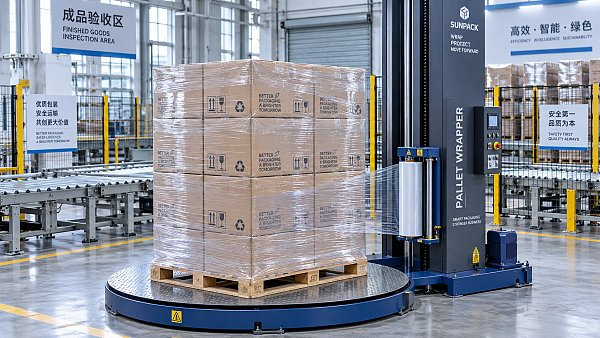
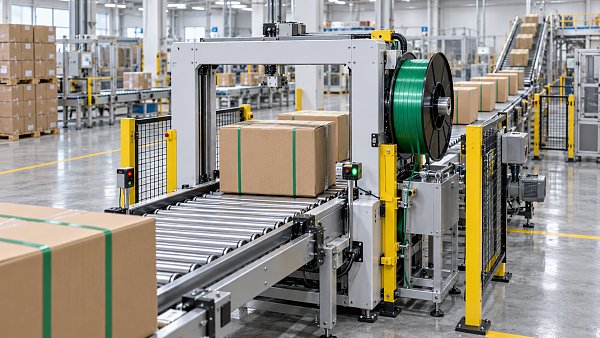
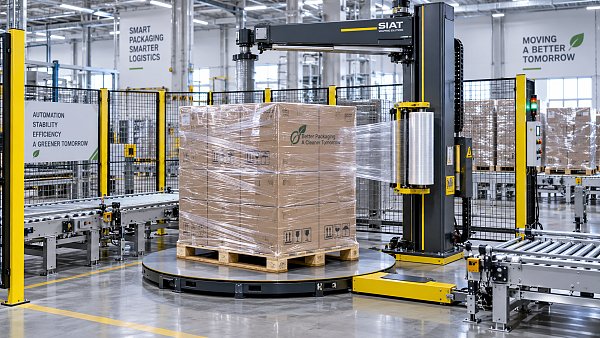
End-of-line automation works only when each section receives a product presentation it can process reliably. Robotic palletizing, for example, depends on stack dimensions, orientation consistency, and predictable arrival spacing. If the stacking machine delivers skewed or incomplete units, the robot either slows down, pauses for confirmation, or drops into fault recovery. Similar issues appear in automatic strapping and wrapping, where poor stack edges can cause strap misplacement or film tearing.
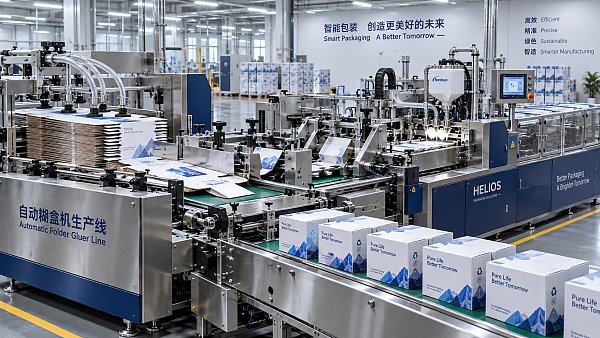
For that reason, stacking should be treated as a line-balancing device, not a simple exit conveyor with lift function. It regulates the handoff between processes with different motion profiles. A die-cutter may discharge in bursts. A folder gluer may create counted batches. A palletizer usually prefers regular pickup cadence. The stacker sits between those behaviors and converts them into something the next machine can accept continuously.
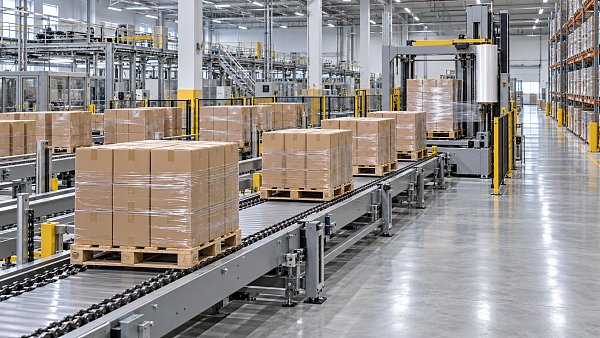
Transport layout around the stacker matters as much as the stacker itself. Throughput can be lost if there is insufficient accumulation conveyor length before or after the machine, poor access for pallet truck or AGV movement, or awkward turning radius for large stack transfer. Installation drawings should be reviewed with real product dimensions, not only machine footprint. In some plants, the main bottleneck is not stack formation but the inability to remove finished stacks without crossing operator walk paths or maintenance zones.
Mechanical features that affect real-world performance
Several design choices have a direct impact on stable output. A controlled descending table supports the stack as height builds, reducing drop shock on lower sheets. Independent side and rear joggers improve squareness, but excessive force can mark soft board or disturb lightweight formats. Servo-based adjustment usually shortens format change and improves repeatability, while purely manual adjustment may still be acceptable on long-run dedicated lines with limited size variation.
Separators and counting gates deserve careful attention where order integrity matters. Miscounts at the stacking stage can create hidden downstream problems, especially when bundles are later strapped and labeled as complete. The line may continue running, but warehouse and shipment errors appear later. If the plant handles mixed SKU production, the stacker should be evaluated for count verification logic, reject handling, and jam recovery without uncontrolled product mixing.
Noise, dust, and adhesive contamination are also practical concerns. Corrugated environments can produce paper dust that affects sensors, photoeyes, and pneumatic components. Glue overspray or fine fiber can reduce sensor reliability near discharge points. Guarding design should allow cleaning access without turning routine maintenance into a shutdown event. A machine that is difficult to clean may show good performance during commissioning and weaker stability after several weeks of production.
Commissioning risks that are often underestimated
A common misjudgment is assuming that if a stacking machine runs at test speed with one board grade and one format, it is ready for full production release. Actual conditions are broader. Warp, moisture variation, print coverage, slot pattern, bundle count logic, and changeover frequency all influence behavior. Acceptance testing should include unstable but realistic combinations: short sheets, long sheets, narrow widths, recycled liners with curl, and products that arrive close to the limit of transfer stability.
Another risk comes from poor interface definition. Throughput suffers when conveyor elevations, communication signals, emergency stop zoning, and fault priorities are not coordinated between stacker, upstream machine, and downstream takeaway or palletizing system. A stacker may function correctly on its own and still perform badly in the line because restart sequencing is wrong or because backlog control is too coarse.
Installation planning should also include spare part logic for wear items such as belts, stop pads, guides, rollers, and pneumatic seals. End-of-line equipment is sometimes treated as lower priority than core converting machinery, which leads to delayed replacement and unstable operation. Since the stacker sits at the point where finished output is accumulated, small wear-related deviations can interrupt the entire line even when the main machine remains mechanically sound.
When a stacking upgrade is justified
A stacking upgrade is typically justified when the discharge area dictates machine speed, when manual pile correction becomes routine, when palletizing faults originate from poor stack presentation, or when order mix has shifted toward shorter runs and frequent size changes. It is also worth reviewing where product damage appears near the end of the line but cannot be traced to printing or converting accuracy. In many cases, the defect is created during uncontrolled piling or transfer rather than during the main production step.
In end-of-line packaging, throughput improves when stack formation, count control, transfer timing, and downstream interface are treated as one system. The stacking machine is effective when it creates a stable unit load that moves forward without correction, waiting, or rehandling. That is the point where line speed becomes usable output rather than speed displayed on a machine screen.
Related News
 What to Check Before Ordering Pallet Wrappers Direct From a FactoryBuying from a pallet wrappers factory? Check load compatibility, output, film costs, safety, and support before ordering. Use this checklist to avoid costly mistakes and buy with confidence.Spatial Folding Strategist
 How an Automatic Folder Gluer System Reduces Carton Setup ErrorsAutomatic folder gluer system solutions reduce carton setup errors with precise feeding, folding, glue control, and compression. Discover how to improve quality and changeovers.Spatial Folding Strategist
 How to Choose a Folder Gluer Machine for Folding CartonsChoose the right folder gluer machine for folding cartons with proven guidance on speed, carton styles, glue quality, automation, testing, and lifecycle costs.Spatial Folding Strategist
 When Chain Pallet Conveyors Improve Warehouse Flow and ThroughputChain pallet conveyors improve warehouse flow by reducing forklift delays, adding controlled accumulation, and protecting packaging throughput. Discover when they deliver the strongest ROI.Spatial Folding Strategist
 How to Compare Automatic Strapping Machine Price and Total CostAutomatic strapping machine price comparison made simple: evaluate installation, throughput, consumables, labor, downtime, and total cost for a smarter investment.Spatial Folding Strategist
 What to Compare When Choosing a Pallet Wrappers SupplierCompare a pallet wrappers supplier by load stability, film efficiency, automation integration, service support, and total cost to choose the right solution.Spatial Folding Strategist