How Stacking Conveyors Reduce Handling Bottlenecks in Sheet Plants
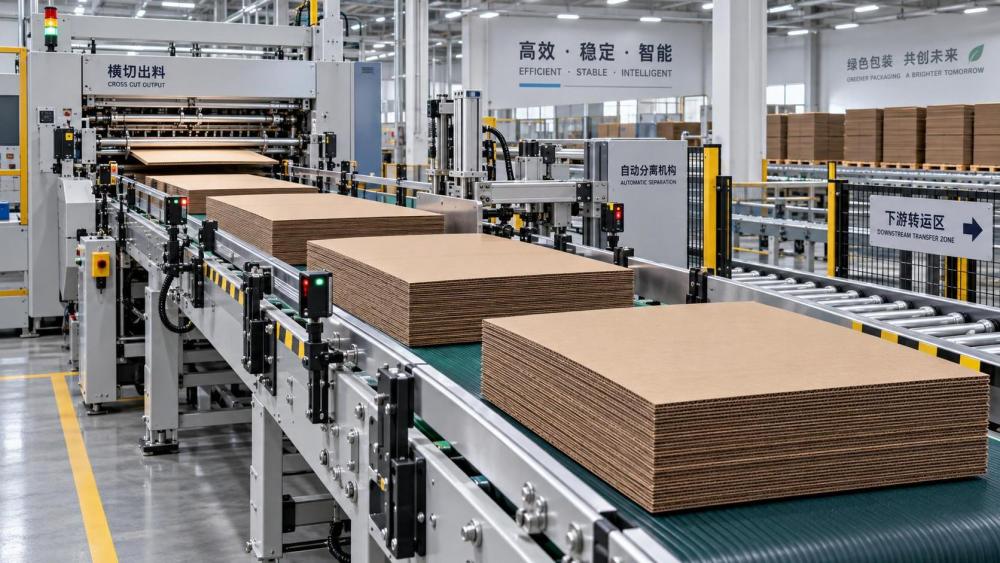
A stacking conveyor should be evaluated as a flow-control element between the corrugator cutter, the stack-forming station, and the next handling point, not as a simple transport bed. When this section is undersized or poorly synchronized, sheets may leave the cutter at the required production speed yet still accumulate in unstable piles, wait for manual clearing, or force the upstream line to slow. The resulting bottleneck is often misdiagnosed as a corrugator speed problem when the real constraint lies in how quickly a completed stack can be stabilized, separated, and transferred.
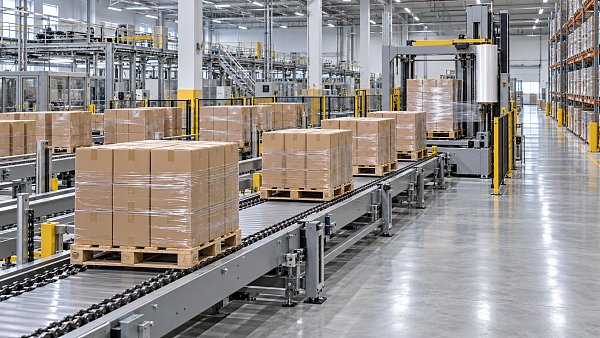
Stacking Conveyors reduce that constraint by creating controlled buffer time and controlled stack movement. A properly designed system accepts sheets without disturbing their alignment, holds the pile long enough to reach the required count or height, and clears the finished load before the following stack interferes with production. Its value comes from matching physical sheet behavior to the actual production rhythm, including order changes, grade changes, stack-height variation, and downstream availability.
Where handling flow starts to fail
Congestion often begins at the transition immediately after cross-cutting. A sheet has residual motion as it arrives at the delivery area. Lightweight board can drift or lift at the leading edge; heavy double-wall board carries more momentum and may push a growing pile out of position. If the conveyor surface, belt speed, braking action, or side guidance is not coordinated with the incoming sheet, the stack can become uneven before it is complete.
An uneven stack is not merely a presentation issue. It can delay removal, complicate transfer to a lift truck or downstream converting line, and create a greater chance of edge damage when piles are pressed together. Operators may compensate by reducing speed, manually straightening piles, or leaving wider gaps between stack cycles. Each response protects the material in the moment but reduces the usable output of the line.
The visible symptom can be identical even when the cause is different. Frequent pile collisions may result from insufficient conveyor discharge length, but they can also be caused by a slow downstream transfer command, unreliable stack-complete sensing, or a production schedule that produces short orders faster than the handling route can clear them. A purchase specification based only on conveyor length will miss these distinctions.
Capacity must be measured as a cycle, not a belt speed
Conveyor speed is easy to quote and easy to misunderstand. A high belt-speed rating does not establish that the installation can clear stacks at the required rate. The relevant cycle begins when the first sheet of an order reaches the stacking zone and ends when the finished pile is clear enough for the next pile to form without interference. That cycle includes sheet arrival, settling, pile formation, stack confirmation, discharge, transfer, and any pause required by the receiving area.
Sheet dimensions, caliper, flute profile, and count per stack all change this calculation. Small-format sheets can create frequent stack cycles even when total board volume is moderate. Long sheets may require more conveyor length to avoid overlap during delivery. Heavy board allows fewer sheets at a given stack height but increases the load that must be accelerated and stopped. Mixed production adds another complication: a system that performs smoothly with long runs of one board grade may lose rhythm when order sizes, cut lengths, or stack recipes change often.
Useful capacity review starts with the highest-demand production patterns rather than an average shift. The specification should account for the shortest repeatable order, the largest practical stack footprint, the highest stack mass, and the most demanding combination of line speed and discharge frequency. It should also identify what happens when a finished stack cannot leave immediately. Some systems provide enough accumulation distance to absorb a brief downstream delay; others require a controlled upstream slowdown before pile quality deteriorates.
Stack quality depends on controlled deceleration
Sheet protection is closely connected to conveyor control. Excessive acceleration or abrupt stopping can shift upper sheets relative to the pile, especially with low-basis-weight liners, warped board, narrow strips, or freshly produced board that has not fully stabilized. A conveyor should provide predictable acceleration and deceleration profiles so the stack moves as a unit rather than sliding across the transport surface.
The transport surface matters as much as the drive. Belt material, roller spacing, support density, and surface friction influence how a stack behaves during discharge. A surface with too little grip can allow the bottom sheets to remain behind while the pile moves. Too much grip can create drag that disturbs the pile as incoming sheets settle. Board dust, adhesive carryover, moisture variation, and worn belts gradually change this behavior, so a design that works during acceptance testing should remain controllable after routine plant exposure.
Side guides, squaring devices, and end stops must be assessed in relation to the product mix. Firm guidance can improve pile alignment on regular slotted carton grades, yet the same settings can mark softer edges or catch distorted sheets. Adjustable guidance is useful only when the adjustment is repeatable and does not rely on lengthy manual repositioning between jobs. The aim is stable stack geometry without forcing sheets against a mechanical constraint at a speed where board damage becomes likely.
Control integration determines whether the conveyor removes or relocates the delay
The conveyor requires reliable information from upstream and downstream equipment. At minimum, it needs a clear signal for order boundary, target stack condition, discharge permission, and fault state. Without these signals, the system may move a stack too early, continue feeding into an occupied zone, or stop at a point that leaves sheets unsupported. Interface design should be reviewed before installation, including signal ownership, response timing, alarm logic, and behavior after an emergency stop.
Order changeovers expose weak integration quickly. The first sheets of a new order may have a different cut length, board grade, stack count, or routing destination. The handling system needs a defined method for separating the prior stack from the next one and confirming that the correct stack recipe is active. A control system that only receives a general run command may require manual intervention whenever the product changes, which turns frequent order changes into a recurring handling interruption.
Downstream routing also affects the required control depth. A conveyor feeding a single collection point has a simpler task than one serving multiple conversion lines, a palletizing zone, or a temporary accumulation area. Where stacks are diverted, the control logic must confirm route availability before the discharge decision. Sending a completed pile toward a blocked lane simply shifts congestion away from the cutter and can make recovery harder because several stacks may become trapped in the same area.
Sensors should be selected for the failure mode they must detect
Presence sensors confirm that a stack occupies a location, but they do not necessarily confirm pile quality. A stack-height device can indicate that a target condition has been reached, while a count-based control can be more appropriate where a fixed number of sheets is required. Neither signal alone proves that all sheets are square, that the stack has fully transferred, or that a double sheet has not altered the count.
Sensor locations should support recovery as well as normal production. If a jam occurs, personnel need a clear indication of where material is present and which section remains enabled. Detection points placed only at zone entrances can leave uncertain conditions within a long transport section. Accessible status indication and fault records reduce the time spent tracing intermittent stops, particularly when a problem appears only on certain cut lengths or board grades.
Layout constraints often decide the practical configuration
Available floor length is a primary constraint, but it should not be assessed in isolation. Space is needed for stack formation, discharge movement, access around drives and sensors, pile removal, and safe clearing of off-spec material. A tightly fitted conveyor can appear efficient on a layout drawing yet become difficult to service once guarding, access paths, lift-truck travel, and stack staging are included.
Elevation changes deserve close attention. A small height mismatch between the conveyor and the next transfer point can catch a leading edge or destabilize the bottom of a pile. Transfers across gaps are especially sensitive with short sheets and flexible board. Where an inclined section is necessary, the system must retain stack control during both ascent and descent. Gravity, belt grip, and acceleration settings have different effects in each direction.
The route beyond the stacker should be defined before finalizing the conveyor. If piles are moved by lift truck, the discharge point requires adequate clearance and a repeatable pickup position. If transfer is automatic, the mechanical handoff must tolerate expected variation in stack height and squareness. A route designed around nominal stack dimensions may fail when maximum-width board, low stacks, or partially completed piles are introduced.
Maintenance requirements reveal long-term handling risk
Handling equipment is often treated as lower risk than the corrugator itself, but stoppages in this area can halt the entire production flow. Maintenance review should cover belt tracking, roller condition, chain or drive wear, lubrication points, sensor cleaning, guarding access, and the method for replacing wear parts. Components located beneath a loaded conveyor or behind fixed guarding can turn a simple adjustment into extended downtime.
Dust management is particularly relevant in corrugated sheet handling. Paper fibers and board dust can affect photoelectric sensors, reduce traction, and accumulate around moving components. The design should allow routine cleaning without removing major guards or reaching into hazardous areas. Electrical enclosures, cable routing, and sensor brackets should also resist vibration and incidental contact during material clearing.
A practical spare-parts approach distinguishes between items that stop production immediately and items that can wait for a planned service interval. Belts, sensors, drive components, and control hardware may have different lead times and replacement procedures. Interchangeable components simplify maintenance, but interchangeability should not be assumed when conveyor zones use different belt widths, motor ratings, or sensor types.
Questions that expose an incomplete specification
- What is the maximum time allowed to remove a completed stack before the next stack reaches the same zone?
- Which sheet sizes and board constructions are most likely to shift, curl, or show edge damage during transport?
- How does the sequence behave when the receiving station is unavailable, and when does it request an upstream slowdown or stop?
- Is stack completion defined by sheet count, pile height, programmed recipe, or a combination of signals?
- Can the transfer surface, side guidance, and motion profile be adjusted without turning each order change into a mechanical setup task?
- Which fault conditions are visible at the conveyor, and which require access to the main line control screen to diagnose?
The strongest evaluation links these answers to the plant's actual order mix and physical layout. A conveyor sized only for nominal throughput may move material quickly while still producing unstable stacks, blocked discharge zones, and repeated manual intervention. When stack formation, transfer timing, downstream clearance, and maintenance access are treated as one operating sequence, the handling section becomes capable of sustaining the speed already available elsewhere in the sheet plant.
Related News
 What to Check Before Ordering Pallet Wrappers Direct From a FactoryBuying from a pallet wrappers factory? Check load compatibility, output, film costs, safety, and support before ordering. Use this checklist to avoid costly mistakes and buy with confidence.Spatial Folding Strategist
 How an Automatic Folder Gluer System Reduces Carton Setup ErrorsAutomatic folder gluer system solutions reduce carton setup errors with precise feeding, folding, glue control, and compression. Discover how to improve quality and changeovers.Spatial Folding Strategist
 How to Choose a Folder Gluer Machine for Folding CartonsChoose the right folder gluer machine for folding cartons with proven guidance on speed, carton styles, glue quality, automation, testing, and lifecycle costs.Spatial Folding Strategist
 When Chain Pallet Conveyors Improve Warehouse Flow and ThroughputChain pallet conveyors improve warehouse flow by reducing forklift delays, adding controlled accumulation, and protecting packaging throughput. Discover when they deliver the strongest ROI.Spatial Folding Strategist
 How to Compare Automatic Strapping Machine Price and Total CostAutomatic strapping machine price comparison made simple: evaluate installation, throughput, consumables, labor, downtime, and total cost for a smarter investment.Spatial Folding Strategist
 What to Compare When Choosing a Pallet Wrappers SupplierCompare a pallet wrappers supplier by load stability, film efficiency, automation integration, service support, and total cost to choose the right solution.Spatial Folding Strategist