How Inline Pallet Wrappers Fit Into Automated Packaging Lines
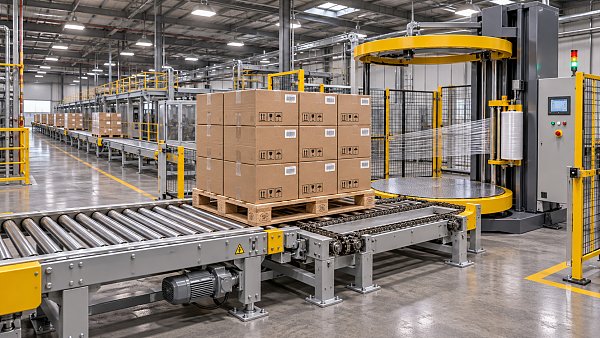
Inline pallet wrappers connect palletizing, conveying, and dispatch operations to help automated packaging lines maintain a steady flow of finished loads.
For project managers and engineering leads, successful integration depends on more than wrapping speed. Load characteristics, conveyor interfaces, controls, safety, and maintenance access all influence performance.
The key judgment is whether the complete end-of-line system can handle peak pallet demand, deliver stable loads, and recover from interruptions without creating upstream bottlenecks.
Where Inline Pallet Wrappers Fit in the Packaging Line
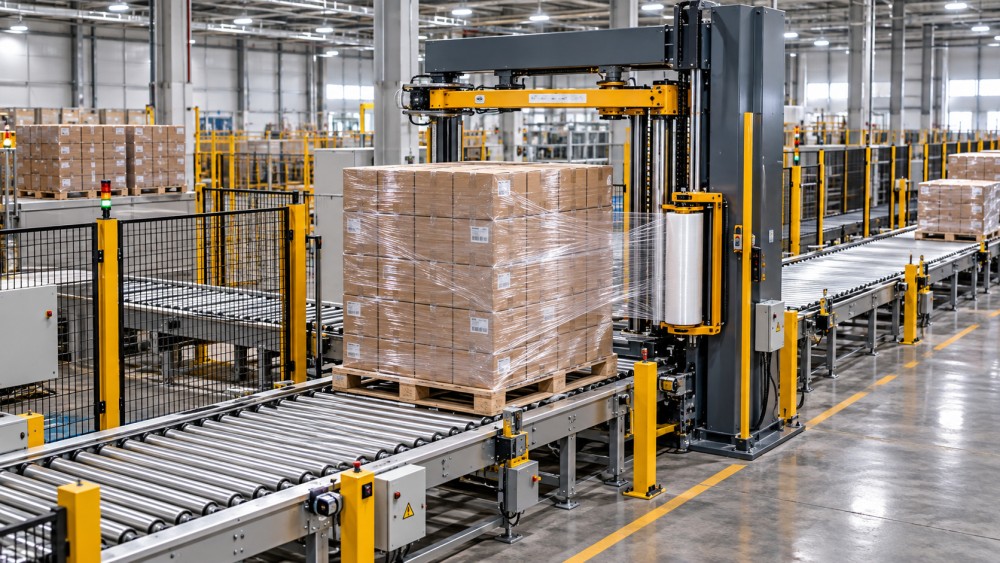
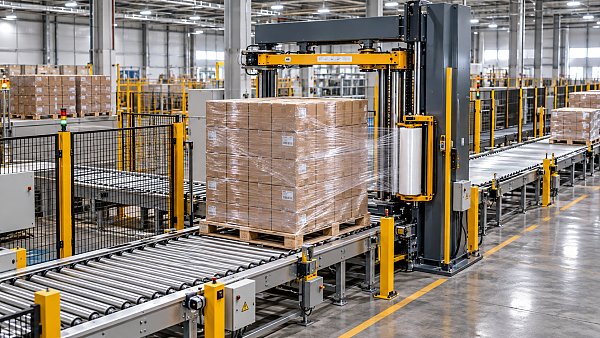
An inline wrapper typically sits downstream of a palletizer and upstream of finished-goods accumulation, labeling, inspection, or dispatch. Its exact position depends on the required workflow.
A common sequence is palletizing, load transfer, wrapping, label application, and movement to a warehouse conveyor or forklift collection point. Some lines add top-sheet application before wrapping.
The wrapper receives a pallet, positions it for the wrapping cycle, secures and cuts the film, and releases the finished load when the downstream route is available.
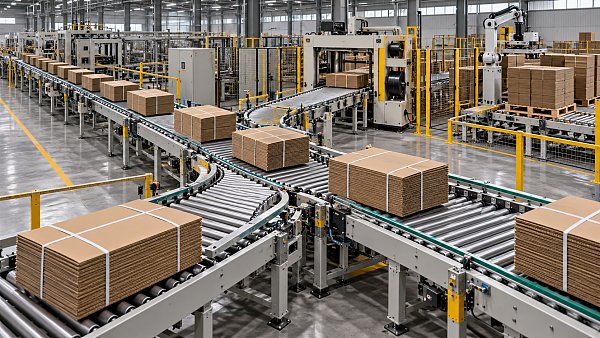
In corrugated plants, wrapped loads may contain bundled flat boxes or sheets. Carton factories may handle cases of finished products, each with different stability and compression limits.
Integration therefore starts with the full range of products and pallet patterns, not a single representative load. The most difficult load can determine equipment requirements.
Can the Wrapper Keep Up With Palletizing?
Compare the wrapper's practical cycle time with the rate at which pallets arrive, including the busiest production periods. Average daily output alone can hide short bottlenecks.
For example, a line producing 30 pallets per hour delivers one pallet every two minutes on average. A wrapper consistently completing a cycle in 90 seconds provides theoretical capacity.
That margin must also cover film changes, fault recovery, load variation, and blocked downstream conveyors. A nominal machine rating does not guarantee the same sustained line performance.
Define cycle time consistently. Depending on the supplier, a stated figure may exclude pallet entry, positioning, film attachment, cutting, or discharge to the next conveyor.
Request cycle-time calculations for each significant load height, wrapping pattern, film overlap, and conveyor arrangement. More revolutions or slower handling can reduce actual throughput.
Where several palletizers feed one wrapper, model their combined peak output and arrival patterns. Simultaneous pallet releases can create queues even when average capacity appears sufficient.
Accumulation conveyors can absorb short interruptions, but they cannot compensate for a wrapper whose sustained capacity is below demand. Agree on the required buffer and its operating purpose.
Which Wrapper Configuration Suits the Loads?
Inline pallet wrappers commonly use turntable, rotary arm, or rotary ring configurations. Each can automate wrapping, but load behavior, throughput, and layout influence the choice.
A turntable rotates the pallet while the film carriage moves vertically. It can suit stable loads, provided rotation, conveyor transfer, and available cycle time meet the application.
A rotary arm moves around a stationary load. This arrangement can be useful for heavy or less stable pallets that should not be rotated during wrapping.
A rotary ring also wraps a stationary load and can support high-speed applications. Its suitability depends on the required film pattern, load envelope, access, and project budget.
Do not select solely by machine category. Ask suppliers to demonstrate the proposed cycle on representative loads, including the lightest, tallest, heaviest, and least stable combinations.
For corrugated products, excessive film force may crush edges or deform bundles. Insufficient containment, however, can allow shifting during forklift handling and transport.
Establish acceptable load deformation and stability criteria before specifying film tension, overlap, and reinforcement wraps. Test the finished load against the actual distribution environment.
What Conveyor and Layout Interfaces Need Early Attention?
Start with a dimensioned layout covering pallet entry, wrapping, exit, accumulation, operator access, and maintenance. Include the complete pallet and load envelope, not just the machine footprint.
Confirm conveyor height, pallet orientation, transfer direction, maximum weight, and support requirements. Pallet construction and bottom-board orientation can affect whether rollers or chains provide reliable movement.
Check minimum and maximum load dimensions, overhang, and any irregular profiles. A load that fits inside the wrapping area may still interfere with guards or film delivery.
Define how pallets are detected, centered, stopped, and released. Positioning tolerances matter because misplaced loads can cause film breaks, collisions, or inconsistent wrapping coverage.
Allow space for film reel replacement, routine cleaning, component removal, and access to electrical cabinets. Maintenance clearances should remain usable after guards and adjacent conveyors are installed.
Consider forklift traffic, emergency access, and future line expansion. A compact equipment layout can become expensive if it restricts recovery procedures or blocks a planned conveyor route.
How Should Controls and Line Ownership Be Defined?
The wrapper must exchange reliable signals with upstream and downstream equipment. A control interface document should identify each signal, its owner, and the expected machine response.
Typical signals include pallet present, wrapper ready, transfer permitted, cycle complete, downstream available, fault, and emergency-stop status. Actual signal lists depend on the system architecture.
Agree on the communication method and responsibilities for network configuration, programmable logic controller changes, and testing. Electrical compatibility alone does not resolve conflicting control sequences.
Document what happens when a pallet arrives while the wrapper is unavailable, or when the exit conveyor becomes blocked. The line should reach a predictable safe state.
Recovery sequences deserve particular attention. Teams should define how to resume after a film break, power interruption, rejected load, or pallet stopped between conveyor zones.
If different wrapping recipes are required, specify how the correct recipe is selected and verified. Options may include operator selection or data provided by an upstream system.
Where traceability is required, define the pallet identifier, data source, and recording point. Confirm whether labels are applied before or after wrapping and remain readable downstream.
How Can the Project Reduce Safety and Installation Risk?
Complete a documented risk assessment for the integrated line, including conveyors, access points, film handling, and interactions between equipment supplied by different companies.
Identify applicable local regulations and standards with qualified safety specialists. Requirements depend on the installation location, machine configuration, and the responsibilities of the integrating organization.
Guards, interlocks, emergency stops, and safe access arrangements must be designed as a coordinated system. A compliant standalone wrapper does not automatically make the complete line safe.
Review manual tasks such as replacing film, clearing faults, and removing damaged pallets. Provide procedures and isolation arrangements appropriate to the hazards and maintenance activities involved.
Confirm utility requirements early, including electrical supply, compressed air where needed, network connections, and floor loading. Verify who supplies installation materials and completes site preparation.
For existing plants, plan shutdown windows and temporary material routes. Installation may require production constraints that are more costly than the mechanical work itself.
What Determines Operating Cost and Load Quality?
Purchase price is only one part of the investment. Compare film consumption, energy use, maintenance, spare parts, labor, downtime, and expected service support over the evaluation period.
Film pre-stretch can reduce consumption when correctly matched to the film and load. Its benefit should be verified through trials, not assumed from a headline stretch percentage.
Measure film used per accepted pallet alongside load stability and product damage. Reducing film weight is valuable only if the resulting load still meets distribution requirements.
Wrapping recipes may need different bottom wraps, top wraps, overlap, or reinforcement bands. Standardize settings where practical, while retaining flexibility for loads with different risks.
Ask suppliers about film availability, compatible specifications, changeover time, and sensitivity to variation. A low film cost per kilogram does not necessarily mean a lower cost per pallet.
Maintenance planning should cover wear parts, inspection intervals, lubrication where applicable, and access to technical support. Confirm spare-part lead times for components that could stop the line.
Use a transparent business case: compare annual operating costs and avoided losses with the current process, then assess the investment against the company's required return period.
Include realistic assumptions for labor reassignment, production volume, film savings, and downtime. Avoid counting the same benefit twice, and test results against lower utilization scenarios.
What Should Acceptance Testing Prove?
Agree on acceptance criteria before ordering equipment. The test plan should cover the integrated operating sequence, not only the wrapper running independently at the supplier's site.
During factory acceptance testing, review machine functions, safety devices, control interfaces, recipe changes, and representative load cycles. Simulate external signals when connected equipment is unavailable.
Site acceptance testing should confirm actual conveyor transfers, communication, guarding, and recovery behavior after installation. Record open issues, responsible parties, and deadlines for resolution.
Run representative loads at the agreed production rate for a defined period. Specify sample size, permitted interruptions, measurement method, and whether film changes are included.
Inspect wrapping coverage, film breaks, load deformation, and stability against agreed criteria. Where transport performance matters, use an appropriate documented test or distribution trial.
Train operators and maintenance personnel before handover. Deliver final drawings, control backups, safety documentation, recommended spares, and a clear escalation route for unresolved faults.
Making the Integration Decision
Inline pallet wrappers create the most value when their capacity, handling requirements, and controls are matched to the entire end-of-line process and the loads being shipped.
For project leaders, the decision is not simply which machine wraps fastest. It is which integrated solution meets peak demand, protects products, and supports reliable recovery.
Validate assumptions with representative load trials, documented interfaces, and measurable acceptance criteria. These steps make supplier comparisons clearer and reduce uncertainty before capital is committed.
Related News
 How to Choose Carton Counting Systems for Accurate ProductionChoose Carton Counting Systems with confidence. Compare sensors, accuracy, line integration, and testing methods to improve production reliability.Spatial Folding Strategist
 How to Troubleshoot an Automatic Case Erecting MachineTroubleshoot your automatic case erecting machine with practical steps for diagnosing jams, vacuum loss, sensor faults, and sealing issues—and restore reliable operation.Spatial Folding Strategist
 How to Choose Pallet Conveyors for a Packaging LineChoosing pallet conveyors for packaging line operations? Compare load requirements, throughput, layouts and safety to find the right solution.Spatial Folding Strategist
 How to Choose Case Packers for an Automated Palletizing LineChoose Case Packers that keep your palletizing line moving. Compare loading methods, capacity, changeovers, and integration to make a confident investment.Spatial Folding Strategist
 How Inline Pallet Wrappers Fit Into Automated Packaging LinesDiscover how inline pallet wrappers integrate with automated packaging lines, improve load stability, and help prevent costly bottlenecks.Spatial Folding Strategist
 What Affects Bundle Handling System Cost in a Sheet Plant?Bundle handling system cost depends on capacity, layout, automation, and integration. Learn how to compare total costs and choose the right system for your sheet plant.Spatial Folding Strategist