How Hydraulic Pile Turners Improve Safety and Sheet Handling
How Hydraulic Pile Turners Improve Safety and Sheet Handling
In a corrugated board plant, carton converting department, or commercial print facility, a stack of sheets may look harmless until it has to be moved, turned, aired, aligned, or prepared for the next machine. A pile can be heavy, unstable, and easily damaged at the edges. It may also carry the consequences of earlier process issues: curled board, uneven stacking, trapped dust, ink set-off risk, or sheets that are difficult to separate at the feeder.
That is where hydraulic pile turners become more than a material-handling accessory. Used correctly, they create a controlled way to rotate and condition sheet piles without relying on risky manual intervention. For operators, the value is immediate: less physical strain, fewer awkward handling steps, and a more predictable pile entering printing, die-cutting, laminating, or folder gluer operations.
For production managers, the benefit extends beyond safety. Stable piles feed more cleanly. Damaged corners and crushed edges are reduced. Changeovers become less disruptive when piles arrive in the correct orientation and condition. In plants working with frequent short runs, mixed board grades, and tight delivery windows, these seemingly small improvements can protect the flow of the whole line.
The moment when sheet handling becomes a production risk
Operators rarely struggle with a pile only once. The same handling challenge can appear at several stages: after printing, before die-cutting, during lamination, after a quality hold, or when sheets need to be turned for reverse-side processing. Without suitable equipment, teams may depend on forklifts, clamps, pallets, manual edge adjustments, or improvised turning methods. These approaches can work under limited conditions, but they also introduce variation.
A pile that shifts during transport may no longer be square. A clamp set too aggressively can mark printed surfaces or compress corrugated flute structure near the edges. Repeated manual correction adds time and exposes employees to pinch points, overreaching, and lifting-related injury. Even when no incident occurs, the operator may have to spend valuable minutes rebuilding a pile that should have remained stable.
The issue is especially visible with coated paperboard, lightweight sheets, pre-printed corrugated blanks, laminated material, and products with a sensitive print face. In these applications, surface quality and edge condition matter just as much as the pile’s weight. A damaged stack can lead to feeder stops, registration problems, poor die-cutting consistency, or unnecessary waste further downstream.
Hydraulic pile turners address this vulnerable transition point. Rather than asking people to control a heavy stack by force and judgment alone, the machine supports the pile through clamping, lifting, rotation, and release in a defined sequence.
What a hydraulic pile turner does in practical terms
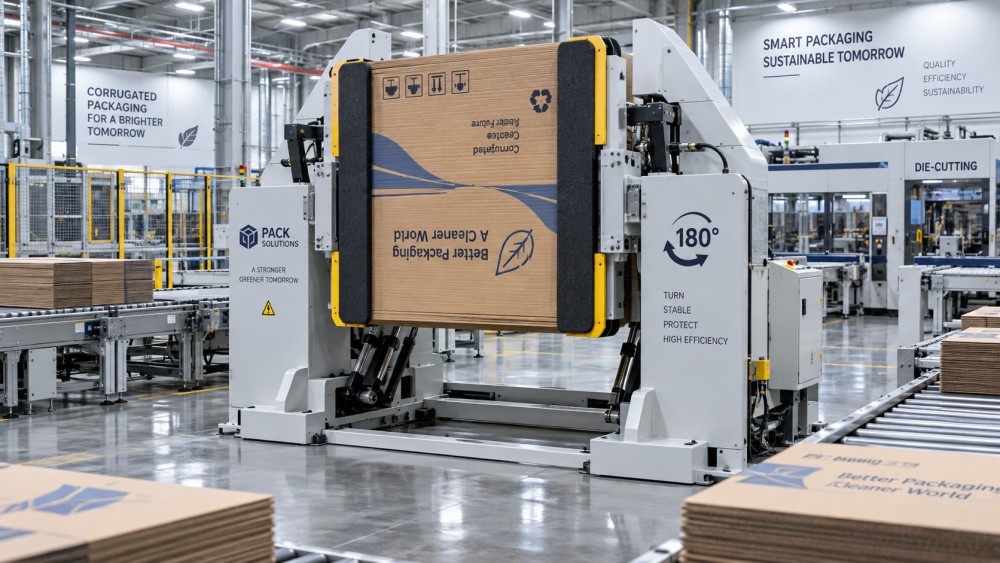
A hydraulic pile turner is designed to grip a stack of paper, paperboard, corrugated sheets, or printed material and rotate it—commonly by 180 degrees—while keeping the pile supported. Depending on the design, it may also provide aeration, vibration, jogging, or alignment functions. These actions are not merely convenient additions. They prepare sheets for reliable downstream processing.
In a typical workflow, a palletized pile is placed in the loading area by forklift or pallet truck. The pile turner positions its clamping surfaces, secures the stack with controlled pressure, lifts or holds the material, and rotates it to the required orientation. Once the pile is set down, the operator can inspect it, remove a pallet or protective board if needed, and transfer the stack to the next process.
The best result is not simply a turned pile. It is a pile that remains square, supported, and ready for production.
Safer work begins with fewer uncontrolled movements
In packaging production, safety improvements are often discussed in terms of guards, emergency stops, and machine interlocks. Those are essential, but material movement deserves the same attention. Handling a large pile involves stored energy: weight, momentum, friction, and the possibility that sheets can slide or collapse. A hydraulic system reduces the number of moments when an operator must stand close to an unstable load and make a manual correction.
That reduction matters in several ways:
- Less manual lifting and pulling: Operators do not need to reposition heavy piles by hand or repeatedly correct leaning stack edges.
- Reduced pinch-point exposure: A controlled clamping and turning sequence is safer than trying to manage the pile between a forklift, pallet, and production machine.
- More consistent load control: Hydraulic motion can be gradual and deliberate, helping prevent sudden shifts that may damage material or create a hazard.
- Clearer working zones: When the pile turning operation has a defined loading position and operating procedure, nearby personnel are less likely to enter an unpredictable handling area.
Of course, installing a pile turner does not eliminate the need for operator discipline. Staff still need training on loading limits, pile condition, clamp settings, lockout procedures, and safe distance requirements. The machine supports safe behavior; it cannot replace it. Yet it gives operators a safer baseline than manual workarounds that depend on experience and luck.
Why turning alone is not the whole story
Many users search for hydraulic pile turners because they need to reverse a stack. But the stronger application case often lies in conditioning the pile before it enters a demanding process. A sheet feeder does not see the history of a pile—it only reacts to its condition. If sheets are stuck together, edges are uneven, or the stack has become compressed, the feeder may deliver doubles, misses, skewed sheets, or frequent stops.
A pile turner equipped with aeration or jogging functions can help loosen sheets and improve pile uniformity. This is useful after printing, coating, or storage, when air between sheets has been reduced. Gentle vibration or alignment can settle the stack and improve edge registration before transfer. For operations feeding high-speed die-cutters, offset presses, flexographic equipment, or laminators, a cleaner pile condition can make the next stage calmer and more stable.
There is an important distinction here: pile conditioning is not a cure for poor upstream process control. It cannot fully compensate for excessive curl, unsuitable moisture balance, severe warp, inadequate ink drying, or badly stacked sheets. However, it can reduce the operational impact of normal variation and give the next machine a better starting point.
Applications across print and corrugated packaging workflows
The way hydraulic pile turners are used depends on the material and production route. In commercial printing, a pile may be turned after one-side printing so that the reverse side can be processed. In folding carton production, printed board may need to be reoriented before die-cutting, foil stamping, embossing, or stripping. The machine helps protect printed surfaces while avoiding excessive manual handling of large sheet stacks.
In corrugated packaging operations, the needs can be different. Sheets may require orientation changes before printing, litho-lamination, die-cutting, or conversion into display packaging. Corrugated material is less forgiving than it appears. Edge compression, damaged flutes, and unstable piles can affect print appearance, cut quality, and the ability of automated feeders to run consistently. Controlled clamping pressure is especially important when handling lightweight board, softer flute profiles, or piles with uneven density.
For plants processing coated, recycled, or moisture-sensitive grades, trial runs are valuable. Operators should observe how the pile behaves during clamping and rotation, then record suitable settings for each material family. A setting that works for dense solid board may not be appropriate for a taller pile of lighter corrugated sheets.
Choosing the right setup: questions operators should ask early
A pile turner is only effective when its working range matches the real production environment. The largest pile is not the only factor. Plants should review the full mix of materials, pallet formats, pile heights, surface sensitivity, and transfer routes.
Before selecting or specifying hydraulic pile turners, consider the following operating questions:
- What are the minimum and maximum sheet sizes handled during normal production?
- What is the heaviest pile, and how does pile height vary by job?
- Will the equipment handle paper, solid board, corrugated sheets, printed work, laminated sheets, or a combination?
- Do printed surfaces require protective contact pads or special clamping arrangements?
- Is a simple 180-degree turn sufficient, or are aeration, jogging, and pile alignment needed?
- How will piles enter and leave the machine: forklift, pallet truck, conveyor, or automated transport?
- Is there enough floor space for safe loading, turning, unloading, and operator access?
It is tempting to specify capacity only by maximum load. That approach can overlook the daily realities of sheet handling. A machine may have enough lifting capacity but still be poorly matched to short piles, unusual pallet sizes, delicate printed work, or the available aisle layout. The right solution should fit the plant’s actual handling rhythm, not only its theoretical maximum.
Clamp pressure deserves more attention than it usually gets
One of the most common mistakes in pile handling is assuming that more clamping force always means better control. In reality, excessive pressure can create problems: compressed board edges, marking on printed faces, distorted pile geometry, or difficulty separating sheets later. Too little pressure, on the other hand, can allow the stack to shift during rotation.
Operators should treat clamp pressure as a material setting, not a permanent machine setting. It should be adjusted according to pile weight, sheet stiffness, surface finish, height, and whether the pile is supported by a pallet or top board. Documenting proven settings for recurring jobs can shorten setup time and help less experienced operators work with greater confidence.
Visual inspection after turning is equally important. Check for edge damage, visible clamp marks, pile lean, sheet displacement, and surface scuffing. If any of these appear repeatedly, the answer may be a pressure adjustment, improved protective surfaces, a revised loading method, or better upstream stacking—not simply a faster turning cycle.
Integrating the turner into a smoother production route
A hydraulic pile turner delivers the most value when it is planned as part of the material flow. If a stack must travel across the plant, wait in a congested aisle, be turned, then return to the original area, the safety and productivity gain may be diluted. Placement should reflect where orientation changes and pile conditioning genuinely occur.
For example, a printer may position a turner between printing and reverse-side processing. A folding carton plant may use it near the transition from print to die-cutting. A corrugated converting operation may locate it close to the feeder where sheets must arrive square, clean, and correctly oriented. In each case, the goal is the same: reduce unnecessary touches and avoid handing a problematic pile from one department to another.
Where plants are moving toward automated packaging factory management, pile handling can also become part of a connected workflow. Job data, material identification, barcode traceability, and production scheduling may guide where a pile goes next. Even without full automation, clearly labeled piles and standardized handling rules reduce mix-ups during busy shifts and frequent job changes.
A practical operating routine for consistent results
A reliable routine protects both people and material. Before loading, confirm that the pile is within the machine’s approved size and weight range, that the pallet is sound, and that loose sheets or damaged corners will not interfere with clamping. Remove obvious foreign objects and verify that the pile is centered as required by the equipment instructions.
During operation, keep hands and feet clear of moving zones, use the designated controls, and avoid attempting to correct the pile while it is clamped or rotating. Once the stack has been turned and released, inspect it before sending it downstream. This is the right time to identify a skewed stack—not after it causes repeated feeder faults on an expensive converting line.
Basic maintenance also supports safe handling. Hydraulic fluid condition, hoses, fittings, cylinder performance, clamp surfaces, safety devices, and control functions should be checked according to the supplier’s maintenance schedule. Small leaks, worn pads, or inconsistent motion may seem minor at first, but they can affect clamping reliability and operator confidence over time.
Better sheet handling is a quality decision as well as a safety decision
Hydraulic pile turners are sometimes viewed as equipment that simply saves labor during pile reversal. That understates their role. In print and corrugated packaging production, the condition of a sheet pile influences what happens next: feeder reliability, print protection, die-cutting accuracy, waste levels, and the pace of the shift.
For operators, the most meaningful improvement is often a quieter, more controlled work area. Instead of wrestling with a difficult stack, they can focus on confirming material condition and keeping the next process running. For the wider plant, that creates a stronger link between safe handling and stable production.
When hydraulic pile turners are correctly matched to material types, pile sizes, and workflow requirements, they help turn a high-risk handling step into a repeatable process—one that respects both the people on the floor and the value already built into every printed or corrugated sheet.
Related News
 How an Automatic Folder Gluer System Reduces Carton Setup ErrorsAutomatic folder gluer system solutions reduce carton setup errors with precise feeding, folding, glue control, and compression. Discover how to improve quality and changeovers.Spatial Folding Strategist
 How to Choose a Folder Gluer Machine for Folding CartonsChoose the right folder gluer machine for folding cartons with proven guidance on speed, carton styles, glue quality, automation, testing, and lifecycle costs.Spatial Folding Strategist
 When Chain Pallet Conveyors Improve Warehouse Flow and ThroughputChain pallet conveyors improve warehouse flow by reducing forklift delays, adding controlled accumulation, and protecting packaging throughput. Discover when they deliver the strongest ROI.Spatial Folding Strategist
 How to Compare Automatic Strapping Machine Price and Total CostAutomatic strapping machine price comparison made simple: evaluate installation, throughput, consumables, labor, downtime, and total cost for a smarter investment.Spatial Folding Strategist
 What to Compare When Choosing a Pallet Wrappers SupplierCompare a pallet wrappers supplier by load stability, film efficiency, automation integration, service support, and total cost to choose the right solution.Spatial Folding Strategist
 How an Automatic Case Erecting Machine Reduces Packing DelaysAutomatic case erecting machine solutions reduce packing delays by delivering consistent, sealed cases, improving line flow, uptime, and end-of-line efficiency.Spatial Folding Strategist