How High Speed Sheet Stackers Improve Throughput Without Damage
How High Speed Sheet Stackers Improve Throughput Without Damage
For project managers responsible for high-output corrugated and print finishing lines, high speed sheet stackers are more than delivery equipment. They directly influence line throughput, sheet protection, labor efficiency, and downstream process stability. Understanding how stacking speed, alignment control, cushioning, and automatic handling work together helps teams specify systems that sustain production targets without increasing edge damage, marking, or costly rework.
A stacker can be running at the advertised cycle rate and still reduce the effective capacity of a plant. If sheets arrive unevenly, the pile requires frequent manual correction, or the transfer section causes crushed corners, the nominal line speed becomes largely theoretical. In corrugated board production, flatbed die-cutting, folder gluing, and commercial print finishing, the useful measure is not simply how quickly sheets are received. It is how many acceptable, correctly counted, stable piles reach the next process during an entire shift.
Throughput Is a System Result, Not a Conveyor Speed
High speed sheet stackers improve throughput by keeping the receiving, alignment, piling, and discharge operations synchronized with the upstream machine. In a corrugator line, for example, the stacker follows slitting, scoring, and cross-cutting. The cutting unit may deliver sheets with different lengths, widths, flute profiles, moisture conditions, and order quantities. A stacker designed only around maximum sheet speed may struggle when the production mix changes.
The control system therefore has to manage more than motion. It must coordinate sheet separation, pile height, batch counting, stop positioning, lateral alignment, and discharge timing. When these functions are linked to production data or the line control system, the machine can prepare for a new order instead of waiting for an operator to intervene. This matters especially in plants handling short runs and frequent changeovers, where lost seconds are repeated many times each day.
The best project evaluation asks a practical question: can the stacker maintain stable operation at the speeds and product mix the factory will actually run? A machine that performs well on one standard board size may need different settings, tooling, or handling logic for lightweight corrugated board, laminated sheets, coated paper, or products with sensitive printed surfaces.
How Stacking Speed Can Cause Product Damage
Sheet damage usually does not come from one dramatic mechanical failure. It develops through repeated impact, friction, poor alignment, excessive compression, or unstable pile transfer. At higher speeds, a small setting error is repeated hundreds or thousands of times, turning a minor handling issue into a visible quality problem.
Common damage points include leading-edge impact during sheet entry, corner deformation when the sheet meets the backstop, scuffing caused by excessive contact with belts or rollers, and pile shifting during discharge. Printed sheets may show rub marks or gloss variation, while corrugated sheets can develop crushed edges, bowed piles, or damaged scores. These defects are particularly troublesome when the stack is sent directly to a die-cutter, folder gluer, or automatic palletizing cell.
Product behavior also changes with material conditions. Moisture variation affects board stiffness and flatness. Lightweight grades may require gentler acceleration and lower contact pressure than heavier board. Coated or freshly printed sheets can be more sensitive to surface marking. For this reason, “high speed” should not mean one fixed motion profile. It should mean controlled speed with enough adjustment range to match the material.
The Main Design Elements Behind Damage-Free Stacking
Controlled sheet entry
The entry section establishes the quality of the entire pile. Sheets should arrive with predictable spacing and a controlled velocity profile. Sudden stops or uncontrolled acceleration can create telescoping, leading-edge impact, or uneven pile formation. Adjustable belts, rollers, guides, and transfer timing allow the stacker to handle different sheet lengths without treating every job in the same way.
Reliable alignment control
Side joggers and rear stops are essential, but aggressive movement is not automatically better. The alignment system needs enough force to square the pile while avoiding repeated crushing of vulnerable edges. A useful specification review should examine the adjustment range, motion sequence, sensor placement, and how settings are changed between orders. If alignment depends heavily on operator judgment, output may vary across shifts.
Cushioned pile formation
A controlled deceleration or air-assisted arrangement can reduce the energy with which sheets settle onto the pile. The exact solution depends on sheet type and machine architecture. The important point is that the sheet should be supported during the final part of its movement, rather than allowed to strike a fixed surface at production speed.
Stable discharge and pile transfer
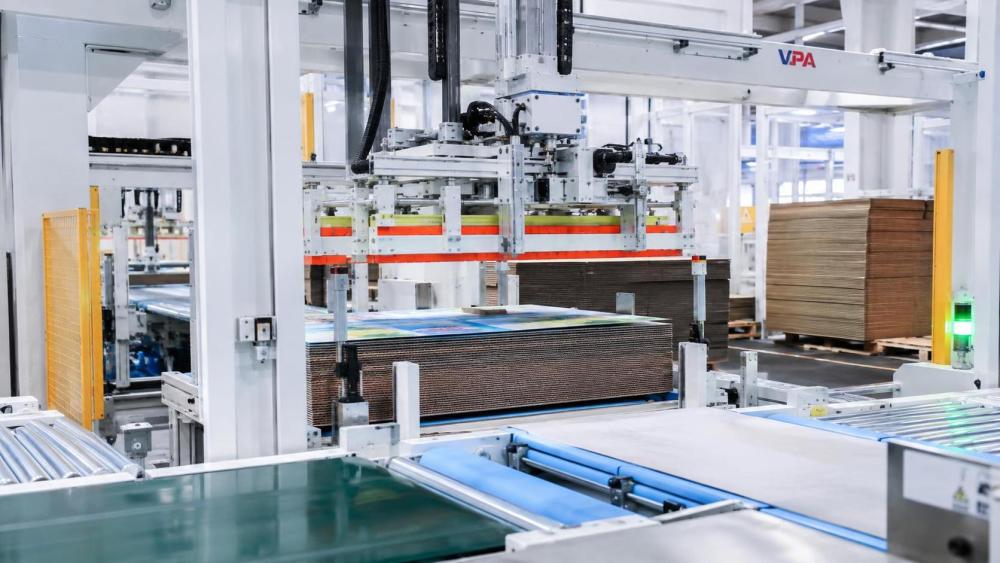
Even a well-formed pile can be damaged during transfer. If the stack tilts, slides, or receives uneven support while leaving the machine, the next process may inherit a quality problem that is difficult to trace. Discharge height, support structure, pallet positioning, and transfer timing should be reviewed together. For plants integrating robotic palletizing or automated conveying, the interface must also account for pile orientation, spacing, and access for downstream handling.
Why Counting and Changeover Control Matter
Throughput is affected by more than the number of sheets per minute. Accurate batch counting prevents manual recounting and reduces the risk of sending incorrect quantities to converting or shipping. It also makes mixed-order production easier to control. When the stacker receives information from the production schedule, it can separate jobs, manage pile height, and prepare the discharge sequence with fewer interruptions.
This is one reason packaging factories increasingly evaluate equipment as part of a connected production system. A high-speed corrugated board line, for instance, may combine cross-cutting, stacking, conveying, order scheduling, and production data collection. The stacker cannot compensate for poor upstream tension control, unstable scoring, or badly synchronized cut-off timing. However, it can prevent those upstream variations from becoming a larger handling bottleneck.
Automatic recipe storage is useful, but project teams should not assume that every stored setting is automatically correct. The recipe must identify the conditions that matter: board grade, sheet dimensions, pile height, jogger behavior, transfer speed, and any special surface or print requirements. A short commissioning procedure with representative materials is more valuable than a long list of nominal functions.
What Project Managers Should Check Before Specification
A procurement specification should begin with the production envelope, not the largest speed number in a brochure. At minimum, the engineering team should define the expected sheet size range, board and paper grades, thickness or flute combinations, surface treatments, pile height, order batch size, and required connection to upstream and downstream equipment.
- Confirm whether the rated speed applies to all planned sheet sizes or only a specific reference condition.
- Review how the stacker handles lightweight, flexible, coated, laminated, or moisture-sensitive sheets.
- Ask how pile squareness is maintained when sheet flatness or stiffness changes.
- Check whether changeover settings are manual, semi-automatic, or automatically coordinated with line data.
- Examine access for cleaning, belt replacement, sensor adjustment, lubrication, and fault diagnosis.
- Define acceptable damage criteria, including edge crush, surface marking, pile offset, and sheet count accuracy.
The final point deserves attention. “No damage” should be translated into observable acceptance criteria agreed by the project team, equipment supplier, and production department. The tolerance for a shipping carton blank may differ from the tolerance for a high-visibility commercial print sheet. Local safety requirements, electrical standards, guarding provisions, and factory integration rules should also be confirmed from the applicable project documents rather than assumed from a generic machine description.
Integration With Printing, Converting, and Automation
A stacker’s value becomes clearer when its position in the complete line is considered. In flexographic and offset workflows, surface protection and accurate delivery can influence later die-cutting, folding, coding, or inspection. In corrugated converting, a square and stable pile reduces the effort needed at the feeder and helps prevent registration problems caused by inconsistent sheet presentation.
The connection to vision inspection and traceability systems is another practical consideration. If rejected sheets are removed, the stacker must preserve counting logic and order separation. If production data is used for scheduling or performance analysis, downtime signals should distinguish between a true stacker fault, an upstream shortage, a full discharge area, and an operator-requested stop. Otherwise, management reports may blame the wrong part of the line.
CPCS approaches this type of equipment within the broader packaging value chain. The relevant question is not whether a stacker is fast in isolation, but whether it supports stable board quality, efficient order changeover, lower handling labor, and predictable downstream feeding. That same system-based view applies when evaluating flatbed die-cutters, folder gluers, inline inspection, and robotic palletizing.
A Practical Way to Validate the Investment
Before approval, run a structured test using the materials and job patterns the factory expects to use. Include more than one sheet size and at least one difficult condition, such as a lighter board grade, a short batch, a coated surface, or a product that requires careful edge protection. Measure sustained output, not only the peak moment after the machine has been adjusted.
Record pile alignment, damaged sheets, stoppage causes, manual interventions, changeover time, count accuracy, and the condition of the pile after discharge. These observations often reveal more than a speed demonstration. A slightly lower running speed with stable quality may deliver more sellable output than a faster setting that creates rework or forces an additional operator to monitor the delivery section.
High speed sheet stackers improve throughput when their mechanical handling, controls, material adaptability, and line interfaces are specified as one operating system. For project managers, the sensible target is not maximum motion at any cost. It is a repeatable flow of accurately counted, square, undamaged sheets that can move directly into the next production stage. That is the standard worth testing before the equipment is accepted and the line is expected to perform every day.
Related News
 How an Automatic Folder Gluer System Reduces Carton Setup ErrorsAutomatic folder gluer system solutions reduce carton setup errors with precise feeding, folding, glue control, and compression. Discover how to improve quality and changeovers.Spatial Folding Strategist
 How to Choose a Folder Gluer Machine for Folding CartonsChoose the right folder gluer machine for folding cartons with proven guidance on speed, carton styles, glue quality, automation, testing, and lifecycle costs.Spatial Folding Strategist
 When Chain Pallet Conveyors Improve Warehouse Flow and ThroughputChain pallet conveyors improve warehouse flow by reducing forklift delays, adding controlled accumulation, and protecting packaging throughput. Discover when they deliver the strongest ROI.Spatial Folding Strategist
 How to Compare Automatic Strapping Machine Price and Total CostAutomatic strapping machine price comparison made simple: evaluate installation, throughput, consumables, labor, downtime, and total cost for a smarter investment.Spatial Folding Strategist
 What to Compare When Choosing a Pallet Wrappers SupplierCompare a pallet wrappers supplier by load stability, film efficiency, automation integration, service support, and total cost to choose the right solution.Spatial Folding Strategist
 How an Automatic Case Erecting Machine Reduces Packing DelaysAutomatic case erecting machine solutions reduce packing delays by delivering consistent, sealed cases, improving line flow, uptime, and end-of-line efficiency.Spatial Folding Strategist