How Do You Choose a High Speed Palletizer Robot for Mixed Loads?
A palletizing cell can look exceptionally fast during a demonstration with identical cartons. The real test comes when a wide, lightweight box arrives behind a compact, heavy case, the next pallet needs a different pattern, and the upstream conveyor has no room to wait.
Choosing a high speed palletizer robot for mixed loads means evaluating that entire situation—not simply comparing advertised cycle rates. In corrugated packaging and end-of-line operations, carton dimensions, compression strength, arrival sequence, and order data all influence usable output. The right system must sustain the required production rate while protecting cartons, building stable loads, and recovering predictably when something goes wrong.
Define what “mixed loads” means in your plant
Before requesting quotations, distinguish between mixed production and mixed pallets. A robot that changes between single-SKU production runs faces a different challenge from one building several customer-specific, mixed-SKU pallets simultaneously.
- Sequential SKU changes: Each pallet contains one product, but carton sizes and patterns change frequently.
- Mixed-SKU layers: Different products share a layer, requiring compatible heights, support surfaces, and placement sequences.
- Order-specific mixed pallets: Each pallet follows an order list, potentially with restrictions on weight distribution, unloading sequence, or product compatibility.
This distinction determines whether you need straightforward recipe management or a broader system with case identification, buffering, sequencing, and dynamic pallet planning. A fast robot cannot compensate for cartons arriving in an order that makes the required pallet impossible to build.
Prepare an operating envelope that records minimum and maximum carton dimensions, weight, center-of-gravity concerns, closure type, surface condition, and permitted orientation. Include pallet formats, maximum loaded height and weight, and whether loads will be wrapped immediately or transported before wrapping.
For corrugated packaging plants, identify the actual handling unit. Sealed shipping cases, strapped bundles of flat cartons, and stacks of die-cut blanks require different gripping and support strategies. Treating them as interchangeable creates avoidable specification gaps.
Translate advertised speed into sustained pallet output
Robot cycle rates are meaningful only when the test conditions are known. A short movement between adjacent points is not equivalent to picking from a conveyor, rotating a carton, reaching across a pallet, and placing it near maximum stack height.
Ask suppliers to state throughput in successfully palletized cartons per minute for your product mix, alongside completed pallets per hour. The calculation should account for normal pallet exchanges, slip-sheet handling, identification delays, and recoverable operating interruptions.
A useful preliminary relationship is:
Required active pick cycles per minute = target cartons per minute ÷ average cartons per pick ÷ productive-time fraction.
For example, a hypothetical target of 24 cartons per minute, averaging 1.5 cartons per pick with 85% productive time, requires approximately 18.8 active pick cycles per minute. That corresponds to roughly 3.2 seconds per active cycle. These are planning assumptions, not a performance claim; each must be validated against the proposed cell.
The average cartons per pick deserves particular scrutiny. Multi-pick handling may be possible for repeated identical cases but unavailable when dimensions, destinations, or arrival sequences vary. A supplier should not calculate mixed-load capacity using a multi-pick assumption that applies only to occasional production.
Separate the losses clearly. If the productive-time factor already includes pallet changes, do not subtract those losses again elsewhere. Also check peak arrival rates and buffer capacity: a cell that meets the shift average may still block a folder gluer or case-packing line during production bursts.
Match the robot and gripper to the most difficult cartons
Payload is only the beginning
Robot payload calculations must include the end-of-arm tool, adapters, valves, sensors, and the maximum product load. Where applicable, include dress-pack loads according to the manufacturer’s calculation method. Confirm allowable wrist moments and inertia, not just total mass.
Reach must be checked at every placement position, including the far corners and top layers of the tallest pallet. Tool orientation, guarding, conveyors, and pallet dispensers can restrict usable motion. Require a layout-specific simulation showing cycle times and clearance throughout the working envelope.
A four-axis palletizing robot may suit applications dominated by upright cartons and repetitive placement. A six-axis robot offers additional orientation flexibility but is not automatically the better choice. Select the mechanism against the actual motions, payload, and cycle requirement.
Gripping must tolerate packaging variation
Vacuum gripping can handle many closed corrugated cases, but performance depends on surface porosity, seams, tape, dust, and top-panel stiffness. Mechanical clamps need controlled contact pressure and adequate side access. Under-support tools can reduce reliance on carton panel strength, although inserting and withdrawing support fingers requires clearance.
Do not accept a gripping demonstration with only pristine samples. Test realistic material variation, including cases from different board batches and operating conditions. The objective is reliable handling without crushing panels, opening closures, or leaving damage that becomes visible only after transport.
A fast placement is useful only if the pallet remains stable
Mixed-load pattern generation must balance space utilization with structural support. Heavy cartons generally belong lower in the load, but weight alone is insufficient: a relatively light carton can still damage a weak box beneath it if its footprint concentrates the load.
Corrugated cases often provide stronger vertical support when their load-bearing edges align. Interlocking patterns may improve resistance to lateral movement while reducing compression performance in some configurations. There is no universally best pattern; the decision depends on carton construction, contents, stack height, and distribution conditions.
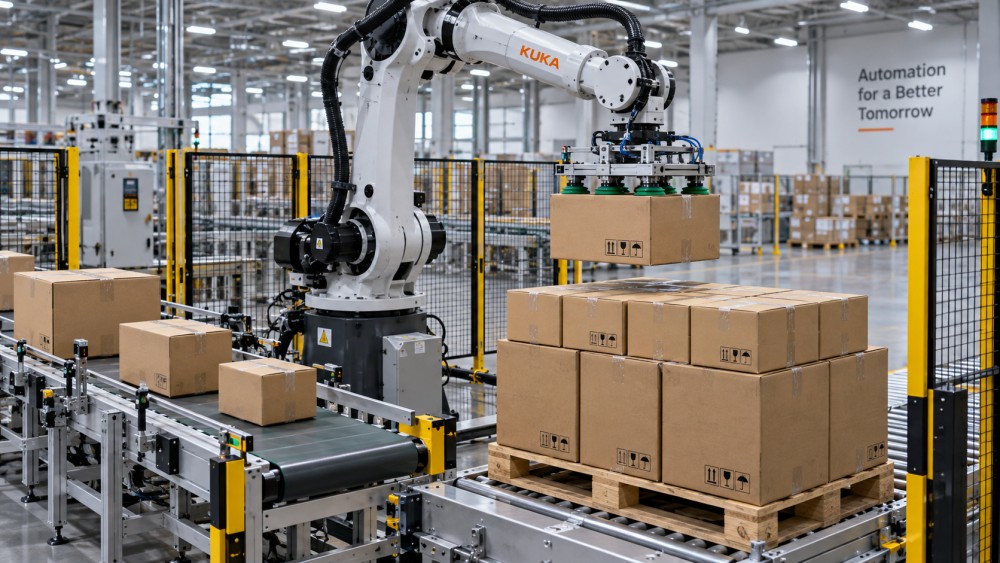
Ask the supplier to demonstrate how its planning software handles unsupported corners, excessive overhang, voids, differing case heights, and restricted orientations. It should also explain what happens when no acceptable placement is available. Silently relaxing a stability rule to maintain speed is not a satisfactory operating strategy.
Evaluate the finished load beyond the robot cell. Conveyor transfers, forklift handling, wrapping forces, storage duration, and transport vibration can expose weaknesses that are invisible immediately after placement. Where compression strength is critical, obtain appropriate packaging test data rather than relying on carton dimensions or board grade alone.
Look behind the robot: sequencing, controls, and recovery
For mixed-SKU palletizing, the hidden bottleneck is often carton presentation. The system needs to know what each carton is, where it belongs, and whether it can be placed now.
Barcode readers, vision systems, dimensioning equipment, and upstream production data serve different purposes. Identification does not automatically verify dimensions or carton condition. Define which information comes from the warehouse or manufacturing system and which attributes must be checked physically.
Technical evaluation should resolve several practical questions:
- Can the controls track each carton from identification through confirmed placement?
- How much buffering is needed for the expected arrival sequence and simultaneous pallet orders?
- Where do unreadable, damaged, unexpected, or duplicate cases go?
- What happens when an order changes after pallet building has started?
- Can operators recover from a removed carton without corrupting the digital pallet record?
Recipe management matters just as much as connectivity. Operators should be able to introduce approved carton formats and patterns through a controlled workflow, with access permissions and version history. Establish whether new SKUs require supplier programming, offline validation, or only parameter entry.
Also examine fault recovery in physical terms. After a dropped case or emergency stop, the system must reconcile the actual conveyor and pallet contents with its stored state. A clear recovery procedure can be more valuable than a small improvement in nominal cycle time.
Make safety and maintainability part of the layout review
A high speed palletizer robot should be evaluated as a complete safeguarded application. Robot selection alone does not establish system safety. Require an application-specific risk assessment and compliance with applicable machinery, robot-system, and local workplace requirements.
Review pallet openings, conveyor interfaces, access gates, interlocks, stopping behavior, and procedures for clearing jams. Collaborative operation should never be assumed simply because a particular robot model supports collaborative functions; payloads, tooling, speed, and trapping hazards determine what is feasible.
Maintenance access affects availability. Check whether technicians can reach vacuum filters, gripping components, sensors, and lubrication points without excessive dismantling. Confirm spare-parts availability, backup and restoration procedures, remote-access controls, and the skills required for routine troubleshooting.
Write acceptance tests before choosing the supplier
The strongest comparison is a shared test specification using representative products and the same operating assumptions. Simulation is useful for screening layouts, but physical trials are needed to reveal gripping problems, carton deformation, and unstable load behavior.
A practical factory acceptance test should cover:
- Representative mixed production: Run the expected SKU distribution and arrival sequence, not a convenient selection of easy cases.
- Boundary conditions: Include maximum weight, minimum grip area, tallest stacks, and difficult but approved packaging combinations.
- Complete operating cycles: Include pallet discharge, empty-pallet supply, slip sheets, and agreed changeovers.
- Disruptions and recovery: Test unreadable codes, missing cases, grip faults, interrupted communications, and controlled restarts.
- Recorded results: Measure sustained output, rejected cases, damage, manual interventions, recovery time, and finished-load quality.
Define the measurement period, exclusion rules, and acceptance thresholds contractually. A short peak-rate demonstration should not substitute for a representative production run. Repeat relevant checks during site acceptance, where actual utilities, upstream equipment, network behavior, and operators influence performance.
Choose the operating result, not the fastest specification
Compare total installed cost across the same system boundary: robot, tooling, conveyors, buffers, pallet handling, guarding, controls, integration, training, and commissioning. Then evaluate recurring costs such as maintenance, compressed air, electricity, software support, spare tooling, and format engineering.
Use an agreed evaluation matrix, but treat essential requirements as pass-or-fail gates. A lower price or shorter cycle time should not offset unacceptable carton damage, unsafe access, or an inability to build the required mixed pallets.
The best high speed palletizer robot is the one that proves its capacity with your cartons, your sequence, and your recovery conditions. For technical evaluators, that shifts the purchasing discussion from impressive motion to dependable production—and makes the final investment much easier to defend.
Related News
 How to Choose Carton Counting Systems for Accurate ProductionChoose Carton Counting Systems with confidence. Compare sensors, accuracy, line integration, and testing methods to improve production reliability.Spatial Folding Strategist
 How to Troubleshoot an Automatic Case Erecting MachineTroubleshoot your automatic case erecting machine with practical steps for diagnosing jams, vacuum loss, sensor faults, and sealing issues—and restore reliable operation.Spatial Folding Strategist
 How to Choose Pallet Conveyors for a Packaging LineChoosing pallet conveyors for packaging line operations? Compare load requirements, throughput, layouts and safety to find the right solution.Spatial Folding Strategist
 How to Choose Case Packers for an Automated Palletizing LineChoose Case Packers that keep your palletizing line moving. Compare loading methods, capacity, changeovers, and integration to make a confident investment.Spatial Folding Strategist
 How Inline Pallet Wrappers Fit Into Automated Packaging LinesDiscover how inline pallet wrappers integrate with automated packaging lines, improve load stability, and help prevent costly bottlenecks.Spatial Folding Strategist
 What Affects Bundle Handling System Cost in a Sheet Plant?Bundle handling system cost depends on capacity, layout, automation, and integration. Learn how to compare total costs and choose the right system for your sheet plant.Spatial Folding Strategist