How Do You Choose Turntable Pallet Wrappers for Unstable Loads?
How Do You Choose Turntable Pallet Wrappers for Unstable Loads?
Unstable pallet loads can shift during wrapping, leaving procurement teams to balance load security, throughput, and equipment cost. Choosing turntable pallet wrappers for lightweight cartons, uneven stacks, or top-heavy loads requires more than checking pallet dimensions and weight capacity. Adjustable rotation speed, gentle acceleration, controlled film tension, and suitable load-support options all deserve scrutiny.
The key question is whether the load can tolerate rotation before the film has built enough containment. If it cannot, a stationary-load system may be more suitable. A useful purchasing process starts with the pallet’s behavior, then works backward to the machine specification—not the other way around.
Identify what makes the load unstable
“Unstable” is not a single operating condition. A tall stack of empty corrugated cartons behaves differently from a mixed pallet containing dense products below and lightweight packages above. Both may move during wrapping, but they need different remedies.
Before requesting quotations, document the load’s height, footprint, weight range, stacking pattern, and packaging materials. Include partial pallets and less frequent orders. The heaviest pallet establishes a capacity requirement; the lightest or tallest pallet may establish the real wrapping limitation.
- Sliding between layers: Smooth surfaces, loose stacking, or unsuitable layer sheets can allow individual layers to move.
- Top-heavy geometry: A narrow base or elevated center of gravity increases sensitivity to rotation and stopping.
- Compression-sensitive packaging: Empty cartons, thin-walled boxes, and some display packs may deform under film pressure.
- Uneven or incomplete stacks: Unsupported corners can pull inward, while irregular top surfaces complicate hold-down contact.
In corrugated and printing plants, also examine board condition, moisture exposure, pallet overhang, and stack alignment. A wrapper cannot reliably correct crushed bottom layers or poor palletizing. Sometimes the appropriate investment includes a stacking change, suitable anti-slip material, or better pallet quality alongside the wrapping equipment.
Prioritize motion control over maximum rotation speed
A variable-speed turntable is useful, but the specification should go further. Ask how the machine accelerates from rest, changes speed, and decelerates at the end of the cycle. A low operating speed does not compensate for an abrupt start.
During startup, the pallet must bring the unwrapped stack into rotation. Weak interfaces between layers may slip before the first securing wraps are completed. At shutdown, abrupt deceleration can create another disturbance. Controlled acceleration and deceleration therefore deserve explicit demonstration, not just a “soft start” entry on a quotation.
Check whether the initial wrapping stage can run gently and whether motion settings can be saved by load type. Recipe storage is valuable when a plant alternates between stable finished goods and lightweight carton stacks. It reduces dependence on operators remembering several settings at each changeover.
Platform suitability matters too. Confirm usable turntable dimensions, the permitted rotating load envelope, and clearance around projecting corners. A pallet may fit on the platform yet sweep dangerously close to the film carriage. Loading ramps, pallet-jack access, and conveyor transfers must also suit the actual pallet construction and handling method.
Separate film pre-stretch from force applied to the load
These two settings are often confused during equipment comparisons. Pre-stretch elongates film before application. Film force is the pulling force applied as film reaches the pallet. A high advertised pre-stretch capability does not, by itself, show that a wrapper can handle fragile or unstable loads.
For lightweight cartons, the machine needs to deliver film without pulling upper layers out of position. A well-controlled powered film carriage may help, but performance depends on its delivery mechanism, control response, film selection, and condition. Ask suppliers to demonstrate low-force wrapping on your packaging rather than infer suitability from the carriage description.
Rectangular and irregular loads are particularly revealing. Film demand changes as corners pass the carriage. Poor response can cause force spikes, loose film, or breaks. Watch the cartons and film throughout each revolution, not only the appearance of the completed pallet.
The objective is adequate containment without distortion. Simply reducing film force until nothing moves may leave a load inadequately secured for handling. Film grade, wrap overlap, carriage travel, and reinforcement locations should be developed together, then checked against the intended distribution conditions.
Treat top platens as load-specific support, not a universal fix
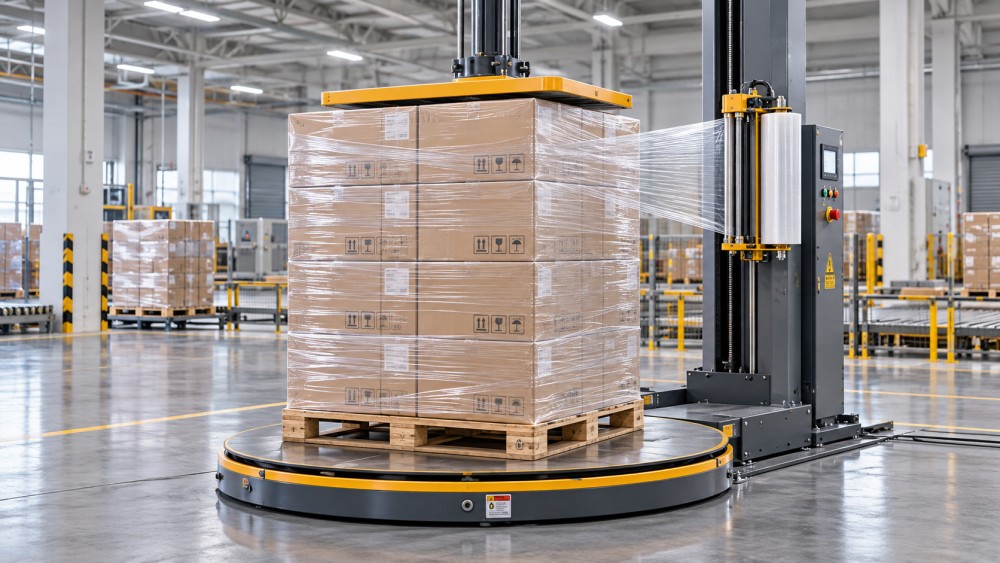
A top platen or hold-down device can help stabilize certain lightweight stacks during rotation. It is most useful when the top surface provides an appropriate contact area and the packaging can tolerate the applied pressure.
For uneven mixed loads, contact may be concentrated on one package. Too much pressure can damage cartons; too little may provide little restraint. Ask how contact force is controlled, how the platen accommodates load height, and whether its contact surface rotates appropriately with the load.
The release sequence also needs attention. The completed load must remain stable when the platen lifts and the pallet leaves the machine. Support during wrapping is not evidence of adequate containment afterward. Corner protection or other stabilizing materials may help in some applications, but include their placement time and material cost in the evaluation.
Know when to stop considering a turntable
Turntable pallet wrappers can be a practical choice when controlled rotation is acceptable. They become less attractive when the required motion profile is so slow that production cannot keep up, or when the stack moves even under gentle settings.
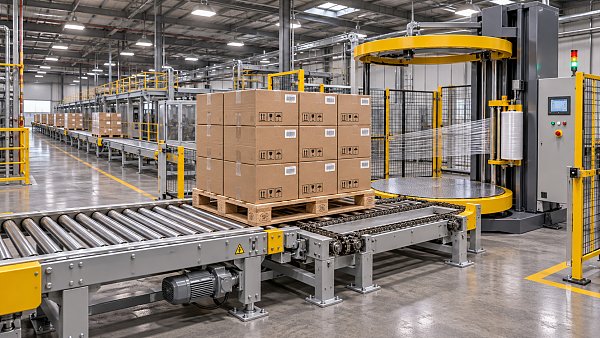
A rotary-arm wrapper keeps the pallet stationary while the film carriage travels around it. A rotary-ring system also avoids rotating the load, although its configuration and investment requirements differ. Removing pallet rotation addresses one source of instability; it does not remove film-force problems or compensate for defective stacking.
Make supplier trials resemble the difficult production shift
A demonstration using a neat, dense pallet says little about unstable loads. Send representative packaging and include the configurations most likely to cause trouble: the tallest stack, lightest load, partial pallet, and uneven top profile. Use the intended production film or a clearly documented alternative.
Agree on acceptance criteria before testing. These should cover visible layer displacement, carton deformation, film breaks, load-to-pallet attachment, repeatability, and completed cycle time. Define tolerances according to product and logistics requirements rather than accepting “looks secure” as the test method.
Record the complete recipe and film consumption by weight, not just the supplier’s chosen pre-stretch setting. Measure cycle time from the same start and finish points for every candidate. For semi-automatic machines, include operator attachment, cutting, unloading, and repositioning where those tasks affect capacity.
Inspect the pallet after platen release and normal handling. Where distribution risk warrants it, arrange appropriate transport simulation or validation with qualified support. Successful wrapping at the machine does not establish performance under braking, vibration, or repeated transfers.
Never rely on an operator manually steadying a moving stack. Review guarding, access control, emergency stops, and safe recovery procedures against the installation risk assessment and applicable local requirements.
Compare the installed process, not the purchase price
The lower-priced wrapper may require more operator intervention, slower recipes, or additional consumables. Conversely, a more complex system may be unnecessary if a simpler turntable handles the full load range reliably. Compare cost per acceptable wrapped pallet using trial evidence, including labor, film, rewrapping, maintenance, and expected downtime.
For automated lines, verify buffer capacity, conveyor handshakes, pallet detection, and recovery after a film break. Confirm service access, spare-parts availability, training scope, utilities, and who owns integration responsibilities. These details can determine whether a wrapper supports the line or becomes its recurring bottleneck.
This system-level assessment reflects the equipment-selection focus of Global Commercial Print & Corrugated Packaging Intelligence (CPCS), which covers packaging machinery, converting systems, and factory automation. For carton and printing plants, wrapping performance belongs in the same investment discussion as palletizing consistency, finished-product quality, and dispatch capacity.
Before issuing a purchase order, attach the tested load range, approved film, operating recipes, acceptance criteria, and site responsibilities to the technical agreement. Choose a turntable only when it protects the difficult loads at the required working rate. If rotation remains the limiting factor, change the wrapping method rather than asking operators to manage the risk.
Related News
 How to Choose Carton Counting Systems for Accurate ProductionChoose Carton Counting Systems with confidence. Compare sensors, accuracy, line integration, and testing methods to improve production reliability.Spatial Folding Strategist
 How to Troubleshoot an Automatic Case Erecting MachineTroubleshoot your automatic case erecting machine with practical steps for diagnosing jams, vacuum loss, sensor faults, and sealing issues—and restore reliable operation.Spatial Folding Strategist
 How to Choose Pallet Conveyors for a Packaging LineChoosing pallet conveyors for packaging line operations? Compare load requirements, throughput, layouts and safety to find the right solution.Spatial Folding Strategist
 How to Choose Case Packers for an Automated Palletizing LineChoose Case Packers that keep your palletizing line moving. Compare loading methods, capacity, changeovers, and integration to make a confident investment.Spatial Folding Strategist
 How Inline Pallet Wrappers Fit Into Automated Packaging LinesDiscover how inline pallet wrappers integrate with automated packaging lines, improve load stability, and help prevent costly bottlenecks.Spatial Folding Strategist
 What Affects Bundle Handling System Cost in a Sheet Plant?Bundle handling system cost depends on capacity, layout, automation, and integration. Learn how to compare total costs and choose the right system for your sheet plant.Spatial Folding Strategist