How Do You Choose Pallet Wrapping Machines for Unstable Loads?
A tall pallet of lightweight corrugated cartons may look secure at the folder-gluer discharge, then begin to lean as it accelerates into the wrapping station. Adding more stretch film is an understandable response—but excessive wrapping force can deform carton corners, while poorly placed film may leave the load vulnerable to movement.
Choosing pallet wrapping machines for unstable loads means finding a workable balance between containment, package protection, and production speed. Technical evaluators need to understand how the load behaves before comparing machine specifications. The strongest proposal is not necessarily the one with the highest pre-stretch ratio or fastest published cycle; it is the one that demonstrates repeatable load stability under realistic operating conditions.
Define what makes the load unstable
“Unstable” is too broad to serve as a purchasing specification. A narrow, top-heavy pallet presents a different problem from mixed cartons with gaps between layers. Before requesting quotations, document the mechanisms that cause movement.
- Geometry: Record minimum and maximum pallet dimensions, load height, overhang, underhang, and irregular profiles.
- Weight distribution: Identify high centers of gravity, heavy upper layers, off-center placement, and changing product mixes.
- Package strength: Note carton compression resistance, board grade, unsupported panels, and sensitivity to moisture.
- Layer interaction: Check stacking patterns, slippery surfaces, interlayer sheets, and gaps that allow cartons to move independently.
- Handling exposure: Include conveyor transfers, forklift movements, braking, turning, storage conditions, and transport duration.
In corrugated packaging plants, the relevant load may contain finished shipping cases, bundled flat blanks, or printed folding cartons. Each responds differently to wrapping pressure. Flat bundles can slip between layers, while erected cartons may suffer panel distortion before the overall pallet appears excessively compressed.
Also establish whether instability begins before wrapping. A wrapper cannot reliably correct poor palletizing, damaged pallets, or a stack that is already leaning. Some loads require changes to stacking patterns, layer pads, or upstream handling before wrapping trials are meaningful.
Choose the machine configuration around load movement
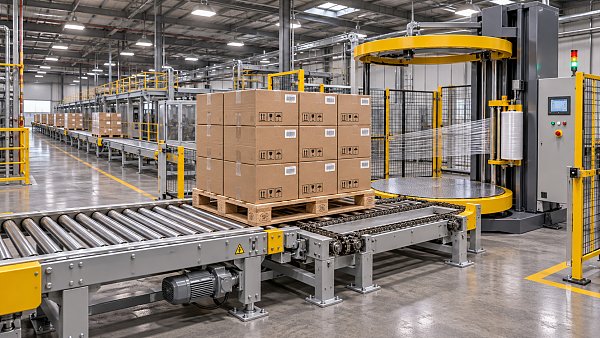
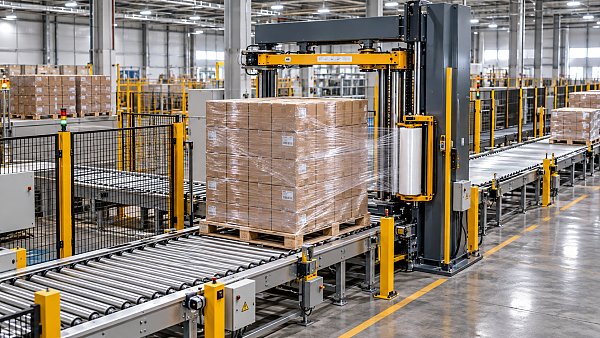
The first major decision is whether the pallet can tolerate rotation. Stationary-load designs often have an advantage for tall, lightweight, or unevenly distributed loads, but they do not eliminate forces applied by the film.
A turntable machine may remain suitable if gentle acceleration and a validated wrapping recipe prevent movement. Rejecting every rotating-load design can unnecessarily narrow the shortlist. However, if the load shifts before sufficient film containment develops, a rotary-arm or rotary-ring machine deserves serious consideration.
For conveyorized systems, verify transfers as carefully as the wrapping motion. A pallet can remain stable throughout wrapping yet move during a rough conveyor handoff immediately afterward.
Top platens are useful, but not a universal remedy
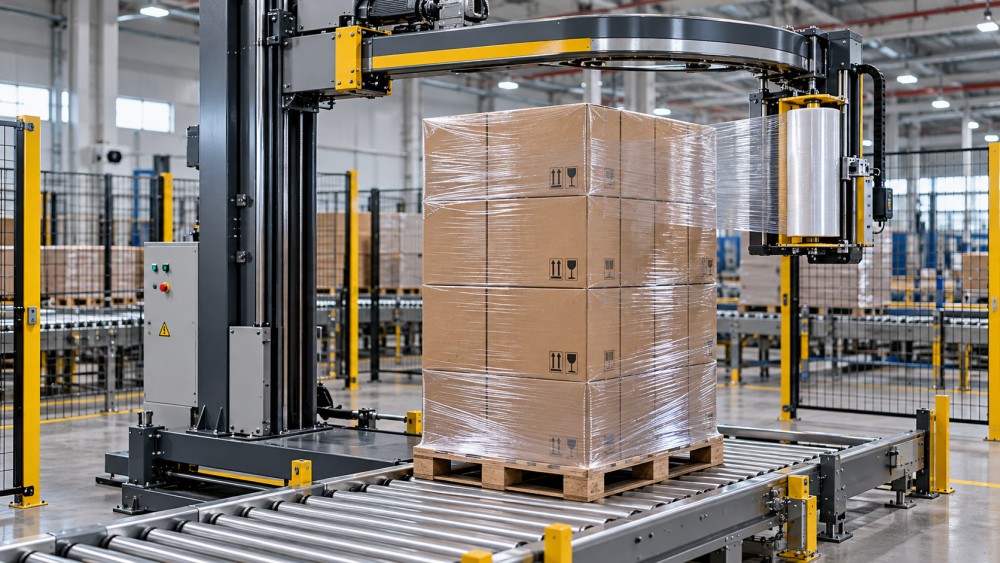
A top pressure platen can help restrain certain lightweight loads during wrapping. Its suitability depends on top-layer strength, contact area, and applied pressure. A platen pressing onto unsupported carton panels may create damage instead of solving instability.
Ask the supplier to demonstrate the exact restraint arrangement with representative products. Any restraint must be engineered and interlocked; operators should never be expected to steady a moving load by hand.
Evaluate film delivery, not just the pre-stretch percentage
Pre-stretch stretches film between rollers before it reaches the pallet. It can improve material utilization, but it is not the same as the force applied to the load. A high pre-stretch rating alone says little about whether a wrapper can protect fragile corrugated cartons.
The more useful question is: Can the machine maintain the required containment without pulling the load out of shape?
Look for responsive force-to-load control
As film travels around a rectangular pallet, the required delivery rate changes between corners and flat faces. Poor compensation can produce force peaks at corners or loose film elsewhere. Irregular loads make this challenge greater.
Compare how shortlisted machines regulate film delivery. Depending on the design, this may involve powered pre-stretch, dancer mechanisms, drive controls, or feedback systems. Ask what is actually measured and controlled rather than accepting “constant tension” as a complete explanation.
Trials should show smooth film application at corners, no progressive carton crushing, and no film breaks across the intended operating range. Test the specified film grades: a machine that runs well with one formulation may need different settings with another.
Specify containment by height zone
Containment force is the restraint provided by the applied film around the load. It depends on film properties, applied stretch, layer count, overlap, wrapping pattern, and relaxation over time—not simply the tension setting displayed on the operator panel.
For unstable loads, assess the bottom, middle, and top separately. A flexible recipe may apply additional bottom wraps to improve pallet connection, moderate force across crush-sensitive middle cartons, and suitable reinforcement near the top. Uniformly increasing force can damage the weakest area without securing the rest.
Measure containment using an agreed method and consistent locations. Immediate readings help compare recipes, but delayed checks matter because film relaxes and cartons can settle. There is no universal containment target suitable for every pallet.
Check the pallet connection and the condition of the cartons
Wrapping products tightly together does not automatically secure them to the pallet. During braking or turning, the entire product stack may slide as one unit if its connection to the pallet is inadequate.
Review the bottom-wrap path, carriage travel, pallet coverage, and any film roping or banding function. These features may strengthen load-to-pallet attachment, but concentrated film forces must not damage carton edges or create handling problems. Keep film clear of fork entry areas where it could be torn during handling.
For corrugated packaging, evaluate conditions beyond the production floor. Moisture exposure and storage time can reduce carton compression performance. A wrapping recipe that looks acceptable immediately after production may leave visible deformation after warehousing.
Where crush resistance limits the available wrapping force, consider packaging changes alongside machine selection. Corner protection, improved layer alignment, anti-slip sheets, or revised stacking patterns may create a wider operating window. Test these changes: improving one aspect of stability can alter another.
Translate throughput claims into a complete line cycle
Published pallets-per-hour figures are useful only when their assumptions match the application. An unstable load may need slower motion, extra reinforcement wraps, or a controlled startup sequence. Those requirements can substantially change achievable output.
Request cycle-time calculations that include:
- Pallet arrival, positioning, and clearance confirmation.
- The complete wrapping recipe for the relevant load height.
- Film attachment, cutting, and tail treatment.
- Pallet discharge and spacing to the next load.
- Film-roll replacement, routine stoppages, and recovery time.
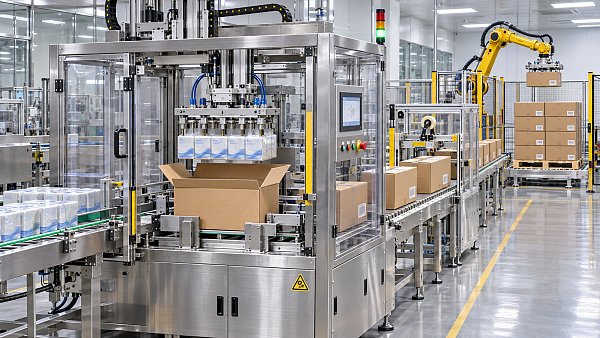
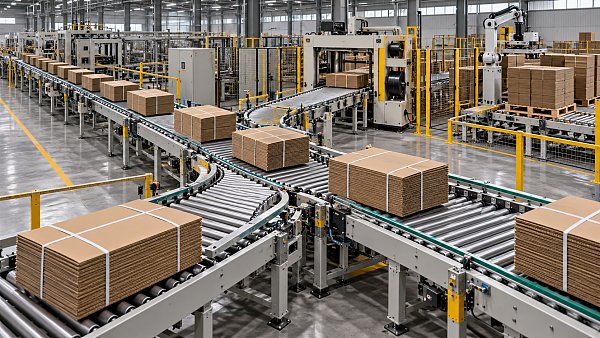
In automated carton plants, the wrapper must also coordinate with robotic palletizing, pallet identification, conveyors, and downstream transport. Confirm how product data selects the wrapping recipe and what happens when identification is missing or inconsistent.
Buffer capacity deserves attention. If a film break stops the wrapper, can the upstream palletizer continue safely for a limited period, or does the entire finishing line stop immediately? This often affects practical production performance more than a small difference in nominal wrapping speed.
Inspect safety provisions early: perimeter guarding, interlocked access, emergency stops, safe maintenance access, and defined restart behavior. Film-break recovery should not encourage operators to enter a hazardous area or bypass safeguards.
Make representative load trials the acceptance gate
A demonstration with a short, square, heavy pallet proves little about a tall mixed load. Build a trial matrix around the difficult combinations the machine will actually encounter.
- Select boundary cases. Include the tallest load, lightest load, weakest cartons, most uneven profile, and demanding normal product mixes.
- Record the starting condition. Document pallet quality, stacking pattern, carton condition, load dimensions, weight, and visible lean.
- Control the variables. Record film specification, pre-stretch settings, force settings, carriage speed, wrap counts, and machine motion settings.
- Measure the wrapped result. Check containment at agreed heights, film consumption, corner deformation, film breaks, and load-to-pallet connection.
- Challenge the load. Use representative handling and an appropriate distribution test protocol, selected for the actual logistics environment.
- Recheck after conditioning. Inspect for settling, containment loss, carton damage, and displacement after a defined storage interval.
Agree on acceptance criteria before testing. “Looks stable” is too subjective for an equipment purchase. Define allowable displacement, unacceptable package damage, film-break frequency, throughput requirements, and the conditions under which each must be achieved.
For formal transport validation, work with a qualified laboratory to select suitable ISTA or ASTM procedures. Wrapping-machine trials alone should not be treated as proof of performance across every distribution route.
Compare the cost of acceptable pallets, not merely film per pallet
Film consumption matters, but reducing it is useful only while protection remains adequate. Track grams of film per accepted pallet alongside product damage, rewrapping, downtime, labor, and maintenance. A lower material figure can conceal higher operating losses.
Ask suppliers about wear components, service access, spare-parts availability, film compatibility, and recipe management. Check whether operators can select validated recipes easily and whether critical settings can be protected against unauthorized changes. Troubleshooting information should help maintenance teams distinguish film problems from sensor, drive, or mechanical faults.
When comparing pallet wrapping machines, use mandatory pass/fail requirements before weighted commercial scoring. A machine that fails the weakest-carton trial should not win because it offers a lower purchase price or a higher theoretical output.
The right choice provides a repeatable operating window: enough containment to resist expected handling forces, low enough application force to protect the packaging, and sufficient capacity for the real line cycle. Once that window is demonstrated on representative loads, the investment becomes far easier to defend—and the production team gains something more useful than an impressive specification sheet.
Related News
 How to Choose Carton Counting Systems for Accurate ProductionChoose Carton Counting Systems with confidence. Compare sensors, accuracy, line integration, and testing methods to improve production reliability.Spatial Folding Strategist
 How to Troubleshoot an Automatic Case Erecting MachineTroubleshoot your automatic case erecting machine with practical steps for diagnosing jams, vacuum loss, sensor faults, and sealing issues—and restore reliable operation.Spatial Folding Strategist
 How to Choose Pallet Conveyors for a Packaging LineChoosing pallet conveyors for packaging line operations? Compare load requirements, throughput, layouts and safety to find the right solution.Spatial Folding Strategist
 How to Choose Case Packers for an Automated Palletizing LineChoose Case Packers that keep your palletizing line moving. Compare loading methods, capacity, changeovers, and integration to make a confident investment.Spatial Folding Strategist
 How Inline Pallet Wrappers Fit Into Automated Packaging LinesDiscover how inline pallet wrappers integrate with automated packaging lines, improve load stability, and help prevent costly bottlenecks.Spatial Folding Strategist
 What Affects Bundle Handling System Cost in a Sheet Plant?Bundle handling system cost depends on capacity, layout, automation, and integration. Learn how to compare total costs and choose the right system for your sheet plant.Spatial Folding Strategist