How Automatic Pallet Wrappers Reduce Load Damage and Film Waste
A finished pallet can look secure at the end of a packaging line and still fail somewhere between the dock door and the customer’s receiving area. A small amount of product movement, an uneven film tail, or insufficient containment force can turn vibration during transport into crushed carton corners, shifted layers, torn stretch film, and rejected deliveries. For project managers and engineering leaders, these failures are rarely isolated warehouse issues. They can affect production planning, customer service, claims handling, and the perceived reliability of the entire plant.
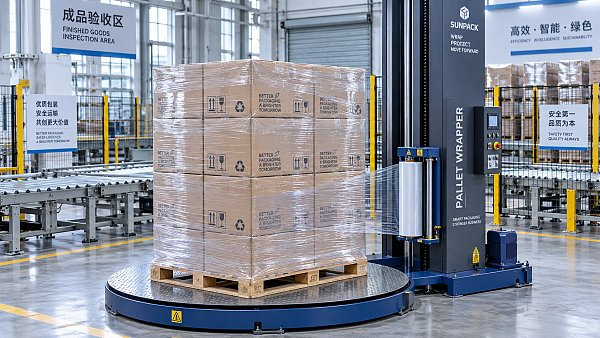
Automatic pallet wrappers address this risk by making load containment more repeatable. Rather than relying on each operator to judge how many revolutions a pallet needs, how tightly to pull the film, or where to reinforce a weak load, automated systems apply defined wrapping recipes. The result is not simply a neater pallet. It is a more controlled end-of-line process that can reduce load damage while avoiding the familiar habit of adding “just a little more film” for safety.
Load damage often begins with inconsistency, not a dramatic equipment failure
In corrugated packaging, commercial print, and converting operations, pallet loads are rarely identical for long. A factory may move from heavy shipping cases to lightweight display cartons, from stable full layers to mixed-SKU loads, or from long production runs to frequent short-run orders. These changes matter because a wrapping pattern that works for one pallet geometry may be excessive—or inadequate—for the next.
Manual wrapping can be practical for low-volume or highly irregular output, but it introduces variation at the moment when the pallet leaves the controlled factory environment. One operator may overlap film generously at the base; another may focus on the top; a third may use more wraps after seeing a previous load shift. None of these decisions is necessarily careless. They are often reasonable responses to time pressure and incomplete information. Yet they make film use and load stability difficult to predict.
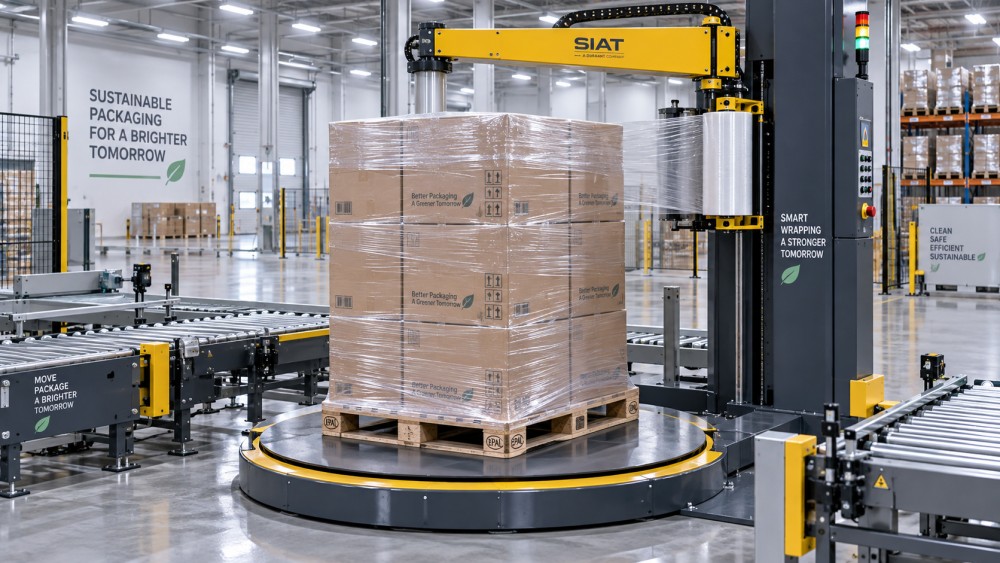
Automatic pallet wrappers replace this judgment-heavy step with programmed motion. Turntable, rotary-arm, and ring-style machines can control carriage speed, film pre-stretch, overlap, wrap count, reinforcement zones, and top-sheet or roping sequences where applicable. When a load is built consistently and the recipe matches its actual transport requirements, the system creates a repeatable containment condition from pallet to pallet.
That repeatability is especially valuable for plants where palletized corrugated cases, folded cartons, printed materials, or bundled converted products move through conveyors, warehouse staging, and third-party logistics networks. The wrapper does not correct poor pallet construction, but it can prevent a sound load from becoming unstable because wrapping quality changed from one shift to another.
Containment force matters more than film thickness alone
A common response to damaged loads is to specify thicker film or add more revolutions. This can work in some cases, but it may also conceal the real issue. Load stability depends on containment force: the inward pressure created by stretch film around the palletized unit. If that pressure is too low, cartons can separate or lean under vibration. If it is too high, lightweight corrugated packaging, flexible printed bundles, or weak product stacks can be compressed and damaged before shipment even begins.
Automatic pallet wrappers provide a more disciplined way to manage this balance. A powered pre-stretch carriage elongates film before application, allowing the film to develop holding force while using less material than unstretched hand film in many applications. The system can then regulate how the film is delivered around the load instead of depending on an operator’s walking speed and pulling technique.
For engineering teams, the important question is not “How many wraps are we using?” It is “What containment level does this load need at the base, body, and top?” The answer may vary by product weight, carton compression strength, pallet overhang, layer pattern, storage duration, and transport route. A tall load of lightweight printed cartons may need different reinforcement from a dense pallet of bundled paper products. The strongest wrapping program is therefore not the most aggressive one; it is the one that matches the load’s real failure mode.
- Base wraps help lock the lower cases to the pallet and reduce sliding during forklift handling.
- Body wraps maintain lateral stability through the main height of the unit load.
- Top wraps or top-sheet retention can reduce upper-layer movement and provide protection where dust, moisture, or warehouse conditions require it.
- Targeted reinforcement can support vulnerable zones without applying excessive film across the entire pallet.
By separating these functions in a recipe, the wrapper makes it possible to adjust performance deliberately. This is much more useful than increasing film consumption across every pallet because a small percentage of loads has caused trouble.
Where film waste enters the process
Film waste is not limited to discarded roll cores or torn material on the warehouse floor. It also includes film that adds little measurable protection: unnecessary top revolutions, excessive overlap, loose tails that require rewrapping, and heavy manual application used as insurance against uncertain load quality. In a busy packaging plant, these small allowances become a recurring operating cost.
Automatic wrapping can reduce waste through controlled pre-stretch and repeatable wrap patterns, but the savings do not come from automation alone. They come from establishing a baseline. Before changing equipment or film specification, project teams should understand current film consumption by pallet type, damage claims, rewrap frequency, and operator practices. Without that baseline, a plant may install a capable machine but continue using overly conservative settings copied from a manual process.
Film optimization should also be treated carefully. Reducing revolutions until a pallet becomes marginal is not an efficiency program; it is a delayed damage claim. A better approach is to test a small number of representative loads, assess stability after handling and simulated transport conditions where possible, and refine the recipe one parameter at a time. Useful variables include pre-stretch ratio, film force, overlap percentage, carriage speed, and the number of wraps in specific zones.
For corrugated packaging producers, this matters because carton strength itself may vary with board grade, humidity exposure, print coverage, die-cut design, and stacking pattern. A wrapping standard created for one box format should not automatically be imposed on every order. Recipe management gives plants a practical way to maintain material discipline while recognizing those differences.
The wrapper must fit the pallet flow—not just the available floor space
Selection often starts with a simple question: turntable or rotary arm? That is a useful starting point, but it is not enough for a project decision. The right configuration depends on how pallets arrive, how stable they are before wrapping, whether loads can rotate safely, and how the wrapper will connect with upstream and downstream equipment.
A turntable wrapper rotates the pallet and is often suitable for stable loads that can tolerate rotation. It can be a sensible choice where footprint, throughput, and pallet characteristics align. A rotary-arm wrapper keeps the pallet stationary while the wrapping arm moves around it, making it attractive for heavy, tall, fragile, or less stable loads. Ring and high-speed automated systems may suit continuous conveyorized lines with demanding output requirements, though their value should be evaluated against the full line design rather than speed alone.
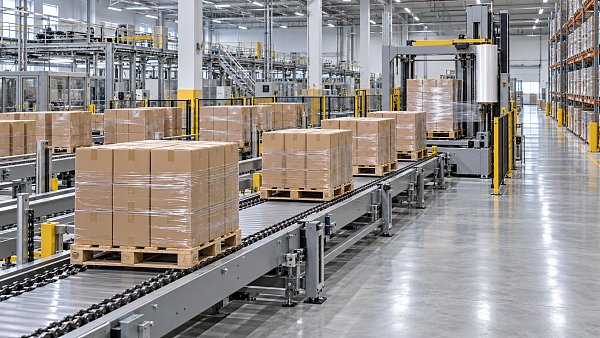
For packaging factories, integration details are often where performance is won or lost. Pallet accumulation must be sufficient to prevent the wrapper from becoming a bottleneck. Conveyor transfers need to preserve load alignment. Safety guarding, pallet centering, load-height detection, film roll access, and discharge logic all influence daily usability. If the line includes robotic palletizing, automatic labeling, coding, or warehouse management interfaces, the wrapper should receive reliable load data rather than operating as an isolated station.
A practical integration review should examine:
- Expected pallets per hour, including peak periods and future capacity plans;
- Load dimensions, weight range, pallet types, and allowable overhang;
- Whether loads are rigid enough to rotate or should remain stationary;
- Required protection against dust, moisture, or outdoor staging conditions;
- Film specification availability, roll-change frequency, and consumable storage;
- Operator access for film replacement, cleaning, troubleshooting, and safe recovery from stoppages;
- Communication with palletizers, labelers, scanners, vision systems, and production data platforms.
Recipe control turns wrapping into a manageable process variable
One of the strongest reasons to use automatic pallet wrappers is not simply labor reduction. It is the ability to convert an informal end-of-line activity into a documented production parameter. A plant can create wrapping recipes linked to product families, pallet configurations, customer shipping conditions, or transport lanes. Operators then select, scan, or receive the appropriate recipe through the line control system.
This approach supports traceability when a shipment issue occurs. Instead of asking only who wrapped a load, the team can review whether the expected program was used, whether the machine completed the cycle, and whether film-related alarms occurred. When paired with barcode identification, production scheduling, or warehouse data, the wrapper becomes part of a broader quality-control chain.
Recipe control is particularly useful in plants managing frequent job changes. Commercial print and folding-carton operations may ship many differently sized products in the same day. Corrugated plants may run orders with varying case footprints and stacking heights. A single “standard wrap” becomes a compromise in these environments. Defined recipes make it easier to protect each load appropriately without requiring operators to reinvent the process at every changeover.
What automation cannot solve by itself
It is important not to treat stretch wrapping as a cure for weak unit-load design. A pallet wrapper cannot fully compensate for unstable layer patterns, poor pallet quality, severe case overhang, damaged corrugated boxes, or insufficient compression strength. If cartons are already leaning before they enter the wrapper, more film may only preserve a flawed shape.
Project teams should inspect the complete load-building process. Are pallet decks flat and consistent? Are cases aligned with enough contact area between layers? Is the heaviest product located appropriately? Are slip sheets, corner boards, anti-slip materials, or top sheets needed for a particular application? Does the palletizer create square loads under normal and peak operating conditions? These questions often reveal improvements that reduce the amount of film needed.
Another mistake is focusing only on nominal machine speed. A wrapper with an impressive cycle rate has limited value if film rolls are difficult to change, recipes are confusing, or upstream pallet flow is unreliable. Availability, recovery time, maintenance access, and operator confidence should carry real weight in the investment review. In end-of-line automation, the simplest daily tasks frequently determine whether a system delivers its planned benefit.
A practical evaluation path for engineering leaders
Begin with representative pallets rather than an abstract average. Include the loads that are most likely to shift, those with the highest film consumption, and those associated with customer complaints or rework. Document the current pallet pattern, film type, wraps applied, loading method, and handling route. Then define the intended outcome: fewer damaged cartons, more stable warehouse storage, lower film use, improved throughput, or better traceability.
Next, evaluate automatic pallet wrappers using real production conditions. Ask suppliers to explain how film force is controlled, how recipes are protected from unauthorized changes, how the system recognizes load height, and what happens when film breaks or runs out. Review the interface points with conveyors and palletizers. A machine demonstration is more meaningful when it reflects the actual pallet mix, not only a uniform demonstration load.
Finally, establish ownership after commissioning. Someone should be responsible for reviewing film use, wrapper alarms, load-damage feedback, and recipe suitability as product formats change. This does not need to become a burdensome reporting exercise. Even a regular cross-functional review involving production, maintenance, quality, and logistics can prevent settings from drifting away from the plant’s real needs.
More reliable shipments begin at the end of the line
Automatic pallet wrappers occupy a relatively small part of a packaging plant, yet their effect reaches into transport quality, customer experience, material cost, and operational control. When correctly specified and integrated, they apply film with a consistency that manual processes struggle to maintain across shifts and product changes.
For project managers, the opportunity is to look beyond the wrapper as a standalone machine. It is a unit-load management tool: one that connects pallet design, corrugated packaging performance, automation flow, consumable use, and shipment reliability. The best result is not merely less film or a tighter-looking pallet. It is a packaging operation that sends out loads with fewer surprises waiting on the road.
Related News
 What to Check Before Ordering Pallet Wrappers Direct From a FactoryBuying from a pallet wrappers factory? Check load compatibility, output, film costs, safety, and support before ordering. Use this checklist to avoid costly mistakes and buy with confidence.Spatial Folding Strategist
 How an Automatic Folder Gluer System Reduces Carton Setup ErrorsAutomatic folder gluer system solutions reduce carton setup errors with precise feeding, folding, glue control, and compression. Discover how to improve quality and changeovers.Spatial Folding Strategist
 How to Choose a Folder Gluer Machine for Folding CartonsChoose the right folder gluer machine for folding cartons with proven guidance on speed, carton styles, glue quality, automation, testing, and lifecycle costs.Spatial Folding Strategist
 When Chain Pallet Conveyors Improve Warehouse Flow and ThroughputChain pallet conveyors improve warehouse flow by reducing forklift delays, adding controlled accumulation, and protecting packaging throughput. Discover when they deliver the strongest ROI.Spatial Folding Strategist
 How to Compare Automatic Strapping Machine Price and Total CostAutomatic strapping machine price comparison made simple: evaluate installation, throughput, consumables, labor, downtime, and total cost for a smarter investment.Spatial Folding Strategist
 What to Compare When Choosing a Pallet Wrappers SupplierCompare a pallet wrappers supplier by load stability, film efficiency, automation integration, service support, and total cost to choose the right solution.Spatial Folding Strategist