How Accumulating Pallet Conveyors Prevent Bottlenecks in End-of-Line Operations
In high-speed packaging and printing plants, end-of-line bottlenecks rarely begin at the palletizer itself. More often, the disruption starts when a stretch wrapper takes longer than expected, a label printer needs attention, a forklift route is temporarily blocked, or an outbound lane is full. If the system has no controlled place for completed loads to wait, that short interruption travels upstream. The palletizer pauses, converting equipment loses its discharge path, and a line that was running steadily begins stopping and restarting for reasons that have little to do with its core production capability.
Accumulating pallet conveyors address this problem by creating managed space between pallet formation and the next handling step. They do not eliminate every downstream delay, nor should they be treated as a substitute for proper scheduling or reliable equipment. Their practical value is more specific: they decouple machines with different operating rhythms, giving the line enough time to absorb normal interruptions without immediately starving or blocking upstream production.
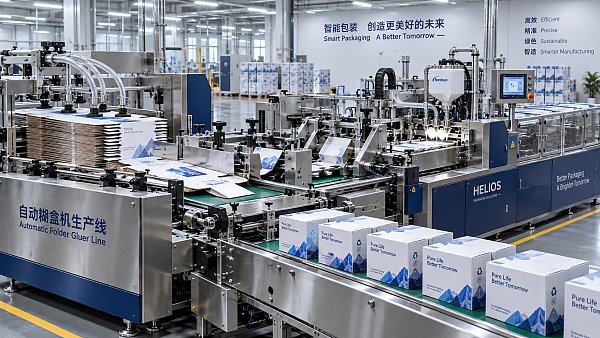
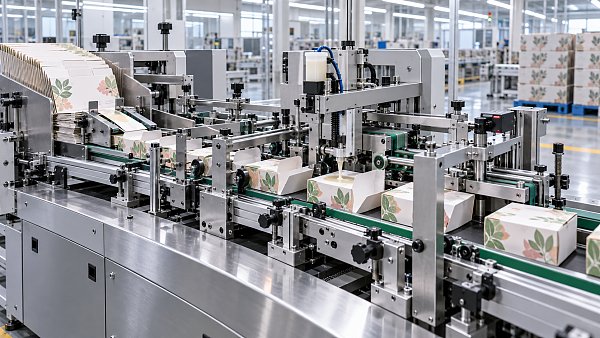
For corrugated box plants, folding carton operations, commercial print facilities, and automated packaging warehouses, this distinction matters. A folder gluer, flexographic press, die-cutter, or robotic palletizing cell may be capable of sustained output, but the end of the line often includes processes that are inherently variable. Pallet wrapping, label verification, quality release, staging, and truck loading do not always happen at the same pace as production. Good conveyor design accepts that reality instead of assuming a perfectly continuous flow.
Why End-of-Line Delays Spread So Quickly
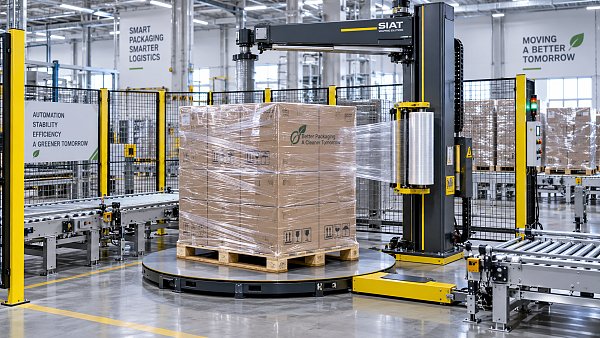
The end of a packaging line is a chain of dependencies. A completed pallet may need to be transferred from a robotic palletizer to a wrapper, then to a label applicator, checkweigher, scan station, or dispatch lane. In some plants, it must also wait for a warehouse management system instruction, a batch release, or an available automated guided vehicle. Each step is sensible on its own. The problem appears when the line has only one pallet position between them.
Consider a corrugated plant producing mixed order sizes. The palletizer may complete a load while the wrapper is still processing the previous pallet. Without an accumulation zone, the palletizer has nowhere to discharge. Once its outfeed is blocked, the upstream bundle handling system may stop. Depending on the layout, that interruption can reach the folder gluer or die-cutting delivery section. Operators then face a familiar but frustrating sequence: stop the line, clear product, restart, inspect for handling damage, and recover stable flow. The wrapper may have been delayed for only a short period, but the operating consequences are larger.
This is especially common where plants run frequent order changes, smaller batches, or a broad mix of pallet footprints. E-commerce-related packaging demand has made production schedules less predictable in many facilities. Lines are expected to process more job variation while maintaining delivery discipline. Under those conditions, the end-of-line system needs flexibility, not merely speed.
What an Accumulation Zone Actually Does
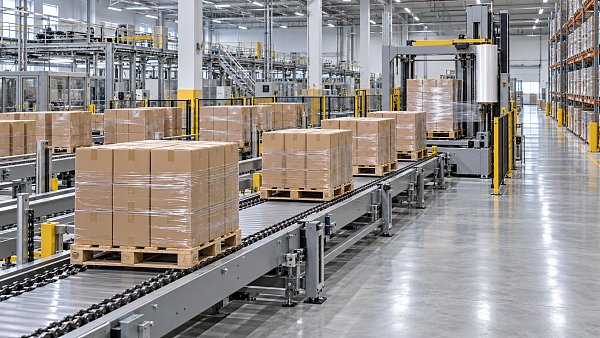
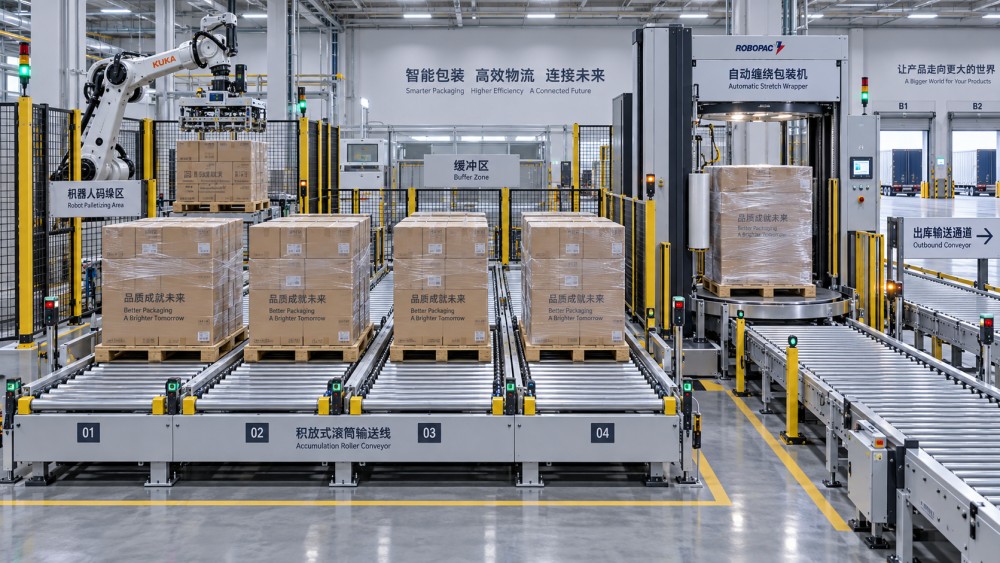
An accumulation conveyor is a section of pallet transport designed to hold one or more loads in a controlled sequence. It detects pallet presence, manages spacing, and releases pallets when the downstream station is ready. Depending on the application, this can be implemented with chain conveyors, roller conveyors, turntables, transfers, lift stations, or combinations of these elements. The physical conveyor is only part of the answer; the control logic determines whether the buffer behaves predictably under real operating conditions.
The basic principle is simple: if wrapping or labeling pauses, completed pallets can move into available buffer positions rather than forcing an immediate stop at the palletizer. When downstream operation resumes, the conveyor releases pallets in the required order. In a well-designed system, upstream and downstream equipment remain synchronized without being mechanically tied to the same moment-by-moment cycle.
That does not mean every project needs a long conveyor line. A buffer that is too small offers little protection; one that is oversized can consume valuable floor space, add capital cost, and hide recurring problems in the wrapping, labeling, or warehouse process. The right amount of accumulation is usually determined by reviewing the duration and frequency of expected interruptions, the time required to complete a pallet, production priorities, and the physical constraints of the site.
The Critical Design Question: What Kind of Delay Are You Buffering?
Projects sometimes begin with a request for “more conveyor” when the underlying issue has not been defined. That is risky. A short, routine pause at a stretch wrapper is not the same as a warehouse that cannot clear finished pallets for twenty minutes. Accumulation is effective against normal operating variation. It is not an economical answer to chronic downstream capacity shortage.
A useful engineering review separates delays into three categories. The first is a brief cycle variation: the wrapper slows during film change, the label printer waits for a print command, or a scan confirmation takes longer than usual. These are the classic cases for accumulation. The second is planned disruption, such as pallet quality inspection, shift handover, or scheduled material replenishment. A buffer may help, but procedures and staffing should also be reviewed. The third is a sustained failure or capacity mismatch. If downstream equipment is regularly unable to process the average production rate, additional conveyor positions will only postpone a full stop.
This is one reason production data matters. Even a basic event log showing palletizer blocked time, wrapper unavailable time, conveyor occupancy, and manual intervention can reveal whether a problem is random or structural. Digital production management is increasingly useful here because it turns an operator’s recurring complaint into a sequence of timestamped events that engineering teams can evaluate.
Buffer Capacity Must Match the Actual Line Rhythm
When sizing accumulating pallet conveyors, the first temptation is to count available floor length. Start elsewhere. Map the line from the moment a finished bundle or carton stream reaches palletizing through to its handover to storage or shipping. Identify the nominal cycle time of each machine, but also ask how the cycle changes when product dimensions, pallet patterns, wrapping recipes, labels, or job instructions change.
Packaging plants often handle different board grades, carton styles, and order configurations. A palletized load of lightweight e-commerce shippers may behave differently from a tightly packed load of printed folding cartons. Pallet dimensions, load height, load stability, and slip-sheet use can affect conveyor transfer behavior. A design that works smoothly with one pallet pattern can become unreliable when the load is taller, less rigid, or overhangs the pallet deck.
The practical sizing discussion should include:
- the longest normal downstream interruption the buffer is expected to absorb;
- the real pallet completion rate during peak production, not only a brochure speed;
- pallet sizes, load weights, center-of-gravity changes, and permissible overhang;
- whether first-in-first-out sequencing is required for order integrity or traceability;
- the consequence of mixing job codes, pallet labels, or shipping destinations;
- safe access for film replenishment, label maintenance, fault clearing, and manual recovery.
The phrase “normal interruption” deserves attention. If a facility expects the conveyor to cover extended warehouse congestion every day, that is a capacity-planning issue. An accumulation zone should protect flow, not become a permanent storage area that obscures dispatch problems.
Controls and Pallet Tracking Are Where Many Projects Succeed or Fail
Mechanical layout receives most of the early attention because it is visible on a drawing. Yet control design is just as important. Sensors must reliably distinguish occupied and clear zones. Pallets should stop without damaging the load or creating excessive contact between adjacent loads. Release logic needs to account for the readiness of wrapping, labeling, inspection, and transfer equipment, rather than simply moving every pallet forward when a sensor clears.
Traceability becomes more sensitive when multiple pallets are held in sequence. In commercial printing and carton converting, a pallet may be associated with a specific job, customer, batch, artwork revision, or inspection status. If labels are applied after accumulation, the control system must ensure that the right print-and-apply instruction follows the right physical load. If labels are applied before the buffer, scanners and data interfaces may be needed to confirm that pallets have not been diverted, rejected, or manually repositioned without the record being updated.
This is also where vision inspection and code verification can add practical protection. The objective is not to add technology for its own sake. It is to prevent a finished pallet with a missing, unreadable, or incorrect identifier from entering a busy outbound flow where correction becomes more disruptive. The right level of verification depends on product risk, customer requirements, and the plant’s existing traceability process.
Layout Choices That Look Minor but Create Major Operational Friction
A straight conveyor buffer is often the simplest option, but it is not automatically the best. A plant with limited floor area may need right-angle transfers, turntables, or compact loop arrangements. Those choices can be justified, but each transfer adds a point where pallet condition, deck gaps, alignment, and control timing need careful attention. Lightweight or uneven loads are less forgiving than a stable, uniformly wrapped pallet.
Access is another recurring issue. Engineers understandably focus on throughput, while operators later discover that there is no comfortable place to replace stretch film, clean a sensor, remove a damaged pallet, or reach an emergency stop without entering an awkward space. Safety guarding, pedestrian routes, forklift separation, and maintenance access should be considered before the conveyor path is finalized. Local safety requirements and site-specific risk assessments must guide the detailed design.
There is also a human factor. When a buffer fills, the system should make the situation obvious. Clear status indication and meaningful alarms help operators understand whether the problem is a wrapper, labeler, downstream transfer, or a blocked collection point. A vague “line fault” message encourages manual workarounds. Those workarounds can compromise pallet sequence and traceability just when the system is under pressure.
A Better Way to Evaluate the Investment
The value of accumulating pallet conveyors should not be judged solely by conveyor speed or the number of pallets they can hold. The more relevant question is how much avoidable upstream downtime they prevent, and whether they reduce the need for operators to intervene in unstable conditions. In a packaging automation project, conveyor buffering should be evaluated alongside palletizer performance, wrapper reliability, labeling accuracy, warehouse release logic, and changeover demands.
This system-level view is increasingly important in corrugated packaging and commercial print operations. Equipment buyers are no longer comparing isolated machines only by purchase price. They need to understand uptime behavior, maintenance access, energy use, labor requirements, material handling risk, and the impact of automation on delivery commitments. Industry resources such as CPCS are useful when they translate individual equipment functions into the wider production flow: corrugator output, printing and converting stability, inspection requirements, palletizing integration, and digital production control all meet at the end of the line.
Before approving a conveyor layout, walk the proposed route with production, maintenance, warehouse, and controls personnel. Review what happens during a film change, a label fault, a rejected pallet, an order change, and an unavailable collection vehicle. If the answer to each situation is simply “the line stops,” the design has not yet created enough operational resilience. If the answer is “the buffer handles it,” confirm for how long, under which pallet conditions, and with what recovery procedure. That is the level of detail that prevents a clean layout drawing from becoming a daily bottleneck on the factory floor.
Related News
 How an Automatic Folder Gluer System Reduces Carton Setup ErrorsAutomatic folder gluer system solutions reduce carton setup errors with precise feeding, folding, glue control, and compression. Discover how to improve quality and changeovers.Spatial Folding Strategist
 How to Choose a Folder Gluer Machine for Folding CartonsChoose the right folder gluer machine for folding cartons with proven guidance on speed, carton styles, glue quality, automation, testing, and lifecycle costs.Spatial Folding Strategist
 When Chain Pallet Conveyors Improve Warehouse Flow and ThroughputChain pallet conveyors improve warehouse flow by reducing forklift delays, adding controlled accumulation, and protecting packaging throughput. Discover when they deliver the strongest ROI.Spatial Folding Strategist
 How to Compare Automatic Strapping Machine Price and Total CostAutomatic strapping machine price comparison made simple: evaluate installation, throughput, consumables, labor, downtime, and total cost for a smarter investment.Spatial Folding Strategist
 What to Compare When Choosing a Pallet Wrappers SupplierCompare a pallet wrappers supplier by load stability, film efficiency, automation integration, service support, and total cost to choose the right solution.Spatial Folding Strategist
 How an Automatic Case Erecting Machine Reduces Packing DelaysAutomatic case erecting machine solutions reduce packing delays by delivering consistent, sealed cases, improving line flow, uptime, and end-of-line efficiency.Spatial Folding Strategist