Bundle Handling Systems for Food and Beverage Packing Lines: Key Design Factors
In high-speed food and beverage packing lines, bundle handling is rarely the machine section that gets attention early in a project. Teams usually spend more time on primary packaging, filling accuracy, labeling, or case packing speeds. Then the line starts running, and the weak point shows up at the handoff: unstable multipacks, skewed bundles, crushed corners, mistimed transfers, or an accumulation zone that cannot absorb normal upstream variation. That is where Bundle Handling Systems stop being a secondary detail and become a line-efficiency issue.
For project managers and engineering leads, the design question is not simply how to move bundles from point A to point B. It is how to move a product that may be soft, slippery, shrink-wrapped, tray-packed, paper-banded, or corrugated-supported, while keeping pace with synchronized upstream and downstream equipment. In food and beverage environments, sanitation, changeover frequency, and packaging-material variability also shape the answer more than many initial layouts admit.
Start with the bundle, not the conveyor
A common mistake is to begin specification with conveyor width, target speed, and discharge height. Those matter, but they are downstream decisions. The real starting point is bundle behavior.
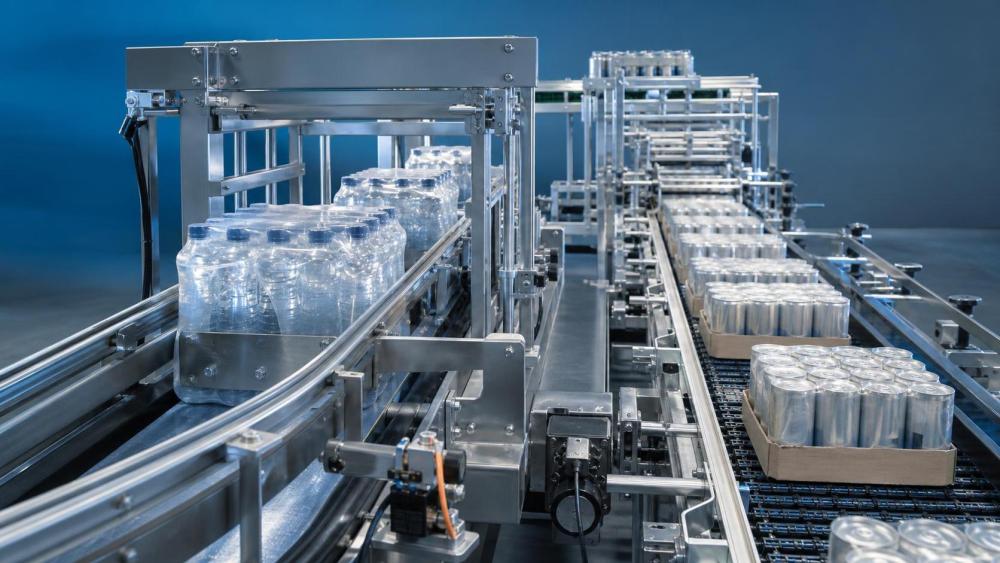
A beverage shrink bundle of PET bottles behaves very differently from a paperboard-wrapped multipack of cartons or a tray of cans. Some products have a stable center of gravity and good base friction. Others are top-heavy, deformable, or prone to “walking” under acceleration. If the bundle can tolerate only limited side pressure, a system that relies on aggressive lane compression may solve spacing while quietly creating quality defects.
This is especially relevant as more food and beverage lines shift toward paper-based secondary packaging, driven partly by retailer requirements and partly by plastic-reduction pressure in markets influenced by regulations such as the EU PPWR. When corrugated trays, wraps, or paper bundles replace more forgiving plastic formats, the handling window often narrows. Engineers used to robust shrink-pack behavior may discover that the new bundle is less tolerant of abrupt transfers, poor vacuum control, or uneven belt speeds.
Line synchronization is where good concepts fail
Most bundle handling problems are not caused by a single machine defect. They come from timing mismatch across the line. A bundler may discharge in a pulse. A wrapper may introduce slight spacing variation. A case packer or palletizing cell may consume product intermittently rather than continuously. If the handling section between them has been designed as a simple transport path, it will amplify instability instead of buffering it.
This is where high-speed packaging intelligence matters. In corrugated and carton finishing, CPCS has long focused on motion precision, registration discipline, and OEE-driven end-of-line design. The same thinking applies here: once speed increases, mechanical transitions are no longer neutral. A short dead plate, a poorly chosen nose-bar diameter, a transfer with marginal product support, or a servo profile that looks acceptable at trial speed can become the source of repeat stoppages in production.
In practical terms, project teams should review at least three synchronization points in detail:
- Discharge pattern from the upstream machine: continuous flow, indexed release, or burst release.
- Required metering or regrouping before the next station.
- The amount of accumulation needed to absorb realistic micro-stops, not idealized line balance.
If those three are not aligned, the system may look fine in a 30-minute FAT run and still underperform in a full production shift.
Mechanical gentleness and positive control have to be balanced
Bundle handling design often swings between two bad extremes. One is over-control: too many side guides, compression rails, hold-downs, and correction devices. The other is under-control: long free-running sections that assume the product will self-track. Neither is ideal.
The better approach is selective positive control. Use it where the bundle is vulnerable to loss of orientation or where the downstream process needs exact pitch and alignment. Ease off where the bundle needs to recover from compression or where minor variation does not matter. This is a judgment call, and it depends heavily on the packaging format.
For example, bundles moving toward robotic palletizing may need more stable presentation than bundles entering a broad infeed table. Likewise, wrapped products with glossy film may need different belt materials, side-guide finishes, or transfer geometry than kraft-based multipacks. The point is simple: “gentle handling” is not a universal design setting. It has to be engineered around actual friction, stiffness, and deformation behavior.
Sanitary design changes the hardware choices
Food and beverage lines do not give much room for awkward maintenance zones or dirt traps. Yet bundle handling equipment is often specified late, when washdown expectations, cleaning chemistry, and hygienic zoning should already be settled.
That creates expensive revisions. Belt type, frame design, motor placement, guarding style, and cable routing all need to match the sanitation regime. A dry snack line and a beverage environment with regular wet cleaning are not the same project. Stainless construction by itself does not solve hygienic risk if fasteners are exposed in the wrong places, if drainage is poor, or if guide adjustments are too tedious and therefore skipped by operators.
There is also a trade-off to manage: the more adjustable the system becomes for future SKU flexibility, the greater the chance of creating cleanability and repeatability issues. In many plants, the better investment is not maximum adjustability everywhere, but smart modularity with defined change parts or clearly indexed settings.
Packaging-material variation is now a real design input
This point gets underestimated, particularly by teams that are more familiar with machine capability than with packaging conversion variability. In food and beverage lines, bundle quality is affected by what happens earlier in the packaging chain: film tension, glue application, board caliper variation, crease quality, tray squareness, and print-to-cut registration where retail-facing paper packaging is involved.
Anyone working around corrugated and carton systems knows that packaging is never just a static material. It is the output of high-speed processes—corrugating, flexo printing, die-cutting, folding, gluing—where motion precision and material control define downstream consistency. If tray blanks vary, if glue windows drift, or if folded geometry is not repeatable, the bundle handling system inherits that instability. It should not be expected to “fix” structural packaging defects after the fact.
That is one reason cross-functional review matters. Mechanical handling should be discussed together with packaging format owners, corrugated suppliers, and line-automation teams, not in isolation.
Accumulation is not just about storage length
When teams talk about accumulation, they often ask one simple question: how many meters do we need? The more useful question is: what kind of disturbance are we trying to absorb?
Short micro-stops, normal discharge pulsation, recipe-based downstream speed changes, and planned operator interventions do not all require the same accumulation strategy. Some lines benefit from low-pressure mass accumulation. Others need single-file buffering, lane balancing, or controlled recirculation. The wrong method may protect throughput while quietly damaging product appearance.
For beverages, where volume can be high and bundle count per minute substantial, pressure management becomes especially important. Product backline force can rise quickly if the accumulation section was sized only for nominal flow and not for upset conditions. Once that happens, wrappers split, trays deform, and downstream restart becomes messy.
Controls, sensors, and inspection deserve more attention than they usually get
Mechanical layout solves only part of the problem. The control layer determines whether the system can run predictably outside ideal conditions. Sensor placement should distinguish between presence detection, orientation confirmation, spacing measurement, and jam anticipation. Those are not interchangeable tasks.
In high-speed packaging sectors, vision inspection and line-scan monitoring have already proven their value for defect detection and process stability. While a bundle handling section may not need the same inspection intensity as pharmaceutical carton serialization, the principle still applies: if a line repeatedly stops because malformed bundles are discovered too late, the cost is not just downtime. It also shows that the process lacks early visibility.
For some applications, a simple sensor architecture is enough. For others, especially where unstable paper-based formats are entering automated case packing or palletizing, vision-assisted rejection or orientation control may be worth evaluating. The answer depends on speed, defect cost, and how recoverable a downstream upset really is.
Plan for changeovers the way operators actually work
A line that handles one bundle format at high speed is a different engineering problem from a line that changes between multiple counts, pack sizes, or retailers. On paper, quick-adjust rails and recipe-driven servo positions sound like the answer. In practice, success depends on whether operators can verify settings quickly and whether the line returns to stable production without a long tuning period.
This is where project teams should be honest. If changeovers happen several times per shift, repeatability matters as much as peak throughput. If a line mostly runs long batches, it may be better to simplify the handling path and optimize reliability. Chasing every future possibility can leave the plant with a more complex system than it actually needs.
Questions worth settling before procurement
Before freezing the specification, it helps to force a few uncomfortable but useful decisions:
- Which bundle defects are acceptable for downstream handling, and which must be rejected earlier?
- What is the actual worst-case product mix, not just the current best seller?
- How much accumulation is needed for real operating behavior, including minor stops and sanitation interruptions?
- Will future packaging shifts toward paper or corrugated-supported formats change friction, stiffness, or dimensional stability?
- Which settings must be operator-adjustable, and which should be locked down for consistency?
Those questions are not glamorous, but they usually reveal whether the proposed Bundle Handling Systems design is mature or still too generic.
In the end, the strongest designs are rarely the most complicated. They are the ones that respect real bundle behavior, match machine kinematics across the line, and leave enough room for sanitation, maintenance, and future packaging changes. If that discipline is applied early, the handling section becomes what it should be: an invisible enabler of OEE rather than the place where good packaging lines lose time and product.
Related News
 How an Automatic Folder Gluer System Reduces Carton Setup ErrorsAutomatic folder gluer system solutions reduce carton setup errors with precise feeding, folding, glue control, and compression. Discover how to improve quality and changeovers.Spatial Folding Strategist
 How to Choose a Folder Gluer Machine for Folding CartonsChoose the right folder gluer machine for folding cartons with proven guidance on speed, carton styles, glue quality, automation, testing, and lifecycle costs.Spatial Folding Strategist
 When Chain Pallet Conveyors Improve Warehouse Flow and ThroughputChain pallet conveyors improve warehouse flow by reducing forklift delays, adding controlled accumulation, and protecting packaging throughput. Discover when they deliver the strongest ROI.Spatial Folding Strategist
 How to Compare Automatic Strapping Machine Price and Total CostAutomatic strapping machine price comparison made simple: evaluate installation, throughput, consumables, labor, downtime, and total cost for a smarter investment.Spatial Folding Strategist
 What to Compare When Choosing a Pallet Wrappers SupplierCompare a pallet wrappers supplier by load stability, film efficiency, automation integration, service support, and total cost to choose the right solution.Spatial Folding Strategist
 How an Automatic Case Erecting Machine Reduces Packing DelaysAutomatic case erecting machine solutions reduce packing delays by delivering consistent, sealed cases, improving line flow, uptime, and end-of-line efficiency.Spatial Folding Strategist