Why UV Flexographic Ink for Label Printing Matters for Durable Labels
UV flexographic ink for label printing is more than a color choice—it directly affects label durability, barcode readability, curing consistency, chemical resistance, and compliance risk. In demanding packaging environments, the interaction between ink formulation, substrate compatibility, UV curing performance, and inspection controls often determines whether a label remains functional throughout filling, transport, storage, and end use.
This matters because a label is frequently a product-control component rather than a decorative surface. It may carry a batch code, ingredient declaration, hazard statement, pharmaceutical information, traceability data, warning symbol, or barcode used by automated systems. When the printed image smears, loses adhesion, changes color, or fails to cure fully, the issue can extend far beyond appearance. It can lead to rejected packs, unreadable codes, customer complaints, rework, recall exposure, or questions about material safety.
What UV Flexographic Ink Actually Changes in Label Production
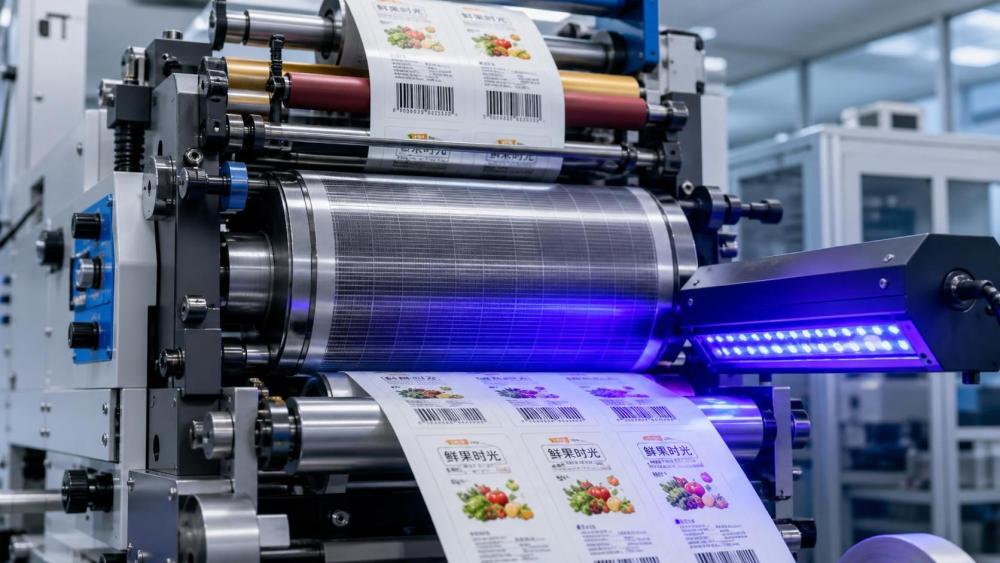
Flexographic printing transfers ink from an anilox roller to a flexible printing plate and then to the label substrate. In a UV system, the ink is not dried mainly by water evaporation or solvent release. Instead, ultraviolet energy initiates a chemical reaction that converts liquid ink components into a cured polymer film.
That basic difference has important production consequences. UV flexographic ink can be used on many common label materials, including coated papers, films, metallized stocks, synthetic papers, and certain specialty substrates. Because the ink can cure rapidly, converters can run at high press speeds without waiting for a long drying section. It also allows relatively sharp print detail and supports processes where labels must be converted, varnished, die-cut, inspected, or rewound soon after printing.
However, “instant curing” is an oversimplification. A printed label may look dry on the press while still having incomplete cure below the surface or in heavily inked areas. For label applications, appearance alone is not proof of adequate performance. The real question is whether the cured ink film meets the requirements of the product’s handling environment and regulatory context.
Durability Is a System Property, Not an Ink Claim
Label durability is often described as if it were a single ink characteristic. In practice, it depends on the entire construction: facestock, ink, primer if used, adhesive, liner, varnish or laminate, curing unit, press settings, and the product environment.
A UV ink that performs well on a coated paper label may show weak adhesion on untreated polypropylene film. An ink film that passes a simple rub test may still fail after exposure to oil, alcohol, moisture, detergent, plasticizer migration, low temperatures, or repeated contact during logistics. Likewise, a strong ink-substrate bond does not guarantee that the barcode will remain readable after abrasion or that a dark color will remain visually consistent under different lighting conditions.
Durability requirements should therefore be defined before ink selection. Common questions include:
- Will the label be exposed to water, condensation, refrigeration, freezing, heat, oils, or cleaning chemicals?
- Will it contact curved containers, flexible pouches, rough corrugated surfaces, or chemically active packaging materials?
- Is the label intended for short-term transport identification or long-term product use?
- Will the print be protected by a laminate, varnish, or overprint coating?
- Which printed elements are critical: decorative graphics, fine text, variable data, a 2D code, or a regulated warning statement?
The answers affect not only the ink series but also anilox volume, ink film weight, cure dose, plate design, substrate treatment, and inspection plan.
Why Cure Quality Is Central to Both Performance and Safety
UV inks typically contain pigments, oligomers, monomers, photoinitiators, additives, and other formulation components. Under UV exposure, photoinitiators generate reactive species that start polymerization. The objective is a sufficiently cured, stable ink film with the required adhesion, resistance, and low residual extractability for the intended application.
Incomplete curing can appear in several ways. The label may have surface tack, poor rub resistance, low scratch resistance, odor, weak intercoat adhesion, poor resistance to chemicals, or later changes in appearance. Some failures are delayed: labels may pass immediately after printing but deteriorate after stacking, rewinding, storage, or exposure to heat.
Three areas deserve particular attention:
UV energy delivery
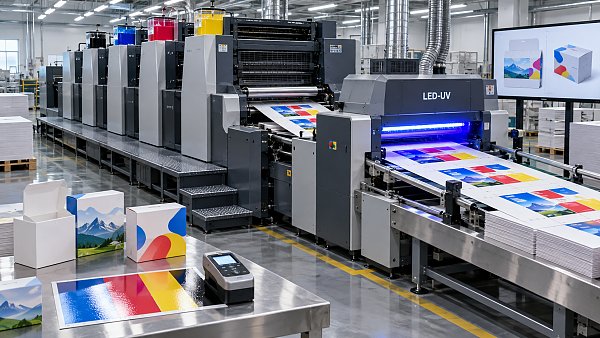
The lamp or LED system must provide enough usable energy at the wavelengths relevant to the ink chemistry. Output can decline as conventional UV lamps age, reflectors become contaminated, shutters malfunction, or cooling conditions change. LED UV systems offer operational advantages in many applications, but their narrow emission spectrum means ink chemistry must be designed for that specific wavelength range. An ink formulated for conventional mercury-vapor curing should not be assumed to cure properly under an LED unit without technical confirmation.
Ink film thickness and color density
Heavy solids, opaque whites, dense blacks, metallic colors, and highly pigmented formulations can be more difficult to cure through the full ink layer. A press setting that works for fine process-color graphics may not be sufficient for a large opaque white panel. Excessive anilox volume may improve coverage but create a cure bottleneck and reduce fine-detail performance.
Substrate and construction effects
Some films contain additives that can interfere with adhesion. Certain labelstocks may require corona treatment, a suitable primer, or a specifically matched ink system. Surface energy should be checked rather than assumed, especially when switching between material lots or suppliers. The same applies to varnishes, laminating adhesives, and other layers that may interact with the printed surface.
Barcode Readability Depends on Print Control, Not Only Artwork
Barcodes and two-dimensional codes create a common misunderstanding in label printing. If the code looks sharp to the human eye, it is often considered acceptable. Yet scanner performance depends on measurable parameters such as contrast, edge definition, modulation, defects, quiet zones, and correct symbol geometry. Ink spread, plate gain, poor registration, mottling, insufficient opacity, or contamination can reduce grade even when the label appears visually normal.
UV flexographic printing can produce highly defined codes, but process control is essential. The printing plate must be selected and maintained for the required line width. The anilox must deliver a controlled volume. Viscosity behavior, temperature, doctor blade condition, plate mounting, impression pressure, and substrate stability all influence dot gain and edge sharpness.
For codes that support inventory, track-and-trace, medical information, or automated distribution, verification should be performed using an appropriate verifier rather than relying solely on a handheld scanner. A scanner answers whether one device can read a code at one moment. Verification evaluates print quality against recognized barcode quality methods and can identify trends before codes become operational failures.
Variable-data labels require additional scrutiny. The UV flexographic image may be stable while a later thermal transfer, inkjet, laser, or coding process becomes the weak point. Any finished-label validation plan should test the complete marking sequence, including overprint adhesion and readability after expected abrasion or chemical exposure.
Food, Pharmaceutical, and Chemical Labels Require More Than a “Low-Migration” Statement
When labels are used on food, pharmaceutical, cosmetic, chemical, or other sensitive products, the safety assessment must consider the complete packaging structure and intended use. A label may be on the outside of a package, but migration or set-off risk can still be relevant depending on package design, storage conditions, printed-side contact during winding or stacking, and the nature of the packed product.
“Low migration” is not a universal pass/fail label for an ink. It describes an approach involving formulation, process control, packaging construction, and application-specific evaluation. The suitability of an ink system depends on factors such as the printed area, cure level, substrate barrier properties, adhesive selection, pack geometry, time and temperature conditions, and whether the print can contact the food-contact side through set-off.
For products sold across markets, legal requirements may differ by region. European food-contact packaging assessments commonly refer to the framework established under Regulation (EC) No 1935/2004 and good manufacturing practice principles under Regulation (EC) No 2023/2006. Printed packaging materials can also involve national guidance, customer specifications, and brand-owner restrictions. In the United States, the relevant compliance route may differ depending on the packaging application and materials involved.
The practical point is simple: a safety declaration from an ink supplier is important, but it does not replace a documented assessment of the finished label in its actual packaging application. Ink suppliers, label converters, packaging manufacturers, and product owners often each hold part of the technical information needed for that assessment.
Resistance Testing Should Reflect Real Failure Modes
Many label problems are found too late because testing is limited to a quick thumb rub or tape pull directly after printing. Those checks are useful as in-process indicators, but they are not sufficient for higher-risk applications.
A more credible test plan starts with anticipated exposure. For example, a beverage label may need resistance to condensation and ice-water handling. A household chemical label may need resistance to surfactants or contents leakage. An industrial lubricant label may require oil resistance. A pharmaceutical or laboratory label may need to remain legible after refrigeration, alcohol wiping, or repeated handling.
Depending on the application, the testing program may include dry and wet rub, scratch resistance, tape adhesion, cross-hatch adhesion where appropriate, water immersion, chemical wipe testing, temperature cycling, humidity exposure, lightfastness, and resistance to the packed product. Results should define the method, contact time, pressure, temperature, number of cycles, and acceptance criteria. A result described only as “passed rub test” is difficult to compare, reproduce, or defend during a customer investigation.
It is also wise to test aged samples. Some ink-substrate failures emerge after post-cure, winding pressure, adhesive interaction, or environmental exposure. Retained production samples can help distinguish a printing defect from a later distribution or application issue.
Common Assumptions That Create Avoidable Risk
“The ink is dry, so it is fully cured.” Surface dryness does not confirm through-cure or long-term resistance. Cure validation must account for the darkest colors, highest coverage areas, and maximum production speed.
“One UV ink works on every film.” Film families differ in surface treatment, additives, texture, and chemical behavior. A controlled substrate-ink compatibility test is more reliable than transferring settings from another job.
“A varnish will solve all durability problems.” A topcoat can improve abrasion and chemical resistance, but it cannot reliably compensate for fundamentally poor ink adhesion or insufficient curing. It may also introduce its own adhesion and cure requirements.
“The supplier’s compliance statement covers the finished package.” Supplier documentation is essential evidence, but final suitability remains application-specific. The finished construction and intended use determine the relevant risk assessment.
“Visual inspection is enough for critical labels.” Visual checks may miss low contrast, registration drift, incomplete codes, variable-data errors, and subtle color shifts. Automated inspection and barcode verification are increasingly relevant where traceability and brand consistency are important.
Building a Practical Control Routine
A robust production routine does not need to be unnecessarily complicated, but it should link incoming materials, press conditions, curing performance, and finished-label testing.
At job setup, confirm the correct ink series, substrate, plate, anilox specification, curing configuration, and approved artwork version. Record the operating window rather than only the final settings: press speed, lamp or LED output conditions, number of curing units, anilox identification, viscosity or temperature controls where applicable, and coating details.
During the run, inspect high-risk elements at defined intervals. These may include opaque whites, fine reverses, small text, barcodes, regulatory statements, color-critical brand areas, and variable codes. If UV output is monitored, trend data should be reviewed rather than treated as a maintenance record with no connection to product quality.
For recurring jobs, retain approved samples and establish reference criteria for color, adhesion, cure-related resistance, and code quality. This makes it easier to identify gradual drift caused by lamp aging, changed substrate treatment, altered ink batches, worn plates, or process changes.
When a defect occurs, the investigation should look beyond the print station. Labels can be damaged by rewinding tension, die-cutting, slitting dust, unsuitable packaging of finished rolls, warehouse heat, or the customer’s label application process. A useful root-cause review follows the label through the complete chain rather than assuming that every visible defect originated in the ink.
The Operational Value of Getting the Ink System Right
UV flexographic ink for label printing matters because it sits at the intersection of visual communication, automated identification, packaging durability, and material safety. Its value is not limited to faster curing or vivid graphics. A well-controlled UV ink system can support stable high-speed production while protecting code readability, resistance performance, and documentation confidence.
The most reliable labels are produced when ink selection is treated as part of packaging engineering. The relevant question is not whether UV flexography is generally durable, but whether the specific ink, substrate, cure method, and finishing construction have been proven for the real conditions the label will face. That distinction is where many preventable failures—and many successful label programs—are decided.
Related News
 What Drives Water Based Flexographic Ink Price in 2026Water based flexographic ink price in 2026 depends on raw materials, color strength, performance, and service. Discover how to compare true print costs and choose smarter.Print Fluidics Scientist
 Water Based Flexographic Ink Selection for Consistent Print QualityWater Based Flexographic Ink selection guide for consistent color, fast drying, strong adhesion, and lower production costs across paper and corrugated board applications.Print Fluidics Scientist
 How to Choose UV Inks for Reliable Color and Fast Production RunsUV Inks for reliable color and fast packaging runs: learn how to match cure systems, substrates, adhesion, finishing, and compliance for consistent results.Print Fluidics Scientist
 How Low Odor Water Based Flexographic Ink Supports Safer PackagingLow odor water based flexographic ink supports safer packaging by reducing residual odor and emissions while delivering reliable color, drying, and rub resistance. Explore practical process control tips.Print Fluidics Scientist
 How a Water Based Ink Metering System Reduces Color VariationWater based ink metering system: discover how stable anilox delivery, circulation, and blade control reduce color variation and improve flexo print consistency.Print Fluidics Scientist
 How Water Based Ink Viscosity Control Systems Stabilize Print QualityWater based ink viscosity control systems stabilize flexographic print quality, reduce waste, and deliver consistent color, sharper graphics, and reliable production.Print Fluidics Scientist