How to Choose a Hot Air Drying Oven for Consistent Production
Choosing a hot air drying oven is a consequential decision for technical evaluators in printing, corrugated packaging, coating, laminating, and converting operations. When drying performance is inconsistent, the symptoms often appear elsewhere: ink rub-off, uneven coating, warped sheets, poor adhesive bonding, curl, odor retention, or downstream die-cutting and folding problems. The oven may be only one station in the process, but it can determine whether the entire line runs smoothly or becomes a daily source of adjustments and rejected material.
For that reason, temperature range alone is a weak basis for selection. A suitable industrial drying oven must match the actual substrate, coating or ink chemistry, production rhythm, loading method, safety requirements, and quality tolerance of the application. The most useful evaluation begins not with a brochure specification, but with a clear picture of what must be dried, how it moves through the process, and what “consistent production” means on the factory floor.
Start with the drying problem, not the oven model
Technical teams are sometimes asked to compare ovens before the process conditions have been defined. This creates a familiar risk: selecting a unit with an attractive maximum temperature, then discovering that it cannot dry a water-based coating evenly at line speed, cannot accommodate a wide corrugated blank, or causes excessive heat exposure on a heat-sensitive printed surface.
A practical review should establish several operating facts before suppliers are shortlisted:
- What material enters the oven: paperboard, corrugated board, coated paper, film-laminated sheet, printed carton blanks, metal components, or another substrate?
- What is being removed or cured: water, solvent, moisture from adhesive, wash residue, coating carrier, or a thermal treatment requirement?
- What is the incoming and required outgoing moisture or dryness condition?
- Is production batch-based, conveyorized, intermittent, or continuous?
- What is the required throughput during normal operation, not only under ideal conditions?
- How sensitive is the product to heat, airflow marks, surface contamination, color shift, deformation, or curl?
In a carton converting environment, for example, a drying oven used after water-based printing or coating must be judged by more than drying speed. It should preserve print appearance, prevent sheets from becoming brittle, and deliver a repeatable condition to the next process. If the oven feeds a folder gluer or flatbed die-cutter, variation from one stack or lane to another can quickly become a finishing-quality issue.
Uniform airflow is the real foundation of repeatable drying
Heat must reach the product, but air movement usually determines whether the drying result is even. A hot air drying oven works by circulating heated air across the load and carrying evaporated moisture away. Poor air distribution creates local hot spots and dead zones. One area may dry too quickly while another remains damp, even when the displayed chamber temperature appears stable.
For technical evaluation, ask suppliers to explain the airflow path rather than simply state that the system uses “forced circulation.” Important questions include whether air is supplied horizontally, vertically, or from multiple directions; how return air is collected; whether dampers can balance different zones; and how the design performs with the actual product load in place.
Horizontal airflow can suit certain trays, racks, and sheet-based products, especially where air needs to pass across surfaces. Vertical airflow may be useful for other loading arrangements. Neither design is automatically superior. The critical issue is whether the circulation pattern reaches all product positions without exposing lightweight substrates to turbulence that could shift sheets, disturb coating surfaces, or create uneven heat transfer.
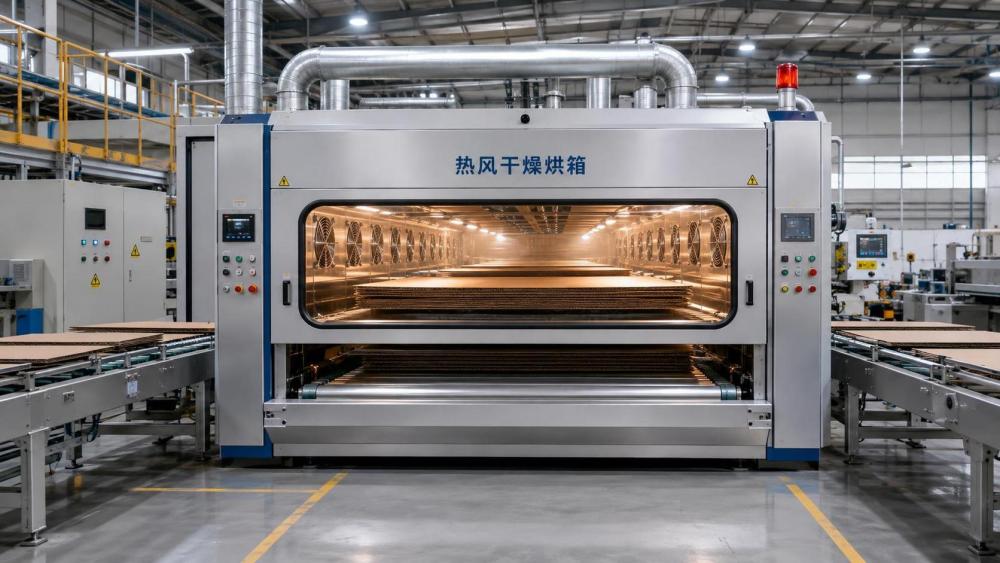
When evaluating a larger chamber or conveyor oven, request temperature-uniformity and airflow information under realistic operating conditions. An empty oven test is useful, but it does not fully represent a loaded production run. Dense stacks, wide board formats, trays with solid bases, and products with variable surface coverage can all change air movement. If possible, run trials using representative substrates, coating weights, and loading density.
Temperature control matters, but overshoot matters too
A wide temperature range is often treated as a sign of versatility. In practice, most packaging and printing applications operate within a narrower, process-specific band. What matters is how steadily the oven holds that setpoint, how quickly it recovers after doors open or fresh product enters, and whether the control system prevents excessive overshoot.
Overshoot can be damaging in paper-based packaging production. Paper and board respond to heat and moisture changes; excessive local heating may contribute to curl, dimensional change, surface cracking, or altered stiffness. Printed sheets may also show gloss variation, ink defects, or changes in color appearance if the drying condition is poorly controlled.
Look for a control arrangement that supports the actual process rather than a basic on-off heating cycle. PID temperature control, independently managed heating zones, calibrated sensors, and a clear controller interface are valuable where product quality depends on narrow operating limits. For continuous systems, zoned control can allow a gentler initial drying stage followed by a higher-energy section, reducing the chance of skinning the surface while moisture remains trapped underneath.
The sensor location also deserves attention. A sensor placed near the heater may report a stable value while the product zone experiences variation. Ask where temperatures are measured, how many sensing points are used, and how the system is verified across the working volume.
Match oven capacity to line behavior, not nominal output
Capacity calculations are frequently oversimplified. A chamber that physically fits the product is not necessarily capable of supporting the required production schedule. Drying capacity depends on moisture load, product surface area, dwell time, airflow volume, exhaust rate, product spacing, and the thermal mass of incoming material.
For conveyor-based production, the central calculation is residence time. If the process requires a certain drying duration at a controlled temperature, oven length and conveyor speed must work together. Raising temperature to compensate for an undersized oven may create new quality risks. In batch production, loading and unloading time, rack arrangement, door-open losses, and operator availability should be included in the cycle-time model.
Technical evaluators should also account for production variability. Corrugated and paperboard plants rarely run one perfectly uniform product all day. Board grades, sheet sizes, print coverage, adhesive application, and order patterns can change. An oven sized only for the easiest job may become a bottleneck when heavier coating weights or moisture-sensitive grades arrive.
Do not ignore the transition between wet and dry processes
The oven should be evaluated as part of a production system. Consider how material enters and exits: manual loading, automatic infeed, belt transfer, accumulation, cooling, inspection, or direct connection to converting equipment. A drying oven that performs well in isolation can still reduce uptime if operators must repeatedly rearrange sheets, wait for discharge, or correct misalignment before the next station.
In automated packaging plants, integration points may include upstream printing presses, coating units, digital production management systems, vision inspection, coding equipment, and end-of-line handling. Signals for line stop, emergency stop, fault status, temperature alarms, and production recipes should be reviewed early. A modest integration requirement can become expensive if it is treated as an afterthought.
Exhaust and humidity control deserve as much attention as heating
Drying is not simply heating. Moisture or vapors must be removed from the oven chamber at a controlled rate. Insufficient exhaust can slow drying, create condensation, and produce unstable conditions as humidity builds. Excessive exhaust wastes energy by pulling too much conditioned air from the chamber and can make temperature stability harder to maintain.
The right exhaust strategy depends on what is being dried. Water-based inks, coatings, and adhesives require moisture removal, while solvent-containing processes may introduce additional ventilation, monitoring, and safety considerations. The process team should identify vapor composition and consult applicable safety and environmental requirements before finalizing a design. A hot air drying oven should never be selected on the assumption that every chemistry can be handled in the same way.
Variable exhaust control can be useful when product conditions change by job. It allows the oven to maintain an appropriate balance between evaporation, air exchange, and energy use. However, adjustability has value only when operators understand the settings and the system provides clear operating guidance. Complex controls without defined recipes often lead to inconsistent manual adjustments between shifts.
Energy use should be evaluated as a production cost, not a nameplate feature
Energy efficiency is increasingly important in packaging operations, where margins can be affected by utility prices and long operating hours. Yet an oven with a lower rated energy figure is not automatically the lower-cost choice. The relevant question is how much energy is consumed per usable output under the intended load profile.
Heat loss through poorly insulated panels, excessive exhaust, long warm-up periods, uncontrolled door opening, and inefficient recirculation can all increase operating cost. Useful features may include effective insulation, well-sealed access doors, recirculated air management, programmable standby modes, and heat recovery where process conditions justify it. For continuous production, stable operation at the required line speed is often more valuable than a unit that saves energy only when running below needed capacity.
Request a transparent discussion of utility requirements, heat source options, warm-up behavior, and expected operating modes. Electric, gas-fired, steam-heated, and thermal-oil-based designs each have different infrastructure needs, control characteristics, maintenance implications, and local compliance considerations. The best option depends on the plant’s existing utilities and production strategy.
Reliability is built into access, maintenance, and operator usability
Drying equipment is often expected to run quietly in the background until a fan fails, a filter blocks, a sensor drifts, or residue accumulates inside the air path. Technical evaluators should look beyond the initial installation and ask how the oven will be inspected, cleaned, serviced, and returned to operation.
Check whether fans, heaters, filters, ducts, sensors, and drive components are accessible without extensive disassembly. Review recommended preventive maintenance intervals and identify consumable parts. If the oven will run near printing or coating processes, consider how dust, paper fibers, ink mist, adhesive residues, or coating particles could affect airflow and cleanliness over time.
Controls should support operators rather than burden them. Clear alarms, recipe storage, trend data, maintenance reminders, and role-based parameter access can reduce reliance on informal shift knowledge. In plants managing frequent order changes, repeatable recipes for substrate and coating combinations help protect quality when experienced operators are not standing beside the machine.
A supplier comparison should include evidence, not only specifications
When several systems appear similar on paper, a structured comparison helps reveal meaningful differences. Technical teams can score each option against process fit, drying uniformity, temperature control, capacity margin, exhaust design, energy performance, safety, maintainability, integration readiness, and supplier support capability.
Ask for drawings that show usable internal dimensions, loading clearances, airflow direction, service access, utility connections, and control architecture. Request clarification on what is included in the quoted scope: conveyors, guards, installation support, commissioning, process trials, spare parts, documentation, and operator training may be treated differently by different suppliers.
It is also sensible to define acceptance criteria before purchase. These might include temperature stability, operating cycle time, product condition after drying, safe alarm behavior, and integration signals. The criteria should reflect production reality, not generic factory test conditions.
The right choice protects downstream consistency
A well-selected hot air drying oven does more than remove moisture. It creates a stable handoff between process stages: from print to coating, from adhesive application to converting, or from treatment to inspection and packing. That stability reduces the hidden cost of rework, production interruptions, extra inspection, and operator intervention.
For commercial printing and corrugated packaging operations, the strongest selection decision is usually the one tied to a complete process view. Evaluate airflow around the real product, verify control behavior at the required throughput, understand exhaust and energy demands, and make sure the oven can be maintained without disrupting the line. When those factors are aligned, drying becomes less of a variable to manage and more of a dependable part of consistent production.
Related News
 What Drives Water Based Flexographic Ink Price in 2026Water based flexographic ink price in 2026 depends on raw materials, color strength, performance, and service. Discover how to compare true print costs and choose smarter.Print Fluidics Scientist
 Water Based Flexographic Ink Selection for Consistent Print QualityWater Based Flexographic Ink selection guide for consistent color, fast drying, strong adhesion, and lower production costs across paper and corrugated board applications.Print Fluidics Scientist
 How to Choose UV Inks for Reliable Color and Fast Production RunsUV Inks for reliable color and fast packaging runs: learn how to match cure systems, substrates, adhesion, finishing, and compliance for consistent results.Print Fluidics Scientist
 How Low Odor Water Based Flexographic Ink Supports Safer PackagingLow odor water based flexographic ink supports safer packaging by reducing residual odor and emissions while delivering reliable color, drying, and rub resistance. Explore practical process control tips.Print Fluidics Scientist
 How a Water Based Ink Metering System Reduces Color VariationWater based ink metering system: discover how stable anilox delivery, circulation, and blade control reduce color variation and improve flexo print consistency.Print Fluidics Scientist
 How Water Based Ink Viscosity Control Systems Stabilize Print QualityWater based ink viscosity control systems stabilize flexographic print quality, reduce waste, and deliver consistent color, sharper graphics, and reliable production.Print Fluidics Scientist