How to Choose UV Inks for Reliable Color and Fast Production Runs
A press can be mechanically ready for a fast packaging run and still lose time at the first quality check: the cyan looks different from the approved proof, a dark solid shows poor cure at the sheet edge, or the ink passes initial adhesion but scuffs after folding. These are not always press-setting problems. They often begin with an ink specification that was selected for color appearance or unit price without confirming how it behaves on the actual substrate, press configuration, curing system, and finishing path.
For reliable color and fast production, choose UV inks as a matched process package rather than a standalone consumable. The strongest purchasing decision starts with the intended substrate and end use, then verifies adhesion, cure response, color-management compatibility, finishing resistance, and regulatory suitability under realistic production conditions. An ink that appears acceptable on a small drawdown may still create waste, slower running, or rework when transferred to a high-speed press line.
Start with the job conditions, not the ink color book
Before comparing suppliers or requesting samples, define the production conditions that the ink must survive. “UV ink for carton printing” is usually too broad a requirement. Folding carton board, coated paper, metallized stock, synthetic paper, laminated sheets, and corrugated pre-print materials can have very different surface energies, absorption behavior, and coating chemistries. A formula that anchors well to one board grade may show marginal adhesion on another, even when both materials look similar.
Purchase specifications should record the production facts that affect ink choice:
- Printing process, such as sheetfed offset, flexographic, screen, digital, or hybrid production.
- Substrate grade, coating type, surface treatment, recycled-content variation, and whether the material is supplied with a varnish, laminate, or primer.
- Expected press speed, ink-film thickness, line screen or anilox volume, and number of printed colors.
- Available curing equipment, including lamp type, lamp condition, reflector condition, cooling arrangement, and curing-unit placement.
- Finishing operations after printing, such as coating, foil stamping, die-cutting, creasing, folding, gluing, window patching, or lamination.
- Functional requirements, including rub resistance, odor limits, low migration requirements where relevant, barcode readability, and brand color tolerances.
This information prevents a frequent purchasing mistake: approving an ink based on a laboratory sample made with curing conditions that are stronger or more stable than those on the production line. A supplier can only recommend a suitable system when the operating envelope is clear. The same applies when a factory changes board supplier, adds an LED curing unit, increases press speed, or introduces a new protective coating. These are process changes, not minor substitutions.
Match the ink chemistry to the curing system
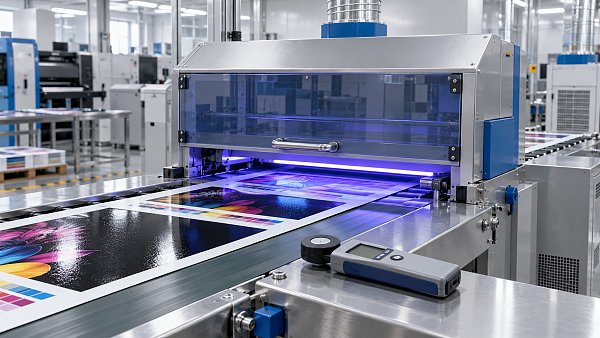
UV curing depends on photoinitiators absorbing energy at wavelengths produced by the curing source. Conventional mercury-vapor systems, LED-UV units, and mixed curing arrangements do not deliver the same spectral output. An ink designed primarily for one system may remain tacky, cure only at the surface, or require a speed reduction when used with another.
Do not assume that “UV curable” automatically means compatible with every UV lamp. Request written confirmation of the intended curing technology and ask whether the formulation has been evaluated at the planned ink-film thickness. Dark shades, opaque white, metallic colors, and heavily pigmented spot colors deserve special attention because pigment can reduce light penetration. A solid white underprint may need more curing energy than a transparent process color, even on the same sheet.
There is also a difference between surface cure and through cure. A sheet may feel dry enough to handle but still have incomplete polymerization below the surface. That condition can later appear as poor scratch resistance, blocking in stacks, odor, weak coating adhesion, or cracking at the crease. Production teams should judge cure by the downstream performance the job requires, not only by whether the sheet exits the delivery dry to the touch.
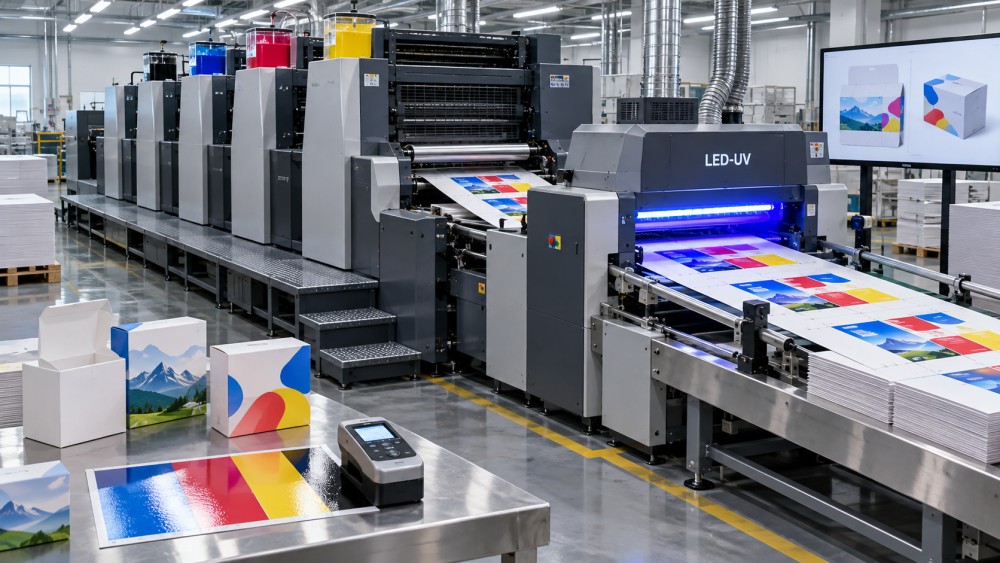
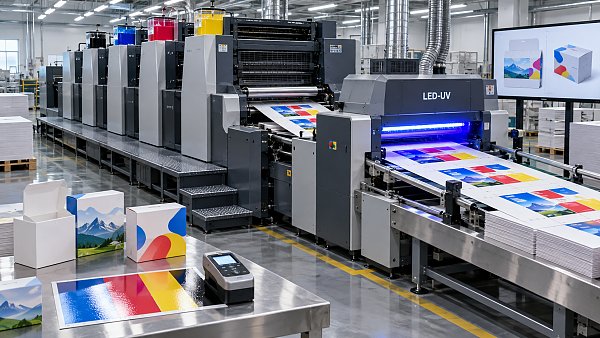
Where energy-efficient LED curing is being considered, confirm that the ink series is formulated specifically for the wavelength range of the installed units. Also establish whether the press can maintain adequate cooling and lamp-to-substrate distance without deforming heat-sensitive stock. Curing performance is a combined result of ink formulation, delivered energy, exposure time, optical density, substrate reflectivity, and press condition.
Adhesion is a substrate-and-finishing question
Adhesion failure is often discovered too late. The printed sheet may look clean at delivery, but ink can lift during die-cutting, flake along a score line, or fail where a carton is handled repeatedly. Low-surface-energy films and some highly coated boards are obvious risk materials, but even paper-based packaging can vary due to coating formulation, storage conditions, dust, moisture, or surface contaminants.
Ask for an adhesion test method appropriate to the material and end use. Tape testing can indicate whether ink is anchored to the surface, but it should not be treated as the only approval criterion. Carton work may also need folding and creasing trials; shipping packaging may need abrasion evaluation; labels and laminated structures may require further checks after coating or adhesive application. The point is to imitate the stress the printed item will actually receive.
Pay close attention to the sequence of operations. A UV ink that adheres well may still interfere with a water-based or UV overprint varnish. A coating may cure correctly but create gluing problems in designated bond areas. In a folder-gluer workflow, ink, varnish, substrate, and adhesive must be reviewed together. It is more efficient to mask glue zones or select a compatible construction during job planning than to diagnose open cartons after conversion.
Questions that reveal hidden adhesion risk
- Will the printed side be creased, folded, embossed, or die-cut after curing?
- Does the job include large solid areas that may crack when the board is folded?
- Will a coating, laminate, hot foil, or adhesive touch the printed surface?
- Could the substrate supplier change within the approved purchasing period?
- Are printed sheets stacked immediately, and could residual heat or pressure contribute to blocking?
These questions help distinguish a basic printability test from a production approval. Procurement teams should avoid approving an ink solely from a flat printed sample when the finished product will be converted into a carton or display structure.
Protect color consistency before the first production run
Reliable color begins with an agreed measurement and control method. A press may reproduce a visually attractive result that still misses a brand standard or shifts from one repeat order to the next. UV inks can show different gloss, density, transparency, and hue depending on ink film, substrate whiteness, curing level, and viewing conditions. The same formulation can look noticeably different on uncoated board and bright white coated stock.
For process-color work, determine whether the ink series is intended to run with the press profile and color targets used by the plant. For spot colors, establish the approved target, the substrate used for approval, and whether color is evaluated before or after any coating or lamination. A wet drawdown is useful for screening, but it is not a final prediction of the cured printed color.
Color variation can also come from the press side rather than the ink. In flexographic printing, anilox condition, doctor blade performance, plate selection, impression settings, and drying or curing response all influence density and dot gain. In offset printing, fountain solution balance, blanket condition, ink-water interaction, and blanket pressure affect the result. An ink supplier should provide operating guidance, but a purchasing specification should not imply that color consistency can be guaranteed without process control.
Evaluate speed through stability, not a single maximum rate
A supplier may state that an ink supports high-speed production, but purchasing teams should translate that claim into conditions that matter on the press. Can the ink maintain stable transfer over the planned run length? Does it require frequent viscosity adjustment? Does a dense black or opaque white force a lower speed to achieve cure? Is the press crew likely to increase ink film to reach density, creating a curing bottleneck?
Fast output is only valuable when registration, color, cure, and finishing quality stay within the job standard. The appropriate trial is therefore a controlled production-representative run, including typical coverage areas, expected speed, and normal curing settings. Review the printed sheets at start-up, after the press has stabilized, and after enough time has passed to reveal stacking or finishing issues. A short sample pulled at low speed cannot reliably answer a high-volume production question.
Cleaning and changeover should be considered in the same evaluation. Ink systems that need special wash procedures, have limited compatibility with existing cleaning agents, or leave persistent residues in chambers and rollers may add downtime between jobs. Conversely, a lower-priced ink that causes more cleaning, more make-ready, or more rejected sheets can cost more over a production month than an ink with a higher purchase price.
Build compliance and end-use requirements into the request
Packaging applications can involve requirements beyond print appearance. Food, pharmaceutical, personal-care, toy, and household product packaging may have defined restrictions related to inks, odor, migration, or the printed pack construction. The correct requirement depends on where the ink is used, whether there is direct or indirect contact, the barrier properties of the structure, and the destination market.
Do not use broad phrases such as “food-safe UV ink” as a purchase specification. Instead, describe the intended pack structure and ask the supplier for the relevant technical and regulatory documentation for that application. The converter remains responsible for validating the complete finished article because migration and odor behavior depend on the full construction, cure level, substrate, coating, adhesive, storage conditions, and contact scenario.
For sensitive packaging, identify low-odor or low-migration needs at the earliest stage. Changing to a different ink after color approval may require renewed work on curing, color matching, and finishing compatibility. Procurement should also confirm batch traceability, shelf life, storage temperature, and procedures for handling expired or partially used materials. These details matter when repeat orders need consistent documentation.
Use a staged approval instead of a single sample sign-off
The most practical selection process separates technical screening from production approval. First, collect technical data sheets, safety information, curing compatibility details, substrate recommendations, and end-use statements. Remove products that do not fit the press technology, material family, or required application conditions.
Next, run comparative samples on the actual substrate. Include the most demanding artwork features: large dark solids, fine type, highlights, reverse text, high-coverage spot colors, and any opaque underprint. Check color after cure, not only immediately after printing. Then move the most suitable candidate into a trial that includes planned finishing steps.
- Define measurable acceptance points for color, cure, adhesion, rub resistance, and conversion performance.
- Test the candidate ink under normal production settings rather than idealized low-speed conditions.
- Record lamp power, speed, ink film control settings, substrate batch, and any adjustment needed to maintain quality.
- Evaluate finished samples after die-cutting, creasing, folding, gluing, coating, or lamination where applicable.
- Approve a controlled combination of ink series, substrate type, curing configuration, and finishing route rather than approving the ink in isolation.
This approach also makes future troubleshooting faster. When a repeat job changes appearance or performance, the team can compare current conditions against the approved combination instead of debating whether the ink, board, lamp, press, or finishing operation changed.
Compare total operating exposure, not only price per kilogram
Unit cost is visible on a quotation; waste and lost press time are often distributed across production, quality, and converting departments. A useful comparison should include expected coverage, usable shelf life, minimum order quantity, cleaning consumption, trial requirements, rejection risk, and the likelihood of special handling. Higher pigment strength may reduce the amount needed to reach target density, but only if it can be controlled without causing dot gain, trapping issues, or curing limitations.
Supply reliability belongs in the same review. Confirm standard lead times, availability of process colors and spot-color matching support, batch consistency controls, packaging sizes, and procedures for handling quality deviations. For recurring packaging programs, changing ink batches without a documented color-control routine can create avoidable variation. Purchasing teams benefit from agreeing in advance on retain samples, batch identification, and communication steps when a material or formulation change is proposed.
The right choice is usually not the ink with the strongest headline claim. It is the one that reaches approved color at the required press speed, cures consistently with installed equipment, remains attached through finishing, fits the end-use requirement, and can be supplied with controlled documentation. That combination reduces the costly gap between a successful press sample and a dependable production run.
Related News
 Why UV Inks Stay Tacky After Curing and How to Fix the ProblemUV Inks still tacky after curing? Discover common causes, from low UV energy to oxygen inhibition, and practical fixes to prevent blocking, reduce waste, and restore print quality.Print Fluidics Scientist
 What Drives Water Based Flexographic Ink Price in 2026Water based flexographic ink price in 2026 depends on raw materials, color strength, performance, and service. Discover how to compare true print costs and choose smarter.Print Fluidics Scientist
 Water Based Flexographic Ink Selection for Consistent Print QualityWater Based Flexographic Ink selection guide for consistent color, fast drying, strong adhesion, and lower production costs across paper and corrugated board applications.Print Fluidics Scientist
 How to Choose UV Inks for Reliable Color and Fast Production RunsUV Inks for reliable color and fast packaging runs: learn how to match cure systems, substrates, adhesion, finishing, and compliance for consistent results.Print Fluidics Scientist
 How Low Odor Water Based Flexographic Ink Supports Safer PackagingLow odor water based flexographic ink supports safer packaging by reducing residual odor and emissions while delivering reliable color, drying, and rub resistance. Explore practical process control tips.Print Fluidics Scientist
 How a Water Based Ink Metering System Reduces Color VariationWater based ink metering system: discover how stable anilox delivery, circulation, and blade control reduce color variation and improve flexo print consistency.Print Fluidics Scientist