Introduction. For technical evaluators seeking lower-impact packaging production, the water based inkjet printhead is becoming a critical component in digital print systems.
It can support high-quality graphics, variable data, rapid job changes, and lower dependence on solvent-based chemistries across corrugated and paper-based packaging workflows.
The strongest sustainability case is not ink composition alone. It depends on printhead reliability, substrate compatibility, curing energy, waste control, maintenance discipline, and production utilization.
What Technical Evaluators Are Really Trying to Determine
When evaluating a water based inkjet printhead, most packaging teams are not simply asking whether water-based ink is environmentally preferable to solvent ink.
They need to determine whether the complete print system can meet production quality targets while reducing waste, energy consumption, hazardous emissions, and operational complexity.
The key search intent behind this topic is practical technology assessment. Readers want to understand where water-based inkjet genuinely improves sustainability and where limitations remain.
For corrugated converters, the decision usually involves balancing board quality, print coverage, drying capacity, uptime, color consistency, and variable-order production requirements.
For commercial printers and folding-carton producers, the focus may shift toward image quality, food-contact considerations, substrate range, short-run economics, and finishing compatibility.
A water based inkjet printhead should therefore be assessed as part of an integrated production platform rather than as an isolated consumable component.
Printhead architecture affects droplet size, firing frequency, nozzle density, recirculation capability, waveform control, and the system's ability to maintain stable output during long runs.
Those characteristics influence print quality directly, but they also determine cleaning frequency, ink waste, rejected sheets, preventive-maintenance needs, and total environmental performance.
How Water-Based Inkjet Reduces the Environmental Burden
Water-based ink formulations use water as their primary carrier, reducing the role of volatile organic compounds commonly associated with many solvent-based printing processes.
Lower VOC emissions can improve the working environment and may reduce the need for extensive solvent handling, abatement equipment, specialized storage, or emissions-management procedures.
That benefit is particularly relevant for packaging plants operating near urban areas, producing brand-sensitive packaging, or working under increasingly strict environmental compliance requirements.
Digital inkjet printing can also reduce material waste by eliminating printing plates, limiting setup sheets, and enabling production volumes closer to actual order demand.
Conventional flexographic workflows remain highly efficient for long repeat runs, but plate preparation and press setup can create avoidable waste for short, changing jobs.
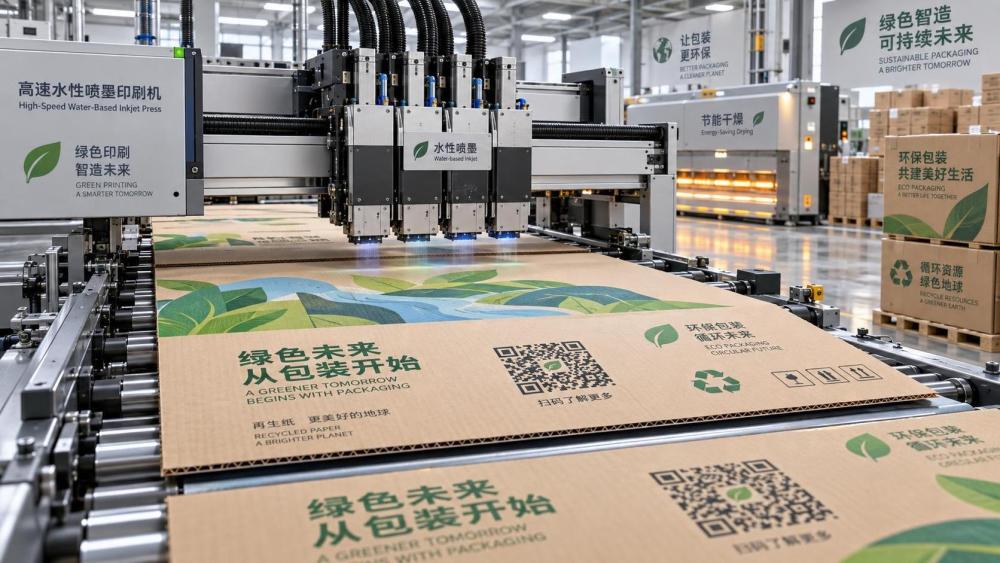
A water based inkjet printhead allows digital systems to place images directly onto approved substrates, making versioning, localized graphics, and serialized information more practical.
This capability supports lower inventory risk because brands can avoid ordering excessive quantities merely to justify conventional setup costs and minimum production volumes.
However, sustainability claims should include drying energy, ink usage, cleaning cycles, substrate pre-treatment, and end-of-life recyclability instead of focusing only on VOC reduction.
Why Printhead Design Has a Direct Effect on Waste and Uptime
Printhead performance determines whether a digital press consistently delivers saleable packaging or creates hidden losses through banding, missing nozzles, color variation, and rework.
A stable water based inkjet printhead maintains controlled drop placement across changing production conditions, including different board grades, ambient humidity levels, and print coverage patterns.
Nozzle reliability matters because a single defective nozzle can create visible streaks, weak barcode contrast, or unacceptable graphics on high-value retail packaging.
Systems with ink recirculation near the nozzle plate can help reduce pigment settling, temperature variation, air entrapment, and nozzle blockage during extended operating periods.
Recirculation is especially important where pigmented water-based inks are used, since pigment stability strongly affects color consistency and the risk of non-firing nozzles.
Evaluate the manufacturer’s approach to automatic nozzle compensation, printhead monitoring, purge cycles, and cleaning routines rather than relying only on stated native resolution.
High nominal resolution does not guarantee efficient packaging output if the machine requires frequent manual intervention, lengthy recovery procedures, or excessive maintenance-fluid consumption.
For a credible comparison, measure rejected material, cleaning waste, labor hours, average availability, and recovery time after stoppages over representative production conditions.
Substrate Behavior Is Often the Main Technical Constraint
Paper and corrugated substrates are variable, absorbent, and structurally complex. Their surface properties can influence dot gain, edge sharpness, color density, drying speed, and ink penetration.
Uncoated linerboard may absorb water-based ink rapidly, reducing surface color strength and potentially causing feathering unless ink chemistry and drop volume are properly matched.
Coated papers can deliver stronger graphics, but they may require controlled drying or surface treatment to prevent slow setting, rub resistance issues, or insufficient adhesion.
Corrugated board creates further challenges because flute profiles, board warp, surface roughness, and inconsistent moisture can affect print uniformity and media transport stability.
Technical evaluators should test the actual paper grades used in production, including recycled-content liners, lightweight materials, high-performance virgin papers, and moisture-variable board.
Laboratory samples are useful, but they cannot fully predict behavior under real press speeds, full-width coverage, production dust, seasonal humidity changes, and frequent order transitions.
Assess whether the water based inkjet printhead system requires primer, coating, preheating, or specialized ink-receptive substrates for each target application.
These process additions may be justified by improved quality, yet they affect cost, energy use, recyclability discussions, maintenance requirements, and the overall sustainability calculation.
Drying Energy Must Be Evaluated Alongside Ink Chemistry
Water evaporation requires energy, making drying design one of the most important factors in determining whether a water-based digital printing platform delivers a net environmental advantage.
Insufficient drying can produce offsetting, poor rub resistance, blocking during stacking, weak adhesion, or downstream converting defects that consume additional material and labor.
Excessive drying capacity can increase electricity or gas consumption, potentially weakening the environmental benefit gained from lower-VOC ink chemistry and reduced setup waste.
The best systems coordinate print coverage, line speed, substrate weight, ambient conditions, and dryer output rather than operating heating equipment at a fixed maximum setting.
Evaluate the drying method carefully, including hot air, infrared, conduction, impingement, heat recovery, and airflow management around the printed web or board.
For corrugated applications, excessive heat can alter board moisture balance, contribute to warp, and affect downstream die-cutting, folding, glue application, or stacking performance.
Energy monitoring should record consumption per square meter and per saleable package, not only total machine energy, because productivity variation can distort simple comparisons.
A trial should include low-coverage and high-coverage jobs, since drying performance and energy demand often change materially when graphics contain large solid color areas.
Print Quality Requirements Extend Beyond Visual Appearance
Sustainable packaging cannot be considered successful when it fails functional requirements. Print quality affects barcode scanning, traceability, brand recognition, regulatory information, and customer acceptance.
Variable-data printing is one of the major advantages of a water based inkjet printhead, enabling batch codes, QR codes, regional text, and serialized identifiers without plates.
For technical evaluation, barcode readability should be verified after printing, drying, converting, abrasion exposure, and distribution-related handling rather than immediately at the press exit.
Color management must account for substrate variation. The same ink set can produce different color values on kraft liners, white-top board, coated papers, and recycled sheets.
Evaluate color stability using defined measurement conditions, target tolerances, calibration intervals, and repeatability data across multiple shifts, operators, and substrate batches.
Image quality testing should include fine text, reversed text, solid areas, gradients, line work, small symbols, photographic graphics, and the brand’s most demanding artwork.
Also inspect print performance after die-cutting and folding. Cracking, scuffing, low rub resistance, or poor glue-area behavior can eliminate savings achieved during printing.
Where food, pharmaceutical, or personal-care packaging is involved, confirm applicable ink compliance documentation and migration-risk controls with qualified regulatory and material specialists.
Maintenance and Ink Management Determine Long-Term Value
Water-based digital printing systems require disciplined maintenance. The practical question is whether cleaning, monitoring, and replacement procedures fit the plant’s staffing and uptime expectations.
Water-based inks can dry at the nozzle face if idle periods, environmental control, capping performance, or startup procedures are not properly managed.
A robust water based inkjet printhead platform uses controlled capping, automated purging, temperature management, filtering, degassing, and software diagnostics to protect nozzle condition.
Ask suppliers for data on printhead life, consumable usage, planned maintenance intervals, service response, recovery processes, and costs associated with nozzle failures or head replacement.
Do not compare only ink price per liter. Measure total ink consumption, including purge losses, cleaning fluid, recirculation losses, unusable residual ink, and rejected production.
Ink supply design also matters. Closed delivery systems can reduce contamination and improve operator safety, while accurate inventory monitoring helps prevent expired or improperly stored materials.
Maintenance routines should be compatible with shift patterns. A process requiring specialist intervention after every interruption may be unsuitable for high-mix packaging operations.
During site trials, involve operators and maintenance personnel early. Their ability to sustain daily printhead performance often determines realized value more than demonstration quality.
How to Build a Defensible Evaluation and Investment Case
Technical evaluators should establish a structured scorecard before comparing suppliers. This prevents an attractive print sample from outweighing hidden limitations in production capacity or operating cost.
Start with the application profile: substrate types, annual volume, average run length, artwork complexity, color coverage, variable-data requirements, finishing process, and delivery expectations.
Then define measurable acceptance criteria for image quality, barcode grades, drying performance, throughput, printhead availability, waste percentage, energy consumption, and operator intervention.
Compare the digital alternative with the current production method at the job level. Short runs, frequent revisions, and personalized packaging usually reveal the clearest benefits.
For longer standardized runs, flexographic or offset production may remain more economical, especially when existing assets are fully utilized and setup frequency is low.
The investment case should include avoided plates, reduced setup material, lower obsolete inventory, fewer logistics movements, faster launches, and potential revenue from versioned packaging.
It should also include realistic expenses for ink, drying energy, maintenance contracts, replacement heads, software integration, pre-treatment, training, and quality assurance equipment.
A phased implementation can reduce risk. Begin with applications where digital flexibility is valuable, then expand once data confirms stable performance and a sustainable operating model.
Conclusion: Sustainable Performance Requires a System View
A water based inkjet printhead can improve sustainable packaging prints by supporting lower-VOC production, reduced setup waste, responsive short runs, and highly targeted variable-data output.
Its real value depends on the total system: ink formulation, printhead reliability, paper behavior, drying efficiency, color control, maintenance design, and downstream converting compatibility.
For technical evaluators, the correct decision is not whether water-based inkjet is universally sustainable, but whether it performs better for the specific packaging mix under review.
Prioritize evidence from representative materials, production-speed trials, measured waste, energy-per-saleable-unit data, barcode testing, and documented maintenance performance across realistic operating conditions.
When those factors are evaluated together, digital water-based inkjet can become more than a graphics technology. It can support a lower-waste, more flexible packaging production strategy.