How Does LED UV Curing Affect Print Quality on Web Offset Presses?
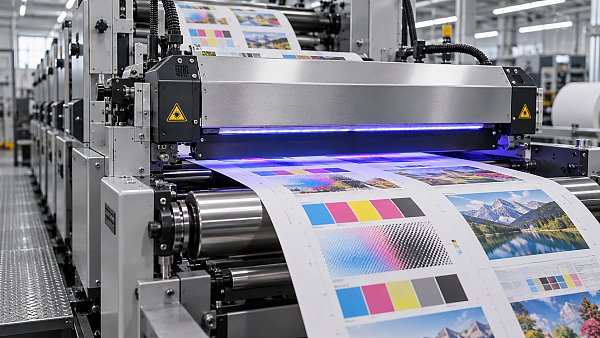
LED UV curing can improve print quality on web offset presses by rapidly immobilizing compatible inks before they reach downstream rollers, folders, or rewind stations. The clearest benefits are reduced ink transfer, better resistance to handling damage, and less dependence on evaporative drying. Sharper dots and more consistent color are achievable, but they are not automatic consequences of installing LED lamps.
The decisive issue is whether the complete ink–substrate–curing system produces stable color, adequate adhesion, and sufficient cure throughout the intended operating range. A print can look clean and feel dry while retaining an inadequately cured ink layer. Conversely, a fully cured image can still have poor tone reproduction, weak trapping, or unacceptable gloss.
What changes when ink is cured rather than dried?
In heatset web offset printing, the dryer removes volatile components from the ink, and chill rolls help establish the film for subsequent handling. Coldset printing relies substantially on ink vehicle absorption into the paper. LED UV printing instead uses radiation to activate photoinitiators in a formulated ink, initiating polymerization and forming a crosslinked film.
This changes the relationship between ink setting and paper absorption. On suitable coated or low-absorbency stocks, rapid curing can retain more of the ink film near the surface instead of relying on penetration to make the print handleable. That can support color strength and reduce marking. It does not remove the effects of coating porosity, paper roughness, or ink penetration before the web reaches the lamp.
LED UV sources emit within a relatively narrow spectral band. Ink designed for a broad-spectrum mercury lamp is not necessarily suitable for an LED source, even when both systems are described as UV curing. The photoinitiator package must respond to the installed wavelength, and the formulation must cure through the relevant pigment and ink-film thickness.
A conversion therefore requires more than replacing the dryer. Ink compatibility, rollers and blankets, cleaning chemistry, fountain solution, lamp position, web transport, and downstream contact points all affect the resulting quality.
Where image quality improves—and where it does not
Dot integrity and fine detail
Once exposed to sufficient radiation, compatible ink rapidly loses mobility. This reduces the opportunity for subsequent smearing or transfer and helps preserve fine text, reverse type, and halftone detail through finishing.
However, curing cannot repair a dot that was already distorted in the printing nip. Plate condition, blanket packing, impression pressure, slur, doubling, and ink–water balance still determine the image delivered to the curing station. Optical dot gain also remains influenced by light scattering within the paper.
Claims of “lower dot gain” therefore need a controlled comparison. A change in ink formulation, stock, solid ink density, or plate curve can alter measured tone value increase independently of the lamp. LED UV production may require revised characterization and compensation curves rather than continued use of an existing heatset or coldset profile.
Color strength, trapping, and repeatability
Rapid curing can reduce some time-dependent color changes associated with absorption and drying. This can make the relationship between an approved press sample and later production more predictable. Nevertheless, gloss development, substrate absorption, and ink chemistry can still affect measured appearance after printing.
Lamp placement is especially important on multicolor presses. If curing occurs only after the final printing unit, the earlier colors still print wet-on-wet. Their trapping behavior depends on ink tack, sequence, film weight, and press conditions. A final LED station does not eliminate these variables.
Interdeck curing changes that relationship by immobilizing an earlier layer before the next color is applied. It can reduce back-trapping or unwanted mixing, but it also changes the surface receiving the next ink. Intercoat adhesion, overprint color, and gloss must be validated with the actual curing sequence. More curing between units is not automatically better.
Gloss and surface appearance
A surface-retained UV ink film can produce strong gloss on an appropriate coated stock. On rough or absorbent paper, the coating structure and pre-cure penetration can limit that effect. Differences in ink leveling time before exposure can also change gloss, even when cure is adequate.
Mottle, pinholes, poor wetting, and coating irregularities remain possible. Rapid immobilization may preserve an uneven film rather than allow it to level. Gloss comparisons should therefore use matched substrates, comparable color targets, and a defined measurement geometry—not visual impressions from unrelated samples.
The curing window determines usable press speed
The relevant specification is not simply lamp power. Print quality depends on the radiation that actually reaches the ink across the web, at the installed working distance and production speed.
Irradiance describes radiant power per unit area at the surface, commonly expressed in W/cm². Radiant exposure, often called dose, describes energy received per unit area, commonly expressed in J/cm². These quantities are related but not interchangeable: exposure integrates irradiance over time, while peak irradiance can influence how effectively a formulation overcomes surface inhibition and initiates curing.
For a fixed lamp configuration and unchanged output, increasing web speed reduces exposure time and therefore radiant exposure. Doubling speed approximately halves exposure under those assumptions. Raising output may compensate only within the lamp’s operating limits and the ink system’s validated curing window.
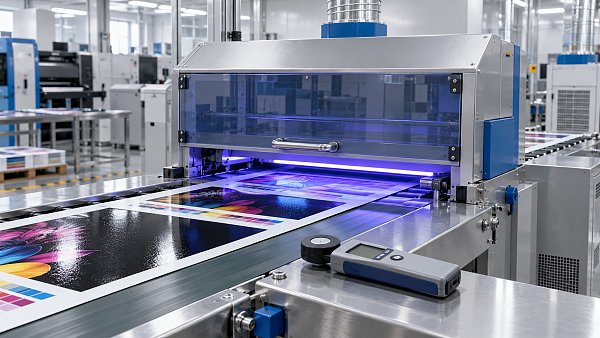
Measurements must use an instrument with an appropriate spectral response for the LED source. Readings from instruments designed for different wavelength bands cannot be assumed equivalent. Lamp electrical ratings also do not establish the UV energy delivered at the web.
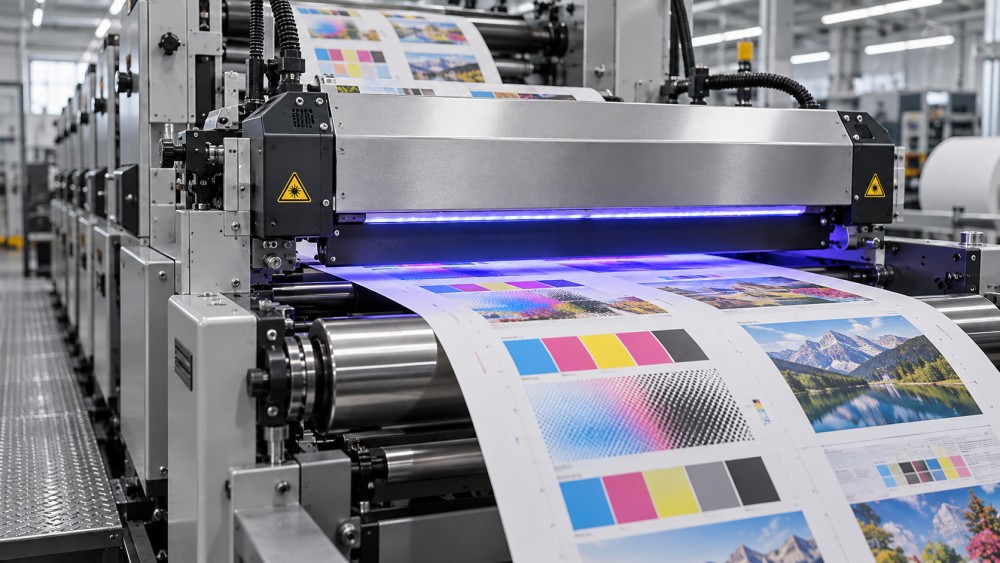
Cross-web uniformity matters as much as a central reading. Contaminated optical windows, failed emitter sections, incorrect cooling, mounting errors, or changes in web-to-lamp distance can create weakly cured bands. A full-width solid or heavy overprint can expose these problems more effectively than a lightly covered demonstration image.
At reduced speed, the opposite problem can arise: unnecessary exposure and heating. LED systems impose less direct infrared loading than many conventional lamp arrangements, but they are not heat-free. The web absorbs radiation, and polymerization releases heat. Speed-linked output control and stop protection are important for both cure consistency and substrate protection.
A dry surface does not prove complete cure
Surface tack is only one indicator. Oxygen can inhibit free-radical polymerization at the exposed surface, while pigments and other ink components can limit radiation penetration deeper in the film. Surface cure and through-cure must therefore be considered separately.
Heavy solids and multilayer overprints can be more demanding than screened areas. The most difficult color is formulation-dependent: dark, strongly absorbing, or opaque inks may require different curing conditions. A satisfactory result on a single black text job does not qualify the system for every ink set and coverage pattern.
Undercure can appear as rubbing, blocking in a wound reel, ink transfer during folding, poor chemical resistance, or adhesion failure. Some deficiencies emerge only after pressure, storage, or subsequent converting. An immediate thumb-rub check cannot establish that the production is fully acceptable.
Adhesion must also be distinguished from cure. A polymerized film may bond poorly to an unsuitable coating or contaminated surface. Increasing lamp output will not necessarily correct inadequate wetting or an incompatible substrate. On flexible webs, the cured film must also tolerate folding without cracking or flaking.
Reduced thermal loading can help registration, but transport still matters
Replacing a heatset drying route with a suitable LED UV configuration can reduce the paper’s exposure to high-temperature drying. This can help limit moisture-related dimensional changes and the associated difficulty of maintaining register or flatness. The benefit depends on the original dryer conditions, paper grade, web tension, and complete press layout.
LED curing does not correct register errors originating from tension instability, cylinder geometry, blanket behavior, or moisture changes caused by fountain solution. Lower dryer heat also does not guarantee that an existing chill-roll or web-conditioning arrangement can simply be removed.
The practical quality question is whether the web remains dimensionally and mechanically stable from the last printing nip through finishing. An image that holds register at the inspection camera but marks on a turning bar or cracks in the folder has not achieved an acceptable finished result.
How to demonstrate a genuine quality improvement
A meaningful press trial should compare equivalent output conditions rather than merely run the LED system at a convenient speed. Paper grade, ink set, color sequence, target color values, fountain solution conditions, and lamp arrangement should be documented. Where the ink technology changes, the comparison should target the same required print appearance rather than identical ink-key settings.
The test form needs demanding image elements: fine positive and reverse text, halftone scales, neutral balances, solids, and heavy overprints distributed across the web. Testing should cover the highest intended production speed, relevant lower-speed operation, and representative start, stop, and acceleration conditions.
Test methods need agreed conditions: conditioning time, applied load, number of rub cycles, contact material, storage temperature, and pass/fail criteria. Solvent-rub testing can be useful when prescribed for the ink system, but results depend on the solvent and procedure. It should not be treated as a universal measure of conversion or migration safety.
For color control, ISO 12647-2 provides a relevant process-control framework for offset lithographic production where its scope and printing conditions apply. LED UV hardware does not itself establish compliance. The selected substrate, characterization data, measurement conditions, and agreed tolerances must support the claimed printing condition.
If food-contact packaging is involved, visual quality and rub resistance are insufficient evidence of suitability. Ink composition, intended packaging construction, set-off transfer, and migration require a separate compliance assessment appropriate to the application and destination market. A tack-free surface is not proof of low migration.
The acceptance criterion is a stable production window
A successful LED UV configuration should deliver acceptable color, detail, adhesion, and durability across the required web width and speed range—not merely produce one attractive sample. Acceptance should include repeat measurements after thermal stabilization and checks following representative handling or storage.
The strongest evidence of improved quality is a documented operating window linking ink and paper specifications to lamp settings, speed, color targets, and finished-print performance. When that window is narrow, small changes in stock, coverage, or lamp condition can turn an apparently successful installation into an unstable process. When it is adequately validated, LED UV curing can preserve image quality through finishing while reducing the marking and drying-related limitations of the previous production route.
Related News
 How to Choose a Print Dryers Supplier for Your Production LineChoose the right print dryers supplier with practical tips on drying performance, integration, safety, and lifetime costs. Compare with confidence.Print Fluidics Scientist
 How to Choose Low Odor Water Based Flexographic Ink for PackagingChoose low odor water based flexographic ink with confidence. Explore substrate compatibility, drying, safety documentation, and practical packaging trials.Print Fluidics Scientist
 How to Set Hot Air Drying Oven Temperatures for Water-Based InksOptimize your hot air drying oven for water-based inks. Learn how to balance temperature, airflow, exhaust, and speed for reliable print quality.Print Fluidics Scientist
 How to Evaluate a Print Dryers Factory Before Placing an OrderEvaluate a print dryers factory with confidence. Compare production tests, safety, total costs and after-sales support before placing your order.Print Fluidics Scientist
 How Does LED UV Curing Affect Print Quality on Web Offset Presses?Web Offset Presses can benefit from LED UV curing with less ink transfer and better handling durability. Discover what drives sharper detail, stable color, and reliable cure at production speeds.Print Fluidics Scientist
 Why UV Inks Stay Tacky After Curing and How to Fix the ProblemUV Inks still tacky after curing? Discover common causes, from low UV energy to oxygen inhibition, and practical fixes to prevent blocking, reduce waste, and restore print quality.Print Fluidics Scientist