What Affects Impression Roller Price When Replacing a Worn Roller?
Replacing a worn impression roller can involve more than comparing supplier quotes. For procurement teams, impression roller price depends on press compatibility, roller dimensions, core condition, surface material, machining tolerances, and balancing requirements. Whether the existing roller can be refurbished or needs complete replacement also changes the cost equation.
The difficult part is that two quotations may describe different scopes. One may cover only stripping and recovering an existing roller; another may include a new core, journal repairs, bearings, inspection records, and delivery. Before deciding which offer represents better value, buyers need to establish exactly what the press requires—and what each supplier will deliver.
Start with the roller’s function, not its name
“Impression roller” is not a sufficiently detailed purchasing specification. Printing equipment uses different arrangements to support the substrate and establish printing pressure. Depending on the machine, the relevant component may be a covered roller, a precision metal cylinder, or part of a larger impression assembly.
A flexographic press printing flexible substrates has different requirements from a corrugated post-printing machine or an offset press. Surface construction, cylinder geometry, drive connections, and operating loads are not interchangeable. An anilox roller or blanket cylinder should not be treated as an equivalent component simply because its dimensions appear similar.
For an initial inquiry, identify the press manufacturer, model, serial number, printing station, and original part number where available. Include a drawing or verified measurements. Photographs help clarify the assembly, but they cannot establish tolerances or material specifications.
This identification step prevents a common purchasing problem: receiving an attractive quotation for a roller that is approximately the right size but unsuitable for the actual application.
What drives impression roller price?
Dimensions, construction, and handling
Face length, outside diameter, shaft geometry, and overall weight influence material consumption and manufacturing time. Longer rollers may also require closer attention to stiffness and deflection under load. Larger assemblies need suitable machining, grinding, balancing, and lifting equipment, narrowing the pool of capable suppliers.
Construction matters as much as size. A hollow body, integral shaft, separate journals, internal passages, or special mounting interfaces can introduce additional fabrication and inspection work. A quotation based only on diameter and face length may therefore be provisional rather than a firm replacement price.
Surface material and operating environment
For covered rollers, the compound must suit the actual contact conditions. Relevant factors include ink chemistry, cleaning agents, temperature, operating speed, substrate characteristics, and required hardness. Rubber compounds and polyurethane formulations vary in resistance to swelling, abrasion, heat, and compression set.
A lower-cost covering is not necessarily economical if routine wash chemicals cause it to soften or change dimensions. Conversely, specifying a specialized compound without an application need can add expense without improving performance.
For metal-surfaced impression components, surface treatment, coating, corrosion protection, and finishing requirements may be more important than elastomer selection. Ask suppliers to explain material recommendations against the operating conditions, rather than relying on labels such as “premium grade.”
Geometry, finish, and balancing
Roller performance depends on more than reaching a nominal diameter. Runout, cylindricity, surface finish, and the relationship between the working surface and bearing journals affect how consistently the roller runs in the press.
Tighter tolerances generally require more controlled processing and inspection. Where applicable, a specified crown or profile adds grinding complexity. These features should follow the machine design, not an assumption that a perfectly straight profile is always correct.
Balancing requirements also affect cost, particularly for high-speed operation. The quotation should identify whether balancing is included and the agreed acceptance criterion. “Balanced” without a defined scope gives procurement little basis for comparing offers.
The core condition can change the entire quotation
A worn surface does not automatically mean the complete roller has reached the end of its useful life. If the core and journals remain serviceable, refurbishment may preserve expensive structural components while restoring the working surface.
However, visible cover wear can conceal corrosion, bonding failure, cracks, damaged bearing seats, or distortion. A supplier may be unable to confirm the full repair scope until the old covering has been removed and the core inspected.
Request an inspection process covering the working body, journals, bearing seats, and mounting features. Where the design and suspected damage justify it, agree on appropriate nondestructive testing. Distinguish between measurements taken before refurbishment and final acceptance measurements.
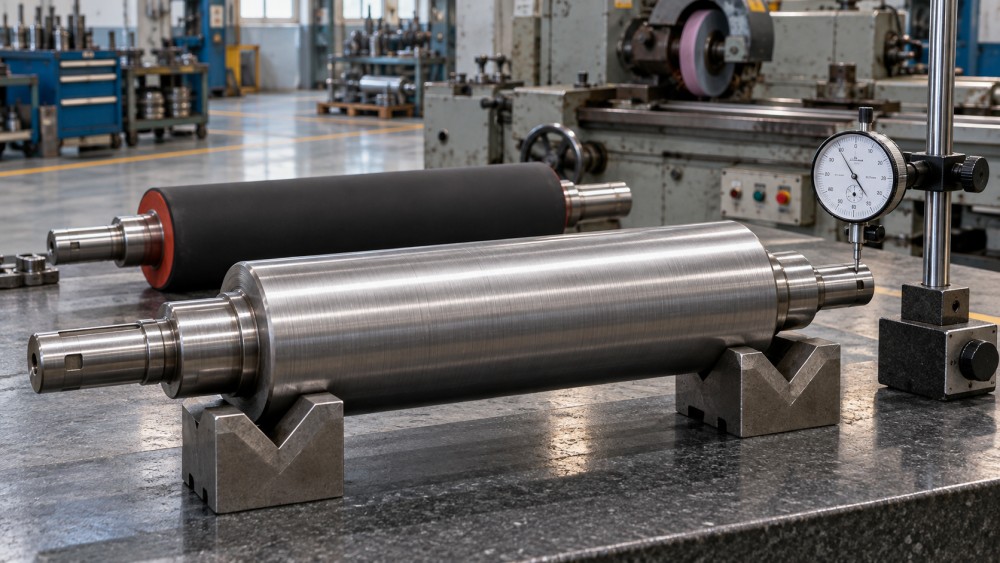
For refurbishment orders, use a clear commercial boundary: an initial inspection charge, a base repair scope, and a requirement for written approval before additional work. If the core proves unsuitable, agree in advance how inspection costs, return freight, or disposal will be handled.
Recover, repair, or replace: choose the right scope
Refurbishment is often worth evaluating, but it is not automatically the lowest-risk choice. Repeated repairs, uncertain material history, or unavailable drawings may make a new assembly more predictable. A spare roller can also allow planned exchanges instead of leaving the press idle throughout an off-site repair.
The decision should account for operating duty. A roller serving a heavily loaded production line deserves a different risk assessment from one used occasionally on a backup press.
Compare quotations on the same technical and commercial basis
When purchasing teams ask why impression roller price varies between suppliers, the answer is often hidden in exclusions. Normalize the quotations before negotiating the headline figure.
- Supply scope: Is the offer for a bare roller, recovered body, or complete assembly? Are bearings, seals, gears, and couplings included?
- Technical specification: Are material, hardness where relevant, finished dimensions, surface profile, and tolerances explicitly stated?
- Inspection: Which measurements are recorded, and are balancing or material records included where required?
- Repair allowances: Are journal restoration, core correction, and additional machining included or charged after inspection?
- Logistics: Does the price include protective crating, collection, return freight, insurance, and applicable import costs?
- Installation support: Who handles removal, refitting, alignment checks, and production trials?
- Warranty: What defects are covered, what operating conditions apply, and who pays removal and transport costs for an accepted claim?
OEM and independent suppliers may also offer different forms of value. An OEM may have access to original drawings and revision history; an independent specialist may offer recovery expertise or alternative repair routes. Neither label replaces verification of technical capability and scope.
There is no reliable universal price range for all impression rollers. Without dimensions, construction details, material requirements, and repair scope, a published figure can mislead more than it helps.
Calculate the cost of getting the press running again
The purchase order amount is only one part of the replacement decision. A practical comparison is:
Total installed cost = roller supply or refurbishment + inspection and approved repairs + transport and import costs + removal and installation + commissioning + attributable downtime and start-up waste.
Keep downtime assumptions realistic. Use the plant’s own production economics and account for whether work can move to another press. Lost sales value is not automatically the same as lost contribution, and not every maintenance hour creates a production loss.
Lead time needs similar scrutiny. A refurbishment schedule may begin only after receipt and inspection of the roller, not when the order is placed. Ask whether the quoted duration includes stripping, repair approval, compound availability, curing, grinding, balancing, and dispatch.
For a critical press, compare standard delivery with expedited service and a spare-roller strategy. The cheapest repair may become expensive if the plant has no workable production alternative while the roller is away.
Confirm that replacement will solve the wear problem
Uneven wear is not always caused by the roller itself. Misalignment, bearing deterioration, incorrect nip settings, contamination, unsuitable cleaning chemicals, or operating conditions outside the intended range can damage a replacement as well.
Ask maintenance and production teams to document the wear pattern before removal. Record which side is affected, whether defects repeat around the circumference, and whether the problem changes with speed, substrate, or job setup. These observations help the supplier assess whether the specified replacement is appropriate.
In corrugated printing, pressure settings must also respect board structure. Replacing a worn component without correcting excessive impression pressure can leave the plant facing board crush, print variation, and premature wear again. Procurement does not need to diagnose the press, but it should ensure that engineering has reviewed the underlying cause.
Build acceptance into the order, not the dispute
A useful purchase order defines how conformity will be demonstrated. Depending on the assembly, this may include finished dimensions, journal measurements, runout referenced to agreed datums, cover hardness and its measurement method, surface finish, and balancing results.
Separate factory acceptance from installation acceptance. The supplier can verify manufactured geometry, while a production trial checks performance within the assembled press. Trial conditions should identify the substrate, operating speed, setup procedure, and relevant quality checks. Avoid promising acceptance solely on vague language such as “good print quality.”
On arrival, inspect transport protection and visible damage before installation. Retain measurement reports and record installation settings so that future wear can be compared against a known starting point.
The best impression roller price is the price attached to a clearly defined, technically suitable scope. Confirm the component, establish whether the core is reusable, compare equivalent quotations, and include the cost of returning the press to stable production. That approach makes a lower price meaningful—and helps prevent an apparently inexpensive replacement from becoming another unplanned shutdown.
Related News
 How Do Flexo Wash-up Systems Reduce Ink Changeover Time?Discover how Flexo Wash-up Systems reduce ink changeover time, limit contamination, and improve press availability—and learn how to measure savings before investing.Print Fluidics Scientist
 How Can Flexo Wash-up Systems Reduce Press Downtime?Flexo Wash-up Systems reduce press downtime through consistent cleaning and faster changeovers. Discover how to prevent contamination and restart with confidence.Print Fluidics Scientist
 How Do Print Register Control Systems Improve Print Accuracy?Print Register Control Systems improve color alignment, reduce setup waste, and help prevent drift. Discover how they work and what to check for consistent print quality.Print Fluidics Scientist
 How to Choose Inline Color Measurement Systems for Flexo PressesChoose inline color measurement systems for flexo presses with confidence. Compare accuracy, substrate compatibility, integration, and production costs.Print Fluidics Scientist
 How to Choose a Printing Sleeve for a Flexographic PressChoose the right printing sleeve for your flexographic press. Compare fit, repeat length, materials and maintenance to improve print consistency.Print Fluidics Scientist
 How Impression Rollers Affect Flexographic Print QualityImpression Rollers can make or break flexographic print quality. Discover how to prevent common defects, protect substrates and improve consistency.Print Fluidics Scientist