Rotary Die Cutters Explained for Faster Flexible Packaging Production
Rotary Die Cutters Explained for Faster Flexible Packaging Production
Rotary die cutters can materially increase flexible packaging output, but only when the web material, tooling, registration system, and downstream process are matched correctly.
For information researchers, the central question is not simply whether rotary die-cutting is faster than flatbed conversion. It is whether the system improves total production economics.
The answer depends on repeat length, substrate behavior, SKU mix, waste tolerance, finishing requirements, and the ability to keep the entire converting line running steadily.
This guide explains how rotary die cutters work, where they create value, what limits performance, and how packaging producers should compare equipment options before investing.
What Rotary Die Cutters Do in Flexible Packaging Lines
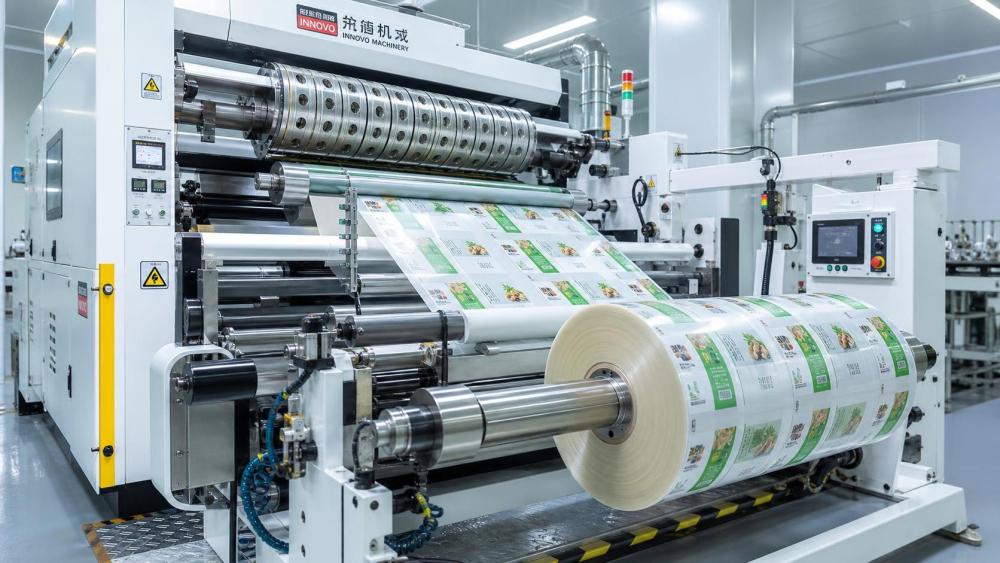
Rotary die cutters use a rotating cutting cylinder and an opposing anvil cylinder to cut, score, perforate, kiss-cut, or shape material as it moves continuously through a web path.
Unlike intermittent die-cutting systems, rotary equipment performs its cutting action while the substrate remains in motion. This makes it well suited to high-speed roll-fed converting.
In flexible packaging production, rotary die cutters commonly process films, paper, foil laminates, labelstock, pressure-sensitive materials, coated papers, and selected multilayer structures.
The cut may create finished pouches, lid shapes, labels, sachet components, tear features, windows, coupons, sleeve blanks, or other formats requiring repeatable web-based converting.
A typical system includes unwind control, web guiding, tension management, printing or registration sensing, the die station, waste stripping, rewind or sheeting, and inspection equipment.
Some production lines integrate rotary die-cutting directly after flexographic printing, lamination, coating, or varnishing. Others use standalone finishing systems for narrower, specialized converting work.
The cutting cylinder carries the tool geometry, while the anvil provides a controlled surface against which cutting pressure is applied. Accuracy depends on cylinder concentricity and setup discipline.
Rotary die-cutting does not automatically eliminate every production bottleneck. A fast die station cannot compensate for unstable unwinds, inconsistent printed registration, or weak waste-matrix removal.
Its practical value comes from converting a stable moving web at high speed while keeping cut position, edge quality, and material waste within the required commercial limits.
For this reason, the best evaluation starts with the complete workflow rather than the headline speed quoted for an individual rotary die cutter.
Why Rotary Die-Cutting Can Increase Throughput
The main productivity advantage is continuous motion. Because the web does not need to stop and start for every impression, rotary die cutters support higher linear speeds.
This advantage becomes especially significant on repeat jobs with long production runs, predictable materials, and limited design changes. Stable jobs allow the equipment to operate near intended capacity.
Faster cycle rates alone are not the whole story. Effective throughput also depends on setup time, material losses during adjustment, unplanned stops, and acceptable finished-product yield.
A line rated at a high maximum speed may deliver lower real output than a slower machine if operators spend excessive time correcting registration or clearing stripped waste.
Rotary systems can reduce dwell time between cuts, improve cut-to-print repeatability, and support inline processing. These benefits can shorten total manufacturing lead time.
Inline conversion is valuable because it avoids extra handling between printing and finishing stages. Fewer transfers can reduce damage, work-in-progress inventory, and opportunities for job mix-ups.
High-speed production also improves labor efficiency when one trained operator can supervise a controlled web process instead of managing repeated manual interventions across several machines.
However, labor savings should be measured against operator skill requirements. Rotary die cutters still require competent setup, tooling handling, tension adjustment, and preventive maintenance practices.
For plants with frequent urgent orders, speed helps only if job changes are also controlled. Quick-change tooling, recipe storage, and accessible adjustment points become commercially important.
When evaluating output claims, buyers should ask for demonstrated running speed on comparable materials, actual setup duration, scrap generated at startup, and average uptime by job type.
Material Compatibility Determines Whether Speed Is Usable
Flexible packaging materials vary widely in thickness, stiffness, stretch, surface friction, heat sensitivity, and layer construction. Those differences strongly affect rotary die-cutting performance.
Polyethylene films, polypropylene films, polyester, paper laminates, aluminum foil structures, and adhesive-backed materials each respond differently to tension, pressure, and blade contact.
Elastic or extensible films can shift under tension changes, creating registration movement even when the cutting cylinder itself is mechanically accurate and properly maintained.
Thin films may wrinkle, telescope, or stretch if unwind braking and nip settings are poorly controlled. Those defects can quickly undermine cut accuracy at speed.
Thicker laminates may require greater cutting force, but excessive pressure can crush edges, distort nearby features, damage liners, or shorten tool life.
For kiss-cut applications, the goal is especially demanding. The blade must cut the face material consistently while leaving the release liner intact across the full web width.
Small variations in coating weight, adhesive thickness, or liner caliper can alter cutting depth. This is why material consistency matters as much as die-cylinder precision.
Packaging teams should provide suppliers with representative material samples, including the actual printed, coated, laminated, or varnished construction intended for commercial production.
Testing should include normal production rolls rather than only ideal laboratory samples. Splice quality, roll hardness, gauge variation, and print coverage can change operating behavior.
A documented material trial gives researchers more useful evidence than a generic capability statement, particularly when evaluating unfamiliar sustainable films or downgauged packaging structures.
Tooling Precision Has a Direct Effect on Quality and Cost
Rotary die-cutting performance is closely tied to tooling quality. The die geometry must match the product design, substrate construction, repeat length, and intended production speed.
Solid rotary dies offer durability and precise cutting for many applications, while flexible dies can provide lower initial tooling cost and easier changeover in suitable jobs.
The correct choice depends on run length, design complexity, required tolerances, material abrasiveness, and how often the converter expects to reuse the tooling.
Blade height, bevel configuration, relief design, and surface treatment influence cutting force and edge quality. Tool specifications should not be treated as a purchasing afterthought.
Poorly matched tooling may create incomplete cuts, excessive dust, rough edges, material lifting, liner damage, or unstable waste stripping. Each defect adds scrap or downstream risk.
Tool life should be evaluated in usable impressions, not only calendar age. Abrasive coatings, foil layers, fillers, and repeated high-pressure operation can accelerate wear.
Tooling storage also affects performance. Cylinders and flexible dies need protection from dents, corrosion, contamination, and handling damage that can compromise registration or cut consistency.
For recurring packaging designs, standardizing repeat dimensions and die interfaces can reduce changeover complexity. This may also simplify spare tooling management across multiple production sites.
Buyers should ask whether the machine accepts common die formats or uses proprietary tooling interfaces. Proprietary solutions may offer advantages but can increase long-term supplier dependence.
A complete tooling cost model should include die purchase, refurbishment, storage, replacement lead time, setup labor, and scrap risk during the first production run.
Registration Control Matters More Than Maximum Machine Speed
In printed flexible packaging, the cut must align precisely with graphics, barcodes, seals, tear notches, and functional zones. Registration error can make otherwise attractive packaging unusable.
Modern rotary die cutters use sensors, printed marks, encoder feedback, and servo-driven corrections to maintain the relationship between the web image and cutting position.
The registration system must respond to web stretch, print-repeat variation, temperature effects, roll tension changes, and acceleration or deceleration during production.
For high-value branded packaging, small positional errors can affect shelf appearance. For medical, food, and traceability applications, they may also create compliance or usability concerns.
Researchers should distinguish between static accuracy and dynamic accuracy. A machine may align correctly at low speed but drift when operating at commercial production rates.
Ask suppliers to demonstrate registration performance at the planned web speed, with the intended substrate and printed artwork. Results should include repeatability over an extended run.
Vision inspection can add another level of control by detecting missing cuts, offset positions, damaged edges, print-to-cut mismatch, and waste-removal problems before finished rolls ship.
Inspection data can also help identify whether a quality issue originated in printing, lamination, web handling, the die station, or final rewind tension.
For plants handling multiple SKUs, digital job recipes can improve repeatability. Saved settings reduce reliance on operator memory when a previously completed job returns months later.
The most useful automation supports faster stabilization after a job change. It does not remove the need for material knowledge, disciplined setup, and meaningful quality checks.
Changeover Speed Often Decides the Business Case
Rotary die cutters are commonly associated with long runs, but many converters now face shorter orders, more variants, seasonal promotions, and frequent artwork revisions.
Under these conditions, the financial value of a machine depends heavily on how quickly it can move from one approved job to the next.
Changeover includes unloading the prior roll, preparing new material, replacing tooling, entering job settings, threading the web, setting tension, establishing registration, and confirming cut quality.
Machine suppliers may quote only die-change time. Buyers should instead measure the full interval from the last acceptable product of one job to the first acceptable product of another.
Features such as cassette tooling, automated web guides, servo positioning, preloaded recipes, splice tables, and accessible guarding can reduce nonproductive time.
Yet automation should fit the plant's job profile. Highly automated systems may be justified for constant short-run turnover but less attractive for stable, repetitive contracts.
Operators should be involved in evaluation trials. Their experience reveals whether controls are intuitive, cleaning is practical, tooling changes are safe, and adjustments can be repeated reliably.
Changeover waste deserves the same attention as changeover minutes. Expensive printed films, laminated structures, and branded materials can make startup scrap a significant cost.
A useful comparison tracks minutes, meters consumed, labor involved, and quality-release time for several representative jobs, rather than relying on one favorable demonstration.
For flexible packaging producers, a predictable 20-minute changeover may be more valuable than a theoretically faster process that varies widely by operator or substrate.
How to Compare Rotary Die Cutters Before Buying
An equipment comparison should begin with the production requirement: annual volume, typical run length, maximum web width, repeat range, substrate list, required tolerances, and finishing sequence.
These inputs create a realistic operating profile. Without them, machine comparisons often become generic discussions of speed, features, and purchase price.
Capacity planning should use net output, not nameplate speed. Net output accounts for setup, startup waste, approved production speed, planned maintenance, and expected downtime.
Calculate whether the new machine removes the actual constraint in the line. In some plants, printing, lamination cure time, inspection, or rewinding limits output more than die-cutting.
Evaluate web-handling architecture carefully. Stable unwind control, appropriate rollers, tension zones, web guiding, and anti-static measures are fundamental to high-speed converting reliability.
Review the machine's supported material range in detail. Confirm thickness limits, maximum roll diameter, tension range, adhesive sensitivity, foil handling capability, and any restrictions on coated substrates.
Ask about maintenance access, spare-part availability, remote diagnostics, service response, and recommended preventive-maintenance intervals. Uptime is an operational capability, not a brochure specification.
Energy consumption, compressed-air requirements, tooling availability, consumables, and operator training should be included in total cost of ownership calculations.
Supplier references are most valuable when they involve similar substrates, web widths, production speeds, and job complexity. A reference in another application may have limited relevance.
Finally, define acceptance criteria before placing an order. They should cover output rate, registration tolerance, cut quality, waste levels, changeover performance, safety, and training completion.
When Rotary Die-Cutting Is the Right Production Method
Rotary die cutters are strongest where continuous web processing, repeatable designs, high volumes, and consistent material behavior justify the investment in equipment and tooling.
They are particularly suitable for labels, pressure-sensitive products, flexible pouches, lidding materials, sleeves, promotional formats, and other roll-fed packaging components.
They can also support more complex workflows when integrated with printing, coating, laminating, inspection, slitting, or automated roll handling systems.
However, rotary die-cutting may not be the best choice for every product. Very short runs, constantly changing designs, unusual rigid materials, or oversized formats may favor alternatives.
Flatbed die-cutting can remain relevant where tooling flexibility, lower initial investment, or specific sheet-fed requirements outweigh the speed advantage of continuous rotary operation.
Laser converting may be considered for highly variable digital workflows or intricate designs, although its economics, edge characteristics, and throughput differ from mechanical die-cutting.
The correct decision comes from matching the process to the order mix, quality specification, material behavior, and factory operating model rather than following a single technology trend.
For information researchers, the most reliable conclusion is based on trial evidence, net productivity, total cost, and quality stability across representative commercial jobs.
Conclusion: Evaluate Rotary Die Cutters as a Complete Converting System
Rotary die cutters can deliver faster flexible packaging production, consistent cut quality, and lower handling effort when the entire web-converting system is engineered for stable operation.
The strongest business case combines suitable materials, accurate tooling, reliable registration, efficient changeovers, and downstream processes that can keep pace with the die-cutting station.
Maximum speed is useful, but net output, startup waste, uptime, tooling cost, and repeatable quality provide a more realistic measure of production value.
Before selecting equipment, packaging producers should test representative jobs, define measurable acceptance standards, and compare complete operating costs instead of focusing on machine purchase price alone.
With that approach, rotary die-cutting becomes easier to assess: it is not simply a fast cutting method, but a production platform for scalable, controlled flexible packaging conversion.
Related News
 How an Impression Roller for Flexo Printing Affects Print QualityDiscover how an impression roller for flexo printing influences ink transfer, dot gain, alignment, and print consistency. Learn practical setup and troubleshooting tips.Print Fluidics Scientist
 Why Color Measurement Systems Matter for Consistent Flexo PrintingColor Measurement Systems help flexo printers achieve consistent brand colors, reduce waste, improve traceability, and protect packaging quality across every production run.Print Fluidics Scientist
 What to Check Before Choosing a Print Dryers Supplier for Your PressPrint dryers supplier selection guide: compare drying methods, press integration, energy use, maintenance, safety, and support to improve print quality and uptime.Print Fluidics Scientist
 How to Compare Web Tension Controller Manufacturers for Flexo PressesWeb tension controller manufacturer comparison guide for flexo presses: assess stability, sensing, integration, service, and real-world substrate performance.Print Fluidics Scientist
 How Hot Air Print Dryers Improve Ink Drying on Flexo LinesHot air print dryers improve flexo ink drying with balanced airflow, controlled heat, and reliable results for faster packaging production.Print Fluidics Scientist
 How to Choose a Plate Cylinder Manufacturer for Reliable Print QualityChoose a reliable plate cylinder manufacturer with proven precision, balance control, material expertise, and press compatibility for consistent print quality.Print Fluidics Scientist