How to Compare Web Tension Controller Manufacturers for Flexo Presses
A web tension controller is not a generic accessory on a flexographic press. It is part of the control chain that determines whether the web remains stable through unwinds, infeed sections, print decks, dryers, chill rolls, laminating units, and rewinds. A manufacturer comparison should therefore begin with the press process and failure modes, not with a catalogue comparison of controller screen size, nominal input count, or headline control features.
For flexo applications, the relevant question is whether a supplier can maintain stable, repeatable tension through the actual disturbances the press creates: roll diameter change, splice passage, acceleration, deceleration, viscosity-related drag changes, dryer temperature effects, variable substrate stiffness, and changes in ink coverage. A controller that performs acceptably on a simple test stand may still create registration drift, wrinkling, web breaks, or excessive waste when installed on a high-speed press running thin film or extensible paper.
Define the tension zones before comparing suppliers
The term web tension controller manufacturer can cover suppliers of very different systems. Some supply standalone closed-loop controllers; others provide load cells, brakes, drives, dancer assemblies, PLC interfaces, web guides, and machine-level automation. These offerings should not be treated as interchangeable.
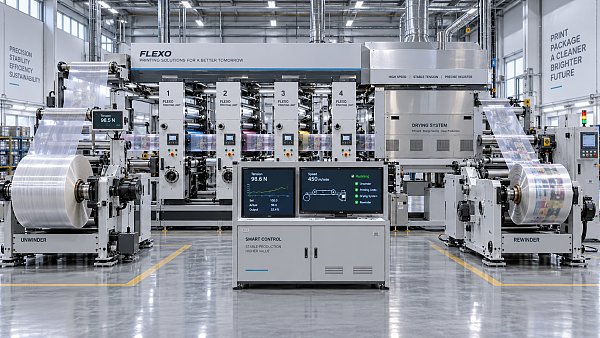
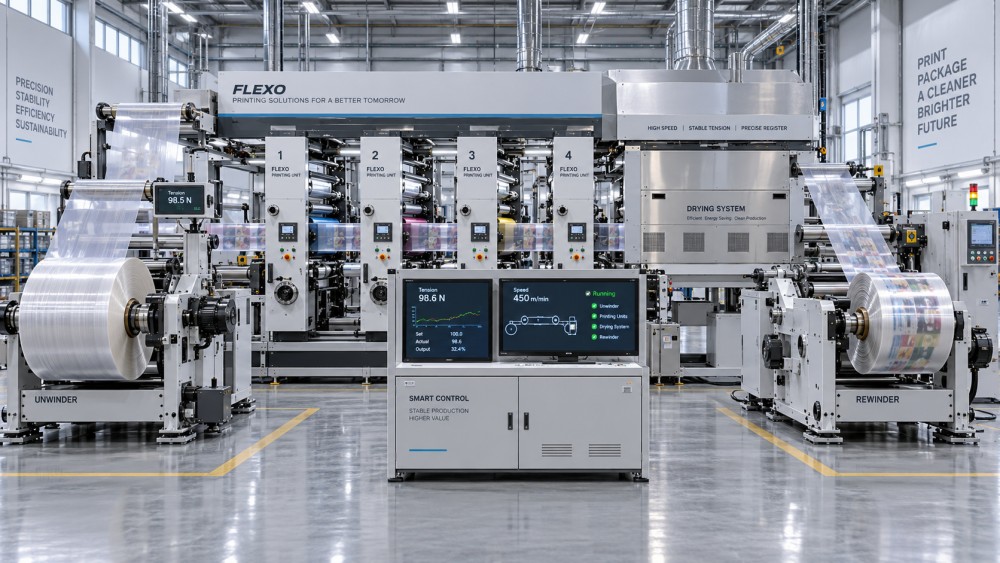
A flexo press normally contains multiple tension zones with different control objectives. The unwind zone must compensate for decreasing roll diameter and changing roll inertia. The infeed zone must isolate upstream variation before the web enters the printing section. Interstation tension must protect print-to-print registration and avoid distortion between decks. Downstream zones may need to manage dryer drag, cooling, laminating, die-cutting, or rewind hardness. The manufacturer’s suitability depends on which of these zones it will control and where its responsibility ends.
Before issuing a request for quotation, the press builder or retrofit team should document:
- the web path, including idler rolls, driven rolls, nips, dryers, chill rolls, and accumulators;
- the required tension range for each zone, rather than one nominal tension value for the whole press;
- minimum and maximum web width, substrate thickness, roll weight, core size, and unwind diameter;
- maximum line speed, acceleration and deceleration requirements, and emergency-stop behavior;
- all tension-sensitive processes, particularly print decks, adhesive application, laminating, cold-seal work, and rewinding;
- existing drive hardware, PLC platform, fieldbus protocol, operator interface, and safety architecture.
Without this zone definition, a supplier may quote a technically capable controller but size the sensing system, brake, motor, or control mode around incomplete process assumptions. The result is often a project that appears compatible on paper but requires extensive commissioning changes.
Control stability matters more than nominal accuracy
Manufacturers commonly describe accuracy, resolution, or repeatability, but these figures do not by themselves predict press performance. Tension is dynamic. The controller must respond fast enough to reject disturbances without becoming unstable, chasing noise, or transmitting corrections into adjacent zones.
For example, a controller with very fine signal resolution may still be unsuitable if its filtering produces excessive delay. Conversely, an aggressively tuned loop may respond rapidly to a splice or speed change but oscillate with a light, elastic film. The practical issue is the balance among sensor signal quality, controller sampling and filtering, actuator response, mechanical compliance, and the inertia of the roll or dancer system.
Ask each manufacturer to explain how its system handles control-loop tuning under changing operating conditions. Useful technical questions include whether gain scheduling is available across different roll diameters or speeds; whether the controller supports separate tuning profiles by substrate; how it distinguishes transient disturbances from noise; and whether tuning parameters can be locked, backed up, and restored by job recipe. A supplier that only offers a generic PID setting may be adequate for a stable, narrow operating window, but it gives less assurance where the press handles widely different papers, films, or coated materials.
Control performance must also be assessed at the low end of the operating range. A heavy paper web can conceal marginal sensing and control behavior because it has higher inherent stability. Thin polyethylene, polypropylene, metallized film, lightweight paper, or highly extensible substrates reveal weaknesses much earlier. The comparison should explicitly state the lowest intended tension and the most difficult web categories, not only the highest-speed production condition.
Evaluate the sensing architecture, not only the controller
A tension controller is only as reliable as the measurement reaching it. In flexo presses, the common feedback methods are load cells and dancer systems. Either can be effective, but they impose different mechanical and control requirements.
Load-cell systems measure force through a sensing roll. Their suitability depends on correct mechanical sizing, load direction, overload margin, bearing arrangement, roll alignment, cable protection, signal conditioning, and calibration access. When comparing manufacturers, verify whether the supplier provides the complete sensing-roll calculation or only the electronic controller. A load cell selected solely from the expected web tension may be poorly sized if dead load, wrap angle, roll weight, and transient forces have not been considered.
Dancer-based systems use dancer position as a process variable and may also incorporate pressure control or load sensing. They can provide useful web storage and isolation, especially where splices or intermittent downstream processes create disturbances. However, their performance depends on dancer travel, moving mass, friction, pneumatic stability where applicable, and the relationship between position control and actual web tension. A manufacturer should be able to define the usable travel range, neutral position logic, end-of-travel response, and behavior during starts, stops, and manual threading.
Sensor compatibility must be reviewed at the electrical and environmental level as well. Check excitation requirements, analogue signal ranges, digital interface options, shielding requirements, cable length limits, ingress protection appropriate to the press environment, and resilience to electrical noise from UV systems, VFDs, servo drives, and static-control equipment. A controller with broad analogue input support is not automatically compatible with an installed sensor if scaling, grounding, or diagnostic requirements are not properly addressed.
Diagnostics deserve particular attention. The system should make it possible to identify a broken cable, sensor overload, unstable zero point, implausible signal, communication loss, or actuator saturation before these faults become a print-quality problem. A vague “fault output” is less useful than clear status information accessible through the machine HMI and, where required, the plant control network.
Match the controller to the actuator and unwind strategy
Tension control is achieved through an actuator, not through the controller alone. On an unwind, this may be a pneumatic brake, electrical brake, torque-controlled motor, regenerative drive, or servo-driven unwind. Rewind sections may use torque control, taper-tension logic, closed-loop load-cell feedback, or a combination of these methods. Manufacturer comparisons should include the actuator model and control method proposed for each zone.
A brake-oriented supplier may be highly capable for conventional unwind sections yet offer limited depth in servo drive coordination. A drive specialist may integrate well with electronically controlled unwinds but provide less mature support for pneumatic brake behavior. Neither approach is inherently superior; the deciding factor is whether the proposed control architecture matches roll inertia, line speed, roll weight, stopping requirements, and the product mix.
For driven unwind and rewind applications, confirm how the manufacturer manages torque limits, speed synchronization, roll diameter estimation or measurement, inertia compensation, taper control, and transitions between open-loop and closed-loop operation. Diameter calculation is especially important. Systems may derive diameter from line speed and rotational speed, receive it from an external sensor, or use operator-entered parameters. Each method has limitations when slip, core irregularity, low-speed operation, or roll build variation is present.
The transition states are often more revealing than steady running. Ask for the control sequence during web threading, splice preparation, automatic splice passage, press acceleration, speed hold, deceleration, stop, restart, and web-break recovery. A technically credible manufacturer can explain what happens to setpoint, actuator command, integrator state, and safety interlocks in each condition.
Integration quality is a manufacturer capability, not a wiring detail
On a modern flexo press, tension control interacts with press speed, registration, web guiding, drying, inspection, recipe management, and production reporting. The controller may be standalone, embedded in a PLC, or distributed across drives and motion control hardware. The preferred architecture depends on the press platform, but the integration boundary must be clear.
Compare available communication protocols against the installed automation standard and confirm which values can be exchanged in real time. At minimum, the integration design should identify speed reference, run/stop state, emergency-stop state, tension actual value, tension setpoint, controller mode, alarm status, splice signal, roll diameter information, and operator commands. If job recipes are managed through the central HMI or manufacturing system, determine whether tension recipes can be selected, versioned, and audited without manual re-entry.
It is also important to establish who owns the software logic. If the controller manufacturer provides only a hardware block and leaves all machine sequencing to the press integrator, the technical risk sits elsewhere. If the supplier provides a complete application library, assess whether the code is documented, editable, protected, and maintainable after warranty. Closed proprietary logic can simplify responsibility during commissioning but may complicate future upgrades or troubleshooting.
For retrofit projects, physical integration can be as important as software compatibility. Existing sensing rolls may have inadequate space for correct load-cell mounting; old idlers may introduce friction; pneumatic supply quality may be poor; cabinets may lack shielding or cooling; and legacy drives may not accept the control mode required. A manufacturer comparison should include an installation review rather than relying on a remote interpretation of drawings alone.
Use substrate behavior to test application depth
The strongest technical differentiator among suppliers is often their ability to discuss substrate-specific limitations without reducing the answer to a generic tension range. Flexo presses can process absorbent paper, coated paper, corrugated preprint liner, PE, PP, PET, shrinkable films, laminated structures, aluminum foil, and pressure-sensitive materials. These webs respond differently to tension, temperature, moisture, and speed variation.
Paper can change dimension with moisture and may exhibit uneven profile stiffness across the roll. Film may stretch, neck down, wrinkle, or retain distortion caused upstream. Heat-sensitive webs can be affected by dryer conditions. Laminated materials may have curl or variable friction between layers. In each case, the tension controller can reduce variation but cannot correct poor web handling geometry, unsuitable roller surfaces, excessive dryer drag, or unstable registration mechanics.
A credible manufacturer will identify these boundaries. It should be willing to state when additional equipment is required, such as a dancer accumulator, low-inertia idlers, web guide, spreader roll, closed-loop drive, static control, or improved roll alignment. Suppliers that imply the controller alone will solve all wrinkle, register, and break problems should be treated cautiously.
Compare evidence through an acceptance test, not a feature list
A useful supplier evaluation converts performance claims into a factory and site acceptance plan. The plan does not need to prescribe one universal tolerance, because acceptable variation depends on substrate, web width, process zone, and press design. It should instead define measurable conditions and agreed observations.
Relevant test conditions may include minimum and maximum specified web tension, representative substrate types, low and high line speeds, acceleration and deceleration, roll-diameter change, splice passage where applicable, and normal production disturbances. The review should record tension trend behavior, actuator output, controller saturation, alarms, recovery after interruption, and the influence on registration or web appearance. Where print registration is being assessed, the responsible party should distinguish tension-related movement from plate-cylinder, sleeve, impression, servo synchronization, or web-guide causes.
Acceptance documentation should include final tuning parameters, sensor calibration records, electrical drawings, I/O lists, communication maps, alarm descriptions, spare-parts lists, and backup files. These documents are not administrative extras. They determine whether the system can be restored after a drive replacement, PLC modification, sensor failure, or operator error.
Service capability should be judged by diagnosability and response path
Service support is often described broadly, but technical evaluation should focus on practical recovery. Determine whether the manufacturer can provide remote diagnostics, whether it has personnel able to analyze both control behavior and mechanical web-handling issues, and whether local support is available for the installation region. Time-zone coverage matters when a press operates across multiple shifts or is exported to another market.
Spare-parts strategy should cover more than the controller unit. Include load cells, amplifiers, cables, connectors, brake valves, pneumatic regulators, encoder interfaces, power supplies, and operator-interface components where relevant. A system built from standard, documented components may be easier to sustain than one dependent on a single proprietary module, although proprietary systems can still be appropriate when the supplier offers dependable lifecycle support.
Training should be evaluated by content. Operators need to know setpoint selection, alarm response, manual-mode limits, and threading procedures. Maintenance personnel need calibration, zeroing, sensor inspection, fault isolation, parameter backup, and replacement procedures. Controls engineers need access to network diagnostics, signal scaling, software backups, and integration documentation. A manufacturer that separates these responsibilities clearly reduces the chance that routine adjustments destabilize the process.
A practical basis for the final comparison
The best supplier is not necessarily the one with the largest product range or the most advanced interface. It is the one whose proposed system can be traced from the press’s real web-handling conditions to a defined sensing method, actuator strategy, control logic, integration scope, and acceptance test.
A robust comparison therefore gives greater weight to demonstrated behavior at difficult substrates and transient conditions than to generic specification claims. It also tests whether the manufacturer can explain the mechanical assumptions behind its solution, identify limits beyond the controller’s scope, and support the system after commissioning. For flexo presses, stable web tension is valuable because it protects registration, reduces preventable waste, and keeps the press within a controllable operating window. The manufacturer evaluation should be built around that operating reality.
Related News
 How an Impression Roller for Flexo Printing Affects Print QualityDiscover how an impression roller for flexo printing influences ink transfer, dot gain, alignment, and print consistency. Learn practical setup and troubleshooting tips.Print Fluidics Scientist
 Why Color Measurement Systems Matter for Consistent Flexo PrintingColor Measurement Systems help flexo printers achieve consistent brand colors, reduce waste, improve traceability, and protect packaging quality across every production run.Print Fluidics Scientist
 What to Check Before Choosing a Print Dryers Supplier for Your PressPrint dryers supplier selection guide: compare drying methods, press integration, energy use, maintenance, safety, and support to improve print quality and uptime.Print Fluidics Scientist
 How to Compare Web Tension Controller Manufacturers for Flexo PressesWeb tension controller manufacturer comparison guide for flexo presses: assess stability, sensing, integration, service, and real-world substrate performance.Print Fluidics Scientist
 How Hot Air Print Dryers Improve Ink Drying on Flexo LinesHot air print dryers improve flexo ink drying with balanced airflow, controlled heat, and reliable results for faster packaging production.Print Fluidics Scientist
 How to Choose a Plate Cylinder Manufacturer for Reliable Print QualityChoose a reliable plate cylinder manufacturer with proven precision, balance control, material expertise, and press compatibility for consistent print quality.Print Fluidics Scientist