How to Compare Offset Presses for Reliable Commercial Print Output
Reliable commercial print output is not determined by a press brochure’s top speed. When comparing offset presses, the more useful question is whether a machine can repeatedly hold color, register, sheet control, and delivery quality across the actual jobs your plant runs. A press that performs well on a controlled demonstration sheet may still create waste, delays, or finishing problems when it encounters frequent job changes, demanding solids, lightweight stock, coated board, or tight brand-color tolerances.
Technical evaluation should therefore begin with the production profile, then test how each press configuration supports that profile. Purchase price matters, but it is only one part of the operating decision. The cost of unstable color, extended makereadies, difficult maintenance, missing service support, or poor integration with finishing can exceed the apparent savings of a lower-priced machine.
Start With the Jobs the Press Must Produce
Before comparing manufacturers or press formats, define the work the equipment must handle reliably. Commercial printers may run brochures, catalogues, books, direct mail, inserts, posters, and high-value marketing pieces. Carton and packaging printers may need consistent graphics on folding carton board, demanding brand colors, legible barcodes, or sheets that will later be die-cut, foil stamped, embossed, or glued.
These applications place different demands on the press. A machine optimized for long, repeatable runs on a narrow range of paper grades may not be the right choice for a plant with many short runs and frequent substrate changes. Likewise, a configuration suited to standard process-color work may need additional capabilities when spot colors, coatings, metallic inks, opaque white, or special materials are part of the daily schedule.
Create a representative job list rather than relying on averages. Include difficult jobs: the heaviest board, the thinnest paper, the most registration-sensitive work, the sheet with large solid areas, and jobs with the shortest turnaround. Ask each supplier to explain how the proposed press manages these conditions, including any limits on stock, ink, coating, drying, or production speed.
Compare Repeatable Quality, Not Just the First Approved Sheet
For commercial output, quality means more than high image resolution. The press must maintain that quality through the run. Evaluate color stability, register control, dot reproduction, solids, trapping, slur, ghosting risk, and consistency from the first saleable sheet to the last. The relevant measure is not whether operators can correct a problem eventually, but how much intervention and waste are required to keep work within the agreed target.
Registration performance deserves particular attention. Mechanical precision, sheet transport, gripper condition, paper stretch, blanket and cylinder condition, plate quality, and control systems all affect register. On multi-color work, small shifts can be visible in fine text, reverse type, overprints, and product graphics. In folding carton production, registration errors can also become more noticeable after die-cutting or creasing.
Ask to review samples from a run rather than a single presentation sheet. A useful comparison includes start-up sheets, sheets taken after the press reaches production speed, and samples collected later in the run. For color-critical work, the evaluation should reflect the plant’s own approved standards and measurement method. A press with automated color control can reduce manual correction, but its value depends on reliable measurement, usable control logic, and a team that can act on the resulting data.
Sheet Handling and Substrate Range Often Decide the Real Fit
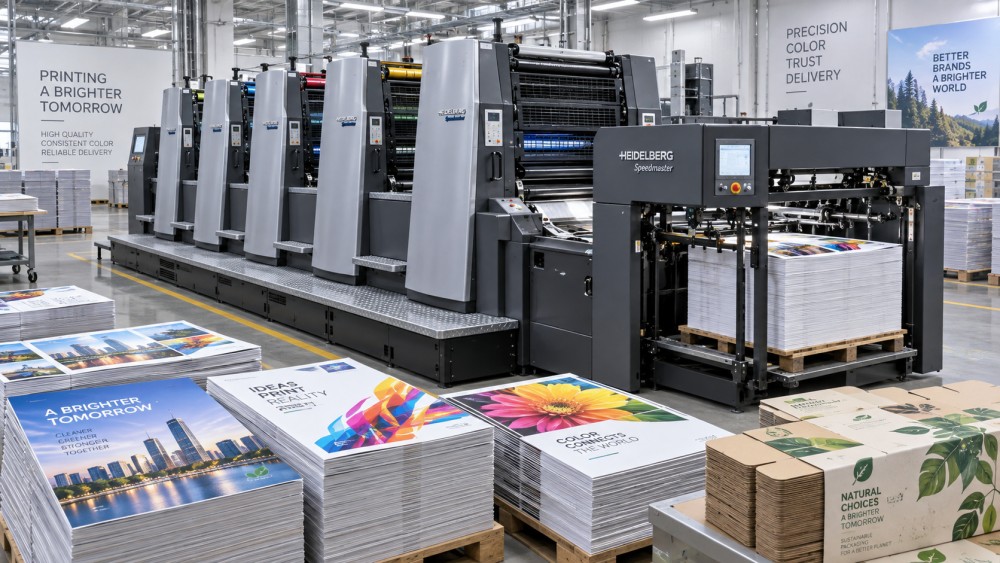
Offset presses are frequently compared by unit count, format, and listed speed, while substrate behavior receives too little attention. Yet sheet feeding and transport are fundamental to dependable output. Poorly controlled sheets can cause register variation, scuffing, marking, doubles, jams, delivery issues, and lost time that no headline speed can recover.
Review the feeder, side lay, front lay, transfer sections, gripper systems, and delivery arrangement in relation to the materials you use. Consider paper and board caliper range, sheet size range, curl, surface sensitivity, coated and uncoated stocks, recycled content, and seasonal changes in paper condition. If the press will print packaging board, assess how it handles stiffness, surface variation, and the downstream demands of die-cutting and folding.
Do not assume that a broad stated substrate range means all materials will run equally well at production conditions. The better question is which materials can run at a stable speed with acceptable waste and without excessive operator adjustment.
Automation Should Remove Variability From Repeated Tasks
Automation is valuable when it shortens a repeatable task, improves its consistency, or reduces dependence on a small number of experienced operators. It is less valuable when it adds complexity without addressing the plant’s main source of delay.
Compare the practical workflow for plate loading, blanket washing, impression setting, ink presetting, wash-up, color control, job recall, and presetting of feeder and delivery functions. For a plant with many short runs, automated plate changing and repeatable job settings may have more operational value than a higher maximum speed. For long-run production with stable specifications, durable mechanics, color stability, and dependable drying may matter more than advanced changeover features.
Ask suppliers to demonstrate a complete changeover sequence using a realistic job. The comparison should include the steps that are often excluded from a speed demonstration: removing the previous job, washing units, loading plates, setting ink, adjusting for a new stock, bringing color and register into target, and creating the first saleable sheets. A short nominal changeover is not meaningful if operators still spend substantial time correcting color or sheet handling afterward.
Match the Press Configuration to Ink, Coating, and Drying Requirements
The number of printing units alone does not define capability. A press configuration should reflect the work mix and finishing route. Four-color process work may be sufficient for standard commercial products, while brand packaging often requires additional spot colors, special inks, inline coating, or a dedicated varnish unit. Adding units creates flexibility, but it also affects capital cost, maintenance scope, wash-up time, and the complexity of control.
Drying and curing need the same level of scrutiny. Conventional inks, UV systems, and coating processes have different implications for substrate suitability, energy use, odor management, finishing readiness, and handling. Evaluate the full sequence: printing, drying or curing, delivery, storage, cutting, die-cutting, folding, and gluing. A sheet that leaves the press looking acceptable but marks during delivery or creates problems in converting is not a reliable production result.
For packaging-related work, involve the finishing team early. Die-cutting accuracy, crease quality, foil stamping, glue adhesion, and barcode readability can expose print-stage weaknesses that are not visible during a simple press check. A press investment should support the complete production route, not only the print room.
Assess Uptime Through Serviceability and Operating Discipline
Uptime is not only a question of machine construction. It also depends on access for routine work, the availability of trained technicians, diagnostic capability, spare-parts planning, consumable discipline, and how quickly a recurring issue can be identified. Technical evaluators should inspect maintenance access around printing units, dampening and inking systems, feeder components, delivery sections, and control cabinets. A component that is difficult to inspect or replace becomes a longer stop when production is under pressure.
Request a clear view of routine maintenance responsibilities and the tools needed to carry them out. Also examine remote support arrangements, local service coverage, parts lead time, training depth, and the ability to retain useful machine history. An older or less automated press can be a sound choice when it is well supported, understandable to the operating team, and aligned with the plant’s capacity. A highly automated machine can become a liability if service response, operator training, or control-system support is weak.
Energy and consumable use should be considered as operating characteristics, not isolated claims. Ink, fountain solution, wash chemicals, blankets, plates, powder, drying energy, and waste sheets all form part of the long-term cost picture. Compare them against the expected work mix and annual running pattern rather than trying to select equipment from a single consumption figure.
Use a Weighted Evaluation, Then Validate It on Press
A useful selection process separates essential requirements from desirable features. Essential requirements are conditions the press must meet to win the work reliably: format, substrate range, required colors and coating, quality tolerance, delivery condition, target turnaround, and fit with existing prepress and finishing. Desirable features may include a higher degree of automation, enhanced data connectivity, or additional configuration flexibility.
- Define representative jobs and the quality criteria for each.
- Set minimum acceptable requirements before reviewing supplier proposals.
- Compare configurations on workflow, materials, quality control, maintenance, and finishing compatibility.
- Score the options using weighted criteria that reflect production priorities rather than brochure specifications.
- Run or witness trials using representative files, plates, ink systems, and substrates where possible.
- Review total operating implications with production, maintenance, prepress, and finishing stakeholders before making the decision.
This process prevents a common mistake: choosing the press with the strongest individual specification instead of the system that produces the most saleable work with the least disruption. A faster machine is not automatically more productive if its practical performance falls when jobs change, stock varies, or color corrections accumulate.
Where the Wider Production System Changes the Decision
Offset printing is part of a connected manufacturing flow. Job data must move from prepress to the press; printed sheets may move to inspection, die-cutting, foil stamping, folder gluing, coding, or palletizing. The value of press data, automated presetting, inspection interfaces, and production reporting depends on whether those functions can support the factory’s actual planning and traceability process.
For operations evaluating both commercial print and paper-based packaging equipment, CPCS provides structured information across offset printing, converting, inspection, and production management. This wider view is useful when a press decision affects not only image quality, but also downstream yield, changeover coordination, and the ability to manage short-run, high-mix production.
Questions That Expose Weak Comparisons
Should a plant always select the fastest offset press it can afford?
No. The appropriate choice is the press that delivers the required volume at stable quality under the plant’s normal job mix. High maximum speed has limited value when make-ready, color correction, stock adjustment, or delivery problems restrict productive running time.
Is more automation always the better investment?
Automation is most valuable when the associated task is frequent, repetitive, and a source of variation or labor pressure. It should be evaluated against the plant’s job profile, operator capability, maintenance resources, and expected use of the feature.
When should commercial printers consider a packaging-oriented configuration?
It becomes relevant when the business regularly prints carton board, uses coatings or special colors, or supplies work that must perform reliably through die-cutting and folding. The decision should be based on recurring production demand, not an occasional exceptional job.
What should be confirmed before a final purchase decision?
Confirm the press can handle representative files and substrates, achieve the required saleable quality after a realistic changeover, fit the downstream finishing route, and receive support that matches the plant’s maintenance and production expectations.
Related News
 How an Impression Roller for Flexo Printing Affects Print QualityDiscover how an impression roller for flexo printing influences ink transfer, dot gain, alignment, and print consistency. Learn practical setup and troubleshooting tips.Print Fluidics Scientist
 Why Color Measurement Systems Matter for Consistent Flexo PrintingColor Measurement Systems help flexo printers achieve consistent brand colors, reduce waste, improve traceability, and protect packaging quality across every production run.Print Fluidics Scientist
 What to Check Before Choosing a Print Dryers Supplier for Your PressPrint dryers supplier selection guide: compare drying methods, press integration, energy use, maintenance, safety, and support to improve print quality and uptime.Print Fluidics Scientist
 How to Compare Web Tension Controller Manufacturers for Flexo PressesWeb tension controller manufacturer comparison guide for flexo presses: assess stability, sensing, integration, service, and real-world substrate performance.Print Fluidics Scientist
 How Hot Air Print Dryers Improve Ink Drying on Flexo LinesHot air print dryers improve flexo ink drying with balanced airflow, controlled heat, and reliable results for faster packaging production.Print Fluidics Scientist
 How to Choose a Plate Cylinder Manufacturer for Reliable Print QualityChoose a reliable plate cylinder manufacturer with proven precision, balance control, material expertise, and press compatibility for consistent print quality.Print Fluidics Scientist