How to Choose Sheet Stackers for Flexo Press Systems Efficiently
A sheet stacker should be selected from the delivery end backward: start with the sheets leaving the flexo press, the pile required by the next process, and the conditions that interrupt stable delivery. A machine that accepts the nominal sheet size but cannot control curled board, light substrates, die-cut blanks, or frequent order changes will create stops where the press should be running.
For flexo systems, good stacking is not simply a matter of placing sheets into a pile. The stacker must receive each sheet at press speed, remove enough energy to prevent rebound, align the edges without crushing the board, and maintain a usable pile as its height changes. These functions must remain stable across the actual production mix, not only on the heaviest and most regular job.
Start with the delivered sheet, not the catalog maximum
Sheet length and width are necessary selection figures, but they do not describe how difficult the sheet is to stack. Record the smallest, largest, narrowest, and widest formats that regularly run. Include the direction of travel. A long sheet entering leading-edge first behaves differently from the same sheet presented in the other direction because its trailing edge remains unsupported for longer.
Also separate maximum format from the format used at maximum press speed. A stacker can be rated for a large sheet while its stable high-speed performance is limited by sheet stiffness, delivery geometry, or the time available for deceleration. Ask for the operating relationship between format, substrate, and speed rather than relying on one maximum speed figure.
Board grade changes the delivery problem. Light single-wall corrugated board may flutter and resist clean side alignment. Heavy double-wall or coated material carries more momentum and can strike front stops hard enough to disturb the pile. Warped sheets can arrive with one corner leading; sheets with strong cross-machine curl can lift after entering the pile. Printed sheets may have surfaces that scuff, stick, or slide differently from unprinted board.
For each representative job, note:
- sheet dimensions, flute direction, thickness, basis weight, and whether the sheet is scored, die-cut, or printed on one or both sides;
- the press delivery speed during normal production, acceleration, deceleration, and restart;
- the required pile height and whether a pallet, slip sheet, or downstream conveyor sets the practical limit;
- visible delivery defects such as skew, edge damage, corner folding, bounce, scuffing, or sheets that bridge above the pile.
This job record prevents a common error: choosing a stacker around the average sheet while the difficult jobs determine lost production time.
Match the stacker to real press output
Press speed and stacker speed need to be evaluated as a system. The delivery unit must accept sheets at the highest realistic output rate, but it also needs controlled behavior during speed changes. A stacker that performs well once the press is settled may lose pile formation when the press slows for an ink adjustment, a feed disturbance, or a job transition.
Consider the sheet interval as well as sheets per minute. Short sheets at high output create a tight delivery interval, leaving little time for the sheet to decelerate and settle. Long sheets can create another issue: the leading edge reaches the pile while the trailing portion is still moving through the delivery path. If belts, rollers, vacuum transfer, or braking devices release too early, the trailing edge may drag and turn the sheet.
There should be enough controlled conveying length between the final press delivery point and the stack formation zone for the material to stabilize. Extra length alone is not a solution. Excessive unsupported travel can increase flutter, especially with light corrugated board. Review where the sheet is gripped or supported, where it is slowed, and where it becomes free to settle.
Sheet overlap must also be understood. Some delivery arrangements use shingling to handle high output, while others aim to deliver individual sheets to the pile. Overlap can support throughput, but it complicates counting, inspection, and downstream transfer if the overlap is inconsistent. When printed sheets must remain clearly separated for inspection or batch handling, an individual-sheet delivery method may be preferable even if its theoretical capacity appears lower.
Examine pile formation as a controlled process
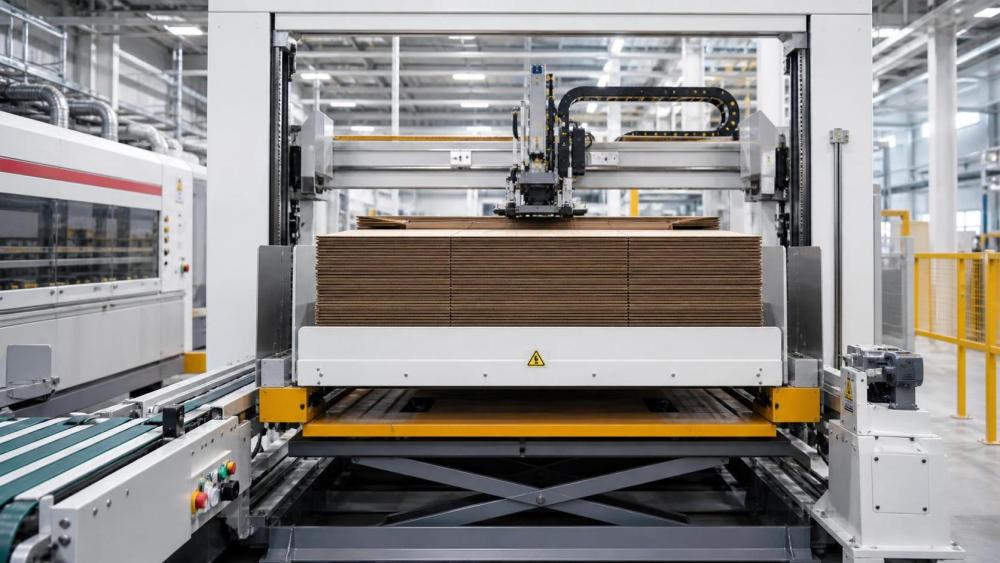
A square pile is the result of several adjustments working together. Front stops arrest forward movement. Side guides control lateral position. Joggers, air devices, brushes, or vibration systems help settle the sheet. The lift table keeps the pile at a usable receiving level. Treat these as linked controls rather than isolated features.
Strong mechanical side jogging can square rigid board effectively, yet it may damage crushed edges, disrupt die-cut waste bridges, or mark sensitive printed surfaces. Gentle air alignment reduces contact, but it can be less reliable on warped material or in a drafty installation area. The suitable approach depends on the material and print condition. A stacker intended for mixed work should allow adjustment rather than assuming one alignment method fits all jobs.
Front-stop design deserves close attention. If the stopping surface is too abrupt for the substrate and speed, sheets rebound and create a loose or stepped pile. If it is too soft or poorly positioned, the leading edge can creep forward over time. Adjustable stop position, cushioning, and reliable synchronization with delivery speed are more useful than a fixed stop designed around a narrow format range.
Look at how the pile remains level as it grows. A lift table should lower smoothly enough that the incoming sheet always meets a consistent receiving height. Sudden lowering produces an air gap and encourages skew. A lift mechanism that reacts too slowly can compress the top of the pile, causing edge damage or sheet bounce. Confirm whether pile-height sensing works accurately with dark printed surfaces, irregular die-cut profiles, and dusty corrugated board.
When pile defects point to different causes
Similar-looking piles can originate from different faults. A recurring diagonal pile often indicates guide alignment, sheet skew before entry, or uneven contact on the front stop. Random skew across a run is more likely associated with inconsistent sheet release, variable board warp, or static and air movement. A pile that looks acceptable at low height but opens at the bottom can indicate poor settling during the early stage of stacking. Sheets that become progressively offset in one direction suggest a fixed mechanical reference issue rather than a temporary delivery disturbance.
Before changing multiple settings, observe where the first positional error occurs. If the sheet enters square and shifts only after contact with the pile, the problem lies in deceleration, stop action, or jogging. If it arrives out of square, inspect the final transfer belts, nip pressure, vacuum zones, and sheet support immediately upstream.
Automation should remove recurring interruptions
Automation has value when it addresses a repeated loss point. Automatic pile lowering is fundamental for continuous stack formation. Automatic side-guide positioning can shorten changeovers where formats change frequently, but its usefulness depends on repeatable job data and guides that return accurately under production conditions. Motorized settings that still require frequent manual correction provide limited benefit.
Pallet change or non-stop delivery functions deserve a practical review. They can maintain press output while a completed pile is removed, yet the transfer sequence must preserve sheet alignment and keep the first sheets of the new pile under control. Evaluate the time required for pallet placement, pile securing, and restart after an interruption. A non-stop function is less effective if the surrounding handling process still requires extended manual intervention.
Counting, batching, and marking functions matter when stacks feed a die-cutter, folder gluer, inspection station, or warehouse flow that needs known quantities. Verify how the stacker counts sheets and how it handles missed, doubled, or overlapping sheets. A simple counter may be adequate for stable, individually delivered blanks. Complex mixed-format work benefits from a system that exposes count faults clearly rather than silently carrying an error forward.
Integration signals should be defined before installation. The press and stacker need coordinated ready, run, stop, fault, and emergency-stop behavior. If there is a downstream conveyor or pallet handling system, establish which machine controls accumulation and what occurs when the next station is unavailable. A stacker that continues receiving sheets after downstream blockage can turn a minor transfer delay into a pile collapse.
Assess changeover at the delivery end
Shorter jobs place more pressure on delivery setup. The relevant question is not whether settings are adjustable, but whether their correct positions can be reached consistently. Format changes commonly involve side-guide spacing, front-stop location, pile-table position, sheet control belts, air volume, jogger intensity, and batch settings. Tools, awkward access, and poorly visible reference points all lengthen this work.
Review the setup sequence at the machine. Adjustment points should be accessible without reaching through moving areas or removing unnecessary guards. Scale markings and digital position displays are useful only when they correspond to the actual sheet path. For repeat jobs, saved settings should include the delivery parameters that influence pile quality, not merely sheet dimensions.
Trial runs should include the transition from the previous job to the next one. A stacker may create a satisfactory pile after several minutes of tuning while still wasting sheets during every order change. Observe the first several sheets, the first partial pile, and the response when the press returns to production speed.
Installation conditions can change the result
Stacker performance is affected by floor condition, available clearance, utilities, and the behavior of nearby equipment. Uneven flooring can influence pile-table travel and pallet positioning. Limited access around the delivery side makes it difficult to clear jams or adjust guides safely. Airflow from open doors, fans, or dust extraction can disturb lightweight sheets just before they settle.
Measure the full operating envelope, including access for pallet trucks or conveyors, removal of completed stacks, service access to drives and sensors, and space for clearing a sheet that has entered at an angle. Check the available electrical supply, compressed-air quality where pneumatic functions are used, and the route for control cables between the press and downstream handling equipment.
Dust management should be considered early. Corrugated board dust can coat optical sensors, reduce vacuum effectiveness, and accumulate around moving guides. A stacker with protected sensing locations, accessible cleaning points, and clear fault indication will be easier to keep stable than one that requires partial disassembly for routine cleaning.
Choose maintainable mechanisms over impressive feature lists
Delivery components experience repeated contact, vibration, paper dust, and occasional sheet strikes. Inspect the accessibility of belts, rollers, bearings, chains, pneumatic valves, sensors, and stop surfaces. Wear parts should be identifiable and replaceable without disturbing alignment across the machine. A design that requires major adjustment after a routine belt replacement can create recurring setup work.
Ask how guide alignment is verified after service, how lift-table synchronization is checked, and how faults are diagnosed. Fault messages should distinguish a full pile, low air pressure, blocked transfer, sensor contamination, and drive overload. A generic stop alarm leaves too much time spent searching for the cause.
The final selection should be based on stable handling of the hardest regular sheet, reliable behavior through speed and job changes, and a pile format that the next process can accept without rework. A sheet stacker that keeps these three conditions aligned will protect both print quality and press availability.
Related News
 How an Impression Roller for Flexo Printing Affects Print QualityDiscover how an impression roller for flexo printing influences ink transfer, dot gain, alignment, and print consistency. Learn practical setup and troubleshooting tips.Print Fluidics Scientist
 Why Color Measurement Systems Matter for Consistent Flexo PrintingColor Measurement Systems help flexo printers achieve consistent brand colors, reduce waste, improve traceability, and protect packaging quality across every production run.Print Fluidics Scientist
 What to Check Before Choosing a Print Dryers Supplier for Your PressPrint dryers supplier selection guide: compare drying methods, press integration, energy use, maintenance, safety, and support to improve print quality and uptime.Print Fluidics Scientist
 How to Compare Web Tension Controller Manufacturers for Flexo PressesWeb tension controller manufacturer comparison guide for flexo presses: assess stability, sensing, integration, service, and real-world substrate performance.Print Fluidics Scientist
 How Hot Air Print Dryers Improve Ink Drying on Flexo LinesHot air print dryers improve flexo ink drying with balanced airflow, controlled heat, and reliable results for faster packaging production.Print Fluidics Scientist
 How to Choose a Plate Cylinder Manufacturer for Reliable Print QualityChoose a reliable plate cylinder manufacturer with proven precision, balance control, material expertise, and press compatibility for consistent print quality.Print Fluidics Scientist