How to Choose Inline Color Measurement Systems for Flexo Presses
Choosing inline color measurement systems for flexo presses requires more than comparing instrument specifications. Technical evaluators must consider measurement geometry, substrate and ink compatibility, press speed, sampling frequency, and integration with existing color management and control workflows. The right system should provide reliable data under production conditions while supporting brand color targets, reducing waste, and improving traceability. This guide examines the technical and operational criteria to assess before selecting a system for a flexographic printing application.
Start with the decision the measurement must support
An inline instrument can tell an operator that a printed color has moved away from its target. It does not necessarily explain why, and it cannot automatically correct every cause. A change in ink strength, anilox condition, impression pressure, substrate shade or drying behavior can all affect the result. Before reviewing suppliers, define whether the intended outcome is earlier warning, documented quality control, faster setup, automated adjustment or some combination of these.
The distinction affects the equipment specification. A press producing repeat brand work may need reliable comparison with approved spot-color targets and a searchable job history. A corrugated sheet plant may be more concerned with identifying variation across board grades and segregating suspect sheets. A short-run operation may value quick job loading and minimal setup over a sophisticated control function that operators rarely have time to configure.
Also decide what constitutes an actionable result. If a reading exceeds tolerance, will the press continue while an operator investigates, will sheets be marked for review, or will an automatic control make an adjustment? Without an agreed response, a system can generate extensive data without changing production decisions.
Match the measurement to the printed surface
Spectral color measurement is useful when a customer specifies color in terms of a target and color difference, commonly expressed as ΔE. Density readings can help monitor changes in ink film behavior, but density alone does not describe every color shift. Ask suppliers which values the system measures directly, which it calculates, and whether those outputs match the plant’s approval process.
Measurement geometry, illumination and viewing conditions matter as much as the reported number. A press-side instrument and a handheld device may disagree because they view the surface differently, use different measurement conditions or sample different areas. Glossy coatings, textured paper, optical brighteners and translucent substrates can make agreement more difficult. Confirm the intended measurement condition, illuminant, observer and color-difference formula with the brand owner or internal quality team before comparing readings.
The substrate changes the problem. On white coated stock, a clean solid patch may be relatively straightforward to measure. On brown or mottled corrugated liner, local variations in the board can influence the reading. Flute-related surface variation, sheet movement and uneven print coverage can add noise. Transparent film may require a defined backing or a measurement arrangement designed for that material. Metallic, fluorescent or highly glossy inks deserve separate testing rather than an assumption that ordinary spot-color methods will transfer.
Ask what area the sensor measures and how it handles texture, registration movement and patch size. A small aperture may be useful where available artwork is limited, but it can also be more sensitive to local substrate variation. A larger area may smooth that variation while making it harder to isolate a small color element. Neither is inherently better; the choice depends on the artwork and the material.
Check where and when the press can measure
A reading is only useful if it represents the product being accepted. Identify the proposed sensor position relative to print units, dryers, coatings and the delivery section. Ink appearance can change as the print dries, while a coating applied after the measurement point can alter the final appearance. If the customer approves a finished, coated sample, establish how an earlier inline reading will be related to that sample.
Installation drawings should show the available space, measurement distance, web or sheet path, access for cleaning and the effect of vibration. On a web press, tension and flutter can change the distance or angle between the sensor and the print. On a sheet-fed corrugated press, sheet position, height variation and gaps between sheets must be considered. A laboratory demonstration cannot establish whether the proposed mounting location will be stable enough at production speed.
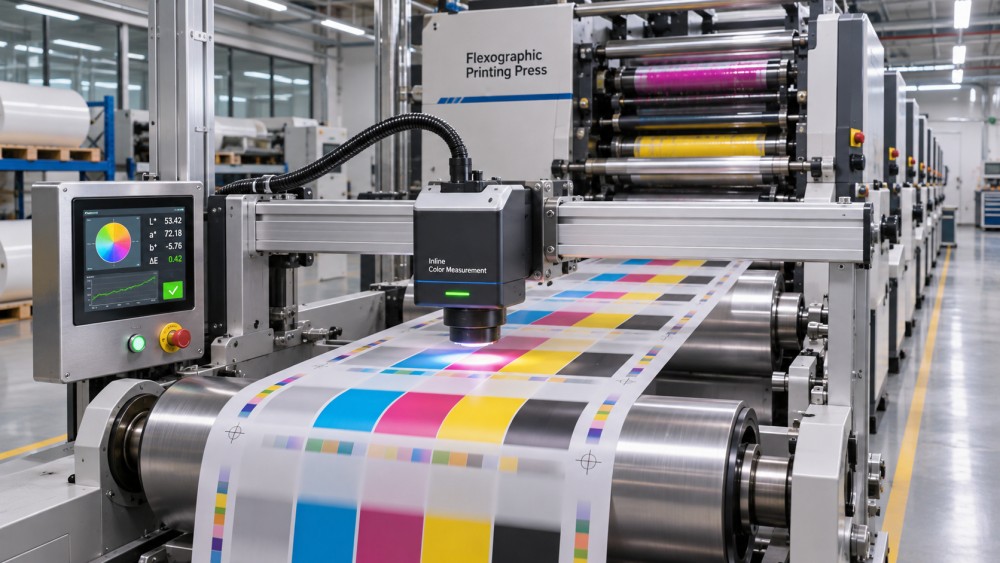
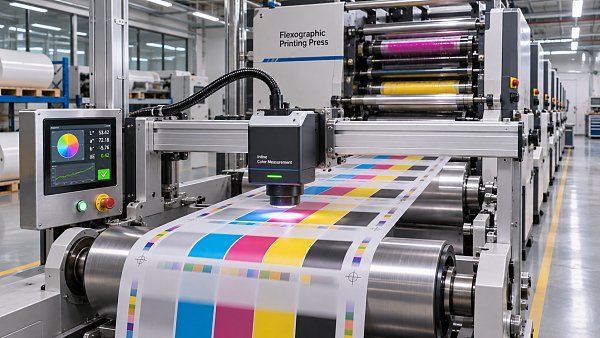
Sampling frequency also needs a practical definition. A fixed sensor observing one patch, a traversing sensor moving across the press width and a camera-based system analyzing an image can have very different coverage. Ask how often each target is actually measured at the required press speed, including traverse time, acquisition limits and any missed reads. “Continuous monitoring” should not be accepted as proof that every color on every repeat or sheet is measured.
Where a control strip is needed, confirm that customers will permit it and that there is usable space outside the finished artwork. If the system measures within the artwork instead, verify how it locates a consistent region and avoids text, highlights, screens or adjacent colors. Color measurement and print-defect inspection can complement each other, but a color reading does not replace inspection for missing print, registration errors or unreadable codes.
Prove agreement with the existing color workflow
The most disruptive commissioning issue may be a disagreement between the inline system and the instrument already used to approve jobs. Before purchase, document how targets are created, which device supplies the reference, how tolerances are assigned and which measurement takes precedence when results differ.
A meaningful comparison uses the same representative materials and defined conditions, not just a supplier’s demonstration tile. Measure production samples with the existing reference device and the proposed system, using comparable locations and settings wherever possible. Assess repeatability on each device separately, then investigate any systematic difference between them. Differences should not automatically be corrected with a software offset: the cause may be geometry, backing, drying, surface texture or the size of the measured area.
Agree in advance on the color-difference formula and tolerance for each relevant job or customer. A single ΔE limit applied to every substrate and color can be misleading. The tolerance must reflect the approval agreement and the measurement method, including how borderline results are handled. If both instruments have normal measurement variation, a result near the limit may require a defined review procedure rather than an immediate pass-or-fail decision.
Calibration and verification deserve equal attention. Establish who performs each task, how often, what reference materials are required and what happens when a check fails. Protecting the optics from dust, ink mist and vibration is not merely a maintenance detail: contamination can turn a reliable measurement into a misleading trend.
Separate monitoring from closed-loop control
Suppliers may describe a system as automatic when it only acquires readings and presents recommendations. Closed-loop control goes further: it uses measurements to command an adjustable process variable. Ask exactly which press components can be controlled, what interface is required and whether the press manufacturer supports that connection.
In flexo, available correction depends on the press and ink system. Color drift may be associated with viscosity, pH for suitable water-based inks, ink strength or other variables, but not every press can adjust these automatically, and not every color error can be fixed through a single adjustment. Changes in anilox condition, substrate or print impression may require operator intervention. A control loop should therefore have clear operating limits, alarms and an accessible manual override.
Timing matters too. The distance between the print unit, sensor and point of adjustment creates a delay. Add drying time, measurement processing and the time needed for the process to respond, and an aggressive control strategy can chase an old condition rather than correct the current one. During evaluation, ask the supplier to explain how the system handles delay, unstable readings, job changes and out-of-range conditions.
Evaluate data integration and the operator’s workload
A useful record connects each measurement with the correct job, color target, timestamp and production position or sheet identifier where available. It should also distinguish measured values from calculated results and record relevant target or tolerance changes. Confirm whether data can be exported in a usable format and whether access depends on a proprietary application or ongoing license.
Integration with press controls, scheduling software or a quality database should be specified as an actual deliverable, not a general claim of compatibility. Determine who supplies the interface, who maps job identifiers, how data is transferred and what happens during a network interruption. Cybersecurity, user permissions and backup arrangements belong in the project discussion, particularly when the system connects to plant networks.
The interface should help an operator decide what to do while the press is running. Review how targets are loaded, how alarms are prioritized and whether a reading can be traced to a physical position for inspection. Frequent nuisance alarms can make even a technically capable system ineffective. Include operators and quality staff in the demonstration; their ability to distinguish a real deviation from normal variation is part of the implementation.
Use a production trial to resolve the remaining risks
A supplier comparison should use a shared test plan based on the actual press and job mix. Include representative light and dark colors, critical brand colors, normal substrate variation, relevant coatings and the speeds at which jobs are expected to run. For corrugated work, include the board grades and surface conditions that are most likely to challenge the sensor. For web flexo, include realistic tension and web movement.
The trial should establish more than whether the device can display a color value. Agree on acceptance criteria for repeatability, agreement with the reference workflow, successful reading rate, coverage, alarm behavior and data export. Test startup, a normal job change, a deliberate target or process change where safe, and recovery after an interrupted reading. Record unresolved limitations alongside successful results.
Finally, compare the full operating cost: engineering and installation, press downtime, integration, training, calibration materials, software support, replacement parts and service response. Estimate potential savings from reduced setup waste or fewer disputed runs using the plant’s own records, and distinguish those estimates from demonstrated results. The system with the most features is not necessarily the one that fits the press.
Global Commercial Print & Corrugated Packaging Intelligence (CPCS) approaches equipment decisions in this wider production context: measurement performance must work alongside press uptime, material use, operator capability and traceability. Before approving a specification, bring the press supplier, measurement supplier and internal quality team together around the same samples, acceptance criteria and responsibilities. That discussion is often where the difference between a promising instrument and a workable production system becomes clear.
Related News
 How Do Flexo Wash-up Systems Reduce Ink Changeover Time?Discover how Flexo Wash-up Systems reduce ink changeover time, limit contamination, and improve press availability—and learn how to measure savings before investing.Print Fluidics Scientist
 How Can Flexo Wash-up Systems Reduce Press Downtime?Flexo Wash-up Systems reduce press downtime through consistent cleaning and faster changeovers. Discover how to prevent contamination and restart with confidence.Print Fluidics Scientist
 How Do Print Register Control Systems Improve Print Accuracy?Print Register Control Systems improve color alignment, reduce setup waste, and help prevent drift. Discover how they work and what to check for consistent print quality.Print Fluidics Scientist
 How to Choose Inline Color Measurement Systems for Flexo PressesChoose inline color measurement systems for flexo presses with confidence. Compare accuracy, substrate compatibility, integration, and production costs.Print Fluidics Scientist
 How to Choose a Printing Sleeve for a Flexographic PressChoose the right printing sleeve for your flexographic press. Compare fit, repeat length, materials and maintenance to improve print consistency.Print Fluidics Scientist
 How Impression Rollers Affect Flexographic Print QualityImpression Rollers can make or break flexographic print quality. Discover how to prevent common defects, protect substrates and improve consistency.Print Fluidics Scientist