How to Choose Hot Air Print Dryers for Flexible Packaging
The right hot air print dryer for flexible packaging is the one that removes enough solvent or water at the required production speed without exceeding the film’s thermal limits. A dryer rated for a press’s maximum speed is not necessarily adequate for a demanding ink coverage, solvent blend, or heat-sensitive substrate. Equally, a high-temperature system can create distortion or blocking before it delivers acceptable residual levels.
Selection therefore starts with the production envelope: the materials, inks, coating weights, web widths, and speeds the line must handle. Airflow, exhaust, heat input, and controls should then be evaluated as a system, rather than as independent specifications.
Define the difficult job, not just the fastest job
Dryer capacity depends on how much liquid must evaporate and how quickly the web passes through the heated section. A useful starting estimate is:
Evaporation load = web area per unit of time × wet deposit per unit of area × volatile fraction.
The wet deposit should reflect the actual print or coating application, not simply the ink’s nominal solids content. A high-coverage design, a heavily deposited white ink, and a lightly printed design can place very different demands on the same dryer. In multicolor printing, the load also changes between interstation dryers and the final dryer.
For example, increasing line speed increases the area processed per minute while reducing the time each section of film spends in a dryer of fixed length. This can create a capacity shortfall from both directions: more liquid must be removed per minute, but each section of the web has less exposure time. Increasing the set temperature alone may not solve the problem if air delivery, exhaust, or film temperature is already limiting performance.
Prepare a representative set of operating cases before comparing suppliers. Include maximum usable web width, intended production speeds, substrate structures and thicknesses, ink chemistry, wet laydown or anilox data where applicable, coverage, and the required residual-solvent or moisture outcome. The most demanding case may be a wide, heavily printed film rather than the job with the highest nominal press speed.
Match heat transfer to the film and ink
Hot air drying works by transferring heat to the wet layer and carrying evaporated solvent or water away from the web. Performance depends on air temperature, nozzle velocity, air distribution, exposure time, and the concentration of vapor already present around the print. A large heater provides thermal input, but it does not guarantee that heat reaches the print uniformly or that vapor is removed effectively.
Flexible films impose a practical ceiling on dryer settings. Polyethylene, polypropylene, polyester, and multilayer structures respond differently to heat and tension; thickness, orientation, coatings, and prior processing also matter. Excessive web temperature can lead to shrinkage, stretching, registration variation, curl, or changes in surface properties. The acceptable limit should be established for the actual structure and downstream process, not inferred solely from the base polymer.
Air temperature and film temperature are not interchangeable. Evaporation can initially cool the web, while the film may heat more rapidly after much of the volatile content has left. A dryer with multiple controllable zones can help match heat delivery to the changing condition of the ink, but zone control adds value only if the setpoints are based on validated web and print behavior.
Ink formulation matters just as much. Solvent-based and water-based systems differ in evaporation behavior, exhaust requirements, and sensitivity to process conditions. A solvent blend may contain components that leave at different rates, so a dry-looking surface does not prove that residual solvent is acceptable. Water-based ink performance also depends on formulation and ambient conditions; a dryer qualified for one ink family should not automatically be assumed suitable for another.
Assess airflow across the usable web
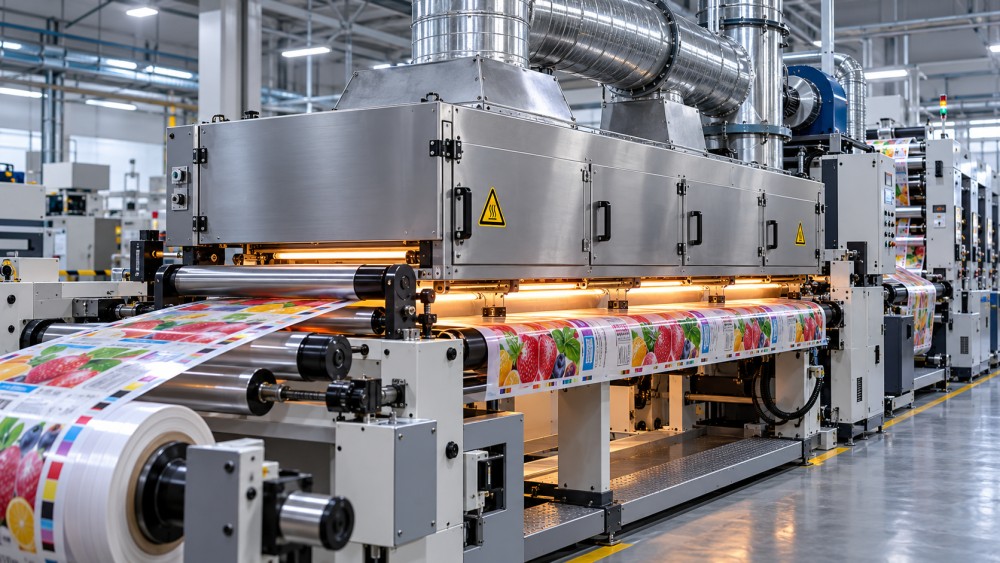
Nozzle design determines how effectively heated air reaches the printed surface and how uniformly it acts across the width. Ask for the usable drying width, nozzle arrangement, adjustable air settings, and the expected distribution at the intended operating point. Pay attention to edges and areas affected by structural supports or changes in the air path: average temperature or total fan flow can conceal local under-drying.
Higher impingement velocity can improve heat and mass transfer, but it can also disturb a light-gauge web. Film flutter, contact with machine components, or tension instability may limit the practical setting before the heater reaches its rated output. The evaluation should therefore consider airflow together with web path, unsupported span, tension control, and the clearance between the web and dryer components.
Air-turn or flotation arrangements can support a web without direct contact over part of its path, while other configurations use rollers and controlled air delivery. The choice depends on the press layout and print condition. Contact with a freshly printed surface can damage the image; unsupported spans demand stable handling. Neither arrangement is inherently superior without considering the particular web path and available space.
Uniformity should be demonstrated on the intended width and substrate, not assumed from a single temperature sensor. Useful evidence includes cross-web measurements, operating air settings, and print-quality results from representative coverage. Where a supplier’s existing test conditions differ from the proposed application, identify what remains unproven.
Size exhaust and recirculation together
Drying requires vapor to leave the vicinity of the ink. Recirculating heated air can reduce heating demand, but solvent-laden air must be controlled and an appropriate portion exhausted. Too little effective exhaust can raise vapor concentration, reduce the driving force for evaporation, and create a safety concern. Excessive exhaust can waste heat and increase the load on building makeup air and downstream treatment equipment.
Compare dryer proposals at the required exhaust flow and operating pressure, including ductwork, filters, heat recovery, and any abatement equipment. A fan rating in isolation does not establish the airflow available at the dryer once the complete system is connected. The facility must also provide sufficient makeup air; otherwise, changes in room pressure can affect ventilation and dryer performance.
For solvent-based inks, the design must address flammable-vapor hazards as a complete system. This includes the applicable limits and safety factors for vapor concentration, ventilation, monitoring where required, equipment suitability, and shutdown interlocks. Requirements depend on the solvent, dryer design, installation, and local jurisdiction. Supplier documentation and a site-specific engineering review should establish how the proposed installation complies with applicable rules.
Changes in ink formulation, coverage, or production speed can alter solvent loading. Check whether the control system adjusts exhaust or restricts operation when conditions approach its design limits, and establish who is responsible for connecting dryer safety functions to the press and plant systems.
Compare configurations at the same duty
Interstation dryers and final dryers perform different tasks. An interstation unit must dry the previous color sufficiently for the next printing operation without compromising registration or print transfer. A final dryer has a longer opportunity to reduce remaining volatiles before winding or subsequent converting. A large final dryer cannot necessarily correct defects caused by insufficient interstation drying, such as color contamination or damage when a wet layer enters the next unit.
When comparing hot air print dryers, request a common duty statement rather than comparing catalog heater power or maximum line speed. It should specify:
- Web material, thickness, width, and intended speed for each evaluated job.
- Ink or coating type, application rate, coverage, and assumed volatile load.
- Dryer length, zone arrangement, temperature range, and available airflow settings.
- Required exhaust flow, supply conditions, utility loads, and downstream pressure assumptions.
- Acceptance criteria for print quality, web stability, and residual solvent or moisture, with the measurement method stated.
This makes trade-offs visible. A longer dryer may achieve the required residence time at a lower thermal load on the film, but it needs more space and may change the web path. A more compact unit may rely on stronger air impingement or higher temperatures, making film handling and thermal limits more critical. The preferred design is the one that meets the specified duty with workable operating margins, not the one with the largest headline rating.
Control, integration, and operating cost
Temperature control should be assessed alongside airflow and line-speed control. A recipe that works at production speed may overheat a stationary or slow-moving web unless the dryer reduces heat input, changes airflow, or moves away from the web as appropriate to its design. Restart behavior also matters: returning immediately to full settings can expose a partially dried print to conditions different from those used during steady production.
Review the response to a press stop, web break, fan failure, loss of exhaust, high-temperature alarm, power interruption, and emergency stop. The required sequence depends on the equipment design and hazard assessment, but responsibilities for sensing, interlocking, and safe restart should be explicit before purchase. Accessibility for nozzle cleaning, filter changes, inspection, and heater maintenance is part of the integration decision, particularly when space around an existing press is constrained.
Energy comparisons should use the same production case and include heater consumption, fan power, exhaust volume, makeup-air conditioning, and any additional abatement demand. Heat recovery or recirculation can lower energy use, but their benefit depends on operating hours, solvent loading, temperature conditions, and the complete air system. Ask suppliers to state assumptions rather than presenting a single efficiency figure without a defined duty.
Make acceptance depend on measured output
A meaningful acceptance test links the equipment’s operating conditions to finished print requirements. Specify the substrate and ink, coverage or test pattern, web width, speed, environmental conditions where relevant, and sampling positions across the web. Record zone temperatures, airflow or fan settings, exhaust conditions, tension, and any relevant web-temperature measurements so the result can be reproduced.
Residual-solvent acceptance should use an agreed sampling procedure, analytical method, and limit appropriate to the package application and subsequent process. Sampling timing and storage conditions matter because residual levels can change after printing. For water-based systems, agree how dryness and downstream performance will be assessed rather than relying only on surface touch.
Where a full-load factory test is impractical, define the evidence available before shipment and the site test needed for final acceptance. The unresolved risk should be clear: whether it concerns maximum evaporation load, cross-web uniformity, film handling, or compatibility with a particular ink. A dryer selection is defensible when its capacity and controls are demonstrated against those specific limits—not merely when the machine reaches the press’s rated speed.
Related News
 How Do Flexo Wash-up Systems Reduce Ink Changeover Time?Discover how Flexo Wash-up Systems reduce ink changeover time, limit contamination, and improve press availability—and learn how to measure savings before investing.Print Fluidics Scientist
 How Can Flexo Wash-up Systems Reduce Press Downtime?Flexo Wash-up Systems reduce press downtime through consistent cleaning and faster changeovers. Discover how to prevent contamination and restart with confidence.Print Fluidics Scientist
 How Do Print Register Control Systems Improve Print Accuracy?Print Register Control Systems improve color alignment, reduce setup waste, and help prevent drift. Discover how they work and what to check for consistent print quality.Print Fluidics Scientist
 How to Choose Inline Color Measurement Systems for Flexo PressesChoose inline color measurement systems for flexo presses with confidence. Compare accuracy, substrate compatibility, integration, and production costs.Print Fluidics Scientist
 How to Choose a Printing Sleeve for a Flexographic PressChoose the right printing sleeve for your flexographic press. Compare fit, repeat length, materials and maintenance to improve print consistency.Print Fluidics Scientist
 How Impression Rollers Affect Flexographic Print QualityImpression Rollers can make or break flexographic print quality. Discover how to prevent common defects, protect substrates and improve consistency.Print Fluidics Scientist