How an Automatic Web Guiding System Prevents Roll Misalignment
On a fast-running printing or converting line, roll misalignment rarely begins as a dramatic failure. It often starts with a small sideways movement that looks harmless: a paper web drifts a few millimeters, the printed image begins to wander, a slit edge becomes uneven, or the material approaches a die-cutting section off-center. Left uncorrected, that small deviation can become waste, poor registration, wrinkles, damaged material, and an unexpected stop.
An automatic web guiding system keeps paper, film, foil, nonwoven materials, and other moving webs on the intended path. It continuously detects the actual web position, compares it with the target position, and makes small corrective movements before drift affects downstream production. For operators working with high-speed corrugated pre-printing, flexographic presses, laminators, rewinders, slitting machines, coating lines, or packaging converting equipment, web guiding is not an optional refinement. It is a practical control point for stable daily production.
Why roll misalignment becomes expensive so quickly
A roll does not need to move far sideways to create trouble. In a narrow-web label process, a modest edge shift may lead to poor die-cut registration. On a wide-web flexographic press, it can affect print-to-cut alignment, repeat accuracy, and the usable width of the substrate. In paper-based packaging production, a drifting web may enter a laminating, scoring, or rewinding stage unevenly, leaving operators to decide whether to slow the line, intervene manually, or continue running and accept a growing quality risk.
The visible defect is only part of the cost. Misalignment can cause more frequent splice problems, uneven winding, telescoped rolls, edge damage, trim loss, and longer setup periods after a job change. It can also put stress on operators. When someone must repeatedly stand beside a machine, watch an edge, and make manual adjustments during a demanding run, consistency depends too heavily on attention and reaction time.
Automatic guidance changes that situation. Rather than asking the operator to chase a moving web, the system manages routine lateral correction in real time. The operator can focus on material quality, print appearance, tension behavior, splice condition, and the wider production process.
What an automatic web guiding system actually controls
The term “web guide” is sometimes used broadly, but its function is specific: it controls the lateral position of the moving material. It does not replace tension control, registration control, or a properly aligned machine frame. These systems work together, yet each solves a different problem.
- Web guiding keeps the web edge, centerline, printed line, or contrasting feature in the desired sideways position.
- Tension control manages the pulling force on the web to reduce sag, stretching, wrinkles, and unstable transport.
- Print registration control aligns printed images in the machine direction and, depending on the press, across the web.
- Mechanical alignment ensures rollers, shafts, frames, and downstream modules are physically installed and maintained in the correct position.
This distinction matters during troubleshooting. If a web is drifting steadily to one side, an automatic web guiding system may correct it. If the web is fluttering because tension is unstable, or wrinkling because a roller is skewed, guiding alone cannot remove the root cause. A good operator learns to read these symptoms before changing settings.
The correction loop: detect, decide, move, confirm
Although individual designs vary, most automatic web guides operate through a closed-loop sequence. A sensor detects where the material is. A controller interprets the difference between the actual and desired position. An actuator shifts a guiding element, often a steering roller assembly, unwind stand, or rewind stand. The sensor then confirms whether the web has returned to its reference position.
Because the correction is continuous, the movement is usually small and gradual. The objective is not to force the material from side to side. It is to make calm, timely adjustments that prevent drift from becoming visible at the next process station.
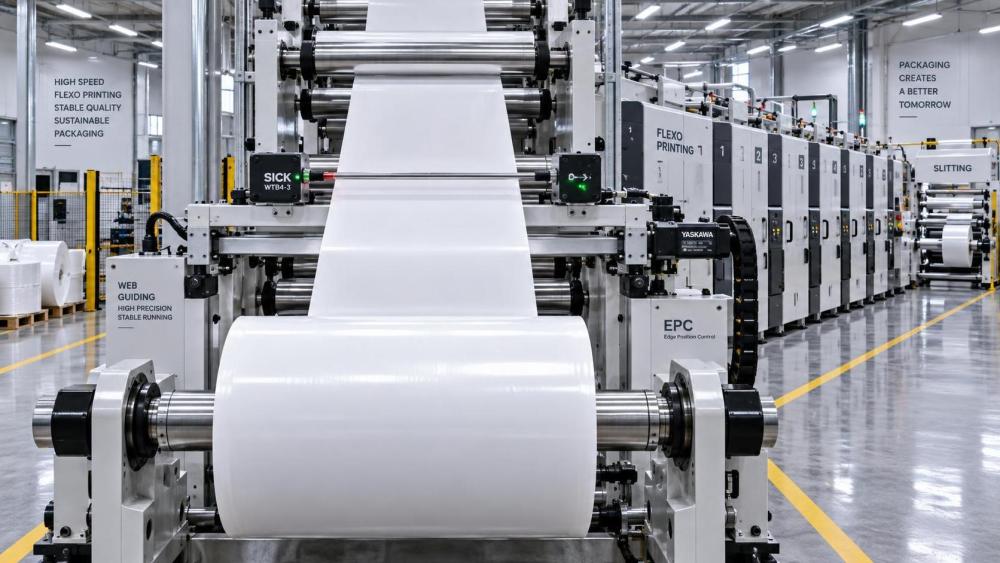
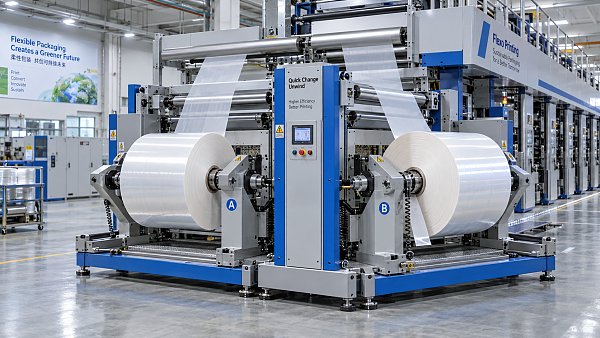
On an unwind application, the system may move the roll or unwind carriage to keep the web entering the machine on center. In an intermediate guiding application, a displacement frame or pivoting steering roller redirects the web before it reaches a critical printing, laminating, or converting section. At the rewind end, guidance can help build a straighter, more stable finished roll and reduce telescoping risk.
Sensor choice depends on the material and reference point
The sensor is the “eye” of the system, and the right sensor depends on what must be followed. Edge sensors are common where a clean, repeatable material edge is available. They may use ultrasonic, infrared, optical, or pneumatic sensing principles, depending on substrate properties and machine environment.
Line-guiding sensors are useful when the material edge is inconsistent but a printed line, color contrast, or defined mark can be followed. This is particularly relevant in pre-printed corrugated liner, decorative packaging materials, and converting operations where the printed image must remain aligned with a later process. For transparent films, highly reflective surfaces, perforated materials, or irregular edges, sensor selection needs more care. A sensor that performs well on opaque kraft paper may not provide stable readings on clear film or shiny metallized stock.
Where web guiding makes the biggest difference in packaging production
In commercial printing and corrugated packaging, roll alignment affects more than one machine. A problem introduced at the unwind can travel through printing, drying, laminating, slitting, and rewinding. The best location for a guide is therefore not always simply “where there is space.” It should be selected around the point where correction protects the most sensitive downstream operation.
On a flexographic press, a web guide near the unwind helps establish a stable web path before printing begins. A further guide may be justified before a critical station where the substrate must arrive consistently for printing, coating, lamination, or die-cutting. In pre-print applications for corrugated packaging, consistent web position supports reliable image placement before the printed liner is converted into board.
Slitter rewinders are another important application. If the parent roll enters unevenly, slit strips may not track consistently, and finished rolls can develop poor edges or winding defects. In coating and laminating lines, lateral drift can cause adhesive coverage issues, uneven overlap, or material mismatch between layers. For each application, the guiding strategy should reflect the web width, material behavior, operating speed, downstream tolerance, and job-change frequency.
How operators should set up the system before a run
A web guide works best when it begins with a stable mechanical and material condition. During setup, it is tempting to treat the controller as a quick fix for every tracking problem. That usually creates unnecessary correction activity and hides issues that should be addressed separately.
Start by checking that the roll is loaded squarely, the web path is threaded correctly, and the selected edge or line is cleanly visible to the sensor. Confirm that guide rollers turn freely and that there is no buildup of ink, adhesive, dust, paper fibers, or coating residue on the sensing area. On paper and corrugated-related materials, dust can be especially persistent; a dirty sensor may “see” a false edge and generate unstable corrections.
Next, set the reference position intentionally. Operators should know whether the process requires edge guiding, center guiding, or line guiding. “Centered” is not always the correct target. For example, a later slit, print lane, or laminate overlap may require the web to follow a fixed edge position rather than the machine centerline.
Once the line begins moving, observe the guide response at a moderate speed before moving into full production. A healthy system corrects smoothly and then settles. If the actuator constantly hunts left and right, pauses too long before responding, or reaches its travel limit, stop and investigate rather than increasing controller sensitivity immediately.
Three common situations that look like guide failure
The web moves, but the guide does not correct
This may be a sensor issue, but not always. Check whether the system is in automatic mode, whether the sensor is positioned over the intended edge or mark, and whether the controller has a valid signal. Then inspect the actuator and guide frame for mechanical restrictions. A seized bearing, damaged cable, low air supply on a pneumatic system, or a blocked guide carriage can prevent movement even when the sensor is working correctly.
The guide corrects continuously from side to side
Oscillation often points to an overly aggressive control setting, poor sensor signal, vibration, or an unstable web. A fluttering material edge can make the sensor report rapid position changes that do not represent true drift. Before changing gain or response settings, examine tension, roller condition, web wrap, air currents, and material curl. A calmer web produces a more reliable control signal.
The guide reaches its limit during a run
When a guide frame travels fully to one side, the system is telling the operator that the underlying offset is larger than its correction range. Recenter the guide according to the machine procedure and inspect the roll loading position, unwind alignment, splice quality, roller parallelism, and incoming material condition. Repeated limit alarms should not be reset and ignored. They can indicate a mechanical alignment problem upstream.
Material changes can change guiding behavior
Operators often notice that a guide runs perfectly with one grade and becomes unpredictable with another. This is normal. Light film, heavy paper, coated board, recycled liner, stretchable materials, and moisture-sensitive paper do not travel in exactly the same way. Curl, bagginess, edge damage, roll hardness, static charge, and thickness variation can all influence how a web presents itself to the sensor and responds to steering.
A job change is therefore a useful moment to review guiding settings, sensor position, and the correct reference point. The goal is not to create a unique adjustment routine for every roll; it is to recognize when a material change has altered the conditions enough to require attention. Recording stable settings by substrate family can make future setups faster and reduce reliance on individual operator memory.
Maintenance that prevents drift before it starts
Web guiding equipment is often small compared with the press, corrugator module, laminator, or rewinder around it. That does not mean it should disappear from preventive maintenance plans. A few routine checks can prevent a guide from becoming the unnoticed cause of waste.
- Clean sensors and inspect lenses, sensor faces, and mounting brackets.
- Verify that cables, connectors, air lines, and control signals are secure.
- Inspect guide rollers, bearings, pivots, linear slides, and actuator movement for wear or resistance.
- Check that the frame returns smoothly to center and that travel limits operate correctly.
- Review alarm history and recurring correction-limit events with maintenance and production teams.
- After major mechanical work, confirm roller alignment and recalibrate the guide reference if required.
For plants using digital production monitoring, web guide alarms and repeated manual overrides can also become useful process data. They may reveal an incoming material issue, a particular shift pattern, a recurring splice problem, or a machine section that needs alignment attention. In this way, the guide is not only an actuator; it can be an early warning point for broader line stability.
A practical operator mindset: guide the web, but diagnose the process
The value of an automatic web guiding system is not simply that it moves a roll left or right. Its real contribution is consistency. It helps maintain the material position that printing, converting, inspection, coding, and finishing equipment expect to receive. That consistency supports cleaner edges, more reliable registration, less avoidable waste, and fewer interruptions caused by a problem that began with a small sideways drift.
For operators, the most useful approach is simple: let the system handle normal correction, but pay attention when its behavior changes. A guide that suddenly works harder than usual is often communicating something about the material, the web path, or the machine condition. Responding early protects production long before roll misalignment becomes a rejected batch or a stopped line.
Related News
 How Quick Change Unwind Stands Reduce Downtime on Flexo PressesDiscover how quick change unwind stands reduce flexo press downtime, streamline reel changes, and improve productivity—plus key tips to assess integration and ROI.Print Fluidics Scientist
 How an Impression Roller for Flexo Printing Affects Print QualityDiscover how an impression roller for flexo printing influences ink transfer, dot gain, alignment, and print consistency. Learn practical setup and troubleshooting tips.Print Fluidics Scientist
 Why Color Measurement Systems Matter for Consistent Flexo PrintingColor Measurement Systems help flexo printers achieve consistent brand colors, reduce waste, improve traceability, and protect packaging quality across every production run.Print Fluidics Scientist
 What to Check Before Choosing a Print Dryers Supplier for Your PressPrint dryers supplier selection guide: compare drying methods, press integration, energy use, maintenance, safety, and support to improve print quality and uptime.Print Fluidics Scientist
 How to Compare Web Tension Controller Manufacturers for Flexo PressesWeb tension controller manufacturer comparison guide for flexo presses: assess stability, sensing, integration, service, and real-world substrate performance.Print Fluidics Scientist
 How Hot Air Print Dryers Improve Ink Drying on Flexo LinesHot air print dryers improve flexo ink drying with balanced airflow, controlled heat, and reliable results for faster packaging production.Print Fluidics Scientist