How an Automatic Flexo Wash Up System Reduces Ink Changeover Time
During a busy flexographic production week, ink changeover time can become the hidden constraint that disrupts the entire schedule. The press may complete the printed quantity on time, yet the next order cannot start because ink chambers, hoses, pumps, doctor blade assemblies, and ink return paths still need to be cleaned. When this work depends heavily on manual washing, the duration can vary by crew, ink color, drying condition, and the accessibility of the press components.
An automatic flexo wash up system reduces changeover time by turning cleaning into a controlled, repeatable sequence. Instead of relying on operators to circulate wash fluid, rinse each path, judge whether residue remains, and manually drain the system, automated equipment can manage timed flushing cycles, fluid circulation, recovery, and final rinse stages. The main benefit is not simply faster washing. It is a more predictable transition between jobs, with fewer residual-color problems, less manual handling, and better control over the downtime surrounding a press change.
Why ink changeovers take longer than the schedule suggests
A changeover is often recorded as one block of non-productive press time, but it consists of several different tasks. Ink removal is only one part. The team may also need to change anilox rollers, replace plates, clean doctor blade chambers, prepare the next ink set, adjust registration, confirm substrate settings, and make the press ready for approval. When wash-up runs late, all downstream preparation becomes compressed, increasing the chance that the press starts with incomplete cleaning or rushed setup work.
The cleaning portion becomes especially difficult when the previous job used dark, high-pigment, metallic, opaque, or strongly tinted ink. Residue may remain in hose bends, pump cavities, chamber corners, filters, or return lines. Water-based inks can dry on surfaces if circulation stops for too long. UV and solvent-based systems have different cleaning-fluid requirements and material-compatibility considerations. A process that appears clean at the chamber outlet may still hold contamination in a section of the circulation path.
Manual wash-up also creates variation. One operator may run sufficient rinse volume and inspect critical areas carefully; another may stop early because the next job is waiting. That variation can surface later as color contamination, inconsistent viscosity, specking, unstable ink transfer, or extra time spent correcting the first production sheets. The apparent time saving from an incomplete clean can therefore shift the loss into make-ready waste and delayed approval.
What automation changes in the cleaning sequence
An automatic system does not eliminate the need for operators, particularly where chambers, doctor blades, anilox rollers, and exposed press surfaces require inspection. Its value is in automating the repetitive fluid-handling portion of the process. Depending on the press configuration, a wash-up sequence may include ink recovery or return, initial flushing, circulation of wash fluid through designated paths, draining, one or more rinse cycles, and a controlled final purge.
The system can apply defined cycle parameters rather than leaving each stage to individual judgment. These parameters may include wash duration, circulation mode, rinse count, fluid routing, pressure limits, and drainage timing. Once validated for a particular ink type and press configuration, the sequence gives the production team a known starting point for planning changeovers.
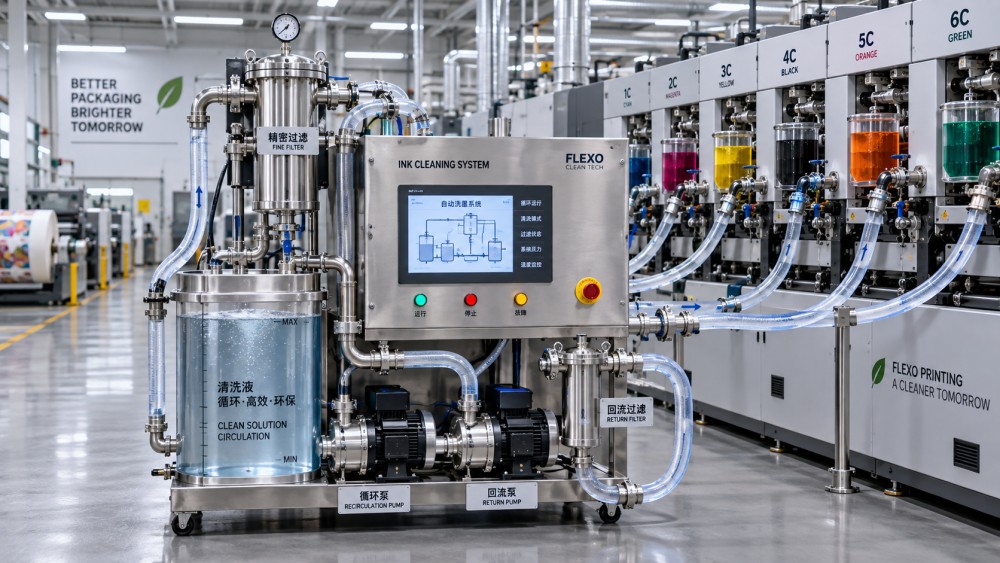
This repeatability matters when multiple crews run the same press. Rather than treating cleaning quality as an informal skill held by a few experienced operators, the press can follow a documented sequence with clear operator checks before the next ink is introduced. The resulting process is easier to train, review, and improve.
Where the time reduction actually comes from
The largest gains usually come from removing waiting and repeated manual actions, not from making every cleaning step instantaneous. An automated wash-up cycle can continue circulating or rinsing while the operator performs nearby tasks that still require human attention. For example, while the system flushes an ink circuit, the operator may prepare the next chamber, stage plates, inspect the anilox condition, confirm the next ink specification, or coordinate substrate readiness.
Time can also be reduced because the system follows an established endpoint. In a manual process, operators may flush longer than necessary to avoid contamination risk, or flush too briefly and then repeat the procedure after a problem appears. A properly developed automatic cycle gives a more consistent balance between cleaning thoroughness, wash-fluid use, and changeover duration.
Another source of improvement is faster fault recognition. When wash cycles are standardized, an abnormal condition stands out. Slower-than-usual draining, weak circulation, unexpected fluid color after a final rinse, or repeated alarms can indicate a blocked filter, a worn pump component, a valve issue, or a restricted line. In a fully manual routine, these signs may be masked by differences in individual working methods.
Map the existing changeover before specifying equipment
Before selecting or configuring an automatic flexo wash up system, break the current process into observable steps. It is not enough to ask how long a complete job change takes. The useful question is where the time is being consumed and which tasks can genuinely overlap.
A practical review should separate the following:
- Time from the last acceptable printed sheet to ink circulation shutdown.
- Ink recovery, drain-down, and disposal or reuse procedures.
- Cleaning of chambers, pumps, hoses, filters, and return lines.
- Manual cleaning of anilox rollers, plates, trays, guards, and exposed surfaces.
- Preparation and connection of the next ink supply.
- Time needed to stabilize color and obtain production approval after restart.
This map often reveals that a wash-up project should not focus only on pump speed or rinse duration. A press may have a fast automated flushing cycle but still lose time because wash fluid is not staged, drain points are poorly located, next-job ink is unavailable, or chamber removal requires excessive manual work. The system should be evaluated as part of the entire changeover path rather than as an isolated accessory.
Match the cleaning method to the ink and press layout
The correct system design depends on the ink chemistry, number of print units, ink delivery arrangement, and cleaning expectations between jobs. Water-based ink applications may prioritize effective water or compatible cleaning-agent circulation, control of dried residue, and management of recovered liquid. Solvent-based operations require suitable materials, vapor control, safe handling arrangements, and compatibility with the cleaning medium. UV ink applications may need dedicated procedures because incomplete removal can affect subsequent color performance and create persistent buildup.
Press layout is equally important. A short, direct circulation route is easier to clean than a system with long hoses, multiple branches, shared pumps, and difficult return paths. Each dead leg or low-flow section can retain residual ink. When specifying automation, identify every component that contacts ink and determine whether the system can flush it effectively. A wash sequence that cleans the chamber well but bypasses a shared hose section may still cause contamination on the next job.
Build a wash cycle around proven operating conditions
Automation should be commissioned with production realities in mind, not only with an ideal cleaning demonstration. Start by grouping common job transitions: similar color to similar color, dark to light, process colors to spot colors, water-based to water-based, and any change involving a different ink family. Each group may require a different approved cycle.
For each cycle, define the required starting state. This may include stopping ink feed at the correct point, recovering usable ink where applicable, isolating the relevant station, confirming the intended wash fluid, and checking that drains and return containers are ready. Poor preparation can cancel the benefit of an automated process; a cycle cannot run efficiently if an operator must stop it to correct a missing connection or closed valve.
Then establish the cleaning endpoint using observable criteria rather than a vague instruction to “wash until clean.” Depending on the operation, this can include visual inspection of return fluid, confirmation that no visible residue remains in the chamber, inspection of filters, a prescribed final rinse condition, and a test print during restart. The endpoint should reflect the risk level of the upcoming job. A transition to a pale brand color may warrant more careful verification than a move between similar dark shades.
Do not treat cycle time as the only setting
Reducing a wash cycle by shortening every timer may look productive on paper, but it can create a false economy. Insufficient circulation may leave contamination in line sections, while excessive pressure can create splashing, leaks, or unnecessary wear in components not designed for it. The aim is to remove non-value-added delay while preserving a cleaning result that supports stable restart.
A better approach is to review each stage independently. Is ink recovery taking too long because of viscosity or line geometry? Is flushing limited by a restricted filter? Does the rinse step continue after the return fluid has reached an acceptable condition? Are operators waiting beside the press even though they could be completing another changeover task? These questions produce more useful adjustments than a blanket reduction in wash time.
Control the tasks that automation does not replace
Even a well-designed system cannot compensate for neglected mechanical condition. Doctor blades with excessive wear, damaged chamber seals, poorly seated hoses, contaminated filters, and worn pump parts can all extend cleaning cycles or cause incomplete wash-up. Anilox rollers also require their own cleaning discipline. Ink circulation flushing does not necessarily remove dried deposits from cells, and poor anilox condition can later be mistaken for an ink or color-control problem.
Operators should retain clear responsibilities at defined points in the cycle: inspect leak-prone connections, verify that the correct wash fluid has been selected, examine removed components where applicable, confirm safe drainage, and check that the next ink circuit is ready. Automation works best when it reduces repetitive handling without making ownership of these checks unclear.
Maintenance teams should also review recurring wash-up alarms and abnormal cycle durations. A gradually lengthening rinse cycle may be early evidence of reduced flow, valve performance issues, or buildup in a line. Addressing these conditions before they cause a production delay is more effective than repeatedly extending the programmed wash time.
Judge the investment by schedule reliability, not only labor reduction
Labor reduction is relevant, but the broader operational value is improved scheduling confidence. When cleaning time varies widely, planners need to add protective gaps between jobs. Those gaps reduce available press capacity even when the press is mechanically capable of more output. A more consistent wash-up process can make changeover duration easier to estimate and can reduce the need for informal recovery efforts later in the shift.
Evaluation should therefore include the full operational effect: manual attendance during cleaning, wash-fluid use, ink recovery practices, restart waste, color-contamination incidents, unplanned maintenance, and the degree to which cleaning can occur alongside other setup work. The right system is not necessarily the one with the shortest nominal cycle. It is the one that fits the press, ink system, plant procedures, and required quality level while making the next job easier to start correctly.
Questions that often arise during wash-up planning
Can one automated wash cycle be used for every color change?
Usually not. Similar-color transitions may need less rinsing than dark-to-light changes, and different ink chemistries can require different fluids and procedures. A small set of validated cycle types is generally more practical than trying to force every job through one setting.
Will automated wash-up remove the need to clean anilox rollers manually?
No. The system can clean the ink delivery path, but anilox cell condition needs separate attention. The required cleaning method depends on ink type, roller condition, and the press manufacturer’s operating guidance.
What is the first sign that a wash-up cycle needs review?
Look for repeated residual-color issues, inconsistent final rinse appearance, longer drain times, recurring filter blockage, or operators adding informal manual steps after the automated cycle. These are signs that the programmed sequence, fluid route, or mechanical condition may no longer match actual production conditions.
Related News
 How Quick Change Unwind Stands Reduce Downtime on Flexo PressesDiscover how quick change unwind stands reduce flexo press downtime, streamline reel changes, and improve productivity—plus key tips to assess integration and ROI.Print Fluidics Scientist
 How an Impression Roller for Flexo Printing Affects Print QualityDiscover how an impression roller for flexo printing influences ink transfer, dot gain, alignment, and print consistency. Learn practical setup and troubleshooting tips.Print Fluidics Scientist
 Why Color Measurement Systems Matter for Consistent Flexo PrintingColor Measurement Systems help flexo printers achieve consistent brand colors, reduce waste, improve traceability, and protect packaging quality across every production run.Print Fluidics Scientist
 What to Check Before Choosing a Print Dryers Supplier for Your PressPrint dryers supplier selection guide: compare drying methods, press integration, energy use, maintenance, safety, and support to improve print quality and uptime.Print Fluidics Scientist
 How to Compare Web Tension Controller Manufacturers for Flexo PressesWeb tension controller manufacturer comparison guide for flexo presses: assess stability, sensing, integration, service, and real-world substrate performance.Print Fluidics Scientist
 How Hot Air Print Dryers Improve Ink Drying on Flexo LinesHot air print dryers improve flexo ink drying with balanced airflow, controlled heat, and reliable results for faster packaging production.Print Fluidics Scientist