How Sheet Stackers for Flexo Press Reduce Handling Bottlenecks
A flexographic press can maintain its rated printing speed and still create a production bottleneck at delivery. The problem often becomes visible when printed sheets begin arriving faster than operators can square, count, inspect, remove, and transfer them. Piles drift out of alignment, operators pause the press to clear the delivery area, or downstream die-cutting and finishing teams wait for usable loads. In this situation, the press is not necessarily the constraint; sheet handling is.
Sheet stackers for flexo press reduce this bottleneck by turning loose, high-speed printed output into stable, counted, aligned stacks that can move directly to inspection, storage, die-cutting, or other converting stages. For an engineering project, their value is not limited to reducing manual labor. A properly matched stacker helps protect print quality, keep press delivery continuous, make job quantities easier to control, and create a more predictable interface between printing and the next process.
Where the handling bottleneck usually starts
Flexo delivery problems rarely begin with one obvious failure. They tend to emerge when several operating conditions overlap: higher press speed, lightweight or warped board, frequent job changes, short delivery windows, limited floor space, or a downstream process that requires clean and square stacks. Manual collection may appear workable during steady, long runs, but its limits become more visible when orders change frequently or when printed sheets need careful handling before converting.
Typical warning signs include operators repeatedly touching stack edges to restore alignment, irregular pile height, mixed or uncertain quantities, sheets slipping at the delivery end, and brief press slowdowns while material is removed. These symptoms can be dismissed as normal production activity. However, each manual correction introduces variation. It may affect stack stability, increase the chance of scuffing or edge damage, and make the actual printed output harder to reconcile with the job order.
The operational consequence is often larger than the delivery section itself. A die-cutter may receive uneven loads that require restacking. An inspection station may need more time to separate sheets. Forklift or pallet handling becomes less stable when piles are not square. When printed sheets carry detailed graphics, barcodes, varnish, or fresh ink, excess contact also raises the risk of marking the surface before the product reaches the next stage.
What a stacker changes in the press-to-converting flow
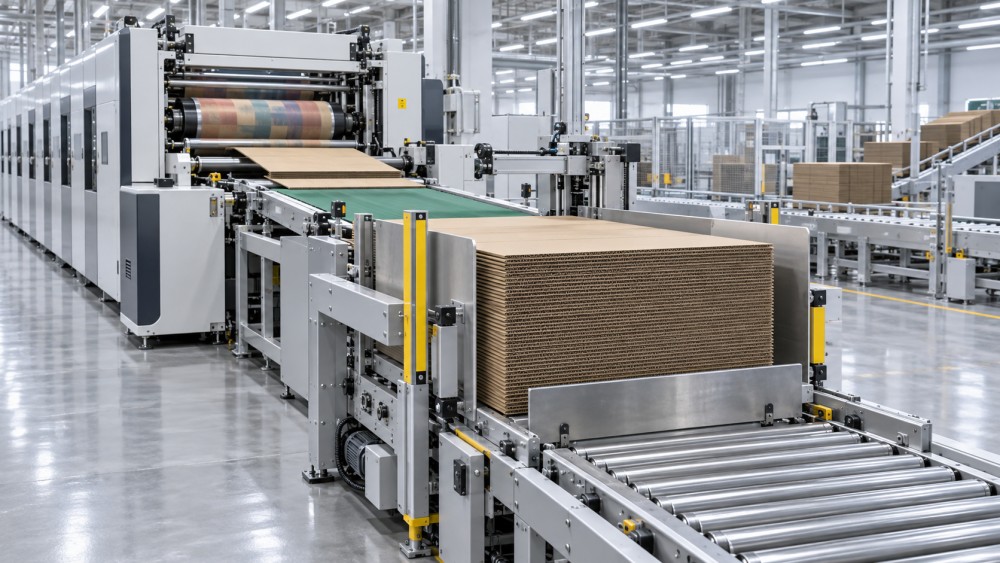
A sheet stacker receives sheets from the flexo press delivery, decelerates and positions them, forms a controlled pile, and supports transfer once the target stack condition is reached. Depending on the line arrangement, the system may include delivery belts, side joggers, front stops, squaring mechanisms, counting functions, pile-height control, sheet separation features, and an outfeed or pallet transfer arrangement.
The essential improvement is controlled accumulation. Rather than asking operators to react to every arriving sheet, the equipment establishes repeatable handling conditions. Sheets are guided into a defined position, and the stack becomes a production unit that can be identified, checked, and moved with less intervention. This does not eliminate the need for operator oversight, especially during setup or material changes, but it removes much of the repetitive handling that interrupts stable press operation.
For project planning, it is useful to view the stacker as an interface rather than an accessory. Its performance affects three connected areas:
- Press continuity: the delivery must accept sheets without forcing unnecessary speed reductions or stops.
- Stack quality: the finished pile must remain square, stable, and suitable for the next handling method.
- Transfer readiness: stacks must be removable or conveyed away without blocking the next production cycle.
A stacker that only forms neat piles but requires a long interruption for every removal may simply shift the bottleneck. Likewise, a fast transfer system has limited value if it cannot maintain sheet control on lightweight, curled, or statically charged substrates. The selection process should therefore begin with actual production behavior, not with nominal press speed alone.
Start with the material and the delivery condition
Sheet behavior determines whether an automated stacker will run smoothly. Printed corrugated sheets, solid board, folding carton blanks, and coated paperboard can react very differently at delivery. Their stiffness, moisture condition, flute direction, cut quality, surface coating, ink coverage, and residual curl influence how reliably they enter a stack.
Lightweight sheets can be more sensitive to air movement and static. Larger corrugated sheets may sag or bounce as they leave the conveyor. Board with uneven moisture can curl, making front-edge registration less consistent. Heavy ink coverage or coating may require careful attention to contact points and stack pressure to avoid scuffing. Sheets that are dimensionally stable at the feeder may behave differently after printing because of heat, moisture, ink, or mechanical transport through the press.
Before specifying equipment, the project team should document the practical sheet range, not only the ideal or most common format. Include minimum and maximum sheet size, thickness range, board grade, typical warp patterns, printed-side sensitivity, maximum pile height, and the percentage of orders that use unusual materials. A stacker designed only around the dominant product may become difficult to use when production shifts to smaller sheets, lighter grades, or high-value printed work.
Watch the transition from press conveyor to stack formation
The transfer point between the press and the stacker deserves close attention. Sheet speed, overlap condition, conveyor geometry, and deceleration all affect alignment. If the sheet arrives with too much speed or inconsistent spacing, even strong side joggers may struggle to correct its position without damaging edges. If deceleration is too abrupt, the sheet can buckle, skid, or strike the front stop inconsistently.
Project teams should confirm how the delivery system handles sheets at different press speeds, rather than assuming one setting will work across every job. Stable operation often depends on coordinated adjustment among delivery belt speed, sheet gap, side-guide position, front-stop action, and pile-height control. These settings should be accessible enough for production personnel to repeat during order changes.
Match stacking capacity to the real production rhythm
Capacity is often discussed as sheets per minute, yet the more useful question is whether the entire handling sequence can keep pace over a complete production cycle. That cycle includes pile formation, counting or batch separation, stack removal, pallet exchange, operator access, and release of the next stack. A system may handle high incoming sheet speed but lose efficiency if completed stacks cannot leave the area promptly.
Consider an operation where the press produces a consistent stream of printed sheets but downstream converting requires specific batch quantities. In this case, accurate count management may be more important than maximum pile height. In another operation, large corrugated sheets may require tall, mechanically stable stacks so that handling equipment can move them efficiently. A short-run environment may benefit more from quick format adjustment and easy batch separation than from a large accumulation capacity.
Stack removal is particularly important. Determine whether the process will use manual removal, pallet handling, automatic outfeed, or connection to a conveyor system. Manual removal can remain appropriate where volumes are limited and floor layout is constrained, but it should be assessed honestly. If operators must enter a restricted area, wait for a safe stop condition, or repeatedly reposition a pallet, the labor task can become the new limiting factor.
Design the automation boundary, not just the machine footprint
A sheet stacker performs best when the surrounding workflow is defined. That includes how jobs are identified, how piles are labeled, who verifies counts, where inspection occurs, and how stacks travel to the next machine. Without these decisions, automated stacking may produce orderly piles while information and material movement remain disorganized.
For example, count marking or batch separation can support downstream control only when the production team agrees on what a batch represents. It may be a converting lot, a pallet quantity, an inspection sample interval, or a customer delivery unit. The chosen logic should fit the actual workflow. Creating arbitrary batch breaks simply because the stacker can do so can increase handling rather than simplify it.
Integration with production data also needs a practical purpose. Useful information may include job number, target quantity, completed stack count, reject-related events, or delivery stoppage time. The objective is not to collect every available signal. It is to make exceptions visible: a stack that was stopped early, an unusual number of delivery interruptions, a quantity mismatch, or a job that required repeated manual alignment.
Layout questions that should be resolved early
The physical space around the stacker has a direct effect on uptime. A layout review should account for operator access, pallet supply, full-stack removal, safe travel paths, inspection space, and maintenance clearance. It should also consider where rejected sheets are collected. When reject material is allowed to accumulate near the delivery section, it can interfere with normal stack handling and make quality disposition less clear.
- Can a completed stack leave the line without crossing the operator’s normal working path?
- Is there sufficient room to stage empty pallets and full loads separately?
- Can personnel reach side guides, sensors, belts, and stop mechanisms for cleaning and adjustment?
- Will the next converting stage receive stacks in the orientation and height it expects?
- Does the installation leave room for future conveyor, inspection, or palletizing integration?
These are not minor commissioning details. A compact installation can look efficient on a drawing but become difficult to operate if every pile removal requires temporary rearrangement of materials or equipment.
Prevent quality losses caused by poor stack formation
Print defects are not always created in the printing unit. Delivery handling can make otherwise acceptable sheets unsuitable for conversion or shipment. Edge crush, corner damage, scratched graphics, blocking, and mixed quantities may emerge after the press has already achieved good registration and color.
Stack squareness is a useful quality indicator because it reflects several conditions at once: sheet arrival consistency, guide setup, deceleration behavior, pile support, and substrate stability. When stacks lean or edges become progressively uneven, operators may compensate by hand. That action can keep production moving temporarily, but it masks the underlying issue. The better approach is to identify where control is being lost.
Begin with the sheet path. Check whether the problem occurs at one format, one board grade, one speed range, or across all jobs. Then examine incoming sheet spacing, conveyor cleanliness, guide positions, static control where relevant, and the condition of belts or contact surfaces. Confirm that pile-height sensing responds correctly; an incorrect height relationship can change the impact and alignment behavior of every arriving sheet.
Fresh ink and coated surfaces need separate consideration. The stacker should not introduce excessive localized pressure or dragging contact. Yet an overly loose pile may shift during transfer. The right setup balances surface protection with mechanical stability, and it may differ between a lightly printed shipping case and a densely printed retail-facing board.
Commissioning should test disruption, not only ideal running
A successful acceptance run should include more than a stable demonstration with one standard sheet. The stacker needs to be evaluated through the disruptions that occur in routine production: speed changes, stack exchanges, short setup periods, different sheet sizes, minor curl, and jobs that require batch control. Testing should verify that the press can resume normal output without prolonged intervention after a completed stack is transferred.
Documenting usable settings matters as much as finding them. Operators need a clear method for setting guides, pile height, delivery speed relationship, and batch quantity. Where control systems support stored recipes, the team should decide which settings are genuinely repeatable and which still require material-specific judgment. A recipe is helpful only when it reflects a proven starting condition and personnel understand when to depart from it.
Maintenance responsibilities should also be established during commissioning. Dust, paper fibers, ink residue, worn belts, contaminated sensors, and loose guide components can gradually degrade stacking quality. Because the decline is often gradual, it may be noticed first as more manual correction rather than as a clear equipment fault. Tracking delivery-related stops and hand-adjustment frequency can reveal the issue before it causes larger interruptions.
When a stacker is the right answer—and when it is not enough
Sheet stackers for flexo press are most valuable when printing output is routinely delayed by manual collection, when stack consistency affects downstream efficiency, or when the press line is being upgraded toward more continuous material flow. They are especially relevant where frequent handling damages printed surfaces, where quantity control is difficult, or where labor must be focused on inspection and exception management instead of repetitive pile formation.
They will not solve every delivery problem by themselves. Persistent registration defects, poor sheet condition, unstable feeder performance, excessive board warp, or inadequate downstream capacity can remain limiting factors. If the next machine cannot consume stacks at the available rate, the project may require buffer capacity, conveying, scheduling changes, or a broader end-of-line design rather than a stacker alone.
The strongest investment decision comes from tracing the sheet from the last printing unit to the first downstream processing point. Measure where operators intervene, where stacks wait, where damage appears, and where information about quantity or job status is lost. The resulting specification can then focus on the handling functions that remove the actual constraint instead of adding automation that looks capable but does not improve the production flow.
Related News
 How an Impression Roller for Flexo Printing Affects Print QualityDiscover how an impression roller for flexo printing influences ink transfer, dot gain, alignment, and print consistency. Learn practical setup and troubleshooting tips.Print Fluidics Scientist
 Why Color Measurement Systems Matter for Consistent Flexo PrintingColor Measurement Systems help flexo printers achieve consistent brand colors, reduce waste, improve traceability, and protect packaging quality across every production run.Print Fluidics Scientist
 What to Check Before Choosing a Print Dryers Supplier for Your PressPrint dryers supplier selection guide: compare drying methods, press integration, energy use, maintenance, safety, and support to improve print quality and uptime.Print Fluidics Scientist
 How to Compare Web Tension Controller Manufacturers for Flexo PressesWeb tension controller manufacturer comparison guide for flexo presses: assess stability, sensing, integration, service, and real-world substrate performance.Print Fluidics Scientist
 How Hot Air Print Dryers Improve Ink Drying on Flexo LinesHot air print dryers improve flexo ink drying with balanced airflow, controlled heat, and reliable results for faster packaging production.Print Fluidics Scientist
 How to Choose a Plate Cylinder Manufacturer for Reliable Print QualityChoose a reliable plate cylinder manufacturer with proven precision, balance control, material expertise, and press compatibility for consistent print quality.Print Fluidics Scientist