How Quick Change Unwind Stands Reduce Downtime on Flexo Presses
Quick change unwind stands reduce downtime on flexo presses by moving reel preparation outside the production stop and shortening the work that must happen while the web is stationary. Their value is greatest when unloading, loading, aligning, and threading a replacement reel account for a meaningful share of lost production time. A faster stand delivers less benefit when the press is already waiting for plate changes, ink preparation, cleaning, or downstream equipment.
For an engineering project, the first distinction is whether the proposed system simply makes a stopped reel change faster or can keep the press supplied during a splice. Both can improve output, but they require different equipment and investment. A stand with two reel positions does not automatically provide continuous operation. The splice mechanism, web storage, tension controls, and press interfaces determine what happens when one reel ends and the next takes over.
Start by measuring the complete reel-change interruption. Timing only the mechanical exchange can hide the losses that matter most: waiting for a replacement reel, finding the web edge, correcting alignment, rebuilding tension, and running material until print quality returns. For production planning, the useful interval runs from the last acceptable output before the change to stable, acceptable output afterward.
Where the stand removes time from a reel change
A conventional change can leave several tasks dependent on the press stopping. The operator removes the spent core, brings in a new reel, engages the shaft or chucks, centers the material, opens the wrapping, prepares the leading edge, and threads or joins the web. Some activities require physical access to the same space, so adding another operator may do little to shorten the sequence.
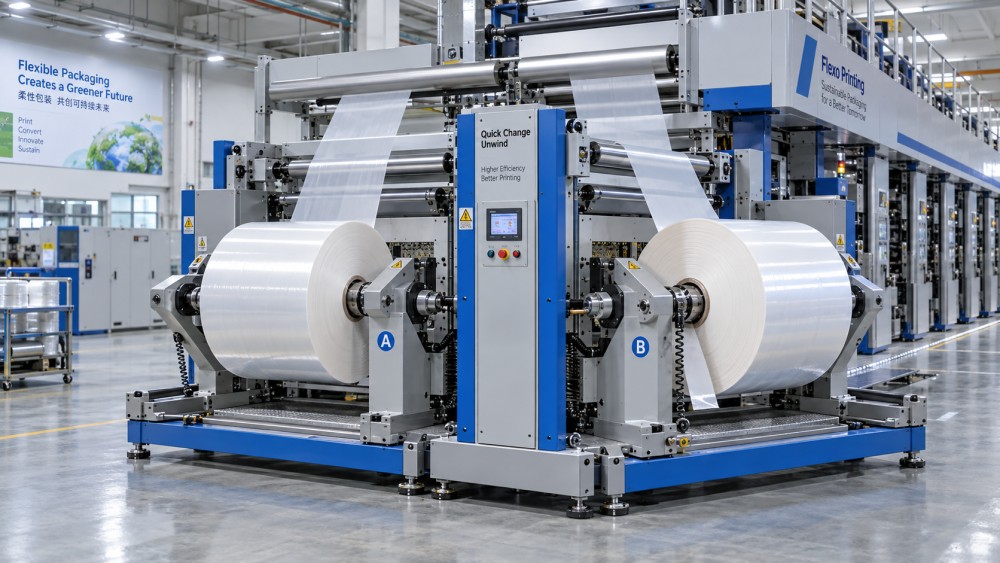
A suitable quick change arrangement allows more of this work to happen while the current reel is running. With an accessible standby position, the replacement reel can be loaded, checked, aligned, and prepared before the active reel reaches its change point. The remaining stop then covers a smaller set of transfer and restart tasks. The improvement comes from changing the sequence as much as from increasing mechanical speed.
The loading method also matters. Shaftless arms can remove the need to extract, handle, and reinsert a separate reel shaft, provided the reel cores and loading arrangement suit the design. Where shafts remain appropriate, prepared spare shafts, loading trolleys, and reliable positioning aids can still shorten the exchange. Either approach needs enough clearance for the reel to enter and for the operator to complete preparation safely.
Alignment features can reduce another source of delay. Repeatable lateral positioning helps present the replacement web to the existing web path with less correction. However, mechanical centering and automatic web guiding perform different jobs. A reel mounted near the intended position can still produce tracking problems if its winding condition, core alignment, or web path is unsuitable. The project should establish how initial reel position and running web guidance work together.
These benefits depend on reel delivery. A standby station cannot save preparation time if the next reel arrives only after the press stops. The operating arrangement needs a defined staging location, a practical handling route, and responsibility for checking the next reel. Material identification, winding direction, width, core condition, and visible damage should be checked before loading becomes urgent.
Choose the change method around the interruption you need to remove
For a press that can tolerate a short planned stop, a quick mechanical exchange with a manual splice may be sufficient. The incoming reel is prepared in advance, the press stops, the webs are joined, and production restarts. This arrangement can remove substantial handling work from the stopped period without requiring a system designed to splice at production speed. Its remaining limits are the splice procedure and the time needed to regain stable printing.
Continuous feed requires additional functions. In a flying splice arrangement, the incoming reel is brought to a suitable surface speed before the web is joined and the expiring web is cut. In a zero-speed splice arrangement, the web stops locally for the join while an accumulator supplies stored web to the running press. These approaches create different requirements for drives, controls, space, and material behavior.
An accumulator has a finite supply of web. Its usable storage must cover the splice sequence and the associated speed transitions at the required press demand. If the sequence takes too long or stored web is insufficient, the press must slow or stop. Likewise, a flying splice must be demonstrated across the intended reel and substrate range; successful operation on one material does not establish reliable operation on every grade.
The joint itself must also pass through the line. Tape, overlap, splice thickness, and any loose edge can affect passage through rollers, printing sections, dryers, and converting equipment. Some production routes require the splice and nearby material to be identified and rejected. Continuous web supply can therefore reduce downtime while still generating a controlled quantity of waste. That waste belongs in the performance assessment.
For short jobs, automatic reel splicing may offer limited benefit if each job ends before the reel is exhausted. A prepared second position may still speed substrate changes, but it will not eliminate plate, color, or cleaning work. For longer runs with repeated reel consumption, avoiding or shortening each reel-end stop can have a stronger effect on available production time. The order mix should decide which capability deserves investment.
Protect the time saving through tension and press integration
Fast loading is only part of a successful restart. The replacement reel must supply web under controlled tension as the press accelerates. Reel diameter and inertia change the demands on the unwind, while different substrates respond differently to tension variation. Poor control can produce web breaks, wrinkles, tracking disturbances, or registration instability, consuming the minutes saved during the physical change.
The engineering review should cover the complete operating envelope: reel width, diameter, mass, core dimensions, substrate properties, target speed, acceleration, and the required tension range. Maximum reel capacity alone is an incomplete specification. The unwind must also control the web as the reel approaches its core and through the transitions associated with stopping, splicing, and restarting.
Braking or drive capability, tension feedback, dancer behavior where used, and web-guide response need to suit the press. An upgrade can alter the distance between the reel and the first controlled draw point, introduce additional rollers, or change how the web enters the machine. Those changes can affect handling, particularly for materials sensitive to stretching, creasing, or surface damage. The proposed web path deserves review alongside the stand layout.
Control integration determines whether the mechanical improvement becomes a repeatable production improvement. The stand and press need coordinated signals for operating state, reel readiness, tension readiness, splice commands where applicable, and fault handling. The sequence should define what happens when a reel is missing, a splice fails, or tension leaves its permitted range. Operators need clear recovery steps that avoid unnecessary rethreading and repeated restart attempts.
Retrofitting also requires space for preparation while the active reel runs. A layout that fits the equipment footprint may still block access to the standby position or force reel transport across a working aisle. Guarding, lifting access, utilities, floor capacity, and maintenance clearance should be assessed with both reel positions occupied. Any time saving that depends on entering a hazardous area or bypassing an interlock is unsuitable as a production target.
Build the investment case from recoverable production time
Before requesting quotations, record a representative sample of reel changes across the main products and shifts. Separate waiting, unloading, loading, preparation, splicing or threading, and restart stabilization. Record whether other job-change work occurs at the same time. This reveals which activities a new stand can shorten and whether that reduction will move the press’s actual restart time.
Parallel work is especially important. If reel preparation finishes while a longer wash-up continues, reducing preparation further will not shorten that particular changeover. It may still reduce labor demand or make the process more predictable, but those benefits should be valued separately. For each production scenario, identify the activity that determines when saleable production can resume.
A useful first estimate is the number of relevant reel changes multiplied by the reduction in press interruption per change. Use observed change frequencies and a realistic proposed sequence. Treat the result as recoverable machine time before assigning a financial value. Recovered minutes generate additional sales only when orders, staffing, and downstream capacity allow the plant to use them.
The business case should distinguish among additional throughput, reduced overtime, lower handling labor, and reduced restart waste. Avoid counting the same recovered time as both extra production and labor savings unless the operating plan supports both. Include installation downtime, integration work, training, splice consumables, and the maintenance needs of any added drives, sensors, or accumulators. A mechanically simpler upgrade may be the better fit where its shorter planned stop meets production needs.
Performance acceptance should then test the promised production sequence. Agree where timing starts and ends, which preparations may occur before the stop, how many operators are involved, and what qualifies as acceptable output. A mechanical loading demonstration cannot establish the full downtime reduction if the press subsequently needs extended adjustment before printing stabilizes.
Trials should cover representative materials and the demanding conditions within the agreed operating range. Relevant cases include heavy reels, narrow webs, sensitive substrates, and reel changes at the required production speed. Alongside interruption time, record restart waste, web breaks, splice passage, alignment correction, and the time needed to restore acceptable registration. Repeated trials help reveal whether the sequence is dependable enough for scheduling.
Quick change unwind stands are a strong candidate when reel handling and preparation repeatedly keep an otherwise ready flexo press idle. Specify the project around the work that can move into running time, the interruption that remains, and the quality conditions required after restart. A practical acceptance target is a repeatable interval from the last good output on one reel to stable good output on the next, achieved with the materials, staffing, and handling arrangements the plant will actually use.
Related News
 How Do Flexo Wash-up Systems Reduce Ink Changeover Time?Discover how Flexo Wash-up Systems reduce ink changeover time, limit contamination, and improve press availability—and learn how to measure savings before investing.Print Fluidics Scientist
 How Can Flexo Wash-up Systems Reduce Press Downtime?Flexo Wash-up Systems reduce press downtime through consistent cleaning and faster changeovers. Discover how to prevent contamination and restart with confidence.Print Fluidics Scientist
 How Do Print Register Control Systems Improve Print Accuracy?Print Register Control Systems improve color alignment, reduce setup waste, and help prevent drift. Discover how they work and what to check for consistent print quality.Print Fluidics Scientist
 How to Choose Inline Color Measurement Systems for Flexo PressesChoose inline color measurement systems for flexo presses with confidence. Compare accuracy, substrate compatibility, integration, and production costs.Print Fluidics Scientist
 How to Choose a Printing Sleeve for a Flexographic PressChoose the right printing sleeve for your flexographic press. Compare fit, repeat length, materials and maintenance to improve print consistency.Print Fluidics Scientist
 How Impression Rollers Affect Flexographic Print QualityImpression Rollers can make or break flexographic print quality. Discover how to prevent common defects, protect substrates and improve consistency.Print Fluidics Scientist