How Hot Air Print Dryers Improve Ink Drying on Flexo Lines
How Hot Air Print Dryers Improve Ink Drying on Flexo Lines
On a fast flexographic line, drying is rarely just a “dryer problem.” When ink remains wet too long, the visible defect may be smudging at delivery, but the actual cost can spread much further: poor rub resistance, set-off between stacked sheets, color variation after the next print unit, slower converting, rejected barcode areas, and operators backing down press speed to keep the job moving.
This is especially familiar in corrugated post-printing and commercial packaging work, where substrate quality changes from order to order. A coated liner, recycled testliner, kraft board, or more absorbent paper surface will not all release moisture in the same way. Add changes in ink coverage, ambient humidity, anilox volume, and press speed, and a drying setting that worked well in the morning can become unstable after lunch.
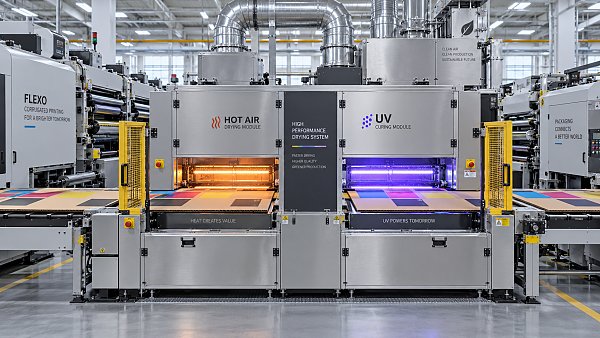
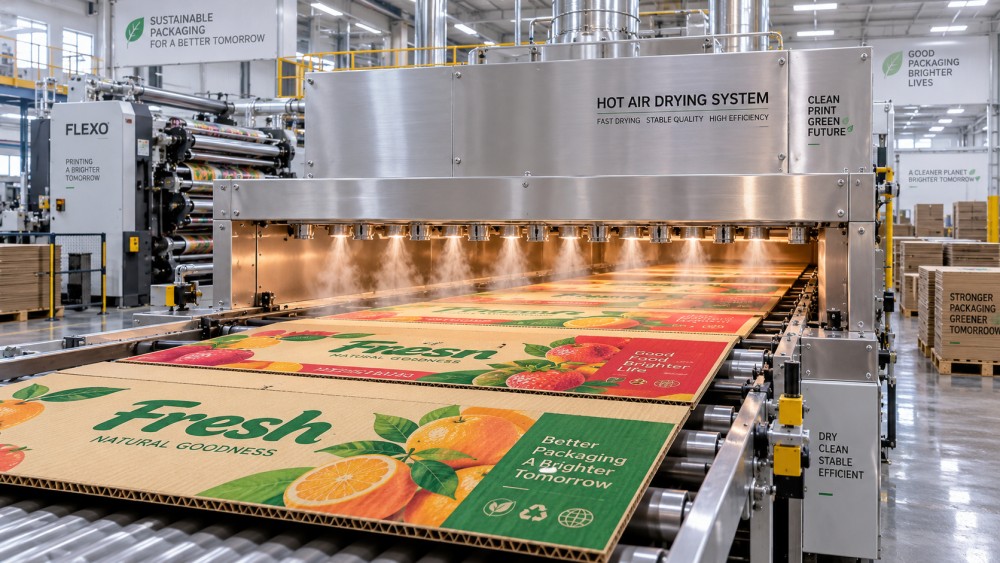
Hot air print dryers are used to make that process more controllable. Rather than relying mainly on natural evaporation between print stations, they direct heated airflow across the printed web or sheet. Done properly, the system removes water or solvent vapor from the ink film before the next process creates a quality risk. The important phrase is done properly: more heat is not automatically better drying.
What a hot air dryer is really doing
For most water-based flexographic inks, drying depends on heat transfer and air exchange. The dryer raises the energy available at the ink surface, while moving air carries evaporated moisture away. If the air around the print remains saturated with moisture, evaporation slows down even when the air temperature seems high. That is why airflow direction, volume, exhaust balance, and nozzle design can matter as much as the heater itself.
A well-designed hot air drying section normally creates a controlled sequence: warm air reaches the freshly printed surface, the boundary layer above the ink film is disturbed, moisture is lifted away, and exhaust removes humid air before it can settle back around the substrate. On multi-color flexo presses, this must happen without disturbing the sheet or web, affecting registration, or overheating a lightweight or moisture-sensitive board.
Operators often notice the benefit first as a more stable press. The last printed color is less likely to mark in the delivery section, and the next unit is less likely to pick up uncured or wet ink. But the bigger value is process consistency. When drying is repeatable, ink density adjustments, speed changes, and substrate changeovers become easier to judge because fewer variables are moving at once.
Why uneven drying causes more trouble than slow drying
Slow drying is obvious: the press cannot run at the intended speed, or operators see wet marks at delivery. Uneven drying is more deceptive. One side of the sheet may dry adequately while another remains tacky. A solid panel may behave differently from fine type or screened graphics. The leading edge may receive more air than the trailing edge. In some cases, the ink appears dry at the press but shows set-off after sheets are stacked under their own weight.
This matters in packaging because the print is often followed by die-cutting, creasing, folding, gluing, coding, or inspection. A wet or partially dried surface can collect dust, transfer ink onto transport belts, interfere with camera inspection, or reduce the consistency of a later operation. On shipping cartons, a small scuff mark may be acceptable in one application and unacceptable in another. For retail displays, branded folding cartons, pharmaceutical packaging, or barcode-heavy e-commerce boxes, the tolerance is usually tighter.
A hot air system improves this situation when it delivers air consistently across the effective print width. The practical objective is not merely to make the surface feel dry. It is to achieve enough drying uniformity that the sheet can travel, stack, convert, and ship without creating a delayed defect.
The operating variables that need to move together
Drying performance is affected by several linked settings. Treating them separately is a common source of unstable results. If press speed rises, dwell time inside the dryer falls. If ink coverage increases, the evaporation load rises. If a more absorbent liner is replaced with a less absorbent coated grade, the surface behavior changes again. A dryer setting that was safe for a light logo job may be insufficient for a job with broad solid areas.
The point is not that every job needs a new drying recipe. It is that the recipe should reflect the actual drying load. Experienced crews usually develop a clear sense of which combinations deserve extra attention: dark solids on less absorbent stock, dense graphics near the trailing edge, high-speed repeat jobs, and humid-day production are typical examples.
Airflow quality matters more than a high temperature setting
When a dryer underperforms, the instinct is often to increase temperature. That may help temporarily, but it can also introduce new problems. Excessive heat can dry the ink surface too aggressively while leaving moisture underneath, particularly where ink laydown is heavy. It may also affect board flatness, increase curl, change substrate moisture balance, or create handling issues downstream.
A better troubleshooting sequence begins with air delivery. Are nozzles clean and unobstructed? Is airflow balanced from operator side to drive side? Are dampers in the intended position? Is humid exhaust being removed efficiently? Has a filter, fan, duct, or recirculation path become restricted? These questions are less dramatic than changing a temperature setpoint, but they often reveal the real issue.
Nozzle position also deserves attention. Air directed too close to the sheet may create flutter, especially with lighter materials. Air directed too far away can lose useful velocity before it reaches the ink surface. The correct arrangement depends on press geometry, substrate behavior, print coverage, and the dryer design. It should be set according to equipment guidance and verified during normal production, rather than adjusted only after a quality complaint.
Drying cannot compensate for poor ink control
Hot air print dryers are a process tool, not a cure for every ink issue. If viscosity is outside the intended working range, pH management is poor for a water-based system, the anilox is delivering too much volume, or doctor blade performance is inconsistent, the dryer may be asked to remove more moisture than the press configuration was designed to handle.
This is why drying should be reviewed alongside the full print unit: ink supply, chamber and blade condition, anilox cleanliness, plate choice, impression settings, substrate storage, and press speed. A stable ink film is easier to dry than an unpredictable one. In corrugated printing, worn or contaminated anilox cells can be especially misleading; an operator may chase color strength with ink adjustments while the actual transfer condition is changing across the roll.
The same principle applies to color. Overdrying between stations can create its own complications if it affects trapping or makes later color adjustments less forgiving. The target is not maximum dryness after every unit. It is sufficient, controlled drying for the next production step.
Where dryers support faster changeovers and cleaner downstream work
Shorter runs and frequent order changes have made drying stability more valuable than it used to be. A long, repetitive job allows crews time to settle the press. Short runs do not. If every change from white-top liner to recycled board requires repeated speed reductions and drying adjustments, the lost time can be more significant than the time spent making plates or washing ink systems.
In an integrated packaging plant, the impact also extends beyond the press. Sheets that leave printing in a more consistent condition are less likely to create avoidable delays at die-cutting, folder gluing, coding, or automated handling. Vision inspection systems benefit when print contrast and code areas remain clean. Robotic palletizing and end-of-line conveying cannot correct set-off created earlier in the process.
This broader view is increasingly relevant when evaluating equipment investments. A dryer should not be judged only by its heater capacity or purchase cost. Energy use, exhaust requirements, maintenance access, fan reliability, noise, cleaning time, control integration, spare parts availability, and operator visibility all affect the long-term operating result. Platforms such as CPCS help connect these details to the realities of corrugated board production, flexographic printing, converting, and plant automation rather than treating each machine as an isolated purchase.
A practical check when print starts to mark
When smudging or set-off appears, avoid changing everything at once. That makes it difficult to identify the cause. A useful shop-floor sequence is to check whether the defect is limited to a specific color, print zone, substrate batch, or speed range. Inspect ink condition and laydown before increasing dryer heat. Then verify airflow, nozzle cleanliness, exhaust, and the condition of filters or ducts. Finally, check the sheet after it has been stacked or passed to the next operation; a press-side touch test alone is not enough.
If the problem is concentrated in heavy solids, investigate ink film thickness and anilox transfer. If it appears mainly on one side of the sheet, suspect airflow balance or a local mechanical issue. If drying varies significantly with weather conditions, plant air and exhaust conditions may deserve more attention than the print station itself.
The strongest hot air drying setup is usually not the hottest one. It is the one that gives operators a repeatable response across real production conditions: different board grades, varying coverage, changing speeds, and the unavoidable pressure of delivery schedules. When airflow, heat, ink control, and downstream handling are treated as one system, flexo lines run with fewer compromises and fewer surprises after the sheets leave the press.
Related News
 How an Impression Roller for Flexo Printing Affects Print QualityDiscover how an impression roller for flexo printing influences ink transfer, dot gain, alignment, and print consistency. Learn practical setup and troubleshooting tips.Print Fluidics Scientist
 Why Color Measurement Systems Matter for Consistent Flexo PrintingColor Measurement Systems help flexo printers achieve consistent brand colors, reduce waste, improve traceability, and protect packaging quality across every production run.Print Fluidics Scientist
 What to Check Before Choosing a Print Dryers Supplier for Your PressPrint dryers supplier selection guide: compare drying methods, press integration, energy use, maintenance, safety, and support to improve print quality and uptime.Print Fluidics Scientist
 How to Compare Web Tension Controller Manufacturers for Flexo PressesWeb tension controller manufacturer comparison guide for flexo presses: assess stability, sensing, integration, service, and real-world substrate performance.Print Fluidics Scientist
 How Hot Air Print Dryers Improve Ink Drying on Flexo LinesHot air print dryers improve flexo ink drying with balanced airflow, controlled heat, and reliable results for faster packaging production.Print Fluidics Scientist
 How to Choose a Plate Cylinder Manufacturer for Reliable Print QualityChoose a reliable plate cylinder manufacturer with proven precision, balance control, material expertise, and press compatibility for consistent print quality.Print Fluidics Scientist