How Does Offset Press Automation Reduce Job Changeover Time?
How Does Offset Press Automation Reduce Job Changeover Time?
How does offset press automation affect job changeover time? For commercial printers and packaging producers managing shorter runs and tighter delivery schedules, the answer lies in automated plate handling, preset ink control, registration systems, and digital job data. By reducing manual adjustments between jobs, automation can shorten setup cycles, limit waste, improve color consistency, and increase overall press availability.
That does not mean every automated press reaches production immediately after the previous job ends. A changeover still includes physical tasks, approval decisions, substrate preparation, proof review, and coordination with prepress and finishing. The practical value of automation is that it removes repeated trial-and-error work from the press crew’s routine. Instead of manually rebuilding settings from memory, operators begin with data, presets, and guided sequences that make the next job more predictable.
For carton printers, commercial print houses, and packaging plants, this matters most when work contains frequent version changes, multiple SKUs, seasonal promotions, brand color requirements, or mixed run lengths. A press may have impressive maximum speed, but its economic output depends heavily on how much time is spent producing saleable sheets rather than washing units, loading plates, correcting register, or pulling waste sheets for color adjustment.
The Changeover Problem Is Larger Than Plate Replacement
A conventional offset job changeover is often treated as a sequence of separate manual activities: remove old plates, mount new ones, wash blankets and ink rollers where required, replace or adjust ink, set feeder and delivery conditions, establish side and circumferential register, bring color to target, and obtain approval. In reality, these steps affect one another. If the substrate is not prepared correctly, feeder stability may delay color approval. If a plate is mounted inaccurately, registration correction takes longer. If ink settings start too far from the required target, the press may consume a significant number of sheets before it reaches a stable condition.
The bottleneck is therefore not only labor time. It is the variability built into manual setup. Experienced operators can compensate for many problems, but a factory cannot scale its performance by relying entirely on individual judgment. Automation turns recurring setup knowledge into repeatable machine actions and stored job parameters.
This is especially relevant in folding carton production. A carton may move from offset printing to coating, die-cutting, stripping, folding, gluing, coding, inspection, and palletizing. A delay at the press can disrupt the entire downstream schedule. Conversely, an apparently fast press changeover has limited value if the next job arrives at finishing without correct color, barcode legibility, or stable sheet dimensions.
Where Automation Removes Time From the Setup Cycle
The most useful press automation does not come from one feature. It comes from connecting several functions so that the press receives job information early and executes adjustments in a controlled order. The exact configuration differs by press format, age, ink system, substrate range, and production mix, but several areas usually deserve close attention.
Automated plate loading and removal
Automatic plate changing reduces the manual handling required at every printing unit. It can also improve consistency because plate loading follows a defined sequence rather than depending entirely on operator technique. On multi-color work, the benefit is not simply that plates move faster. The press crew can prepare other elements of the next job while the plate sequence is underway, reducing idle time between tasks.
However, plate automation should be evaluated with the prepress workflow in mind. Plates need correct identification, orderly staging, reliable imaging, and a job file that matches the press configuration. A plate changer cannot correct weak file preparation, last-minute artwork revisions, or a plate logistics process that leaves the next set unavailable at the press.
Ink presetting based on digital image data
Ink presetting is one of the clearest examples of how digital job data affects physical setup. Instead of opening ink keys from a generic starting position, the system uses image-area information to establish an initial ink profile across the sheet. The operator still monitors the result, particularly when changing substrate, ink series, coating conditions, or coverage patterns, but the first pull is normally closer to the intended target than a fully manual start.
The real gain is often reduced convergence time: fewer rounds of adjusting, running, measuring, and adjusting again. This can lower the volume of sheets produced before the job is stable. For packaging printers working with brand colors, the impact may be as important as the minutes saved, because color variation can trigger approval delays or create rework further down the line.
Closed-loop color and register control
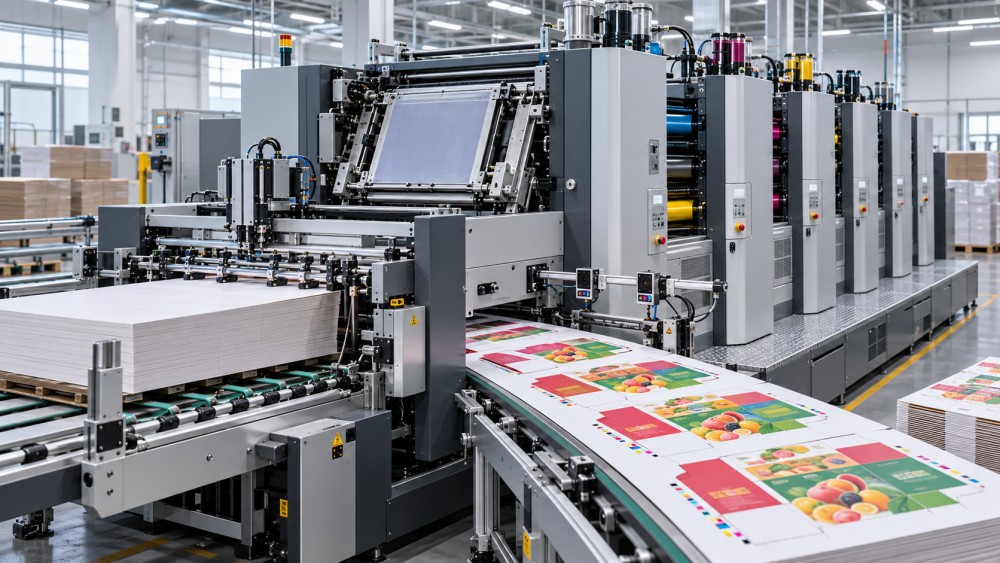
Automatic color measurement and register control can shorten the period between startup and approved production. Registration systems detect print marks and correct positional deviation. Color control systems compare measured values with defined targets and adjust ink delivery according to the selected workflow. Their usefulness is highest where the production environment is disciplined: measurement conditions must be consistent, targets must be defined correctly, and the press must be mechanically maintained.
Automation does not eliminate the need for human judgment. Operators still need to recognize issues such as paper variation, plate damage, fountain solution imbalance, ghosting, set-off risk, or a defect that lies outside the color control loop. What changes is the nature of the work. Instead of spending most of the setup period making repetitive corrections, the operator can focus on exceptions that actually require expertise.
Preset feeder, delivery, and cylinder settings
Job changeover also depends on the time required to make the sheet run reliably. Automated or motorized presets for feeder, delivery, format-related settings, and selected cylinder adjustments can reduce the number of manual interventions needed when moving between stock types or sheet sizes. For cartonboard, coated paper, specialty substrates, and jobs with different finishing requirements, stable sheet transport is essential to prevent false starts, marking, register variation, and pile-delivery problems.
The limitation is straightforward: stored settings are only as useful as the production conditions they represent. A job record from one substrate lot may not perform identically with another. Humidity, board stiffness, grain direction, coating, curl, and static can all affect press behavior. Presets provide a strong starting point, not a guarantee that no fine adjustment will be needed.
Job Data Is the Link Between Automation and Repeatability
A highly automated press still loses time if job information arrives late, is incomplete, or must be re-entered manually. The more useful approach is to treat the press as part of a connected production workflow. Prepress, planning, press operation, quality control, and finishing should work from compatible job identifiers and agreed production data.
A good job record may include plate sequence, ink and coating instructions, substrate details, target color values where applicable, feeder and delivery settings, approval notes, and known risks from prior runs. When repeat work returns, this record gives the team a practical baseline. When a job is new, it creates a structured handoff rather than relying on emails, handwritten notes, or verbal instructions.
This is why press automation is increasingly discussed together with production management systems. The press itself carries out the mechanical actions, but scheduling and data management determine whether the correct job is ready at the right time. In a packaging plant, the value grows when job data also supports die-cutting setup, folder gluer instructions, coding requirements, vision inspection criteria, and batch traceability.
What Should Be Measured Before Investing?
A decision based only on claimed changeover speed can be misleading. The useful question is not “How fast can the press change jobs under ideal conditions?” but “Where does this factory lose time and waste in its actual order mix?” A plant with long, repetitive runs may prioritize uptime and maintenance stability. A producer handling many short-run cartons may gain more from plate automation, rapid presetting, and digital job recall.
Before comparing automation options, production teams should map the current changeover in detail. Record when the prior job is considered complete, when the next job’s plates and materials arrive, how long washing and loading take, how many adjustments are made before approval, and where operators wait for information or quality decisions. It is equally important to separate unavoidable process time from avoidable delay.
- Changeover frequency by shift, week, and product category.
- Average and variable setup time, not only the best observed result.
- Startup sheets, rejected sheets, and the reasons they are rejected.
- Time spent waiting for plates, ink, substrate, approvals, or job clarification.
- Differences between operators, shifts, substrates, and repeat versus new jobs.
- Downstream consequences, including delays at coating, die-cutting, or folding and gluing.
This baseline also prevents a common mistake: buying advanced automation while leaving surrounding processes unchanged. If plates are manually searched for, color targets are not controlled, or the finishing department cannot accept work at the resulting pace, the investment may not deliver its full operational value.
Automation Changes Roles, Not Just Machine Movements
Some factories frame automation as a way to reduce dependence on operators. That view is too narrow. In practice, automation reduces dependence on manual repetition while increasing the importance of process discipline. Operators need to understand job data, measurement results, alarms, maintenance conditions, and the relationship between press settings and substrate behavior. Maintenance teams need the capability to support sensors, drives, software updates, and mechanical systems together.
Training should therefore cover more than button operation. The team needs clear procedures for job preparation, exception handling, color approval, cleaning routines, data correction, and recovery after interruptions. A press that is technically capable of fast changes can still become slow if staff do not trust the presets, override them inconsistently, or lack a common standard for when production is ready to release.
The Risks Behind the “Fully Automated” Claim
Automation should be assessed as a production system, not a collection of impressive functions. Integration complexity, software compatibility, service coverage, spare parts access, cybersecurity practices, and long-term support all deserve attention. This is particularly relevant when retrofitting older presses, where mechanical condition and control architecture may limit what can be added effectively.
There are also process risks. Aggressive changeover targets can encourage teams to shorten cleaning or verification steps that remain necessary for quality. In regulated or brand-sensitive applications, a fast startup is not enough; printed information, color, codes, and variable data must still meet the required inspection and release process. A factory should not confuse automation with automatic compliance.
For this reason, project reviews should consider the complete workflow: prepress readiness, press configuration, ink and substrate management, quality control, finishing capacity, and operator training. The right level of automation may be different for a commercial printer producing varied marketing materials than for a carton plant running repeatable packaging programs at high volume.
A More Useful Way to Evaluate Offset Press Automation
Offset press automation reduces job changeover time by making setup actions faster, more coordinated, and less dependent on manual correction. Automated plate changes, ink presets, register control, color measurement, and stored job settings can all contribute. Yet the strongest results come when these functions are supported by accurate data and a factory workflow designed around short, controlled handoffs.
For equipment buyers and production managers, the practical next step is to compare automation packages against their own job history rather than against a generic demonstration. Review the order mix, startup waste, bottlenecks, existing digital workflow, maintenance capability, and downstream constraints. Global Commercial Print & Corrugated Packaging Intelligence (CPCS) examines offset printing, converting, inspection, and packaging factory automation through this wider operational lens, helping project teams connect machine features with the conditions that determine whether faster changeovers are genuinely achievable.
Related News
 How an Impression Roller for Flexo Printing Affects Print QualityDiscover how an impression roller for flexo printing influences ink transfer, dot gain, alignment, and print consistency. Learn practical setup and troubleshooting tips.Print Fluidics Scientist
 Why Color Measurement Systems Matter for Consistent Flexo PrintingColor Measurement Systems help flexo printers achieve consistent brand colors, reduce waste, improve traceability, and protect packaging quality across every production run.Print Fluidics Scientist
 What to Check Before Choosing a Print Dryers Supplier for Your PressPrint dryers supplier selection guide: compare drying methods, press integration, energy use, maintenance, safety, and support to improve print quality and uptime.Print Fluidics Scientist
 How to Compare Web Tension Controller Manufacturers for Flexo PressesWeb tension controller manufacturer comparison guide for flexo presses: assess stability, sensing, integration, service, and real-world substrate performance.Print Fluidics Scientist
 How Hot Air Print Dryers Improve Ink Drying on Flexo LinesHot air print dryers improve flexo ink drying with balanced airflow, controlled heat, and reliable results for faster packaging production.Print Fluidics Scientist
 How to Choose a Plate Cylinder Manufacturer for Reliable Print QualityChoose a reliable plate cylinder manufacturer with proven precision, balance control, material expertise, and press compatibility for consistent print quality.Print Fluidics Scientist