How Digital Web Tension Control Systems Prevent Print Defects
A press can appear stable at the unwind while defects develop several stations downstream: a barcode shifts slightly, a solid area shows banding, a coating edge wanders, or a wrinkle reaches the rewind and forces a stop. In web-fed printing and converting, these failures are often treated as separate print, ink, or material problems. Yet the underlying condition may be a changing force on the substrate.
A digital web tension control system prevents many print defects by measuring web tension continuously and adjusting brakes, drives, or dancer position fast enough to keep the web within a defined operating range. The goal is not simply to pull the material tight. It is to maintain the right tension for the substrate, roll condition, process section, and machine speed. When this is done correctly, the web travels more predictably through printing, drying, laminating, coating, die-cutting, and rewinding.
Why unstable tension becomes a visible print problem
Web tension is the longitudinal pulling force carried by paper, film, foil, labels, or other roll-fed materials. That force affects how the web stretches, tracks, contacts rollers, enters a print nip, and responds to speed changes. A small variation may not be obvious to an operator standing near the unwind, especially when the press is running at a moderate speed. At the print unit, however, tension variation can change the effective repeat length, alter web position, and disturb contact between the substrate and printing components.
In flexographic printing, unstable tension can contribute to register movement between colors, particularly when a light or extensible web responds to changing draw conditions. In gravure, coating, or pre-print operations, the same instability can affect coat weight appearance, edge alignment, or the uniformity of material passage through a nip. In digital web processes, inaccurate transport tension may influence media handling and downstream finishing accuracy even when the print engine itself is performing normally.
The defect is not always constant. A production team may see good registration at startup, gradual drift as the unwind roll diameter reduces, then a short period of wrinkling after an acceleration. This pattern is useful evidence. It suggests a control issue linked to changing roll inertia, brake response, speed synchronization, or an incorrectly tuned tension zone rather than a fixed image-setting problem.
The control loop behind stable web handling
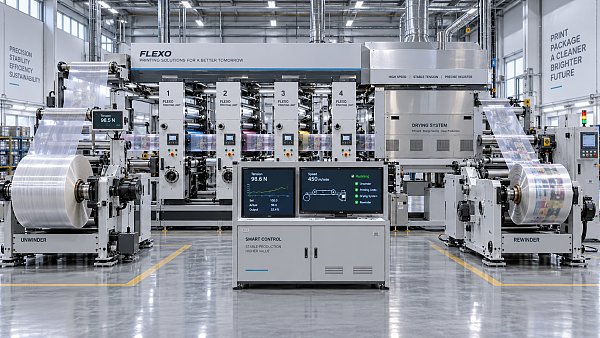
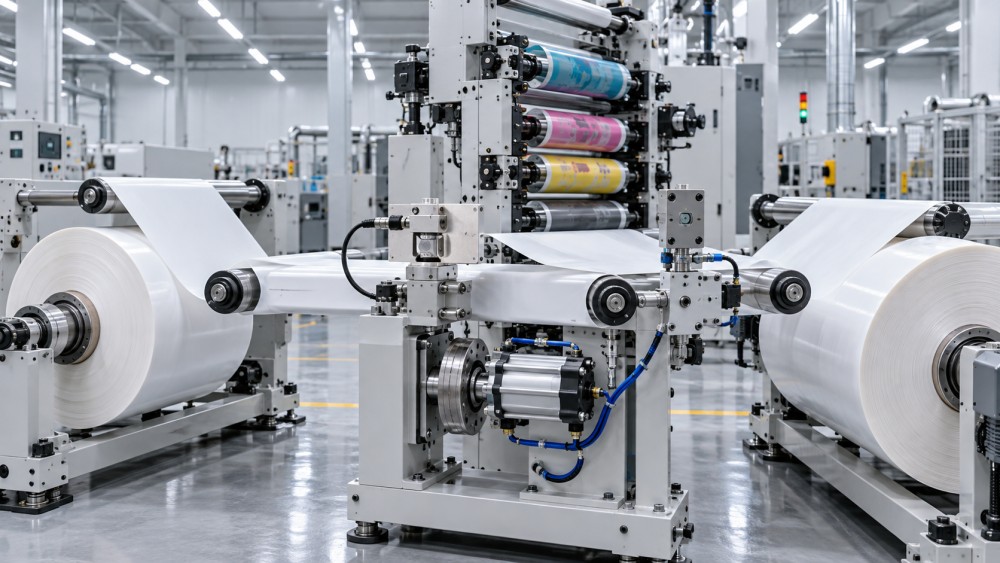
A digital system normally combines a tension sensor, controller, and output device. Load cells mounted on an idler roller measure the force applied by the web. A controller compares that live signal with a target value, then sends corrective commands to equipment such as a pneumatic brake, magnetic-particle brake, servo motor, AC drive, or regenerative drive. In dancer-based arrangements, position feedback may also be used to absorb short-term variation and maintain a stable web path.
Unlike a manually adjusted brake, a closed-loop system reacts as process conditions change. The unwind roll gets lighter and smaller; a splice passes through; machine speed rises; a coating station adds drag; or the rewind diameter builds. The controller does not remove every disturbance, but it reduces the amount of tension change that reaches sensitive print and converting sections.
The system is most effective when each web zone has a clear purpose. An unwind zone controls material leaving the supply roll. A process zone may isolate a printing unit, laminator, dryer, or coater from disturbances elsewhere. A rewind zone maintains winding quality as the finished roll grows. Treating the whole press as one tension zone can allow a disturbance at one end of the line to influence print registration or die-cut accuracy in another.
Defect patterns that point to tension control
Quality investigations are faster when the team separates symptoms caused by tension from those caused by plate mounting, ink viscosity, worn bearings, poor web guiding, or substrate variation. Tension is not the cause of every defect, but several patterns make it a credible starting point.
Direction matters. A web can be correctly tensioned in the machine direction yet still wrinkle because the force is uneven across its width. Misaligned rollers, crowned roller issues, contaminated idlers, edge-guide problems, or a distorted roll can create lateral stress that a standard tension controller cannot correct by itself. A quality team should avoid assuming that a stable load-cell reading proves the entire web path is mechanically sound.
Start with the material, not the controller setting
A target tension that works on one job may damage another. Lightweight papers can elongate or break under a setting that is acceptable for a heavier grade. Films may have a narrow tension window: too low and they wander or wrinkle; too high and they stretch permanently, distort print repeat, or create curl after lamination. Corrugated pre-print liners and paper webs can also change behavior with moisture, roll hardness, fiber orientation, and supplier variation.
Before changing control gains or replacing hardware, establish the job conditions:
- substrate type, thickness, width, and known sensitivity to stretch;
- unwind roll condition, core security, roll hardness, and splice quality;
- maximum production speed and the acceleration profile used for the order;
- processes that introduce drag, including print nips, dryers, chill rolls, coaters, and slitting sections;
- acceptable registration, web handling, and finished-roll requirements;
- the tension setpoint assigned to each isolated zone.
This baseline prevents a familiar mistake: tuning a controller to compensate for a material or mechanical issue. A digital control system can stabilize an appropriate process. It cannot make a damaged roll, weak splice, badly aligned roller train, or unsuitable substrate behave like a sound production input.
A practical investigation when defects appear mid-run
When a defect is first noticed, avoid making several adjustments at once. Changing brake pressure, register settings, web-guide parameters, and speed ramps together may recover the job temporarily, but it removes the evidence needed to identify the source. A more controlled approach is to compare the defect timing with machine events.
Check whether the tension signal is believable
Look at the live value, not only the displayed setpoint. Does the signal remain steady while the web visibly slackens or pulls tight? Does it jump when a roller is touched, when the machine is stopped, or when the web is removed? These observations can reveal incorrect load-cell calibration, mechanical binding, damaged cables, sensor overload, or a roller arrangement that transfers force improperly to the measuring roll.
A sensor should be verified under safe, controlled conditions according to the machine procedure. Zero drift matters because it can cause the controller to apply unnecessary correction. A load cell that reads consistently but inaccurately may still lead the team to chase the wrong tension target.
Review the event history around the defect
Digital controllers and connected machine systems may provide trend data for tension, torque demand, dancer position, line speed, and alarms. The useful question is not merely whether an alarm occurred. It is whether the tension deviation began before the print defect, at the same time, or afterward. A deviation during acceleration suggests ramp or control-response issues. A gradual rise over a long run may point to unwind brake behavior, changing friction, or an improper diameter calculation. Repeated excursions at one roll location may indicate poor winding quality or a splice-related disturbance.
Inspect the web path before changing software parameters
Mechanical conditions often create control symptoms. Check idler rollers for free rotation, contamination, damaged surfaces, and abnormal resistance. Confirm that pneumatic components hold pressure properly and that brake surfaces are not worn or contaminated. Examine nip settings, roller parallelism, and any recent changes to slitting width or web path. A control loop may oscillate because it is reacting to friction that changes unpredictably, not because its tuning values are inherently wrong.
How digital control reduces specific defect risks
Registration stability: A stable process-zone tension reduces unintended web stretch and relaxation between color stations. This helps registration controls operate within a more predictable material condition. It does not replace camera-based register systems or correct plate errors, but it prevents web-force fluctuations from repeatedly disturbing their reference condition.
Wrinkle prevention: Properly controlled tension keeps the web sufficiently flat and engaged with transport rollers without overloading it. The controller is only one part of wrinkle prevention; web guiding, roller alignment, spreader-roll selection, and air management around lightweight materials remain important. Still, avoiding sudden tension peaks is essential because a wrinkle often begins during a transient rather than at steady speed.
Coating and laminating consistency: Tension influences dwell, nip entry, and substrate elongation. When the web alternately slackens and tightens, the material may enter process points inconsistently. A well-tuned system makes the operating condition more repeatable, which supports more reliable process adjustment.
Reduced web-break exposure: Breaks commonly occur when the process cannot absorb a disturbance: a roll change, splice, abrupt stop, or incorrect restart. Digital control can limit force excursions through controlled ramps, dancer management, torque adjustment, and correctly configured tension recipes. Break prevention still depends on observing lockout procedures, guarding moving rolls, and ensuring operators do not attempt unsafe manual intervention around an active web path.
Setpoints, taper, and tuning should reflect the job
One fixed tension value across the entire run is not always appropriate. At the rewind, taper tension may be needed as roll diameter increases. Without taper, the outer layers may be wound too tightly, increasing the risk of crushed cores, blocking, starring, or deformation. Too much taper can produce a loose roll that telescopes or handles poorly in later converting.
Controller tuning also requires restraint. Aggressive proportional or integral settings may cause hunting: the brake or drive continually over-corrects, creating the very tension oscillation it is meant to remove. Settings that are too conservative may allow long deviations after a speed change. The correct response depends on web elasticity, roll inertia, actuator type, sensor location, and the distance between the controlled element and the sensitive process point.
For that reason, tuning should be assessed at realistic operating conditions, including startup, steady production, planned speed changes, and stopping behavior. A setting that appears stable during a slow trial can become unsuitable at normal production speed. Record approved job recipes with the material and process details that justify them; otherwise, operators may inherit numbers with no clear application boundary.
Control-system practices that support both quality and safer operation
Quality and safety overlap when web handling becomes unstable. Repeated breaks increase the temptation to clear material quickly near rotating rollers, nips, and rewind shafts. Frequent manual brake adjustments can also expose operators to inconsistent procedures and unnecessary intervention. Reliable automatic control reduces the number of disturbances that demand attention, but it must be supported by clear operating limits.
Alarm thresholds should distinguish between a brief acceptable deviation and a condition requiring action. An alarm that activates constantly will be ignored; one set too wide may fail to warn the team before registration loss or a break. Where the control system permits it, trend review should be part of defect disposition, especially for repeat jobs with variable roll quality or frequent speed changes.
Maintenance should include sensor calibration checks, inspection of measuring-roll bearings, verification of actuator response, confirmation of dancer travel, and review of control recipes after major machine modifications. Any changes to roller geometry, brake type, drive programming, or substrate range can alter the response of a previously stable loop.
A digital web tension control system is most valuable when it is treated as a process-control tool rather than a brake automation device. It gives the production team a measurable way to hold the web in a stable condition, identify disturbances, and protect print quality before a small transport variation becomes registration waste, material damage, or an avoidable stop.
Related News
 How an Impression Roller for Flexo Printing Affects Print QualityDiscover how an impression roller for flexo printing influences ink transfer, dot gain, alignment, and print consistency. Learn practical setup and troubleshooting tips.Print Fluidics Scientist
 Why Color Measurement Systems Matter for Consistent Flexo PrintingColor Measurement Systems help flexo printers achieve consistent brand colors, reduce waste, improve traceability, and protect packaging quality across every production run.Print Fluidics Scientist
 What to Check Before Choosing a Print Dryers Supplier for Your PressPrint dryers supplier selection guide: compare drying methods, press integration, energy use, maintenance, safety, and support to improve print quality and uptime.Print Fluidics Scientist
 How to Compare Web Tension Controller Manufacturers for Flexo PressesWeb tension controller manufacturer comparison guide for flexo presses: assess stability, sensing, integration, service, and real-world substrate performance.Print Fluidics Scientist
 How Hot Air Print Dryers Improve Ink Drying on Flexo LinesHot air print dryers improve flexo ink drying with balanced airflow, controlled heat, and reliable results for faster packaging production.Print Fluidics Scientist
 How to Choose a Plate Cylinder Manufacturer for Reliable Print QualityChoose a reliable plate cylinder manufacturer with proven precision, balance control, material expertise, and press compatibility for consistent print quality.Print Fluidics Scientist