Flexo Printing Sleeve Market Outlook: Demand Drivers and Buyer Risks
Interest in the flexo printing sleeve market is being driven by a practical operating question: can a converter improve changeover performance and print consistency without creating a new source of cost, handling damage, or press downtime? For many packaging operations, sleeves can support that goal. They are not, however, a universally economic substitute for conventional cylinders or a stand-alone answer to registration and quality problems.
The commercial case is strongest where jobs change frequently, repeatability matters across reorders, and the press is already equipped to use sleeves effectively. It is weaker where artwork remains stable for long runs, press utilization is limited, storage conditions are poor, or the supplier cannot support the required dimensional and technical tolerances. Buyers assessing this market should therefore look beyond demand narratives and test whether sleeve construction, press interface, workflow, and service support fit their own production model.
Why sleeves are attracting attention
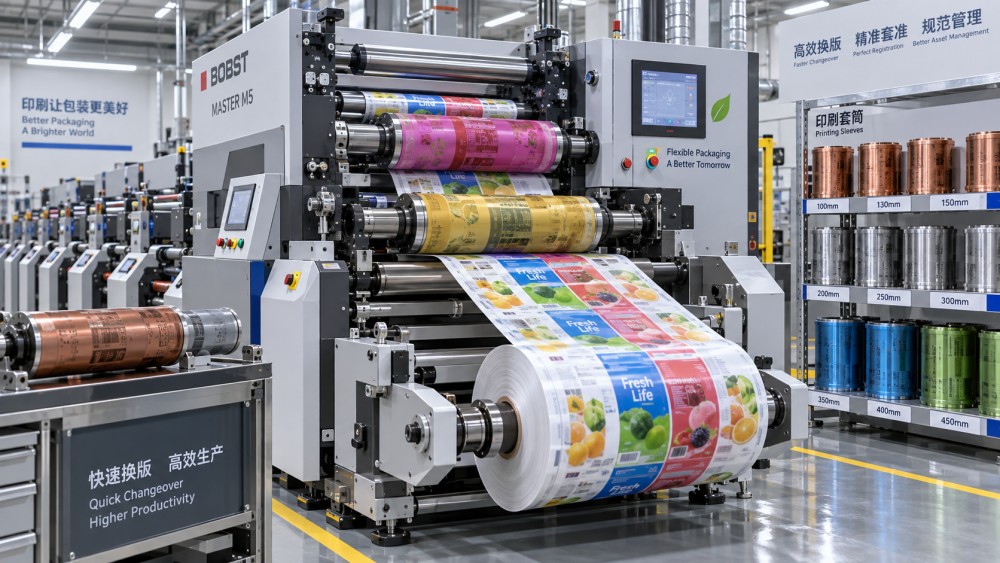
A flexographic sleeve is a cylindrical carrier used on a compatible press, commonly supporting a plate or functioning as an imaging or printing element depending on the application. Its value is closely connected to the way packaging production has changed. Shorter order cycles, more SKU variation, versioned artwork, retailer-specific packs, and tighter delivery windows all increase the value of faster, more repeatable setup.
Conventional cylinder-based systems can perform well, especially in established long-run work. Yet each cylinder change requires physical handling, mounting steps, and careful alignment. A sleeve system can simplify that process when the press has suitable air-mandrel technology and operators follow a controlled handling routine. The commercial benefit does not come merely from having a lighter or more easily exchanged component. It comes from reducing the time and variability between jobs while preserving print quality at production speed.
That distinction matters for business evaluators. A sleeve that shortens a changeover by a modest amount may have little financial impact on a press that changes work once per shift. The same improvement can matter substantially on a line handling many short or medium runs, particularly when late changeovers disrupt downstream converting, inspection, and shipment schedules.
The market is also linked to rising quality expectations in flexible packaging, labels, paper packaging, and corrugated pre-print applications. Brand owners increasingly expect color consistency, readable codes, stable graphics, and repeatable presentation across multiple production batches. Sleeves can help create a more controlled printing interface, but only as part of a wider system that includes plates, mounting practice, anilox selection, inks, doctor blades, registration controls, drying conditions, and inspection.
Demand is being shaped by production economics, not by sleeve adoption alone
The most durable demand drivers in the flexo printing sleeve market are operational. Packaging converters are under pressure to get more usable output from existing press capacity while managing labor availability, waste, and order complexity. A sleeve program can contribute to each of these areas, although the value varies sharply by application.
More frequent job changes
Short-run work is often described as the central growth opportunity for sleeve systems, but the relevant measure is not run length in isolation. Buyers should examine the number of changeovers per week, the time required for each change, the proportion of setup waste, and the amount of production that is delayed because the press is unavailable. A plant with medium-length jobs but frequent version changes may gain more from sleeves than a plant running shorter jobs in irregular, low-volume batches.
Fast changeover also depends on discipline outside the press. Jobs need accurate prepress data, compatible plates, organized sleeve storage, validated mounting procedures, and a predictable cleaning and inspection process. Without those conditions, the sleeve may simply move complexity from the press deck to another part of the workflow.
Pressure for repeatable quality
Repeat orders are where a well-managed sleeve system can show its value. Once a job has been qualified, stable sleeve dimensions and controlled mounting can support reliable registration and impression conditions. This can reduce the amount of adjustment needed at startup, provided the plates, inks, substrates, and press settings remain within controlled limits.
It would be a mistake to treat sleeves as an automatic quality upgrade. Print defects still arise from plate wear, incorrect tape selection, substrate variation, anilox condition, ink viscosity, drying imbalance, gear or bearing issues, and registration instability. A supplier claim focused only on concentricity or dimensional precision should be assessed in the context of the complete press and print process.
Investment in higher-output flexographic presses
Newer flexographic press investments often place greater emphasis on automation, reduced setup intervention, and repeatable recipes. Sleeve-based architectures fit naturally into that direction because they can support standardized job preparation and quicker mechanical changeover. In these installations, the sleeve decision is frequently embedded in the broader press configuration rather than treated as a separate consumables purchase.
For existing presses, the case is more complex. Retrofitting may be technically possible, but commercial feasibility depends on mandrel compatibility, available print widths, air supply, press condition, software or automation interfaces, and the remaining life of the equipment. A retrofit that works mechanically can still disappoint if it causes excessive downtime during installation or creates a mix of incompatible legacy and new-format tooling.
Where market enthusiasm can mislead buyers
The flexo printing sleeve market is often discussed through simple benefits: lower changeover time, better registration, reduced weight, and higher productivity. All can be valid. None should be accepted without examining the operating assumptions behind them.
First, lower handling weight does not eliminate handling risk. Sleeves can be damaged through impact, poor storage, unsuitable cleaning agents, incorrect mounting, or careless removal. Even minor surface damage or dimensional distortion can affect print performance. The plant needs adequate storage racks, clear identification, transport protection, and procedures that prevent operators from treating sleeves as generic shop-floor items.
Second, a lower unit cost is not necessarily a lower total cost. Buyers need to account for the full sleeve population required to support active jobs, spare capacity, lead times, plate and tape compatibility, storage infrastructure, inspection, cleaning, repairability, and replacement exposure. The right comparison is not one sleeve against one conventional cylinder. It is the lifecycle cost of two operating systems over a realistic mix of jobs.
Third, standardized dimensions do not guarantee interchangeability. Sleeve systems involve several critical interfaces: the press mandrel, inside diameter, wall thickness, repeat length, plate mounting method, and any adapter or bridge arrangement. A nominally similar sleeve from another source may not produce equivalent performance. In high-quality print work, small differences in dimensional accuracy, stiffness, or surface behavior may become visible through registration drift, bounce, uneven impression, or inconsistent dot reproduction.
Fourth, service risk can be underestimated. A converter may accept a promising supplier quotation only to find that replacement sleeves have long lead times, technical support is remote, or specifications are not controlled consistently between batches. This is particularly serious where a sleeve is tied to active repeat business and no qualified backup is available.
A buyer's evaluation should start with the job mix
The first question is not which sleeve material is best. It is which production problem the sleeve program is expected to solve. A useful evaluation separates the current job portfolio into operating groups: frequent-change short runs, repeat medium runs, long stable runs, difficult-registration work, and jobs with unusually demanding substrates or inks. The expected benefit and risk profile may be different for each group.
This analysis should be performed using actual production records where possible: job counts, average setup duration, spoilage during startup, repeat-order frequency, and lost production hours. The aim is to identify whether sleeve adoption improves the constraint that limits the plant. If the primary constraint is drying capacity, ink management, plate availability, or downstream converting, sleeve investment may offer only a partial return.
Technical qualification should focus on interfaces and durability
For commercial evaluation, sleeve specifications need to be translated into operating consequences. Inside diameter and wall thickness affect fit and repeat geometry. Concentricity and runout influence registration stability and print uniformity. Stiffness can affect behavior under printing loads. Surface construction influences plate mounting and cleaning. Material compatibility affects how the sleeve performs with process chemicals, wash systems, temperature variation, and normal handling conditions.
Buyers should ask suppliers to define the usable operating envelope rather than relying on broad performance descriptions. That discussion should cover press type, mandrel configuration, printing width, repeat range, plate thickness, mounting tape, ink chemistry, cleaning method, storage conditions, expected production speed, and inspection practice. It should also establish what constitutes acceptable wear and how a damaged sleeve will be assessed.
A qualification trial needs to include more than a brief startup demonstration. The sleeve should be evaluated through repeated mounting cycles, normal cleaning, relevant production speeds, and a representative set of artwork conditions. Registration performance should be reviewed alongside practical factors such as installation effort, removal force, operator handling, identification, and whether the sleeve can be returned to storage without avoidable risk.
Where multiple suppliers are being considered, the comparison must be controlled. Running different sleeve constructions with different plates, tapes, or press settings makes the result difficult to interpret. Procurement teams should define common job files and acceptance criteria before testing. Otherwise, supplier selection can become driven by a visually persuasive trial rather than repeatable operating evidence.
Supply continuity is part of the product decision
Sleeves are often categorized as tooling or consumables, but in an active packaging operation they can become production-critical assets. A failed or unavailable sleeve may delay a repeat job even when the press, plates, and substrate are ready. This changes the supplier assessment from a price comparison into a continuity review.
Commercial teams should examine manufacturing location, stated production lead times, specification control, repair or replacement processes, local technical support, and the supplier's ability to provide consistent sleeves over the life of the program. The issue is not whether every sleeve must be dual-sourced from the first day. It is whether the converter has an informed contingency plan for critical repeats and a defined process for qualifying alternatives.
Documentation also matters. Each sleeve should be traceable to a clear specification, job application, purchase record, inspection status, and storage location. A plant with dozens or hundreds of sleeves can lose much of the expected efficiency if operators spend time searching for tooling, mounting unverified sleeves, or discovering damage only after a job reaches the press.
What to watch as the market develops
The direction of the market will be influenced less by a single material or product format than by how sleeves fit into increasingly connected flexographic workflows. Press automation, digital job management, inspection data, maintenance records, and standardized setup recipes can make sleeve assets easier to control and more valuable to the operation. In that environment, sleeves support a broader effort to make changeovers predictable rather than merely faster.
At the same time, buyers will place more scrutiny on lifecycle performance. Claims around productivity will face practical questions: How many mounting cycles can be expected under the plant's conditions? How stable is performance after cleaning and storage? What happens when the sleeve is damaged? Can equivalent replacements be supplied without requalifying the entire job? These questions are likely to matter more than generalized statements about market growth.
For business evaluators, the relevant outlook is therefore conditional. Sleeve demand is likely to remain closely tied to packaging converters that need high job flexibility, controlled quality, and better use of press time. The sound investment case comes from matching the sleeve system to a verified production bottleneck, qualifying it under normal operating conditions, and treating supply support and asset management as part of the purchase decision.
Related News
 How an Impression Roller for Flexo Printing Affects Print QualityDiscover how an impression roller for flexo printing influences ink transfer, dot gain, alignment, and print consistency. Learn practical setup and troubleshooting tips.Print Fluidics Scientist
 Why Color Measurement Systems Matter for Consistent Flexo PrintingColor Measurement Systems help flexo printers achieve consistent brand colors, reduce waste, improve traceability, and protect packaging quality across every production run.Print Fluidics Scientist
 What to Check Before Choosing a Print Dryers Supplier for Your PressPrint dryers supplier selection guide: compare drying methods, press integration, energy use, maintenance, safety, and support to improve print quality and uptime.Print Fluidics Scientist
 How to Compare Web Tension Controller Manufacturers for Flexo PressesWeb tension controller manufacturer comparison guide for flexo presses: assess stability, sensing, integration, service, and real-world substrate performance.Print Fluidics Scientist
 How Hot Air Print Dryers Improve Ink Drying on Flexo LinesHot air print dryers improve flexo ink drying with balanced airflow, controlled heat, and reliable results for faster packaging production.Print Fluidics Scientist
 How to Choose a Plate Cylinder Manufacturer for Reliable Print QualityChoose a reliable plate cylinder manufacturer with proven precision, balance control, material expertise, and press compatibility for consistent print quality.Print Fluidics Scientist