Is Ceramic Anilox Roller Damage Repairable Without Affecting Print Quality?
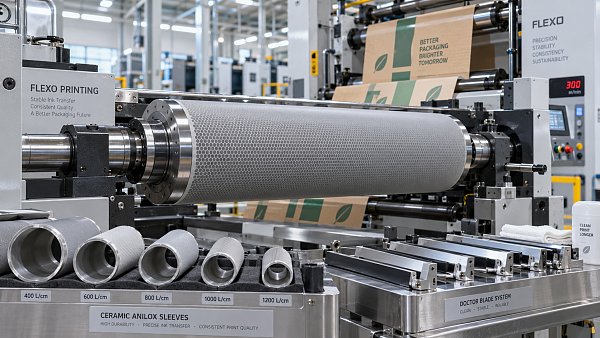
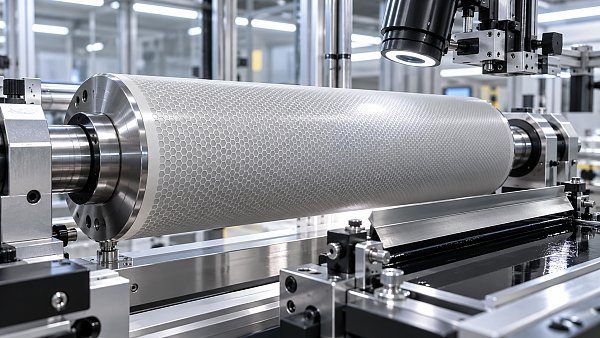
Yes—ceramic anilox roller damage can sometimes be repaired without a measurable loss of print quality, but only when the repair restores the roller’s functional surface rather than merely making the defect less visible. The decisive question is not whether a chip, scratch, blocked area, or worn band can be altered cosmetically. It is whether cell volume, cell opening geometry, surface uniformity, and runout can be returned to a condition compatible with the print specification.
A ceramic anilox roller is an ink-metering component. Even a small local defect can change ink film weight, create a density shift, generate streaks, or reduce repeatability across the web. A repair that looks acceptable under normal workshop lighting may still fail under magnification, during ink drawdown comparison, or after the roller returns to high-speed production. Repairability must therefore be judged from the expected effect on ink transfer, not from damage size alone.
What “repairable” means in anilox service
For an anilox roller, a successful repair means that the repaired zone performs closely enough to the surrounding engraved ceramic surface that it does not create a visible print defect or destabilize the doctor blade contact. This standard varies by application. A minor imperfection may be tolerable on a coarse-line corrugated shipping carton with solid graphics, yet unacceptable on a narrow-web label job, process-color work, fine text, barcodes, or high-opacity white printing.
Four technical conditions determine whether repair is realistic:
- Damage depth: Surface contamination and very shallow marks are fundamentally different from damage extending through the ceramic coating toward the metal base.
- Damage area and location: A defect outside the active print width has a different consequence from one in a repeated image area or in a high-coverage solid.
- Cell specification: Line screen, cell shape, volume, engraving method, and ink system define how sensitive the roller is to local geometric change.
- Mechanical condition: Ceramic integrity cannot be evaluated separately from roller runout, journal condition, balance, concentricity, and end-seal performance.
The phrase “Is ceramic anilox roller damage repairable?” therefore has no universal yes-or-no answer. Some damage can be corrected by deep cleaning, localized treatment, re-polishing, or ceramic restoration. Other damage requires re-engraving or replacement because any local intervention would create a permanent metering inconsistency.
Damage that may be restored without changing print performance
Plugged cells are often mistaken for ceramic damage. Dried ink, coating residues, adhesive carryover, paper dust, calcium deposits, or cleaning-chemical residues can block cell openings and reduce effective volume. The roller may show weak solids, poor density, dirty color, or uneven transfer even though the ceramic layer remains intact. In this case, the correct remedy is controlled cleaning—not grinding, polishing, or coating repair.
Cleaning method selection matters. Sodium bicarbonate media, plastic media, ultrasonic cleaning, laser cleaning, and selected chemical systems all have different effects depending on cell volume, line count, ink chemistry, and contamination type. An aggressive method can widen cell openings, damage fragile cell walls, or leave residue inside cells. The objective is to remove contamination while preserving the original cell geometry. A roller should be inspected before and after cleaning with suitable magnification and, where print variation is significant, with volumetric measurement rather than visual assessment alone.
Light doctor-blade scoring may also be recoverable if the mark is superficial and does not substantially interrupt the cell field. Fine scratches can result from trapped dried ink, metallic particles, damaged blade edges, incorrect blade pressure, misalignment, or unsuitable blade material. If the scratch affects only the top land area and does not fracture the ceramic or deform cell openings, a specialist may be able to reduce its effect through controlled surface treatment. However, polishing is not automatically harmless. Removing material from the land area changes the relationship between blade, chamber, and cell openings; excessive polishing can worsen sealing or promote streaking.
Small edge chips can sometimes be stabilized when they are outside the working width and do not propagate toward the engraved area. The repair objective is usually to prevent further chipping and eliminate a sharp edge that could damage seals or handling equipment. It is not necessarily to restore the original engraved pattern. If the chip reaches the doctor blade track, transfer area, or press-side sealing zone, the evaluation becomes more restrictive.
Minor localized ceramic defects may be candidates for restoration when the damaged site is limited, stable, and the print requirement allows a controlled local deviation. The repair provider must be able to explain how the affected surface will be prepared, how adhesion will be achieved, whether the area will be re-engraved, and how the restored cell volume will be verified. Filling a chip with a generic hard compound can make the roller appear smooth but does not recreate an ink-metering cell structure.
When repair is likely to compromise quality
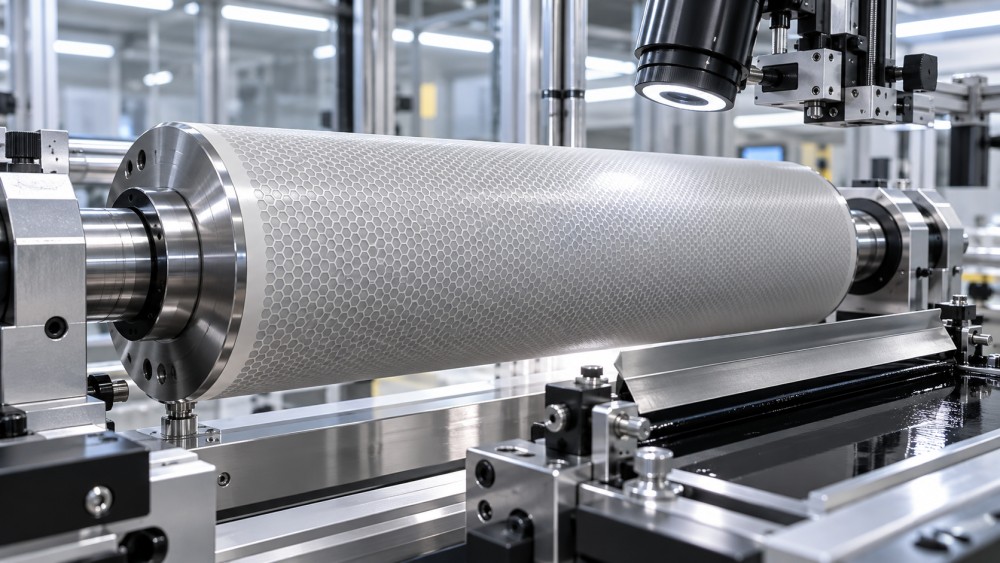
Damage becomes difficult to repair reliably when it alters the engraved structure over a meaningful part of the print width. Deep gouges, widespread ceramic fracture, extensive pitting, delamination, and cracks that spread beneath the surface are not simple surface defects. They can create variable ink release and may continue to deteriorate under doctor blade load, cleaning cycles, and repeated press operation.
A repaired patch is particularly risky on high-line-count anilox rollers. Fine cells have small dimensions and tight volumetric tolerances. Reproducing the original geometry in one local area is technically demanding, and even a small mismatch can appear as tonal variation, a light line, a dark line, or inconsistent screening. The same concern applies where exact ink film control is required for expanded-gamut work, process-color consistency, fine reverse type, pharmaceutical graphics, or machine-readable codes.
Damage in the doctor blade contact zone deserves special attention. A defect can disturb blade contact before it visibly affects ink transfer. The result may be a persistent streak, chamber leakage, accelerated blade wear, or localized blade damage that then causes secondary scoring elsewhere. If the roller cannot provide a stable, continuous blade track after repair, print quality risk remains even if the engraved area has been partially restored.
Recurrent defects are another warning sign. If similar scratches or chips reappear after cleaning or after a short production interval, repairing the roller alone does not solve the underlying problem. Blade holder alignment, chamber pressure, blade selection, end seals, ink filtration, wash-up practice, handling fixtures, or particulate contamination may be responsible. Returning a repaired roller to an unchanged system can lead to rapid repeat damage and an unnecessary cycle of downtime.
Inspection must separate contamination, wear, and coating failure
A sound decision begins with diagnosis. Visual inspection is useful for locating obvious damage, but it cannot determine whether cells are blocked, worn, fractured, or geometrically altered. A roller that appears dark or glossy may simply be contaminated; a roller that appears clean may have lost usable volume through wear.
Inspection should establish the following:
- Whether the defect is within the effective print width and whether it aligns with a reported print symptom.
- Whether the ceramic is chipped, cracked, delaminated, or only marked on the surface.
- Whether cell openings remain intact around the defect.
- Whether the issue is isolated or repeated around the circumference.
- Whether there is a measurable change in cell volume compared with the roller specification or a suitable reference area.
- Whether total indicated runout, journal condition, and balance remain within the press and roller supplier’s applicable requirements.
Microscopic imaging is valuable because it distinguishes a plugged cell from an eroded cell. In a plugged cell, the original wall structure may still be present beneath residue. In a worn or chemically attacked cell, edges can become rounded, walls may collapse, and openings may become irregular. Both conditions can reduce ink-transfer consistency, but they require different corrective actions.
Volume measurement is especially important when print quality complaints concern color density or solid coverage without a single visible defect. A cleaning result should not be judged only by how bright the ceramic looks. Similarly, a repaired area should not be accepted merely because it is flush with the surface. Its local ink capacity and release behavior must be considered against the job’s tolerance.
Repair methods have different technical limits
Deep cleaning is the least invasive option and should be considered before any mechanical or coating intervention when contamination is plausible. It preserves the original engraving if performed correctly. Its limitation is clear: it cannot restore missing ceramic, repair a crack, or replace lost cell walls.
Controlled polishing or lapping may reduce superficial scoring or raised debris, but it removes material. On engraved ceramic, that makes it a precision operation rather than a general workshop procedure. If the process alters the land area unevenly or reaches the cell structure, the roller can become harder to doctor and less predictable in ink release.
Localized ceramic repair can be appropriate for limited defects, especially outside critical image zones. Its success depends on substrate preparation, bond integrity, hardness compatibility, surface finish, and the ability to recreate a functional surface. Where the repair enters the engraved field, the provider should specify whether the repaired zone will be laser engraved and how its volume will be checked. A smooth patch without metering cells is not equivalent to the original anilox surface.
Strip, re-coat, and re-engrave is often the more defensible route for major ceramic damage when the roller body, journals, and core geometry remain serviceable. This process can restore a uniform coating and a complete engraved pattern across the roller. It is more extensive than local repair, but it avoids accepting a permanent local discontinuity in a critical print area. The practical decision depends on lead time, cost, roller age, core condition, and whether the original engraving specification remains suitable for current jobs.
Replacement is the safer decision when mechanical integrity is uncertain, damage is extensive, the roller has repeated coating failures, or the required print tolerance leaves no room for local variation. Replacement may also be preferable when a re-engraved roller would no longer match the press’s established ink and plate combination, or when several rollers in the same color set need coordinated specification changes.
Print testing should follow the repair, not precede acceptance
Bench inspection alone cannot fully predict print behavior. Before a repaired roller returns to normal production, acceptance should include a controlled press trial using the intended ink family, doctor blade system, and representative substrate where possible. The trial should check solid density, tonal response, streaking, print mottle, edge definition, and repeatability across the web. For jobs with barcode or fine reverse-text requirements, verification should include those elements rather than relying only on a solid patch.
It is useful to compare results against a known-good roller of the same specification or against documented target values from the production process. The goal is not necessarily identical cosmetic appearance of the roller surface; it is stable, repeatable print output. If the repaired area produces a defect at a specific repeat interval, the roller should not be released simply because the rest of the print is acceptable.
Documentation also prevents later confusion. The service record should identify the roller specification, damage location, suspected root cause, repair method, inspection findings, measured condition where available, and press-trial result. This creates a basis for deciding whether similar defects can be repaired in the future or whether they should trigger immediate re-engraving or replacement.
The decision is driven by functional risk, not repair cost alone
Low-cost repair can become expensive if it causes color instability, extended make-ready, customer rejection, or repeated press stoppages. Conversely, immediate replacement is not always justified when the issue is contamination, a non-critical edge defect, or a superficial mark that can be corrected without changing the metering surface.
The most reliable rule is straightforward: repair is acceptable only when the roller can return to its required ink-transfer function and mechanical stability. If the original cell structure cannot be preserved or credibly restored in a print-critical area, a cosmetic fix should not be treated as a quality repair. Deep cleaning, controlled restoration, complete re-engraving, and replacement each have a place—but they solve different conditions, and confusing them is where print-quality risk begins.
Related News
 How to Choose an Anilox Sleeve Supplier for Consistent Print QualityChoose an anilox sleeve supplier with proven engraving control, reliable sleeve construction, and expert support to achieve consistent print quality and lower waste.Print Fluidics Scientist
 How to Choose an Ink Viscosity Sensors Supplier for Flexo PrintingChoose an ink viscosity sensors supplier for flexo printing with confidence. Compare ink compatibility, installation, calibration, controls, and service support to improve color consistency and reduce waste.Print Fluidics Scientist
 How Ink Metering System Manufacturers Improve Anilox Ink ControlInk metering system manufacturer insights: improve anilox ink control with stable blade loading, reliable seals, and efficient circulation for cleaner flexo printing.Print Fluidics Scientist
 Is Ceramic Anilox Roller Damage Repairable Without Affecting Print Quality?Is ceramic anilox roller damage repairable? Learn when cleaning, restoration, re-engraving, or replacement can protect consistent print quality.Print Fluidics Scientist
 How to Evaluate a Doctor Blade Holder Manufacturer for Flexo PressesDoctor blade holder manufacturer evaluation guide for flexo presses: compare design, sealing, materials, service, and lifecycle cost to improve uptime and print quality.Print Fluidics Scientist
 How Ceramic Rollers for Flexo Presses Reduce Wear and Ink VariationCeramic rollers for flexo press applications reduce wear and ink variation. Explore practical cleaning, inspection, and maintenance tips for stable print quality.Print Fluidics Scientist