How Ink Metering System Manufacturers Improve Anilox Ink Control
Stable anilox ink control depends less on how much ink is pumped into the chamber than on how consistently excess ink is removed from the anilox surface. A well-designed ink metering system creates a controlled contact line between doctor blade and roller, maintains reliable chamber sealing, and returns unused ink without allowing aeration, leakage, or contamination to disrupt the circuit. When these elements are unstable, color density, print cleanliness, and start-up repeatability all become harder to control.
An ink metering system manufacturer influences this result through mechanical design rather than through ink supply alone. Chamber geometry, blade holder stiffness, pneumatic loading, seal material, ink inlet and outlet placement, and wash-up access all affect what happens at the anilox roller. The practical objective is straightforward: fill the engraved cells evenly, wipe the roll clean without damaging it, and keep that condition stable throughout the run.
The metering system is the control point between ink supply and print quality
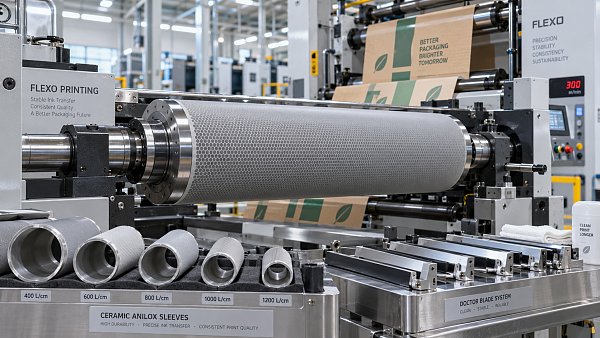
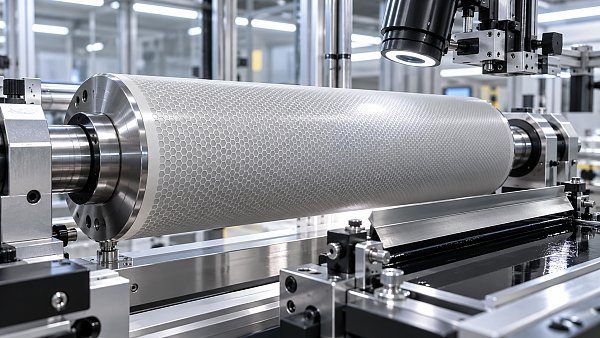
In flexographic printing, the anilox roller carries a defined volume of ink from the chamber to the plate. The cells must be adequately filled, while the land area between cells must be clean when the roller reaches the printing plate. If a residual ink film remains on the anilox surface, the press may show dirty print, halos around image areas, uncontrolled density, or ink buildup on the plate. If metering is too aggressive, blade wear can accelerate and the system may begin to score or damage the roller.
This is why an anilox issue should not automatically be treated as an anilox issue. Anilox cell volume, line screen, ceramic condition, cleaning history, ink viscosity, and press speed all matter, but the metering assembly determines whether the roller can deliver its designed volume consistently. A clean, correctly specified roller cannot compensate for a chamber that leaks, flexes, traps air, or applies uneven blade pressure.
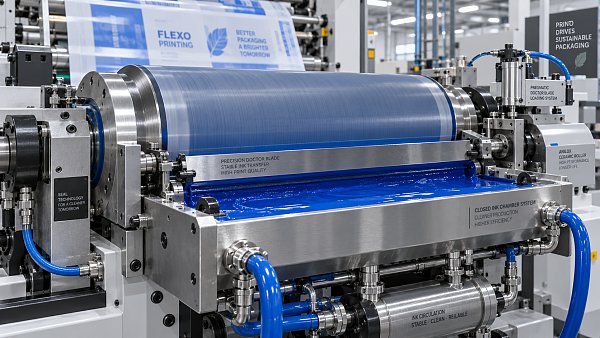
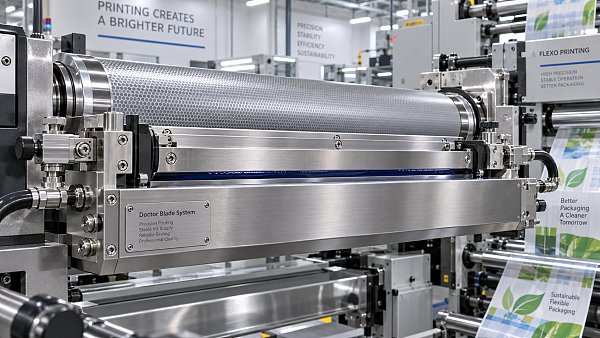
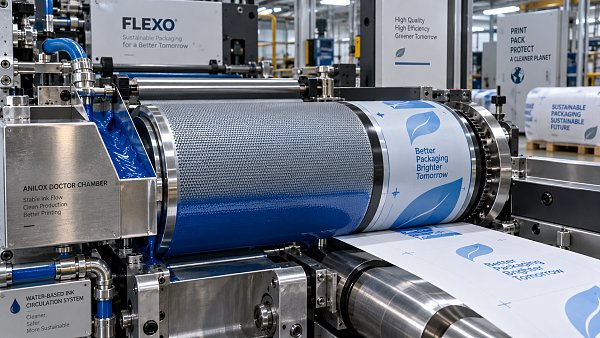
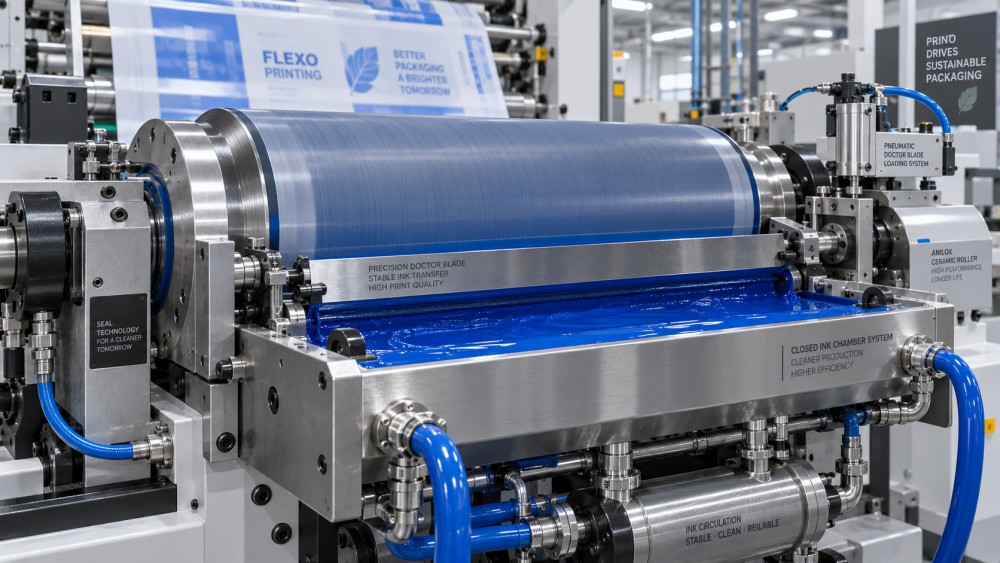
Closed-chamber doctor blade systems are widely used where controlled ink transfer and reduced open-pan exposure are required. Their advantage is not simply that they contain ink. They establish a more repeatable environment around the anilox: the chamber floods the roll, the metering blade removes surface ink, the containment blade closes the second side, and seals confine the ink at both ends. The performance of this arrangement depends on how these components work together under real running conditions.
Blade-holder rigidity determines whether the wipe is uniform
The metering blade works along the full face width of the anilox. At low speeds and narrow web widths, minor holder deflection may be difficult to see. At wider widths, higher speeds, or with lower-viscosity inks, uneven blade contact becomes more visible as side-to-side density variation, intermittent streaking, or localized ink haze.
A manufacturer improves control by designing the blade holder and chamber body to resist deflection while still allowing accurate adjustment. The holder needs to maintain a consistent blade angle and contact force across the working width. Excess flexibility can cause the blade to lift slightly in some areas, leaving more surface ink on the roll. Excessive rigidity without controlled loading can make the blade unforgiving, increasing the risk of rapid wear or scoring when contamination enters the contact zone.
Blade geometry is part of this balance. A thinner blade can conform more readily to minor roller variation but may wear faster or become less stable at demanding speeds. A thicker blade generally offers greater stiffness, yet it can require more careful loading and alignment. The correct choice is linked to anilox diameter, press configuration, ink chemistry, chamber design, and expected run length. Treating blade thickness as a universal preference is a common source of inconsistent results.
Blade angle also matters because it changes the wiping action. A change in angle can alter how the blade rides on the ceramic surface, how quickly it wears, and how effectively it removes the ink film. The target is not the highest possible contact pressure. The target is a clean, stable wipe achieved with the lowest force that remains reliable during the run.
Pneumatic loading must be even, responsive, and restrained
Many chamber systems use pneumatic loading to bring the doctor blades into contact with the anilox. This makes it possible to engage and disengage the chamber consistently, but air pressure should never be treated as a simple cure for printing defects. Raising pressure may temporarily reduce a dirty-print condition, while simultaneously increasing blade wear, heat at the contact line, and the chance of ceramic damage.
Effective systems distribute loading evenly along the chamber so that contact does not depend on a few highly loaded points. They also allow repeatable pressure settings after blade changes and wash-up. Where the system uses separate loading zones or adjustable supports, these should be set to preserve parallel contact rather than to compensate casually for poor chamber alignment.
Uneven pressure has recognizable symptoms. A streak that repeatedly appears at the same cross-machine location may point to a localized blade-contact issue, holder contamination, damaged blade edge, or an anilox defect. Broad density variation across the web can indicate chamber misalignment, uneven loading, or blade-holder deflection. If a defect changes rapidly with press speed or ink condition, ink rheology, air entrainment, or circulation stability should be investigated before mechanical adjustments are made.
A useful discipline is to record the normal operating pressure range for each press and ink application. When a job begins to require materially higher pressure to print cleanly, the cause should be identified. It may be a worn blade, dried ink in the chamber, damaged seals, incorrect blade installation, degraded anilox cleanliness, or a circulation issue. Increasing pressure without diagnosis can hide the original problem until it becomes a more expensive one.
End seals are small parts with a large effect on ink stability
Chamber end seals must maintain contact with the anilox ends while allowing the roller to rotate without excessive friction. Their role is often underestimated because the most obvious result of seal failure is external leakage. The deeper problem is that poor sealing changes the chamber environment. Ink can escape, air can enter, pressure distribution can become unstable, and dried ink may accumulate near the seal contact area.
Seal selection should account for anilox diameter, chamber width, ink type, solvent or wash chemistry, temperature, press speed, and expected abrasion. A seal material that performs acceptably with one water-based ink may behave differently with another formulation or cleaning agent. Chemical swelling, hardening, edge wear, and poor conformity can all shorten seal life.
Seal shape is equally important. The seal must follow the anilox contour and support the intended chamber pressure without creating excessive drag. Too little contact can lead to leakage and air intake. Too much contact can create heat, accelerate wear, and deposit seal debris into the ink circuit. Debris is especially problematic because it can lodge under a doctor blade, producing score lines or repeatable streaks.
During installation, the seal edge should be inspected for nicks, compression damage, dried ink, and uneven wear. The chamber end plates and anilox ends should also be clean. Replacing a seal without removing hardened residue from its contact zone often produces a short-lived improvement rather than a reliable correction.
Ink circulation design affects cell filling before the blade can meter it
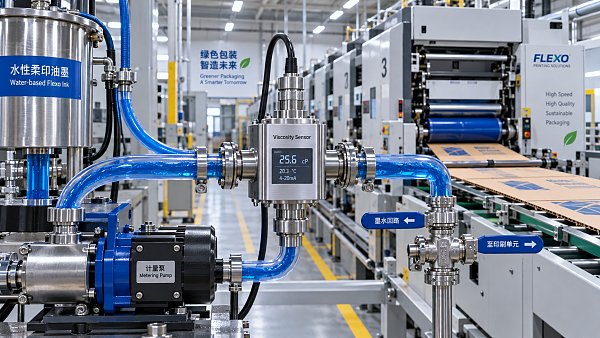
The doctor blade cannot correct an anilox that is not being properly flooded. Ink inlet position, outlet position, hose routing, pump behavior, filtration, and return flow determine whether the chamber receives a stable ink supply. A manufacturer can improve anilox control by designing flow paths that reduce dead zones, avoid trapped air, and promote complete chamber filling.
Air in the chamber is a frequent cause of erratic density and pinholing. It may enter through a leaking fitting, an inadequately primed line, a failing seal, a pump condition, or a return line that creates turbulence. Foaming is not always visible at the print unit, particularly in enclosed circulation systems, so the first visible sign may be density fluctuation or unstable solid coverage.
Ink viscosity and temperature must be kept within the process window established for the ink and print job. A metering chamber does not make unsuitable ink behave consistently. If viscosity rises during production, the chamber may require higher circulation energy and may show altered blade behavior. If viscosity becomes too low, leakage, misting, and uncontrolled transfer can become more likely. Stable ink preparation and controlled circulation are therefore part of anilox metering, not separate housekeeping tasks.
Filtration should be selected to protect the system without restricting flow. Filters that are too coarse may allow particles to reach the blade contact area. Filters that are too fine for the ink system can create pressure loss or encourage bypass practices. The relevant question is whether the filtration arrangement removes contaminants that could damage the blade-anilox interface while maintaining dependable ink delivery.
System design should make cleaning verifiable, not merely easier
Dried ink, coating residues, paper dust, adhesive contamination, and damaged blade fragments can alter the metering result quickly. A chamber designed for difficult disassembly or poor wash access tends to create inconsistent conditions between jobs. The issue is not only cleaning time; it is whether the system can be returned to a known condition before the next run.
Quick-release mechanisms, accessible blade holders, drainable chamber geometry, and fittings that can be cleaned without trapping residue all support repeatability. However, fast access should not compromise positional accuracy. Each time a chamber is opened and reinstalled, the mounting arrangement must return it to the correct parallel relationship with the anilox.
Cleaning must address both the chamber and the roller. A clean-looking anilox can still have partially blocked cells that reduce delivered volume. When print density falls, crews sometimes increase impression, ink strength, or blade pressure before checking whether the anilox is transferring its intended volume. Those adjustments can create new problems without restoring the original ink-transfer condition.
Inspection should distinguish between a dirty roller, a worn blade, and a chamber-related fault. If cleaning restores density only briefly, the cause may be contamination entering the system, insufficient filtration, improper wash procedure, or ink drying during idle periods. If a new blade improves print cleanliness immediately, the prior blade edge or installation condition deserves attention. If problems persist in the same position after blade and seal replacement, inspect the anilox surface and chamber alignment.
What to check when color density becomes unstable
Stable color does not come from adjusting one variable repeatedly. A practical troubleshooting sequence starts with the condition of the ink circuit and then moves to the mechanical contact point. Confirm ink level, viscosity control method, temperature, circulation flow, and the presence of air or foam. Examine hoses, pump behavior, filters, and return flow before changing blade pressure.
Then inspect the chamber itself: blade condition, correct blade orientation, holder cleanliness, end-seal wear, chamber parallelism, and pneumatic loading. A blade may look intact but still have a worn edge that no longer meters evenly. Likewise, a chamber can be mounted securely while sitting slightly out of parallel with the roll, producing uneven contact from one side to the other.
Only after these checks should the anilox be assessed for cell plugging, scoring, glazing, or localized damage. This sequence avoids a familiar mistake: treating density loss as a plate or impression problem when the root cause is inconsistent ink delivery at the anilox.
Choosing a metering system means matching it to the press, ink, and maintenance reality
An ink metering system manufacturer should be evaluated by the fit between its design and the intended operating conditions. Chamber length and mounting arrangement must suit the press structure. Blade holder design must support the required print width and speed. Seal materials need compatibility with the inks and cleaning chemicals in use. The circulation arrangement must work with the available pump, filtration, viscosity control, and wash-up process.
Interchangeability is also relevant. If a press runs frequent job changes, blade and seal replacement should be accurate and practical without relying on improvised adjustments. Where multiple press units use similar chambers, standardized consumables can reduce installation errors, provided the blade and seal specification remains technically appropriate for each unit.
The strongest indicator of a suitable system is not an isolated feature claim. It is whether the chamber can repeatedly deliver a fully flooded anilox, clean surface metering, controlled leakage, manageable wear, and predictable restoration after wash-up. When those conditions are maintained, print density adjustments become smaller, start-up waste is easier to contain, and anilox performance is less likely to be blamed for faults created elsewhere in the ink circuit.
Anilox ink control is therefore a system discipline. The roller, blade, chamber, seals, ink, circulation equipment, cleaning practice, and press settings must remain aligned. A properly engineered metering system gives that discipline a stable mechanical foundation; consistent inspection and restrained adjustment keep it effective during production.
Related News
 How to Choose an Anilox Sleeve Supplier for Consistent Print QualityChoose an anilox sleeve supplier with proven engraving control, reliable sleeve construction, and expert support to achieve consistent print quality and lower waste.Print Fluidics Scientist
 How to Choose an Ink Viscosity Sensors Supplier for Flexo PrintingChoose an ink viscosity sensors supplier for flexo printing with confidence. Compare ink compatibility, installation, calibration, controls, and service support to improve color consistency and reduce waste.Print Fluidics Scientist
 How Ink Metering System Manufacturers Improve Anilox Ink ControlInk metering system manufacturer insights: improve anilox ink control with stable blade loading, reliable seals, and efficient circulation for cleaner flexo printing.Print Fluidics Scientist
 Is Ceramic Anilox Roller Damage Repairable Without Affecting Print Quality?Is ceramic anilox roller damage repairable? Learn when cleaning, restoration, re-engraving, or replacement can protect consistent print quality.Print Fluidics Scientist
 How to Evaluate a Doctor Blade Holder Manufacturer for Flexo PressesDoctor blade holder manufacturer evaluation guide for flexo presses: compare design, sealing, materials, service, and lifecycle cost to improve uptime and print quality.Print Fluidics Scientist
 How Ceramic Rollers for Flexo Presses Reduce Wear and Ink VariationCeramic rollers for flexo press applications reduce wear and ink variation. Explore practical cleaning, inspection, and maintenance tips for stable print quality.Print Fluidics Scientist