How High Volume Anilox Sleeves Affect Ink Transfer Consistency
How High Volume Anilox Sleeves Affect Ink Transfer Consistency
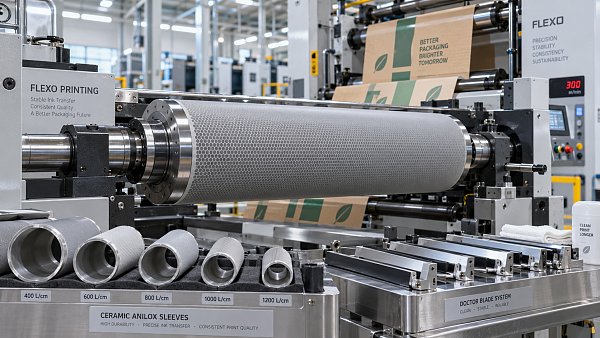
High volume anilox sleeves can significantly influence ink transfer consistency in flexographic printing, particularly where solid coverage, coarse graphics, heavy coatings, or absorbent corrugated substrates are involved. Yet evaluating a sleeve only by its nominal ink volume is a common mistake. A sleeve may carry more ink on paper, but that does not automatically mean it will deliver more usable ink to the plate and substrate in a stable way.
For technical teams assessing flexographic equipment, the practical question is more demanding: can the selected anilox sleeve maintain predictable ink release across production speed changes, ink batches, doctor blade wear, plate designs, and board grades? This is where high volume sleeves become both useful and potentially difficult. They can support strong solids and coating weights, but they also make the press more sensitive to process control.
In corrugated post-print, pre-print, paper bag, linerboard, and certain packaging coating applications, ink transfer is not simply a printhead issue. It sits at the intersection of the anilox, doctor blade chamber, plate, mounting tape, substrate, drying capacity, and operator discipline. A technical evaluation should therefore treat the sleeve as part of a printing system rather than as an isolated consumable.
Why Higher Volume Changes the Transfer Window
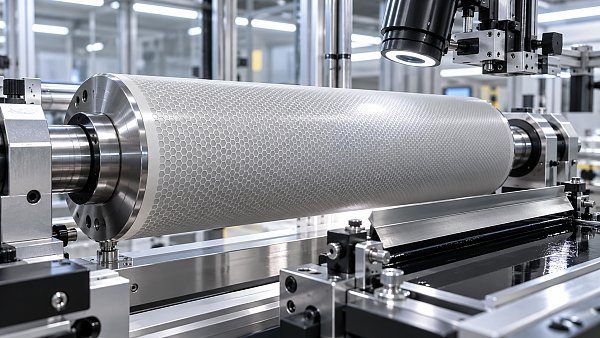
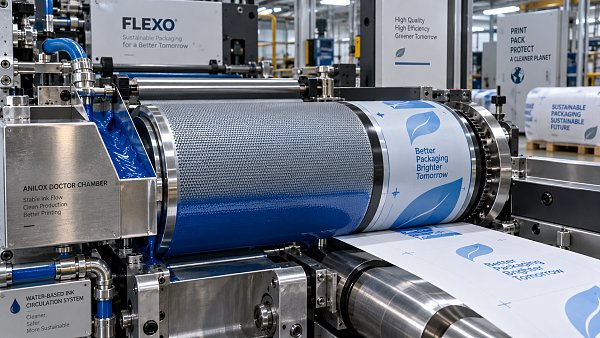
An anilox sleeve meters ink through engraved cells. Higher volume generally means that the cell structure can retain a greater quantity of ink or coating per unit area. Depending on the engraving specification, that volume may be achieved through deeper cells, wider openings, lower screen counts, or a combination of these characteristics. The result is a larger ink reservoir at the point where the sleeve contacts the printing plate.
That reservoir is valuable when a job needs dense color on rough kraft, strong linework on corrugated board, opaque white, varnish, primer, adhesive-like functional coatings, or substantial flood coverage. On a porous substrate, a low-volume sleeve may leave solids visually weak because too little ink remains after the substrate absorbs part of the film. A higher-volume sleeve can provide the film build needed to achieve the intended appearance.
The trade-off is that the ink transfer window becomes narrower. More ink in the cells means more variables can influence how evenly it releases. If ink viscosity drifts, if the doctor blade does not meter cleanly, or if the plate is over-impressed, the printed result may shift quickly from acceptable coverage to mottling, dirty type, dot gain, halos, or slow drying. The sleeve is carrying more potential variation as well as more ink.
This matters on high-speed corrugated lines, where paper surface variation can be substantial even within a single production period. A liner with a more open surface can pull ink differently from a smoother grade. Changes in moisture, sizing, recycled content, flute profile, board compression, or surface preparation may all alter the appearance of a print that was stable on the preceding order.
Cell Geometry Often Matters More Than a Volume Number
Two high volume anilox sleeves with a similar nominal volume can behave differently on press. The reason is cell geometry. Cell opening, wall structure, depth-to-opening relationship, engraving angle, and surface condition all influence the way ink is picked up, metered, released, and cleaned.
A deep cell with a restricted opening may hold ink effectively but release it less freely when the ink has higher viscosity, contains larger pigment particles, or begins to dry near the chamber. A more open geometry may release ink more readily, but it can also be more exposed to contamination, blade sensitivity, and uncontrolled ink film variation. There is no universal “best” geometry; the suitable choice depends on ink chemistry, target coverage, line screen, plate design, and substrate.
For this reason, technical specifications should not stop at volume. Evaluators should ask for the engraving format, screen or cell count, recommended ink family, cleaning guidance, and intended application range. If a supplier only presents a volume figure without explaining the engraving relationship, the information is incomplete for process qualification.
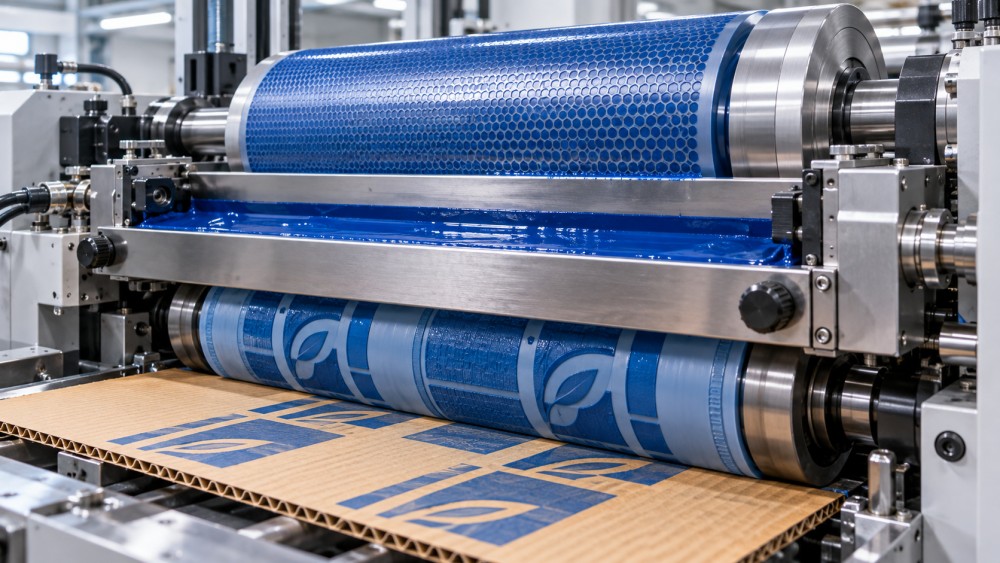
The issue becomes particularly visible in jobs combining large solids with fine reverse text, barcodes, or small process elements. A sleeve selected solely to strengthen solids may overload the finer image areas. Conversely, choosing a sleeve for fine detail may leave broad solids under-inked. In many plants, this is why separate anilox specifications are maintained for different job families rather than forcing one sleeve to cover every requirement.
Ink Release Is Not the Same as Ink Capacity
The volume inside an anilox cell is only the starting point. Not all of that volume transfers to the plate, and not all ink received by the plate transfers evenly to the substrate. Release is affected by surface energy, ink rheology, plate surface characteristics, press pressure, speed, and the condition of the doctor blade system.
Water-based inks commonly used in corrugated printing are especially dependent on disciplined viscosity and pH management. As water evaporates, the ink may become less predictable in the chamber. Pigment dispersion, foam, temperature, and resin behavior can also change the effective release characteristics. A high volume sleeve can make these shifts easier to see because it starts with a heavier film.
This is why a print crew may report that a sleeve “prints too much ink” on one day and “does not release” on another, even when the sleeve itself has not changed. The real cause may be a process drift elsewhere. Before replacing the sleeve, it is sensible to check ink condition, chamber pressure, blade contact, recirculation stability, plate cleanliness, and impression settings.
Doctor blade performance becomes less forgiving
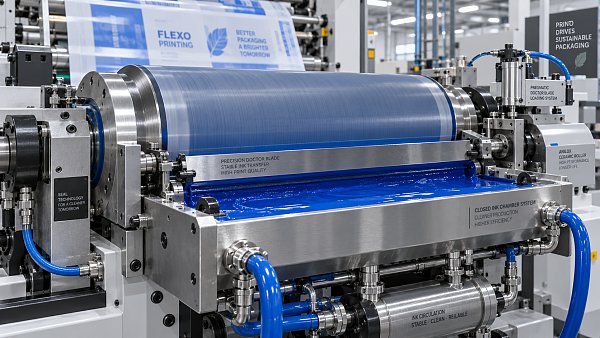
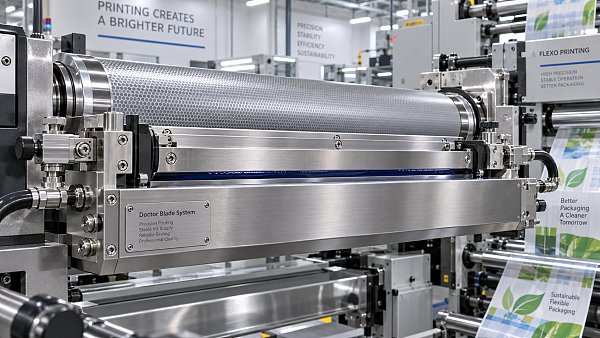
A doctor blade chamber is expected to meter the sleeve cleanly, leaving a controlled ink volume in each engraved cell. With high-volume engravings, poor blade contact or blade wear can leave excess ink on the sleeve surface. That excess does not behave like metered cell volume; it can create dirty print, inconsistent solids, streaking, or excessive ink build-up at the plate nip.
Blade material, blade angle, chamber alignment, end-seal condition, and sleeve runout all deserve attention. A sleeve that appears to be an ink-transfer problem may actually be revealing a chamber system that was already marginal. On wide-web flexographic presses, small alignment issues can become more visible from operator side to drive side, particularly on heavy solid jobs.
The Corrugated Substrate Adds Its Own Variables
Corrugated printing rarely offers the uniformity of a coated film or a high-grade cartonboard sheet. Liner surface roughness, board warp, flute variation, crush, dust, and inconsistent moisture can all affect contact between plate and substrate. High volume anilox sleeves are often selected precisely because corrugated requires more ink to visually cover these irregularities. But excess film cannot solve every board-quality issue.
When poor coverage is caused mainly by uneven contact, increasing anilox volume may deepen the darkest areas while leaving light areas unresolved. The press can then be pushed toward higher impression pressure, which risks fluting, washboarding, loss of fine text, and plate deformation. In practical terms, the team may be treating a mechanical contact issue as an ink-volume issue.
The more reliable approach is to assess the full print stack: board flatness, vacuum transfer or feeding stability, plate mounting tape, plate hardness and relief, impression setting, and ink film requirement. This is especially relevant for packaging plants trying to standardize output across multiple corrugators, paper sources, or board constructions.
What to Review During Sleeve Selection and Qualification
A useful evaluation process starts with the actual job mix, not an abstract preference for high or low volume. A sleeve chosen for a heavy black flood on recycled kraft may be inappropriate for a job containing small type, barcode bars, and fine line art. Likewise, a sleeve that performs well with a water-based ink may need reassessment when UV, solvent-based, metallic, white, or heavily pigmented formulations are introduced.
Qualification trials should run long enough to expose real operating conditions. A brief startup proof may look acceptable before ink temperature changes, blade wear develops, or the press reaches its typical production speed. It is also useful to assess the sleeve after cleaning. If residual dried ink remains in high-volume cells, the effective volume may decrease unevenly, creating variation that is difficult to trace back to its source.
Cleaning and Inspection Are Part of the Print Standard
High-volume sleeves can be more vulnerable to gradual cell contamination when inks dry, pigment accumulates, or cleaning practices are inconsistent. This does not necessarily mean the sleeve is unsuitable; it means the maintenance plan must match the application. A sleeve that is clean in broad visual terms may still have partially blocked cells that alter transfer in subtle but commercially relevant ways.
Routine visual inspection, documented cleaning methods, and periodic volume or cell-condition verification can help distinguish sleeve wear from process variation. The appropriate inspection method depends on the plant’s quality system and available equipment. What matters is trend visibility. If the same color increasingly requires higher impression or altered ink settings to achieve the prior result, the team should investigate the sleeve condition before accepting the drift as normal.
For packaging operations with barcode, traceability, pharmaceutical carton, or branded color-control requirements, this discipline is not merely aesthetic. Ink inconsistency can affect code readability, visual approval, rework exposure, and the reliability of downstream inspection decisions.
A Better Decision Than “More Volume Is Better”
High volume anilox sleeves are valuable tools for applications that genuinely need a heavier and more forgiving ink film. They are often a sensible choice for demanding solids, absorbent papers, coated effects, and specific corrugated graphics. Their value, however, depends on whether the rest of the press can meter, transfer, dry, clean, and monitor that ink film consistently.
For technical evaluators, the strongest specification is usually not a single volume target. It is a documented operating window covering sleeve geometry, ink type, doctor blade setup, plate configuration, substrate range, press speed, drying conditions, cleaning procedure, and acceptable print criteria. This system view is increasingly relevant as packaging plants manage shorter runs, more frequent changeovers, tighter waste control, and broader material variation.
Platforms such as CPCS can help project teams compare these linked factors across flexographic presses, anilox systems, corrugated production equipment, inspection technology, and factory automation. But the final sleeve decision should still be validated on representative production work. If a high-volume sleeve improves a drawdown yet creates unstable color after several hours on press, it has not solved the real production problem.
Related News
 How to Choose an Anilox Sleeve Supplier for Consistent Print QualityChoose an anilox sleeve supplier with proven engraving control, reliable sleeve construction, and expert support to achieve consistent print quality and lower waste.Print Fluidics Scientist
 How to Choose an Ink Viscosity Sensors Supplier for Flexo PrintingChoose an ink viscosity sensors supplier for flexo printing with confidence. Compare ink compatibility, installation, calibration, controls, and service support to improve color consistency and reduce waste.Print Fluidics Scientist
 How Ink Metering System Manufacturers Improve Anilox Ink ControlInk metering system manufacturer insights: improve anilox ink control with stable blade loading, reliable seals, and efficient circulation for cleaner flexo printing.Print Fluidics Scientist
 Is Ceramic Anilox Roller Damage Repairable Without Affecting Print Quality?Is ceramic anilox roller damage repairable? Learn when cleaning, restoration, re-engraving, or replacement can protect consistent print quality.Print Fluidics Scientist
 How to Evaluate a Doctor Blade Holder Manufacturer for Flexo PressesDoctor blade holder manufacturer evaluation guide for flexo presses: compare design, sealing, materials, service, and lifecycle cost to improve uptime and print quality.Print Fluidics Scientist
 How Ceramic Rollers for Flexo Presses Reduce Wear and Ink VariationCeramic rollers for flexo press applications reduce wear and ink variation. Explore practical cleaning, inspection, and maintenance tips for stable print quality.Print Fluidics Scientist