How Anilox Sleeves for Flexo Printing Control Ink Transfer Accuracy
How Anilox Sleeves for Flexo Printing Control Ink Transfer Accuracy
For technical evaluators, anilox sleeves for flexo printing are not simply consumable components mounted on a press. They are a controlled metering surface between the ink system and the printing plate. Their condition and specification influence how much ink reaches the plate, how evenly it is delivered across the web or sheet, and whether the same colour can be reproduced after a job change, a cleaning cycle, or a sleeve replacement.
That makes anilox selection a process-control decision rather than a catalogue exercise. A flexographic press may have sound registration, capable plates, and stable ink preparation, yet still show colour-density drift, poor solids, plugged highlights, pinholing, or excessive dot gain if its ink metering is inconsistent. In corrugated post-print, flexible packaging, labels, paper bags, and folding-carton work, the severity of those symptoms changes with the substrate and ink chemistry. The underlying question remains the same: can the anilox system deliver the intended ink film predictably at production speed?
This is why a sleeve should be evaluated as part of a complete flexo printing unit: engraved surface, base and sleeve construction, plate design, doctor blade chamber, ink formulation, viscosity control, press pressure settings, cleaning practice, and measurement method. Looking at one parameter in isolation can lead to expensive but inconclusive changes.
The anilox sleeve’s real job: meter, release, repeat
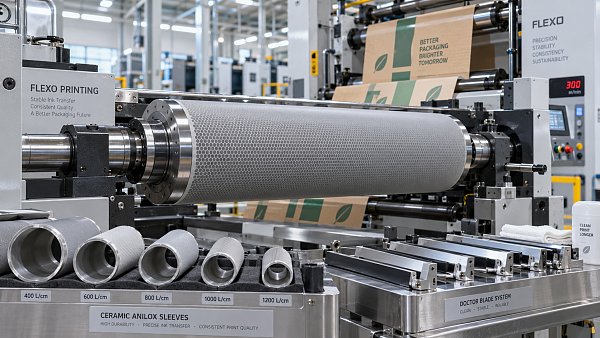
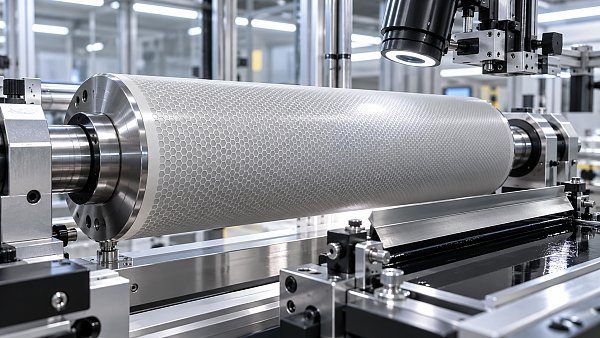
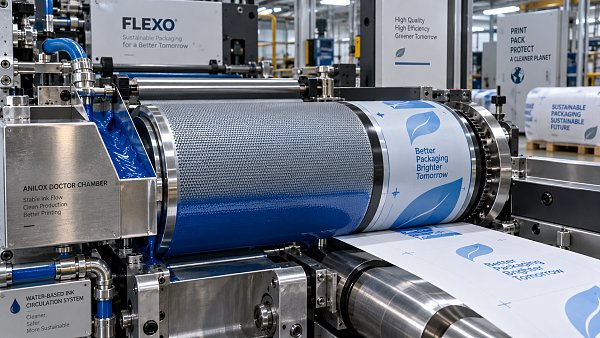
An anilox sleeve carries a pattern of engraved cells that fills with ink in the chamber and transfers a controlled portion of that ink to the raised image areas of the printing plate. The plate then transfers the image to the substrate. In practical terms, the sleeve needs to do three things well: hold the expected volume, release ink consistently, and retain those characteristics throughout its useful production life.
Nominal cell volume is often treated as the principal specification because it defines the theoretical ink capacity of the engraved surface. It is essential, but it is not the whole story. A stated volume does not by itself describe the cell opening, cell depth, wall structure, engraving angle, surface finish, or actual release behaviour with a particular ink. Two sleeves with similar nominal volumes can perform differently when paired with different inks, plates, doctor blade configurations, or cleaning routines.
The practical objective is not maximum ink carryover. It is the ink film required to achieve approved density, opacity, tonal response, and print cleanliness without over-inking the plate. Too much ink can fill fine reverses, increase dot gain, dirty non-image areas, lengthen drying demand, and create unstable colour during speed changes. Too little can weaken solids, reduce barcode contrast, expose substrate texture, and make operators compensate through pressure or viscosity changes that introduce further variation.
In other words, transfer accuracy is the ability to reach the target condition with a controllable process window. A sleeve that produces an acceptable sample only under narrow pressure, viscosity, or speed conditions may be less useful than one that gives slightly lower peak density but runs consistently across normal production variation.
Cell volume, line screen, and engraving geometry must be read together
Cell volume determines the amount of ink available for transfer, while line screen indicates how many cells occur across a given distance. Higher screen counts generally support finer ink distribution and are often associated with detailed graphics, smoother vignettes, and fine type. Lower screen counts generally provide larger cells and greater volume potential, which may suit heavy solids, coatings, or more absorbent substrates. Neither direction is universally better.
The complication is geometry. Cell shape and opening affect how readily ink enters during doctoring, how much remains after the blade passes, and how effectively it releases onto the plate. A deep cell with a restricted opening may offer nominal capacity but release ink differently from a wider, shallower cell. Engraving angle also influences the interaction between the cell pattern, the doctor blade, plate screen, and printed image. Technical reviews should therefore avoid comparing sleeves by line screen alone or assuming that volume conversion between suppliers is exact.
For process-critical work, the sleeve specification should identify the measurement basis used by the engraver and clearly distinguish nominal from measured values. Measurement methods, sampling areas, and reporting conventions can differ. Where a job is sensitive to colour strength, fine text, opaque white, metallic inks, or functional coatings, a trial using the actual ink, plate, substrate, and press configuration is more informative than a volume number on its own.
Why ink release changes from one application to another
Water-based inks on corrugated board behave differently from UV inks on non-absorbent film, and both differ from solvent-based inks or high-opacity white systems. Pigment particle size, resin system, rheology, solvent or water balance, and drying mechanism affect how ink fills and exits anilox cells. A sleeve selected for process colours on coated paper may not be suitable for a high-coverage white on film, even when the required printed appearance seems comparable.
Substrate absorbency adds another variable. More absorbent linerboard can make operators seek additional ink to maintain visual strength, but increased volume may not correct uneven board surface or unsuitable plate screening. It can instead magnify mottle and spreading. On films and coated stocks, ink can remain more visible at the surface, so an excessive film weight may lead to dot bridging, poor trapping, drying issues, or insufficient resistance after conversion.
A sound technical approach starts with the approved print target. Determine whether the priority is solid density, opacity, colourimetric control, small text, highlight reproduction, barcode performance, coating weight, or a balance among several requirements. Then establish whether the limitation comes from ink delivery, plate imaging, substrate variability, drying, or press settings before changing the sleeve specification.
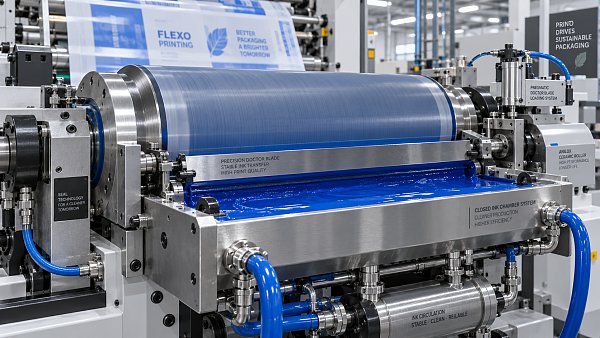
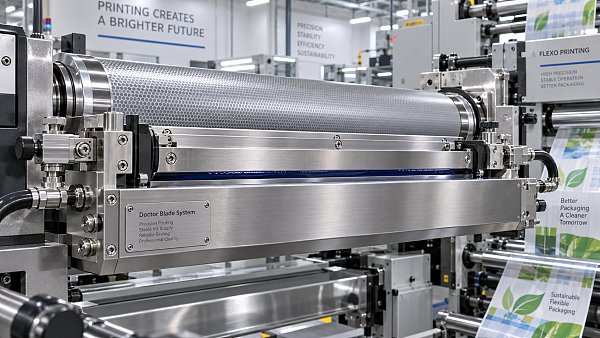
The doctor blade chamber is part of the metering system
Anilox performance is often discussed as though the engraving works independently. It does not. The doctor blade system controls the condition of the ink film on the sleeve surface before plate contact. Blade material, tip profile, contact angle, loading, chamber sealing, alignment, and wear all affect metering. A damaged or incorrectly set blade can leave streaks, create uneven density, accelerate wear, or make a healthy sleeve appear defective.
Pressure is a frequent source of false correction. When density falls, increasing impression or blade loading may seem to restore output briefly. Yet excessive mechanical force can distort the plate, increase wear, and reduce the repeatability that the correction was intended to recover. Technical teams should document settings at the point of approved print and treat unexplained changes as an investigation trigger rather than a routine adjustment.
Chamber cleanliness also matters. Dried ink, coating residues, damaged seals, or poor circulation can affect how cells fill before they are metered. If a colour problem occurs only after extended running time, the cause may be ink temperature, viscosity drift, foam, contamination, or circulation behaviour rather than the engraved volume. The time pattern of the defect is useful evidence.
Surface condition is a hidden source of process drift
A sleeve can remain visually clean while losing effective volume. Gradual cell plugging from dried ink, varnish, adhesives, or cleaning residues reduces available capacity and often appears as a slow decline in density or opacity. Damage to cell walls, scoring, corrosion-related effects, or uneven wear can cause a different problem: irregular transfer across the width, visible streaking, or variation between repeat runs.
The response should not automatically be more aggressive cleaning. Chemical, ultrasonic, laser, media-based, and other cleaning approaches each need to be compatible with the sleeve surface, construction, contamination type, and supplier guidance. An unsuitable method may damage the engraving, seals, or sleeve body. The objective is to restore the metering surface without compromising its geometry or service life.
A practical control programme records sleeve identification, engraving specification, installation date, jobs run, observed print condition, cleaning history, inspection findings, and measured volume where appropriate. This creates a baseline. Without it, a pressroom may repeatedly troubleshoot density problems as ink or plate issues while a sleeve has simply moved outside the process condition expected at qualification.
Mechanical fit cannot be treated as secondary
Sleeve concentricity, dimensional stability, mounting accuracy, and compatibility with the air mandrel influence print stability as directly as the engraving does. Runout can contribute to uneven impression and tonal fluctuation. Incorrect mounting procedures can damage the sleeve or create inconsistent press-side results. For wide-web presses and high-speed corrugated applications, the practical consequences may include bounce, banding, uneven solids, and longer setup time.
Technical acceptance should therefore cover both engraving and mechanical requirements. The press supplier’s dimensional and operating limits remain the primary reference. Sleeve suppliers should be asked to confirm the relevant inside diameter, face length, repeat relationship, wall construction, weight considerations, approved mounting method, storage requirements, and compatibility with the press mandrel. These details are particularly important when replacing sleeves from another source or introducing a different construction.
A more useful evaluation protocol than “does it print?”
A controlled comparison should test sleeves under the same practical conditions: ink batch or documented ink adjustment, plate set, substrate grade, doctor blade configuration, press speed range, drying settings, and operator-approved print settings. The trial should include more than a visual check at startup. Evaluate solids, screens, reverse type, barcode areas where relevant, colour readings when they are part of the job specification, streaking, scumming, and stability after the press has reached normal operating conditions.
The following questions tend to expose whether a proposed sleeve is genuinely suitable:
- Does it achieve the approved print target without abnormal impression or blade loading?
- Is density and tonal response stable across the usable speed range?
- Does it hold consistency across the web or sheet width and through a production-length run?
- Can the existing cleaning process maintain cell openness without unacceptable labour or risk?
- Are the ink, plate, chamber, and sleeve specifications traceable enough to repeat the result on the next order?
This approach is especially relevant for packaging operations with frequent order changes. A technically correct sleeve that takes excessive time to identify, mount, verify, and return to specification may raise changeover cost even if its print quality is strong. Sleeve inventory should be rationalized around actual job families and ink requirements, not built as an uncontrolled collection of near-duplicate engravings.
Linking sleeve control to wider packaging-plant decisions
In a packaging plant, anilox sleeves sit within a larger chain of quality decisions. On corrugated post-print lines, board moisture, flute profile, liner variability, machine vibration, and drying capacity can all shape printed output. In flexible packaging and label production, substrate treatment, ink curing, laminate requirements, and inspection criteria may be equally significant. The sleeve is highly influential, but it cannot compensate for every upstream or downstream limitation.
That wider view is central to the work of Global Commercial Print & Corrugated Packaging Intelligence (CPCS). The platform examines flexographic presses, anilox systems, doctor blade technology, colour management, converting equipment, inspection, traceability, and factory automation as connected production systems. For a technical review, that perspective helps distinguish a component problem from a process interaction—and prevents investment decisions based solely on purchase price or a single press demonstration.
Before approving new anilox sleeves for flexo printing, confirm the printed target, ink and substrate range, expected speed, plate technology, chamber configuration, measurement method, cleaning route, mechanical fit, and maintenance responsibility. The resulting specification may be more demanding than a simple volume-and-screen callout, but it gives the pressroom something more valuable: a repeatable basis for accurate ink transfer across real production conditions.
Related News
 How to Choose an Anilox Sleeve Supplier for Consistent Print QualityChoose an anilox sleeve supplier with proven engraving control, reliable sleeve construction, and expert support to achieve consistent print quality and lower waste.Print Fluidics Scientist
 How to Choose an Ink Viscosity Sensors Supplier for Flexo PrintingChoose an ink viscosity sensors supplier for flexo printing with confidence. Compare ink compatibility, installation, calibration, controls, and service support to improve color consistency and reduce waste.Print Fluidics Scientist
 How Ink Metering System Manufacturers Improve Anilox Ink ControlInk metering system manufacturer insights: improve anilox ink control with stable blade loading, reliable seals, and efficient circulation for cleaner flexo printing.Print Fluidics Scientist
 Is Ceramic Anilox Roller Damage Repairable Without Affecting Print Quality?Is ceramic anilox roller damage repairable? Learn when cleaning, restoration, re-engraving, or replacement can protect consistent print quality.Print Fluidics Scientist
 How to Evaluate a Doctor Blade Holder Manufacturer for Flexo PressesDoctor blade holder manufacturer evaluation guide for flexo presses: compare design, sealing, materials, service, and lifecycle cost to improve uptime and print quality.Print Fluidics Scientist
 How Ceramic Rollers for Flexo Presses Reduce Wear and Ink VariationCeramic rollers for flexo press applications reduce wear and ink variation. Explore practical cleaning, inspection, and maintenance tips for stable print quality.Print Fluidics Scientist