Why Pre-Breaking Units Matter for Smooth Folding and Fewer Cracks
If you run a folder gluer or any carton converting line, you already know the symptom: the carton looks fine after die-cutting, but the fold line starts whitening, cracking, or resisting when the blank enters the folding section. In many of these cases, the problem is not only board quality or crease depth. It is the lack of proper pre-fold conditioning. That is where Pre-Breaking Units matter. They help open the crease in a controlled way before final folding, which usually means smoother carton erection, less surface damage, and more stable running at speed.
Operators often notice the benefit first on difficult jobs: heavy solid board, laminated carton, printed surfaces with dark ink coverage, UV-coated stock, and short-grain layouts that do not want to bend cleanly. A well-set pre-breaking section does not “fix everything,” but it removes a lot of avoidable stress from the fold path.
What Pre-Breaking Units actually do on the machine
In simple terms, a pre-breaking unit starts the folding action before the carton reaches the main folding belts and rails. Instead of forcing a flat blank into a sharp fold all at once, the unit partially opens the crease in stages. That matters because paperboard and corrugated-based carton materials do not fail only at the crease center. Cracks often start on the outer printed surface, especially when the substrate is dry, heavily coated, or structurally stiff.
A controlled pre-break reduces the peak stress at that moment of fold. The board gets “introduced” to the folding direction rather than shocked into it.
That is the short answer many operators are looking for: Pre-Breaking Units reduce cracking because they distribute folding stress more gradually and more consistently across the crease line.
This is also why the unit becomes more important as line speed increases. At low speed, a marginal crease can sometimes pass because the board has more time to respond. At high speed, weak folding control shows up very quickly as cracked panels, fish-tailing, poor squareness, or unstable glue seam alignment.
Why smooth folding is rarely just a die-cutting issue
A common misunderstanding on the shop floor is that if cartons crack, the die-cutter must have made a bad crease. Sometimes that is true. But not always.
Fold quality is the result of several linked conditions:
- crease rule and matrix match
- board caliper and fiber direction
- moisture condition of the sheet
- print and coating build-up on the outer surface
- machine speed
- folding path geometry
- pre-breaking angle and timing
When operators blame only the die-cutting section, they can miss the real source of instability. A decent crease can still crack if the carton is folded too aggressively downstream. On the other hand, even a challenging crease can often run acceptably when the pre-breaking setup is right.
In practical production, this is why experienced teams look at the whole converting path instead of one station in isolation.
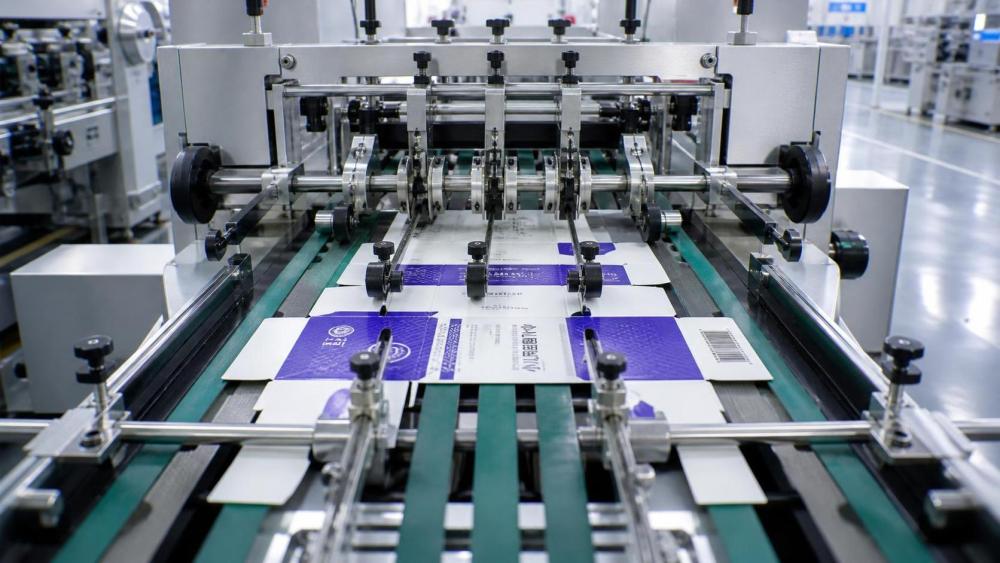
Where Pre-Breaking Units make the biggest difference
Not every carton job needs aggressive pre-breaking, and that is an important point. If you are running light board with good grain direction and no demanding surface finish, the benefit may be modest. But there are jobs where the difference is obvious within minutes.
1. Reverse tuck and straight-line cartons with heavy ink or coating
Dark solids, varnish, film lamination, and UV finishes tend to highlight any stress whitening. The fold may be structurally acceptable, but the visual defect is still enough to reject the carton. Pre-breaking helps reduce that visible damage.
2. Pharmaceutical, cosmetics, and premium folding cartons
These jobs are less tolerant of cracked score lines because the pack has to look clean at the retail shelf. Minor fold damage that might pass in transit packaging can become a quality failure here.
3. Thick board or high-stiffness material
The stiffer the board, the more sudden force builds up at the fold point. A staged fold is usually easier to control than a direct fold.
4. High-speed production with frequent job changes
At higher throughput, small setup weaknesses become recurring waste. A pre-breaking unit gives operators more control over repeatability, especially when orders change often and material behavior is not perfectly consistent.
How fewer cracks translate into real production value
Cracks are not only a cosmetic issue. They usually come with side effects that operators deal with every shift.
First, rejected cartons increase waste, and waste in printed carton work is expensive because the value added is already in the sheet. By the time the blank reaches folding and gluing, material, print, die-cutting, labor, and time are already invested.
Second, cracked or poorly controlled folds often lead to downstream instability. Cartons may skew in the folding section, glue flaps may present inconsistently, and compression in delivery can become less uniform. So the cost is not only the visible defect. It is the loss of running confidence.
Third, without proper pre-breaking, teams often compensate in the wrong way. They slow the machine, increase manual checks, or accept a quality level that is not really acceptable. That may keep the line moving for the day, but it does not solve the process.
In plants that measure productivity seriously, smoother folding usually shows up in three places: lower spoilage, more stable output, and less operator intervention.
What operators should check before blaming the Pre-Breaking Unit
There is another trap here. Some teams install or upgrade a pre-breaking section and expect it to eliminate cracking on every job. That expectation is too broad.
If folding cracks persist, check these points first:
- Is the crease deep enough for the board structure and coating level?
- Is the grain direction working against the main fold?
- Has the material become too dry in storage or production?
- Are the folding rails forcing the blank after pre-break instead of guiding it?
- Is belt pressure creating drag or twist?
- Are left and right pre-break settings balanced?
A pre-breaking unit cannot compensate for poor carton design, incorrect creasing specification, or badly conditioned material. It is a process aid, not a miracle device.
This is why experienced operators pay attention to the carton before it enters the machine. If the blank already shows weak scores, board memory, or edge curl, the folding section will have less room to recover.
Setup details that are easy to overlook
Many folding problems come from settings that seem minor at first glance.
Pre-break angle is one of them. Too little angle and the benefit is limited. Too much and the carton can become unstable before it reaches the main folding path. The right setting depends on board stiffness, panel geometry, and production speed.
Timing and sequence matter as well. The carton should enter the next stage already prepared, not partially distorted. If the fold starts too early or too unevenly, you may trade one defect for another.
Blank alignment is another frequent issue. If registration through the feeder and carrier section is inconsistent, the pre-break action will not hit the crease line the same way every time. That usually shows up as one side cracking more than the other.
Surface finish changes the behavior of the board more than many new operators expect. A coated board with dense print can react very differently from an uncoated substrate of similar thickness. The machine setting that worked yesterday may not be safe today.
When Pre-Breaking Units may not be the main answer
There are cases where teams focus too much on machine hardware and not enough on packaging design or substrate selection.
If a carton structure has very tight folds, awkward panel proportions, or an unfavorable grain direction, even a strong pre-breaking system may only partially improve the result. The same is true when a decorative finish is extremely brittle. In that situation, the better question may be whether the material and design are realistic for the required production speed.
This matters for operators because it changes the conversation. Instead of repeatedly adjusting the machine to chase the defect, it may be necessary to escalate the issue to prepress, structural design, or material purchasing. Good production teams know when a problem belongs to setup and when it belongs to job specification.
Pre-Breaking Units and folder gluer buying decisions
If you are involved in machine evaluation, pre-breaking should be judged as part of the whole folding control system, not as an isolated feature on a brochure.
Ask practical questions:
- How adjustable is the unit for different carton styles?
- How stable is it at the speeds you actually run?
- How long does setup take during changeover?
- Can operators make fine corrections without excessive trial-and-error?
- How well does it handle coated, laminated, or heavier board grades?
That broader view is one reason industry platforms such as CPCS are useful to production and engineering teams. In carton converting, one component rarely tells the full story. The real value comes from understanding how folding control, die-cutting quality, feeding stability, glue application, and inspection work together in day-to-day production.
For operators, the takeaway is simpler: do not judge a machine feature only by whether it exists. Judge it by whether it gives you repeatable control on the jobs that usually create waste.
A good unit helps, but operator judgment still decides the result
People sometimes talk about automation as if it removes the need for operator skill. In folding and gluing, that is not how it works. Better machine functions make good decisions easier, but they do not replace process awareness.
The best operators notice patterns early. They watch where whitening begins. They compare left and right folds. They pay attention to whether the defect gets worse with speed, with a new pallet, or after a humidity change. Those observations tell you whether the pre-breaking setting is the real lever or whether the issue started earlier in the process.
If your cartons are cracking at the crease, resisting fold closure, or running inconsistently through the folding section, Pre-Breaking Units deserve serious attention. They are not just an extra mechanical option. On the right jobs, they are a practical way to improve fold quality, protect printed surfaces, and keep production stable without relying on constant speed reduction or manual correction.
FAQ
Do Pre-Breaking Units always eliminate carton cracking?
No. They reduce fold stress, but they cannot fully correct bad creasing, wrong grain direction, brittle coating, or poor material condition.
Are Pre-Breaking Units only useful for premium printed cartons?
No. Premium cartons show the visual benefit more clearly, but any job with stiff board, difficult folds, or speed-related instability can benefit.
Should operators increase the pre-break angle to solve every crack problem?
Usually not. Too much pre-break can create carton instability or misfolding. The setting has to match the substrate and carton structure.
What is the first sign that pre-breaking setup is wrong?
One common sign is uneven fold behavior from one side to the other, especially when crease whitening appears asymmetrically at stable speed.
Image Placeholder List
Suggested placement: after the section explaining how smooth folding is not only a die-cutting issue.
Suggested image content: a side-by-side diagram showing carton blank folding without pre-break versus with pre-break, highlighting crease stress and surface cracking risk.
Suggested alt text: Pre-breaking unit comparison showing smoother carton fold and reduced crease cracking.
Internal Link Anchor Text Suggestions
- Folder gluer setup guide: setup and adjustment best practices for folding cartons
- How crease quality affects carton converting: die-cutting and scoring performance
- Common causes of carton cracking in post-press: troubleshooting folding defects
- Choosing converting equipment for coated and laminated board: machinery selection advice
- Packaging plant inspection systems: inline quality control for cartons
External Source Suggestions
- Industry association technical documents on paperboard converting and carton performance
- Board or coating supplier technical manuals covering fold endurance, grain direction, and crack resistance
- Machine manufacturer application notes for folder gluers and carton pre-breaking systems
Related News
 When a Custom Embossing Die Delivers Better Packaging DetailDiscover when a custom embossing die adds premium tactile detail, sharper branding, and repeatable packaging quality for cartons that stand out on shelf.Post-Press Kinematics Expert
 What to Compare Before Buying a Luxury Rigid Box Making MachineCompare a luxury rigid box making machine by usable throughput, automation, quality consistency, lifecycle cost, and supplier support to protect premium packaging margins.Post-Press Kinematics Expert
 What Determines Window Patching Machine Price for Packaging LinesWindow patching machine price depends on speed, accuracy, film compatibility, automation, and support. Compare total costs to choose the right packaging solution.Post-Press Kinematics Expert
 What Drives the Cost of a Custom Foil Stamping DieCustom foil stamping die costs explained: compare materials, artwork complexity, die size, run length, and press requirements to choose durable, cost-effective tooling.Post-Press Kinematics Expert
 What to Compare Before Buying Hot Foil Stamping MachinesHot Foil Stamping Machines: compare quality, registration, setup time, foil compatibility, and uptime to choose a press that delivers profitable, repeatable results.Post-Press Kinematics Expert
 How to Choose Foil Stamping Dies for Consistent Fine DetailFoil Stamping Dies: learn how to select the right material, relief, and press compatibility for crisp fine detail, reliable registration, lower waste, and consistent packaging quality.Post-Press Kinematics Expert