When a Crash Lock Pre Breaking Unit Improves Carton Folding Accuracy
In high-speed carton converting, folding accuracy is rarely decided by one dramatic failure. More often, it is shaped by a chain of small variables: board memory, crease quality, panel symmetry, machine timing, glue position, and how the blank is guided before compression. That is why a crash lock pre breaking unit matters. It does not replace good die-cutting or careful folder gluer setup, but it often determines whether a lock-bottom carton folds cleanly and repeatedly at production speed or turns into a source of intermittent trouble.
For project managers and engineering leads, the question is not simply whether a machine “has” this function. The more useful question is when that function materially improves carton folding accuracy, and when it is mostly irrelevant. In packaging lines where job mix is broad, speeds are high, and rework is expensive, that distinction affects specification, acceptance criteria, and long-term operating cost.
Why crash lock cartons are harder to fold consistently
A standard straight-line box gives the folder section a relatively predictable path. A crash lock bottom carton does not. Its pre-glued bottom geometry depends on several panels folding in a controlled sequence so the locking structure forms correctly when the box is erected later. If one crease opens too little, one panel arrives late, or one flap resists bending because of paper stiffness or laminate structure, the result may be subtle at delivery and obvious only downstream: poor squareness, bottom burst, unstable filling, or cartons that do not pop open cleanly.
This is especially common on shorter runs with frequent changeovers, mixed substrates, or blanks from different die-cutting conditions. The folding problem is not always visible as a complete misfold. It may appear as creeping variation, where a line runs acceptably at one speed and starts producing borderline geometry once output increases.
That is where pre-breaking becomes less of an accessory and more of a process control feature.
What a crash lock pre breaking unit actually does
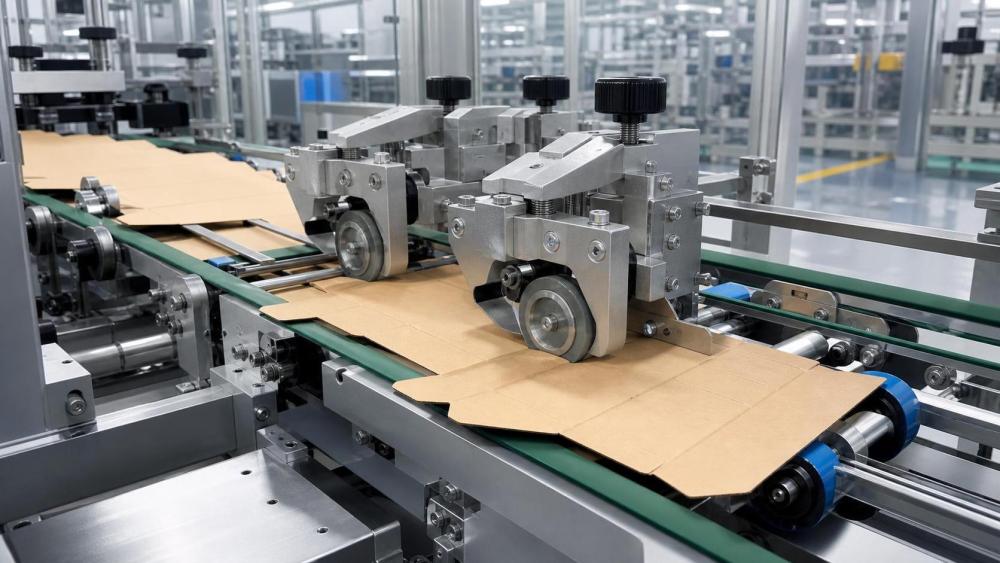
A crash lock pre breaking unit is designed to initiate and control the opening of specific creases before the final folding and gluing stages. In practical terms, it reduces the resistance of the board at critical fold lines and helps the blank follow a more stable folding path. This matters because paperboard and microflute materials have memory. If the crease is not opened progressively and symmetrically, the board tends to recover or twist, especially at speed.
Pre-breaking also helps synchronize the movement of interdependent bottom panels. Instead of asking the carton to perform a complex fold all at once in the final section, the machine distributes that motion earlier. That usually improves squareness and makes lock-bottom formation more repeatable.
This is why experienced operators often describe a good pre-breaking section not in marketing terms, but in operational ones: fewer cartons that need manual checking, less sensitivity to speed increases, and more stable behavior across a shift.
When the unit makes a visible difference
Not every folding box needs it. But there are several conditions where a crash lock pre breaking unit tends to justify itself.
The first is carton geometry. If the design includes complex lock-bottom structures, narrow panels, asymmetrical flaps, or tight tolerance requirements for automated filling, controlled pre-breaking usually improves repeatability. A carton may still run without it, but the process window is often narrower.
The second is substrate behavior. Heavier board, coated board, laminated structures, and some recycled fiber grades can resist folding differently from lighter virgin materials. The crease may look acceptable at the die-cutter but still behave aggressively in the folder gluer. Pre-breaking helps compensate for that stiffness by preparing the fold instead of forcing it at the last moment.
The third is speed. On slower lines, operators can sometimes maintain acceptable results through careful setup and compromise. At higher output, the mechanical timing becomes less forgiving. Minor differences in blank entry, belt pressure, or crease recovery can quickly translate into visible quality variation. That is often the point at which engineering teams realize folding accuracy is not only about rated machine speed, but about how the folding path is managed before compression.
The fourth is downstream automation. If cartons go into automatic packing, filling, coding, or inspection systems, folding consistency becomes more critical. A slightly distorted bottom may pass manual packing but cause jams or misfeeds in automated lines. For that reason, projects involving integrated packaging plant automation should assess the pre-breaking section as part of the whole process, not as an isolated folder gluer feature.
What it cannot fix
There is a common mistake in equipment evaluation: treating pre-breaking as a cure for poor upstream quality. It is not.
If crease lines are inconsistent, if die-cut registration is unstable, if blank dimensions vary excessively, or if glue flap design is unsuitable for the box structure, even a well-designed crash lock pre breaking unit will only partly mask the problem. The unit can improve fold initiation and path control, but it cannot create geometric accuracy from a bad blank.
This is why technical reviews should link die-cutting, creasing, and folding together. In CPCS coverage of converting systems, folder gluer performance is not treated as a stand-alone machine question. It sits downstream of die quality and upstream of packing efficiency. That broader view is often more useful for investment decisions than looking only at catalog features.
How to evaluate the function during specification and FAT
For project teams, one of the most practical steps is to define what “improves folding accuracy” means before procurement is finalized. Without that, the discussion stays too abstract.
A useful evaluation should include at least these points:
- Whether the pre-breaking section is adjustable for different carton sizes and board grades rather than optimized for a narrow demo range.
- How well the machine maintains panel alignment and bottom formation as speed increases.
- How sensitive setup is to job changeover. A technically capable section that is difficult to reset may lose value in short-run production.
- Whether sample blanks used in FAT or SAT represent actual production structures, including challenging SKUs.
- How quality will be checked: carton squareness, lock-bottom opening behavior, glue line position, and performance in downstream packing or filling if relevant.
In many projects, acceptance discussions focus heavily on top speed. That is understandable, but incomplete. For crash lock work, the more revealing question is often the stable speed at which the line maintains acceptable fold geometry across the real product mix.
Points that deserve closer engineering review
If the line is being specified for a new plant or a capacity upgrade, several details deserve attention early rather than after installation.
Blank range matters. Some machines handle standard crash lock formats well but become less stable at very small or very large sizes. The issue is not theoretical machine width; it is the controllability of folding elements across the target range.
Crease profile compatibility matters too. If the plant runs a mix of folding boxboard, kraft-backed materials, or light corrugated formats, engineering teams should confirm how much mechanical adjustment is required between structures. A unit that performs well on compact board may respond differently on E-flute or other paper-based packaging formats where caliper and rebound change the folding behavior.
Maintenance should not be treated as an afterthought. Pre-breaking sections rely on precisely positioned mechanical components that are exposed to wear, dust, and setup error. Easy access, repeatable adjustment references, and clear maintenance intervals matter because small deviations can gradually erode folding consistency without causing an obvious machine alarm.
Operator dependence is another quiet cost. Some lines run beautifully only with the most experienced crew. Others are engineered so that settings are easier to standardize. For plants facing labor turnover or multi-shift production, that difference can be more important than a headline speed claim.
Why this detail now matters more than it used to
The packaging industry has been moving from isolated machine purchases toward system-based investment. That shift is visible across commercial printing, corrugated converting, inspection, coding, and end-of-line automation. In that environment, a folding accuracy issue is no longer just a converting defect. It affects waste, labor, scheduling reliability, and downstream machine efficiency.
CPCS has been built around this broader industrial reality. Its coverage spans corrugated board lines, printing systems, folder gluers, inspection technologies, robotic palletizing, and production management tools because packaging performance is cumulative. A crash lock pre breaking unit is a good example of that logic. It is a relatively specific mechanism, yet its value becomes clear only when viewed through the larger production chain: material behavior at the die-cutter, repeatability at the folder gluer, and carton performance in filling, packing, and logistics.
A practical decision standard
If the plant mainly runs simple straight-line cartons at moderate speed, the pre-breaking question may not be decisive. If the line is expected to handle crash lock bottoms, multiple substrate types, tighter quality expectations, and automated downstream operations, the function deserves serious technical review.
The best decision standard is not whether the machine brochure mentions a crash lock pre breaking unit. It is whether the unit gives the project a wider and more stable operating window under real production conditions. That usually means checking adjustment range, repeatability, maintainability, and performance on representative blanks rather than ideal samples.
For engineering teams preparing specifications or comparing suppliers, it is worth documenting the carton styles, board structures, speed expectations, and downstream process constraints before the final machine review. In crash lock work, folding accuracy is rarely won by one feature alone, but this is one of the features that can decisively reduce variability when the rest of the process is already under control.
Related News
 When a Custom Embossing Die Delivers Better Packaging DetailDiscover when a custom embossing die adds premium tactile detail, sharper branding, and repeatable packaging quality for cartons that stand out on shelf.Post-Press Kinematics Expert
 What to Compare Before Buying a Luxury Rigid Box Making MachineCompare a luxury rigid box making machine by usable throughput, automation, quality consistency, lifecycle cost, and supplier support to protect premium packaging margins.Post-Press Kinematics Expert
 What Determines Window Patching Machine Price for Packaging LinesWindow patching machine price depends on speed, accuracy, film compatibility, automation, and support. Compare total costs to choose the right packaging solution.Post-Press Kinematics Expert
 What Drives the Cost of a Custom Foil Stamping DieCustom foil stamping die costs explained: compare materials, artwork complexity, die size, run length, and press requirements to choose durable, cost-effective tooling.Post-Press Kinematics Expert
 What to Compare Before Buying Hot Foil Stamping MachinesHot Foil Stamping Machines: compare quality, registration, setup time, foil compatibility, and uptime to choose a press that delivers profitable, repeatable results.Post-Press Kinematics Expert
 How to Choose Foil Stamping Dies for Consistent Fine DetailFoil Stamping Dies: learn how to select the right material, relief, and press compatibility for crisp fine detail, reliable registration, lower waste, and consistent packaging quality.Post-Press Kinematics Expert