What to Compare Before Buying a Luxury Rigid Box Making Machine
What to Compare Before Buying a Luxury Rigid Box Making Machine
A luxury rigid box making machine is often evaluated as a finishing investment, but its effect reaches much further. It influences how reliably a packaging plant can serve cosmetics, spirits, jewellery, electronics, giftware, and other premium-brand programs where presentation defects are not easily tolerated. A box with a slightly exposed corner, an uneven wrapped edge, a misaligned lid, or visible glue staining may be technically usable, yet still fail the brand’s approval standard.
For business evaluators, the comparison should not begin and end with machine price or a supplier’s stated output rate. The more useful question is whether a proposed system can produce the required box styles, with the actual boards and covering materials, at an acceptable yield and labor level. The right luxury rigid box making machine can reduce manual dependency and stabilize premium packaging output. The wrong one can create a fast bottleneck: capable on a demonstration sample, but difficult to run consistently across daily orders.
This is why equipment selection increasingly resembles a system investment review. The machine must fit upstream board preparation, printing or lamination, foil stamping where required, glue preparation, drying conditions, inspection, packing, and the production schedule. That wider perspective is central to the work of Global Commercial Print & Corrugated Packaging Intelligence (CPCS), a B2B information platform covering printing, paper-based packaging machinery, converting systems, factory automation, and the operating factors behind long-term equipment value.
Start with the box portfolio, not the brochure specification
“Luxury rigid box” describes a family of products rather than one format. A standard two-piece setup box has different process demands from a shoulder-and-neck box, a book-style magnetic closure box, a drawer box, a hinged presentation case, or a box with inserts and multiple wrapped components. Before comparing manufacturers, build a representative job list from recent orders and expected future demand.
That list should include finished box dimensions, board thickness and grade, covering-paper weight, surface treatments, corner construction, lid-to-base tolerance, and any materials that are difficult to handle. Textured papers, metallic papers, soft-touch laminated sheets, dark stocks that reveal glue marks, and warp-prone board can all change the practical operating window. A machine may accommodate the theoretical size range while still requiring careful adjustment to achieve the desired appearance with demanding materials.
Ask suppliers to demonstrate samples that resemble your real work rather than their preferred stock sample. If confidential brand materials cannot be sent, provide a written material and quality specification. The objective is not simply to confirm that a box can be made. It is to understand the likely repeatability of the result after normal setup, during a production run, and after a job change.
Compare usable throughput rather than headline speed
Published production speed is a starting point, not a capacity plan. A stated maximum rate is generally achieved under stable conditions with a compatible box format, prepared materials, trained operators, and limited intervention. In a real premium-packaging operation, output is affected by make-ready time, board loading, wrapping-paper alignment, glue consistency, rejected pieces, cleaning, changeovers, and downstream handling.
A slower machine that changes from one common format to another predictably may be the better commercial option for a plant handling frequent short runs. Conversely, a higher-output automatic line may be justified where programs are repetitive, volumes are sustained, and the surrounding workflow can continuously feed and receive product. The decision depends on the order mix, not on an isolated speed comparison.
During evaluation, request a clear definition of what is included in any productivity claim. Does it include feeding and delivery? Is it based on a simple square box or a complex format? How much time is assumed for adjustment? These questions are not adversarial; they prevent the project team from comparing unlike production conditions.
Automation is valuable when it removes the right variability
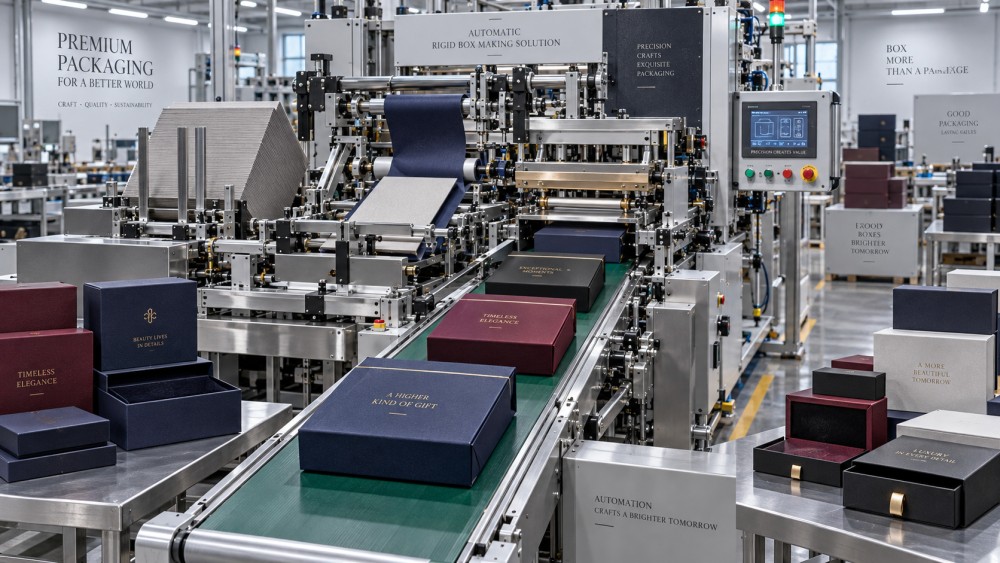
Automation in rigid box production can cover board feeding, corner taping, glue application, board positioning, paper feeding, wrapping, edge folding, pressing, and delivery. It may also extend to vision inspection, counting, conveying, and pallet or carton handling. Yet automation should be assessed task by task. More modules do not automatically mean a better investment.
The first priority is usually process stability at the points where manual variation creates visible defects. Accurate board positioning and controlled wrapping can be more valuable than a nominally automatic feature that does little for the plant’s actual defect pattern. If the operation regularly produces book-style boxes or magnetic closures, the purchasing team should distinguish between a machine designed for those formats and one that requires additional manual steps or separate equipment.
It is also essential to identify the labor that remains around the machine. A highly automated forming section may still need people to inspect delicate surfaces, assemble inserts, protect finished boxes, or prepare materials. A credible labor model maps every touchpoint from printed sheet or covering material to packed finished box. That is more useful than accepting a general claim that a line “saves labor.”
Quality consistency is a mechanical and process question
Premium boxes are judged close up. The evaluation should therefore examine edge folding, corner coverage, paper tension, wrap registration, glue cleanliness, squareness, compression marks, and lid-base fit. For surface-sensitive work, even the contact points of belts, rollers, guides, and delivery components deserve attention. Ask how the machine manages material registration and whether adjustments are manual, recipe-based, or dependent on operator judgement.
Glue handling needs particular scrutiny. The adhesive type, application method, temperature or viscosity controls where applicable, cleaning routine, and effect of ambient conditions may all influence production quality. A supplier should be able to explain material compatibility boundaries without treating every stock as interchangeable. If a buyer plans to use a new paper supplier, recycled board grade, or specialty finish, trial production is usually more informative than a verbal assurance.
Inspection should match the risk. Some plants rely on trained final inspectors for premium lines; others may benefit from vision systems that identify recurring visual or positioning defects. The value of inspection is not only defect removal. It can reveal whether variation starts at printing, lamination, board cutting, machine setup, adhesive application, or handling after delivery.
Calculate lifecycle cost as a production system
The purchase price of a luxury rigid box making machine is visible. Most of the meaningful cost differences emerge later: labor, material waste, consumables, energy, maintenance, unplanned downtime, changeover losses, and the cost of reworking premium packaging. A lower-cost machine may remain a rational choice for limited volume or a narrow, stable product range. It becomes risky when its lower capital cost is offset by slow setup, fragile parts support, high rejects, or extensive manual finishing.
A practical investment model should use the plant’s own assumptions rather than generic return-on-investment claims. Include expected annual production by format, realistic scheduled operating time, staffing by shift, estimated waste from current production, planned maintenance time, freight and installation, training, tooling or format parts, and the likely cost of spare parts. If the system requires compressed air, heating, extraction, or special electrical work, these site requirements should be included early rather than treated as incidental.
Do not overlook opportunity cost. A manual operation may be economically acceptable until it delays a high-value launch, limits response to a rush order, or ties skilled operators to repetitive work. On the other hand, buying a fully integrated line without sufficient recurring volume can lock capital into underused capacity. The best financial case is usually based on the volume and complexity that the business can reasonably support, not on its most optimistic forecast.
Supplier capability includes commissioning and recovery support
Technical comparison should include the supplier’s ability to bring the equipment into stable operation. Confirm the factory acceptance process, sample approval approach, installation responsibilities, operator and maintenance training, manuals, recommended spare parts, and escalation path if quality problems appear after commissioning. Where equipment crosses borders, clarify who handles shipping scope, site preparation guidance, customs documentation where relevant, and remote support across time zones.
Ask for a clear list of exclusions. Optional equipment, format tooling, automation interfaces, inspection devices, and post-machine conveyors can alter the project cost substantially. A low initial quotation may not include the elements needed to produce the target box efficiently. Equally, an extensive quotation may contain modules that are not justified by the actual order profile.
CPCS approaches these decisions in the same way it covers corrugators, flexographic presses, die-cutters, folder gluers, and plant automation: equipment should be evaluated in relation to uptime, setup efficiency, material behavior, operating skill, maintenance exposure, and workflow integration. For rigid box projects, this perspective helps prevent the common mistake of treating the forming machine as an isolated asset.
A disciplined comparison reduces expensive surprises
Before making a final selection, reduce the decision to a documented comparison of representative formats, material trials, usable throughput, defect criteria, operator requirements, layout needs, service commitments, and complete project cost. Invite production, quality, maintenance, finance, and commercial teams into the review; each will see a different risk that may not appear in a supplier presentation.
The machine that makes the strongest purchase case is not necessarily the fastest or most automated model. It is the one whose real operating range matches the box portfolio, whose quality controls suit the brand standard, and whose support and ownership costs remain credible after installation. For a premium packaging operation, that is the comparison that protects both margin and reputation.
Related News
 How to Compare Laminating Machines for Packaging ApplicationsCompare Laminating Machines for packaging by material compatibility, bond quality, production speed, and operating cost. Find the right fit for your application.Post-Press Kinematics Expert
 What to Consider When Buying a Film Window Patching MachineBuying a film window patching machine? Compare material compatibility, usable output, changeovers and total costs to make a confident investment.Post-Press Kinematics Expert
 How Brass and Magnesium Embossing Dies Compare for PackagingCompare brass and magnesium Embossing Dies for packaging. Discover how detail, durability, and total tooling costs affect your choice—and find the right fit for your next project.Post-Press Kinematics Expert
 What to Check Before Buying a Steel Chase Frame for Foil StampingBuying a steel chase frame? Discover key checks for press fit, precision, heat stability, and supplier quality to avoid costly downtime and buy with confidence.Post-Press Kinematics Expert
 How Male Female Dies Create Clean Embossed Details on PaperboardMale Female Dies create crisp embossed paperboard details. Discover how die clearance, board selection, and press alignment reduce defects and deliver consistent packaging quality.Post-Press Kinematics Expert
 Why Does a Precision Embossing Die Produce Uneven Relief on Cartons?Is your precision embossing die producing uneven carton relief? Discover how to fix alignment, pressure, and board issues to reduce waste and achieve consistent results.Post-Press Kinematics Expert