What to Check Before Buying a Steel Chase Frame for Foil Stamping
A steel chase frame can look straightforward on a quotation: a rectangular assembly, a few dimensions, and a price. On a foil stamping press, however, small differences in its seating surfaces, locking arrangement, or behavior under heat can turn a routine changeover into hours of adjustment.
For procurement teams, the challenge is separating a frame that merely fits inside the machine from one that supports repeatable production. Before comparing prices, verify the interface with the press, the tooling arrangement, dimensional accuracy, structural stability, and inspection evidence. Those details determine whether a lower purchase price remains a saving after installation.
Start by defining exactly what the supplier is quoting
“Chase,” “die frame,” “tooling frame,” and “hot stamping frame” are not always used consistently. Depending on the press design, the steel chase frame may retain a separate tooling plate, support a die-mounting assembly, or form part of a removable heated tooling system. It should not automatically be treated as interchangeable with a honeycomb plate or a heated platen.
This distinction matters because the component’s function determines its specifications. A frame that locates a separate plate has different interfaces from an assembly supplied with heaters, sensors, wiring, and mounting accessories.
Ask the supplier to mark the scope of supply on a drawing. Identify which parts are included, which existing components will be reused, and who is responsible for confirming their compatibility. An inexpensive quotation becomes less attractive if it excludes the locking hardware or requires an additional mounting plate.
Machine compatibility: check the interfaces, not just the envelope
Matching the outer length and width is only the beginning. Two frames with identical external dimensions may differ in thickness, locating features, insertion clearance, or clamp engagement. Even frames intended for the same press family can vary by machine generation or tooling configuration.
Send suppliers the machine manufacturer, model, serial number, and relevant tooling drawings. Where possible, include photographs of the existing installation and details of any modifications. A model name alone is not a sufficient manufacturing reference.
Do not assume that additional packing can correct every mismatch. Packing may be part of an approved setup procedure, but it is not a substitute for correct frame geometry, secure retention, or the specified tooling height.
What to inspect on the steel chase frame itself
A freshly finished surface can hide weak specification control. Focus inspection on the features that establish location, carry load, and retain the tooling—not simply on cosmetic appearance.
Material and manufacturing route
Request the steel grade and the applicable material standard. Descriptions such as “premium steel” or “heavy-duty steel” are not enough to establish suitability. The supplier should explain why the selected material and construction suit the frame size, operating conditions, and intended tooling arrangement.
Also establish whether the frame is machined from a single blank, fabricated from joined sections, or produced through another route. A welded construction is not automatically unsuitable, but welding can introduce distortion and residual stress. Ask how these are controlled before final machining and whether stress relief is included where necessary.
Heat treatment should likewise have a stated purpose. Greater hardness is not automatically better: machinability, toughness, thread durability, and repair options also matter. For critical applications, request material traceability and relevant treatment records rather than relying on a general certificate of conformity.
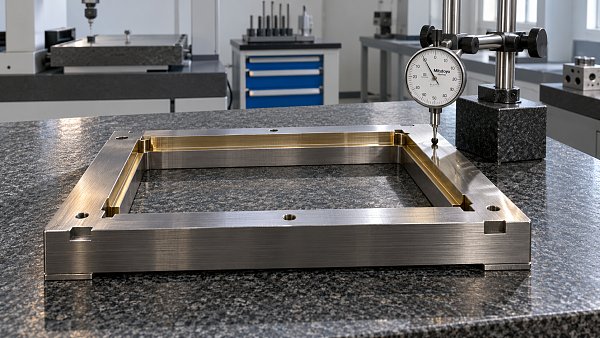
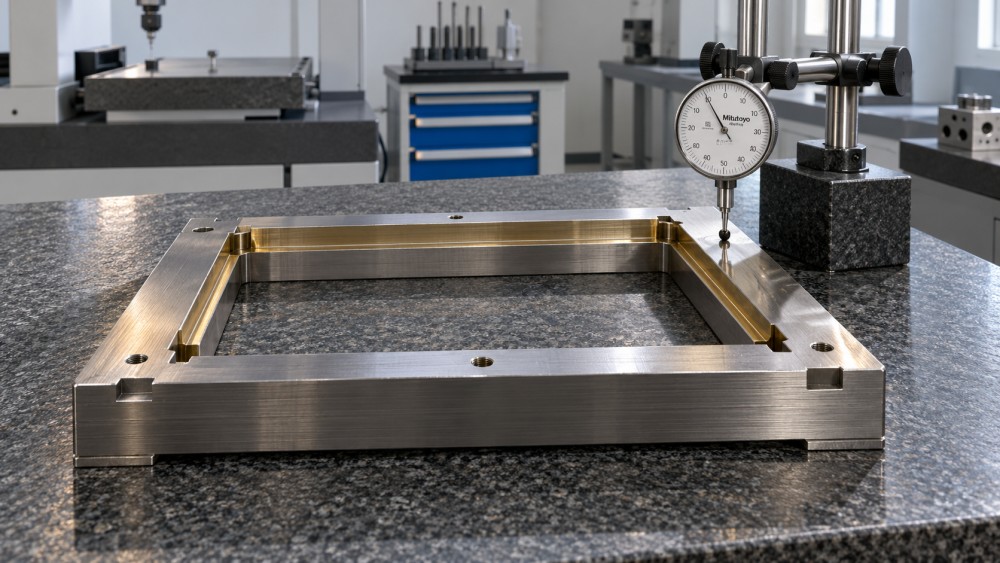
Flatness, parallelism, and squareness
These terms describe different characteristics. Flatness concerns an individual surface; parallelism concerns the relationship between surfaces; squareness concerns perpendicular features. A frame can satisfy one requirement and still fail another.
There is no single tolerance suitable for every foil stamping chase. Required limits depend on frame dimensions, press design, tooling construction, and production requirements. Ask for tolerances against identified drawing datums, not an unsupported claim that the frame is “precision ground.”
The inspection method matters too. Confirm which surfaces are measured, how the frame is supported during measurement, and the inspection temperature. Thin or large frames can give misleading results if checked under different support conditions.
Machined details and surface condition
Check locating edges, bolt holes, threads, clamp seats, and tooling support areas. Burrs or raised edges can prevent proper seating even when the main dimensions are correct. Damaged threads can complicate installation and reduce reliable fastener engagement.
Surface protection also needs scrutiny. Ask which surfaces are coated, whether coating thickness is included in dimensional allowances, and how corrosion protection will be removed before installation. Precision seating faces should not acquire an unintended buildup that changes their fit.
Cold inspection is necessary—but may not be enough
Foil stamping depends on a controlled combination of heat, pressure, dwell time, tooling, foil, and substrate. The chase does not control all these variables, but its behavior can influence how consistently the tooling is supported and located.
Steel expands as its temperature rises. The practical question is whether expansion is accommodated by the locating and locking arrangement without binding, shifting, or creating distortion. A frame inspected at room temperature may behave differently once the assembly reaches production conditions.
Ask the supplier to distinguish between the heated platen temperature, tooling temperature, and the temperature the frame is expected to experience. They are not necessarily identical. Compatibility claims should reflect the actual installation rather than a generic maximum temperature.
For a replacement design, larger format, or demanding application, discuss a controlled warm-up and production trial. Useful checks include:
- Whether insertion, seating, and locking remain satisfactory after warm-up.
- Whether tooling location remains repeatable through representative operating cycles.
- Whether the assembly shows binding, loosening, or permanent distortion.
- Whether removal and reinstallation restore the expected position.
Keep the diagnosis balanced. Uneven foil transfer or registration drift can also result from tooling, sheet positioning, substrate variation, foil selection, temperature control, or press condition. A production trial should evaluate the frame within a controlled setup, not attribute every defect to it.
Rigidity and useful working area deserve a joint review
A larger opening may offer more layout freedom, but it can also change the stiffness of the frame. Conversely, heavier sections may improve rigidity while reducing usable space or making changeovers harder. Neither maximum opening nor maximum weight is a reliable purchasing objective on its own.
Share representative job layouts with the supplier, including die positions and any concentrated stamping areas. Confirm allowable tooling arrangements and operating limits with the press manufacturer where required. An overall load figure, if provided, should not be assumed to permit the same force concentrated anywhere within the opening.
For plants running short batches and frequent changes, handling deserves particular attention. Confirm whether existing lifting aids, storage racks, and changeover equipment can accommodate the replacement. Operators should not have to improvise a handling method because procurement assessed only the installed position.
Compare total purchasing cost, not an incomplete unit price
The lowest quotation may cover only the bare frame. Another may include inspection, locating hardware, protective packaging, and installation support. Normalize these differences before making a commercial comparison.
A practical evaluation separates costs into three groups:
- Acquisition: frame, engineering, accessories, inspection, freight, duties, and protective packaging.
- Introduction: receiving checks, trial installation, press time, approved adjustments, and operator familiarization.
- Service life: maintenance, replacement hardware, repairs, repeated setup effort, and downtime attributable to frame problems.
Use your own production records to assess the value of setup time. If the existing tooling arrangement requires frequent correction, document the causes before assuming a new frame will eliminate them. Count only the improvements that are technically justified or demonstrated during an agreed trial.
Lead time has commercial value as well. Ask separately about drawing approval, manufacturing, inspection, and delivery. For a production-critical spare, confirm whether the supplier retains controlled drawings and can reproduce the same revision later. A quick first delivery is less useful if the next replacement requires a fresh reverse-engineering exercise.
Put acceptance criteria into the purchase order
A quotation saying “suitable for your machine” leaves too much room for disagreement. Before ordering, convert the supplier’s commitments into measurable acceptance requirements.
The purchasing package should include an approved drawing with revision control, material specification, critical dimensions and tolerances, scope of accessories, and the agreed inspection documentation. State whether acceptance is based on dimensional inspection, machine fit, a production trial, or a combination of these.
Where a trial is required, define representative tooling and operating conditions, responsibilities, and how results will be assessed. Avoid vague requirements such as “perfect stamping,” which depend on more than the frame.
Clarify the remedy for nonconformance before payment terms become difficult to change. Who pays for return freight? Can the supplier authorize local rework? What happens if installation reveals interference despite an accepted drawing? These questions are easier to resolve before the press is waiting for a usable component.
For repeat purchases, consider first-article approval before releasing the remaining quantity. This is particularly useful when the part has been reverse-engineered, the machine has been modified, or the supplier has not previously produced that exact configuration.
Warning signs that justify pausing the order
Be cautious when a supplier confirms compatibility from a photograph alone, declines to identify the steel grade, or offers precise tolerances without explaining the measurement method. Another concern is an inspection report that cannot be linked to the delivered frame or approved drawing revision.
Promises that one frame will fit several machine variants without interface checks deserve scrutiny. So do claims that a heavier frame automatically guarantees better stamping, or that flatness alone will resolve registration problems.
The strongest purchasing decision is not necessarily the most expensive frame. It is the one supported by a clear specification, credible inspection evidence, an appropriate acceptance process, and a realistic understanding of operating cost. When those points are settled, price negotiations become more meaningful—and the production team is less likely to inherit an avoidable tooling problem.
Related News
 How to Compare Laminating Machines for Packaging ApplicationsCompare Laminating Machines for packaging by material compatibility, bond quality, production speed, and operating cost. Find the right fit for your application.Post-Press Kinematics Expert
 What to Consider When Buying a Film Window Patching MachineBuying a film window patching machine? Compare material compatibility, usable output, changeovers and total costs to make a confident investment.Post-Press Kinematics Expert
 How Brass and Magnesium Embossing Dies Compare for PackagingCompare brass and magnesium Embossing Dies for packaging. Discover how detail, durability, and total tooling costs affect your choice—and find the right fit for your next project.Post-Press Kinematics Expert
 What to Check Before Buying a Steel Chase Frame for Foil StampingBuying a steel chase frame? Discover key checks for press fit, precision, heat stability, and supplier quality to avoid costly downtime and buy with confidence.Post-Press Kinematics Expert
 How Male Female Dies Create Clean Embossed Details on PaperboardMale Female Dies create crisp embossed paperboard details. Discover how die clearance, board selection, and press alignment reduce defects and deliver consistent packaging quality.Post-Press Kinematics Expert
 Why Does a Precision Embossing Die Produce Uneven Relief on Cartons?Is your precision embossing die producing uneven carton relief? Discover how to fix alignment, pressure, and board issues to reduce waste and achieve consistent results.Post-Press Kinematics Expert