What Should You Know Before Buying a Double Wall Paper Cup Machine?
The right double wall paper cup machine is not simply the fastest machine within budget. It must produce a consistent outer sleeve-to-cup fit at the paper grades, cup sizes, and order patterns the factory expects to run. A low initial price can become expensive when sleeve misalignment, adhesive failures, limited size range, frequent stoppages, or unavailable spare parts reduce saleable output.
Double-wall cups are used where a single paper wall does not provide enough insulation or rigidity. Their construction introduces a second converting operation: an already-formed inner cup must be combined with a printed or plain outer wrap. That added step makes machine selection less about a headline speed figure and more about synchronization, material behavior, rejection control, and support for the full production process.
Start with the cup specification, not the machine catalogue
A double wall paper cup machine is designed around a relatively specific range of cup geometries. Before comparing suppliers, define the products that need to be made: top diameter, bottom diameter, cup height, finished capacity, rim style, and whether the outer wall is a full-height sleeve or a shorter band. A machine that is suitable for a standard hot-drink cup may require different forming tools, guides, and sleeve blanks for a tapered soup cup, a wide-mouth beverage cup, or a cup with an unusually tall print area.
The key question is whether the machine can cover the required size range with practical tooling changes. Suppliers may state a broad diameter range, but the commercial value of that range depends on the conversion process. If each size requires extensive mechanical adjustment, new forming moulds, new sleeve dies, and lengthy trial runs, the machine may be poorly suited to a business with frequent SKU changes. Conversely, a narrower, stable product range can justify a more dedicated configuration because consistency matters more than flexibility.
Ask for a clear schedule of every item needed for each cup format: moulds, bottom tooling where relevant, sleeve forming components, guides, change parts, sensors, and any software parameters. The quotation should distinguish between components included with the machine and components priced separately. This prevents a common cost distortion: comparing a base machine quote from one supplier with a production-ready package from another.
Rated speed is only useful when linked to acceptable output
Machine speed is often expressed as cups per minute, but this figure is not a production guarantee. It may refer to a short trial using a particular cup size, paper grade, adhesive system, and operator setup. Double-wall production also includes rejection caused by sleeve position errors, insufficient bonding, wrinkles, incomplete forming, scuffing, and feeding faults. The more meaningful measure is the number of cups that meet agreed quality requirements over a normal operating period.
Capacity planning should therefore separate three figures:
- Mechanical rated speed: the maximum cycling rate stated by the manufacturer.
- Practical running speed: the rate achievable with the intended paper, cup dimensions, and adhesive.
- Good-output rate: finished cups that pass visual, dimensional, and bonding checks after rejects and stoppages.
A supplier should be able to explain what conditions support the stated output and what changes when cup diameter, sleeve height, paper stiffness, or print finish changes. It is reasonable to request a production demonstration using representative blanks where practical, rather than accepting a speed claim based solely on samples selected by the machine builder.
Short stoppages deserve as much attention as major breakdowns. Sleeve magazines that feed inconsistently, sensors that misread dark or reflective printing, adhesive nozzles that need frequent cleaning, and difficult access to jam points can all reduce output without appearing in a specification sheet. These losses are especially important where labour is assigned to multiple machines and cannot continuously intervene.
The paper and coating specification determine whether the process is stable
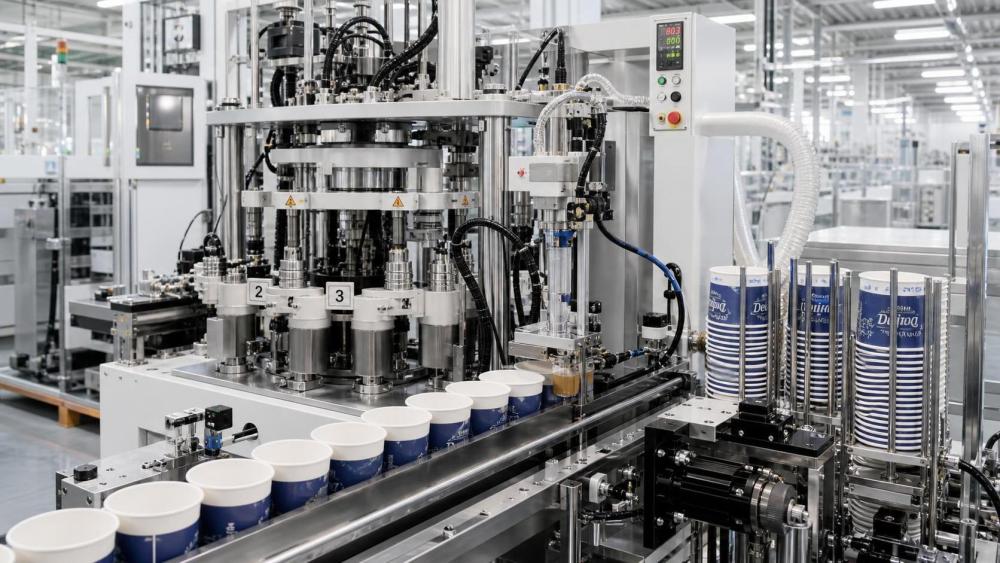
Not all cupstock behaves the same way on a double wall paper cup machine. The inner cup and outer sleeve can use different paper grades, calipers, coatings, and print treatments. The inner cup commonly requires a barrier layer appropriate for the intended beverage and filling conditions, while the outer sleeve is selected for appearance, insulation contribution, stiffness, and print performance. The machine must feed, position, and bond both materials reliably.
Paper stiffness is not interchangeable with basis weight. Fibre composition, moisture condition, grain direction, coating structure, and converting quality all affect feeding and shaping. An outer sleeve that is too stiff may resist forming around the cup; one that is too soft may wrinkle or lose its cylindrical appearance. Curl at the leading edge, variation in blank dimensions, and inconsistent scoring can also create intermittent defects that are incorrectly blamed on the machine.
Material compatibility must be discussed in terms of the exact blank construction. This includes polyethylene-coated paper, water-based barrier paper, and other coated or treated substrates where applicable. Bonding performance depends on whether the adhesive system can form a durable connection to the relevant surfaces without marking the outer print or contaminating the cup interior. If a supplier proposes hot-melt adhesive, the review should cover adhesive grade, melt temperature control, application pattern, open time, nozzle maintenance, and the ability to maintain bond quality at planned production speeds.
Do not treat the printed sleeve as purely decorative. Heavy ink coverage, varnish, metallic effects, and certain coating systems can affect sensor detection, friction, folding behavior, and visible scuff resistance. Where branded cups are a major part of the order mix, run samples should include the actual print finish rather than only unprinted board.
Quality requirements should be written as acceptance criteria
A machine quotation may promise “stable quality,” but that phrase has little value unless the required quality is defined. For double-wall cups, acceptance criteria should address both function and appearance. Relevant checks include sleeve centering, vertical alignment, overlap consistency, glue coverage, bonding strength, absence of glue strings, rim integrity, cup roundness, print orientation, surface damage, and stacking behavior.
There is also an important distinction between cup-making quality and the quality of the incoming inner cup. Some double-wall machines receive finished single-wall cups from a separate line; others are supplied as part of an integrated production arrangement. When the inner cups come from another machine or supplier, dimensional variation must remain within a range that the sleeve applicator can handle. A double wall unit cannot fully compensate for poorly formed, out-of-round, or inconsistent single-wall cups.
The inspection method should be proportionate to the product risk. Basic visual checks and regular sampling may be sufficient for a simple, unbranded foodservice cup. Higher-value printed cups, regulated food-contact supply chains, or customers with strict packaging specifications may justify additional controls such as camera-based orientation or defect detection. Automation is valuable only if it identifies defects that would otherwise reach shipment and if the rejection mechanism works reliably at production speed.
Automation should reduce unstable manual work, not add unnecessary complexity
Automation levels vary widely. A basic configuration may rely on manual replenishment of cup and sleeve magazines, manual glue adjustment, and operator-led fault recovery. More automated systems may include automatic feeding, servo-controlled positioning, recipe storage, alarm history, rejection handling, counting, and conveyor connections to packing equipment.
The right level depends on volume, labour availability, product variation, and the surrounding line layout. A highly automated machine can improve repeatability, but it also increases the importance of controls support, electrical documentation, and availability of replacement sensors, drives, and motion components. A complex machine with poorly supported controls can create longer downtime than a simpler unit with accessible components.
Focus on operations that currently create variability or consume operator time: loading sleeves, correcting registration, clearing jams, monitoring glue application, counting finished cups, or moving product to packing. Each proposed automated feature should be assessed against a specific operational problem. Features without a defined purpose can increase capital cost and commissioning time without improving good output.
Interface requirements matter where the machine will feed directly into sleeving, bagging, cartoning, or conveyor systems. Confirm discharge height, cup orientation, accumulation capacity, communication signals, emergency-stop integration, and whether the downstream equipment can handle the machine’s realistic output rather than its rated maximum.
Calculate cost by the finished cup, not by equipment price alone
The purchase price is only one part of the investment. A useful evaluation compares the expected cost per accepted double-wall cup across the anticipated product mix. The calculation does not need a speculative market forecast; it needs disciplined assumptions about actual operating conditions.
Waste is frequently underestimated. Outer sleeves often carry higher print value than the inner cup, so misapplication can destroy a larger share of material value than a simple cup-forming defect. The economic effect is not limited to discarded paper; it includes machine time, adhesive, inspection effort, and the risk of delivery shortfalls.
Energy use should be evaluated with the actual process configuration in mind. Electrical consumption, compressed air demand, and adhesive heating are relevant, but there is little value in comparing isolated nameplate values if machines run at different good-output rates. A lower-power machine that produces more rejects or requires more manual intervention may not deliver a lower finished-cup cost.
Supplier capability is part of the equipment specification
Double-wall cup equipment often crosses borders, making documentation and support as important as mechanical construction. A complete commercial review should cover manufacturing lead time, inspection arrangements before shipment, packing method, installation responsibilities, commissioning scope, operator training, warranty terms, and remote troubleshooting procedures.
Request the electrical drawings, pneumatic diagrams, operating manual, spare-parts list, and recommended preventive-maintenance schedule before finalizing the purchase where possible. The purpose is not only to check document quality. It reveals whether the machine can be maintained systematically after handover. Clear component identification, standard electrical parts where appropriate, and accessible service points reduce dependence on a single supplier contact.
Spare parts should be divided into commissioning spares, consumable parts, wear parts, and critical failure parts. A modest starter kit may prevent extended disruption, but it should be selected from the machine’s actual risk points: heaters and temperature controls for adhesive systems, sensors, belts, bearings, pneumatic components, cutters or forming parts where used, and control-system items with long replacement lead times.
For food-contact packaging, the equipment itself does not replace the need to manage material compliance, hygienic production, traceability, and customer-specific requirements. Machine surfaces, lubricant choices, glue handling, cleaning access, and the separation of finished goods from dust or scrap should be reviewed against the factory’s intended hygiene controls. Claims about cup suitability should be supported by the relevant material and production documentation, not inferred from the machine alone.
Acceptance testing should reflect the order mix that will pay for the machine
A factory acceptance test is most useful when it reproduces the conditions under which the machine will operate. The test protocol should identify cup size, inner-cup source, sleeve material, print condition, adhesive, target speed, inspection method, allowed defect categories, and test duration. A short demonstration can show that a machine cycles; it does not establish stable production.
The protocol should also state who provides the blanks and what happens if supplied materials fall outside the agreed specification. This protects both sides. Without a defined substrate standard, a supplier can attribute every defect to material variation, while the buyer may attribute every defect to the machine.
Where multiple cup formats are planned, test at least the formats that create the greatest technical or commercial risk: the smallest diameter, the tallest cup, the heaviest sleeve board, or the most demanding printed finish. It is more informative to test difficult, recurring products than to approve a machine solely on an easy standard cup.
A sound purchase decision is based on production fit
The best choice is the machine whose proven good output, format capability, material compatibility, serviceability, and total operating cost fit the planned cup programme. A lower-priced unit can be appropriate for a limited range and modest output requirement. A more capable system may be justified where repeatable print presentation, frequent order changes, higher automation, or controlled downstream integration materially affect delivery performance.
Before issuing a purchase order, convert every important promise into a measurable item: supported cup formats, supplied tooling, test materials, acceptable defects, output conditions, utility requirements, spare parts, documentation, training, installation scope, and warranty response. That discipline turns a double wall paper cup machine purchase from a comparison of brochures into a controlled decision about usable capacity and finished-cup cost.
Related News
 How Blanking Machines Remove Carton Waste Without Damaging BlanksDiscover how Blanking Machines remove carton waste without damaging blanks. Learn tooling, alignment, and setup tips to reduce defects, protect print quality, and improve production.Post-Press Kinematics Expert
 When a Custom Embossing Die Delivers Better Packaging DetailDiscover when a custom embossing die adds premium tactile detail, sharper branding, and repeatable packaging quality for cartons that stand out on shelf.Post-Press Kinematics Expert
 What to Compare Before Buying a Luxury Rigid Box Making MachineCompare a luxury rigid box making machine by usable throughput, automation, quality consistency, lifecycle cost, and supplier support to protect premium packaging margins.Post-Press Kinematics Expert
 What Determines Window Patching Machine Price for Packaging LinesWindow patching machine price depends on speed, accuracy, film compatibility, automation, and support. Compare total costs to choose the right packaging solution.Post-Press Kinematics Expert
 What Drives the Cost of a Custom Foil Stamping DieCustom foil stamping die costs explained: compare materials, artwork complexity, die size, run length, and press requirements to choose durable, cost-effective tooling.Post-Press Kinematics Expert
 What to Compare Before Buying Hot Foil Stamping MachinesHot Foil Stamping Machines: compare quality, registration, setup time, foil compatibility, and uptime to choose a press that delivers profitable, repeatable results.Post-Press Kinematics Expert