What Drives the Cost of a Custom Foil Stamping Die
The price of a custom foil stamping die is not determined by size alone. Two dies with similar dimensions can carry very different costs because they require different materials, engraving methods, artwork preparation, and production life. For a premium folding carton, label, book cover, invitation, or promotional piece, the die is a tooling decision: its cost should be judged against expected run length, finishing quality, setup time, and the risk of replacement during production.
A low quotation can be appropriate for a simple, short-run design. It can also be a warning sign when the application requires fine detail, repeated impressions, difficult substrates, or close registration with printed graphics. The useful question is not simply, “What does the die cost?” It is, “What die specification will produce the required result through the planned production cycle?”
Material Is Usually the First Major Cost Driver
Foil stamping dies are commonly made from magnesium, copper, brass, or, for specific applications, other specialized materials. The choice affects the initial tooling price, engraving capability, heat behavior, durability, and suitability for the press and foil being used.
Magnesium can be a sensible choice when the job is a single campaign, the artwork is open and uncomplicated, and the press conditions are stable. Its lower cost becomes less attractive when the design contains narrow lines, small reversed text, dense areas, or features likely to wear before the run is complete.
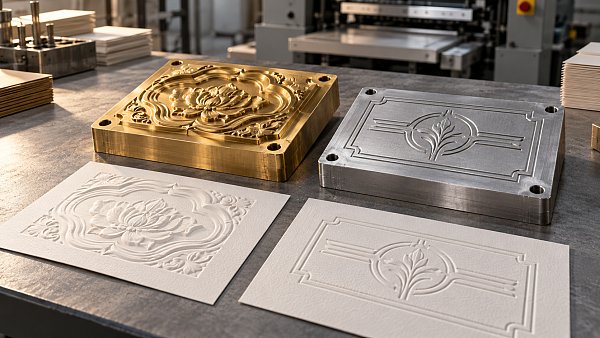
Brass generally costs more because the material and machining process are more demanding. That higher purchase price can be justified when a die must maintain detail over many impressions, operate under difficult heat and pressure conditions, or support foil stamping combined with embossing. Copper sits between these options in many sourcing decisions, although the practical choice still depends on the die maker's process and the intended job.
A common buying mistake is treating material as a generic upgrade. It is not. A more durable material does not compensate for unsuitable artwork, poor foil selection, weak sheet control, or incorrect press settings. Conversely, specifying a premium die for a one-time, simple job may add cost without improving the delivered package.
Die Area Affects More Than Raw Material Consumption
Large dies cost more because they use more material, but area also changes machining time, mounting requirements, handling, and the difficulty of achieving even pressure across the image. A wide solid foil panel is often more challenging than a large design made of separate open elements. The die must transfer heat and pressure consistently over its full surface; uneven conditions can create incomplete foil coverage, patchiness, or excessive make-ready time.
Buyers should provide the active foil area, not only the finished sheet size. A supplier also needs to know whether the die contains one image, multiple repeats, step-and-repeat layouts, or separate positions for different carton panels. A single large die may reduce changeovers, while smaller individual dies may offer greater flexibility when artwork versions change. The lowest tooling total is not always the lowest production cost.
For repeated carton designs, ask whether a multi-up die will be run on a compatible chase and whether the press can maintain uniform pressure across the layout. A larger die can be commercially efficient when the job is stable and volume is sufficient. It becomes harder to justify when frequent design revisions, regional variants, or uncertain forecasts could make part of the tooling obsolete.
Artwork Complexity Drives Engraving Time and Production Risk
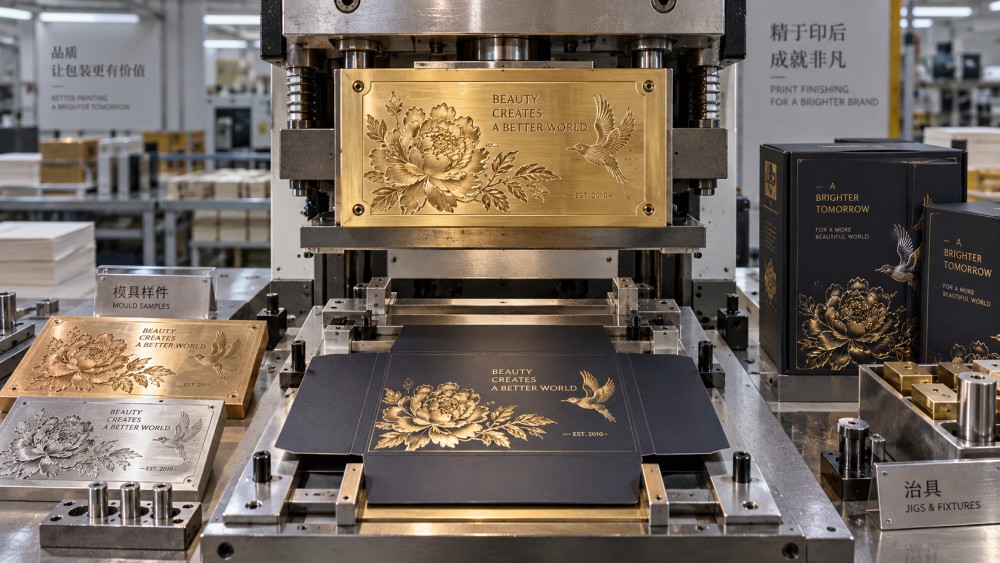
Artwork is one of the most underestimated contributors to custom foil stamping die cost. A bold logo with open letters may be straightforward to engrave. A logo containing thin strokes, tiny counters, textured backgrounds, fine borders, halftone-like detail, or very close spacing requires more careful toolpath planning and more demanding production control.
Fine detail does not simply increase engraving time. It can also reduce the practical tolerance available during foil stamping. When small features must release cleanly, the die face, foil, temperature, dwell time, pressure, substrate surface, and sheet positioning all need to work together. If the project has a critical visual requirement, the die supplier may recommend a different material, a modified line weight, or a revised artwork treatment. Those changes are part of obtaining a reliable production result, rather than arbitrary additions to the quote.
Large solid areas deserve special attention. They can require more energy to transfer foil cleanly and can reveal subtle substrate texture or pressure inconsistency. A broad metallic background with fine unfoiled text may look simple in a digital proof but be more difficult to stamp consistently than an open-line design. Buyers should request that the die quotation reflects the actual foil coverage and not merely the outer dimensions.
Artwork Preparation Can Prevent Avoidable Tooling Charges
Providing correct production-ready artwork reduces clarification cycles and helps the die maker quote accurately. Vector artwork is normally preferred for linework and type. All fonts should be converted to outlines, linked elements should be embedded or clearly supplied, and the foil area should be separated from print, emboss, varnish, and cut lines. Registration marks, sheet direction, and the intended press orientation should be unambiguous.
Late artwork corrections are particularly expensive when they occur after engraving begins. Some changes can be repaired; others require a new die or a major remake. A purchasing process should therefore include sign-off by design, prepress, the printer, and the finishing operation before tooling is released.
Engraving Depth and Relief Design Affect Both Price and Performance
Foil stamping requires a die with sufficient relief to transfer foil onto the intended image while avoiding unwanted contact in non-image areas. The required depth depends on the artwork, substrate, press configuration, and whether the operation includes embossing or debossing.
Deeper or more complex relief generally demands more machining and inspection. It may also require additional work where the die includes fine details close to broad foil areas. In combination work, where foil stamping and embossing occur in one pass, the tooling system may include a matched counterforce or counterpart component. This is not comparable to ordering a flat foil die alone, so quotations should identify each item separately.
The functional requirement matters more than requesting “deep engraving” as a general preference. Excessive depth does not automatically improve foil transfer. It can create other setup difficulties, especially on lightweight or highly textured stocks. The die supplier and finishing team need a clear description of the visual effect: flat foil, raised foil, sculpted embossing, registered foil over print, or foil applied to an uncoated board.
Expected Run Length Determines Whether Durability Has Value
Tooling should be selected for the number of impressions it must produce, not for an abstract idea of quality. A short-run luxury carton launch may only need a die that performs cleanly for one controlled production cycle. A recurring consumer product, seasonal gift box, or widely distributed label can require tooling that remains stable over repeated runs and storage periods.
Expected volume also affects the value of replacement planning. If a project has no production buffer and the die is likely to be used again, a more durable specification may reduce the operational risk of worn edges, damaged detail, or an unplanned retooling delay. For a short-run design with no reuse, paying for a long-life die may not recover its cost.
It is useful to distinguish between the print quantity and the expected die life. A product might have a modest initial order but a high chance of repeat demand. In that case, retaining the die and documenting its storage location, mounting format, version, and approved artwork can prevent unnecessary remakes. The tool itself is only valuable if it remains identifiable and compatible with future production conditions.
The Press, Foil, and Substrate Change the Right Specification
A foil stamping die does not operate alone. The same design can require different tooling decisions on coated folding boxboard, uncoated paper, textured stock, laminated sheets, synthetic labels, or rigid box wrap. Surface texture and stiffness affect the pressure needed for clean transfer. Coatings and laminates can change foil adhesion. Sheet variation can affect registration and coverage.
The type of press matters as well. Flatbed, platen, cylinder, and other foil stamping configurations impose different conditions on the die and job setup. A quotation should identify the press type, chase dimensions, mounting method, and whether the job uses manual, semi-automatic, or automated feeding. These details help prevent a die being delivered in a format that requires unexpected adaptation before it can run.
Foil choice should be considered early, especially for unusual metallic shades, holographic effects, pigment foils, or materials with difficult surfaces. Foil is selected for the substrate and process conditions, not just appearance. A die designed around an assumed application may require adjustment if the final board, laminate, or foil grade changes late in development.
Cost Items That Are Often Missing From an Initial Comparison
When comparing quotes, buyers should separate the die price from the total cost of making the foil-stamped component. A lower die quotation may exclude artwork review, mounting, proofing, counterforce tooling, packing, delivery, or future storage. These are not always required, but they should be visible rather than discovered after approval.
- Design and prepress review: correction of unsuitable linework, missing vectors, or unclear registration instructions.
- Make-ready support: time and materials required to establish clean transfer and accurate registration.
- Counterparts and makeready materials: especially relevant for embossing, debossing, or high-relief work.
- Mounting and press compatibility: backing, base requirements, chase format, and orientation.
- Sampling or production proofing: useful where premium appearance or brand color interaction is critical.
- Storage and reuse: labeling, protection, condition tracking, and retrieval for repeat orders.
Make-ready deserves particular attention in a production environment with many short jobs. A cheaper die that takes longer to bring into register or produces inconsistent coverage can cost more through machine time, foil waste, rejected sheets, and delayed delivery. The tooling quotation should therefore be reviewed alongside the expected finishing setup, not in isolation.
How to Request a Quote That Can Be Compared Fairly
A meaningful request for quotation gives every supplier the same operational information. Without it, suppliers may quote different materials, assumptions, die depths, or delivery scopes, making the lowest number misleading.
- Provide approved vector artwork and clearly identify the foil image.
- State the final substrate, including coatings, laminates, texture, and approximate sheet construction.
- Describe the intended effect: flat foil, registered foil, embossing, debossing, or a combined finish.
- Confirm the press type, chase size, mounting requirements, sheet direction, and number of-up.
- Share estimated initial volume, likely repeat frequency, and whether the die must be retained for future work.
- Ask suppliers to state die material, engraving approach, included accessories, lead time, remake terms, and storage options.
This level of detail makes sourcing more efficient because it moves the discussion from a generic die price to a usable tooling specification. It also gives the finishing operator an opportunity to flag a design that may need adjustment before production begins.
When the Lowest Die Price Is the Right Choice
The least expensive option can be appropriate when the image is simple, the run is short, the substrate and foil are conventional, and the artwork is unlikely to return. It may also be suitable for early design validation, provided the sample run does not need to represent the final production durability.
It is less suitable when the job includes fine branded elements, close registration, recurring production, large solid coverage, embossing, or a costly substrate that leaves little tolerance for spoilage. In those cases, the primary buying criterion should be repeatable output, not just the invoice value of the die.
For packaging operations evaluating foil stamping alongside die-cutting, folder-gluing, inspection, and automated handling, tooling decisions should be tied to the wider production flow. Platforms such as CPCS focus on this broader converting context: finishing quality is shaped by press capability, material control, setup discipline, and downstream yield as much as by a single component purchase.
FAQ
Should a foil stamping die be reused?
Reuse is practical when the artwork, press format, substrate, and finishing requirement remain stable. A die should be protected, clearly identified, and checked for wear before repeat production. Reusing a damaged or mismatched die can create more cost than remaking it.
Is brass always better than magnesium?
No. Brass is often better suited to demanding or repeat work, but magnesium can be commercially sensible for simple, shorter runs. The appropriate choice depends on design detail, expected impressions, production conditions, and required finish quality.
Can the same die be used for foil stamping and embossing?
Some jobs use combined tooling, but embossing usually involves additional counterpart tooling and more demanding setup. The supplier needs to know the intended effect before quoting, because a flat foil die is not equivalent to an embossing system.
What should be approved before die engraving starts?
Approve the final foil artwork, substrate, foil area, press orientation, registration relationship to print, and the required visual effect. These decisions have a direct impact on die design and reduce the risk of costly changes after tooling production begins.
Related News
 How to Compare Laminating Machines for Packaging ApplicationsCompare Laminating Machines for packaging by material compatibility, bond quality, production speed, and operating cost. Find the right fit for your application.Post-Press Kinematics Expert
 What to Consider When Buying a Film Window Patching MachineBuying a film window patching machine? Compare material compatibility, usable output, changeovers and total costs to make a confident investment.Post-Press Kinematics Expert
 How Brass and Magnesium Embossing Dies Compare for PackagingCompare brass and magnesium Embossing Dies for packaging. Discover how detail, durability, and total tooling costs affect your choice—and find the right fit for your next project.Post-Press Kinematics Expert
 What to Check Before Buying a Steel Chase Frame for Foil StampingBuying a steel chase frame? Discover key checks for press fit, precision, heat stability, and supplier quality to avoid costly downtime and buy with confidence.Post-Press Kinematics Expert
 How Male Female Dies Create Clean Embossed Details on PaperboardMale Female Dies create crisp embossed paperboard details. Discover how die clearance, board selection, and press alignment reduce defects and deliver consistent packaging quality.Post-Press Kinematics Expert
 Why Does a Precision Embossing Die Produce Uneven Relief on Cartons?Is your precision embossing die producing uneven carton relief? Discover how to fix alignment, pressure, and board issues to reduce waste and achieve consistent results.Post-Press Kinematics Expert