What Determines Pile Feeder Price and Total Cost of Ownership
The Purchase Price Explains Only Part of the Investment
A pile feeder can appear to be a relatively contained purchase beside a die-cutter, folder gluer, foil stamper, or inspection line. That impression can be misleading. The quoted pile feeder price may cover a basic feeding unit, while the operating result depends on sheet range, pile handling, separation reliability, controls, safety configuration, delivery interfaces, and the work required to connect it to the rest of the line.
For a procurement team, the useful question is not simply, “Which supplier offers the lowest pile feeder price?” It is, “Which feeder can maintain the required production rate with our actual substrates, job mix, staffing model, and downstream equipment, without transferring cost into downtime, waste, or manual intervention?” A lower-priced feeder can be the better choice for stable, standardized work. It can also become expensive if it struggles with warped board, coated sheets, lightweight stock, frequent size changes, or high-value printed work.
The price difference between two apparently similar machines often reflects a difference in the production risk each machine is designed to manage. That difference needs to be made visible before a purchase order is issued.
What Usually Drives Pile Feeder Price
The largest price drivers are generally mechanical capacity, sheet-handling capability, automation, controls, and the scope of supply. A supplier quotation should separate these items clearly. When they are bundled into a single machine figure, it becomes difficult to compare offers or identify where a lower initial price has omitted essential capability.
Feeding format, pile height, and structural design
A feeder built for a larger maximum sheet size or a higher pile requires a more substantial frame, lifting system, guides, transport elements, and safety arrangement. These features affect more than floor space. They determine how much material can be loaded per cycle, how frequently an operator must replenish the feeder, and whether the system can support the intended run length without disrupting downstream production.
Maximum sheet dimensions should be checked against the full production envelope, not only the most common carton blank. Procurement teams should include oversized promotional packaging, display work, and any future board format that the plant expects to run. Buying around the average job can create an avoidable capacity constraint when an important order falls outside the feeder’s practical range.
Nominal pile height deserves similar attention. A high pile specification has value only if the plant can load it safely and efficiently, and if the material remains stable through the lift and separation process. Board condition, stack quality, humidity, curl, and the way sheets are delivered from the previous process all influence usable pile height.
Substrate range and separation technology
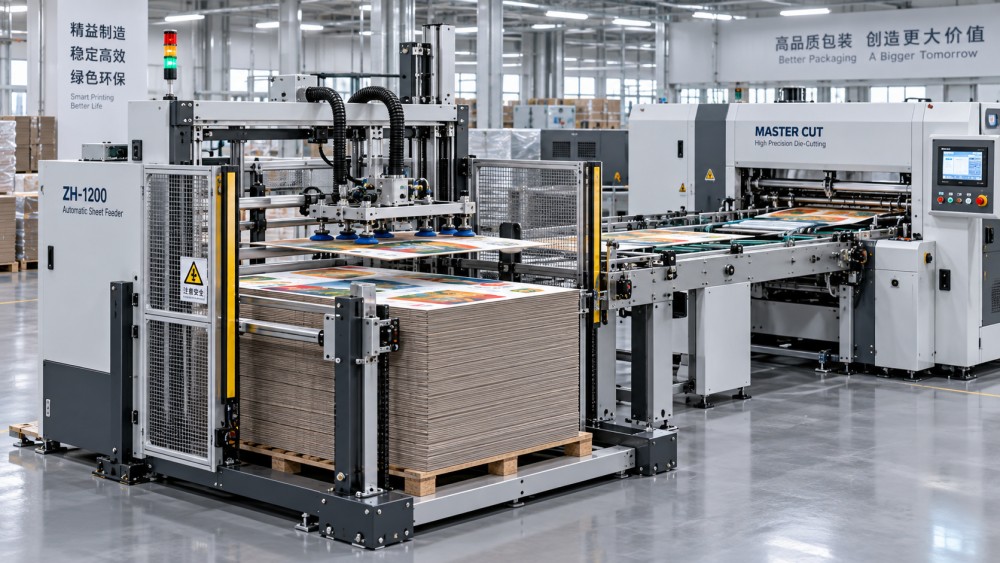
Feeding a flat, uniform sheet at moderate speed is a different task from feeding mixed cartonboard grades, corrugated sheets, laminated materials, metallic substrates, coated stock, or sheets with pronounced curl. The latter applications may call for more capable air separation, adjustable suction settings, anti-static measures, double-sheet detection, sheet flattening provisions, or enhanced guide control.
These options add cost because they reduce the probability of missed feeds, double feeds, skewed sheets, marking, and jams. Their value rises sharply when the feeder supplies a process where an error creates costly waste. A missed sheet before a simple operation may be recoverable. A double feed before foil stamping, precision die-cutting, gluing, coding, or vision inspection can result in damaged tooling, rejected output, or a disruption that takes longer to clear than the feeder issue itself.
Buyers should ask suppliers to identify the materials their standard feeder can handle reliably and the materials that require optional configurations. “Suitable for paper and board” is too broad to support a purchasing decision. The request should specify basis-weight range where relevant, thickness range, coating type, sheet flatness, flute profile for corrugated work, print or varnish condition, and the expected variation between jobs.
Speed claims versus sustainable operating speed
Rated speed is often a prominent part of a quotation, but it should not be treated as a direct measure of usable capacity. A pile feeder may reach its maximum cycles per hour under favorable conditions: a stable substrate, a well-prepared pile, limited format variation, sufficient operator attention, and a downstream machine that accepts the same rate continuously.
A procurement comparison should distinguish between maximum mechanical speed and the speed that can be held across the expected production mix. The second figure is usually more useful, even if suppliers are unwilling to commit to a single number for every substrate. Ask how speed changes for lightweight material, warped sheets, heavy board, large formats, short runs, and frequent changeovers. Also confirm whether the stated rate includes pile replacement, adjustments, clearing events, and quality checks.
A feeder that runs slightly slower on paper but requires fewer interventions can deliver more usable output over a shift than a faster machine that repeatedly needs adjustment. This is especially important where the feeder governs the pace of an expensive converting line.
Automation and operator dependency
Automation features can explain a meaningful share of the price gap between entry-level and advanced pile feeders. Examples include automatic pile alignment, motorized side and front guides, recipe storage, servo-controlled adjustments, automatic format setting, pile change systems, sensors for sheet position, and diagnostic functions.
These features are not automatically justified. Their economic value depends on the job profile. A plant producing long, repetitive runs with one or two stable materials may gain limited benefit from elaborate setup automation. A converter handling many short runs, multiple carton sizes, and tight delivery schedules may recover the additional investment through shorter setup periods, fewer adjustment errors, and reduced reliance on highly experienced operators.
Automation should be evaluated as a workflow decision. It is useful to map every action required between jobs: removing the prior stack, adjusting guides, setting separation, entering job data, verifying feed quality, loading new material, and approving the first acceptable sheets. The supplier’s specification may describe automatic settings, but the plant needs to know which steps still require manual judgment.
The Costs Commonly Missing From a Basic Quote
The feeder itself is only one cost element. Total cost of ownership includes the work and resources needed to commission, operate, maintain, and eventually support the equipment. These costs do not always make a cheaper purchase unattractive, but they should be estimated before comparing suppliers.
- Installation and integration: Site preparation, electrical work, compressed air, extraction or static-control arrangements, guarding, conveyors, interfaces, and commissioning support can materially alter the final project cost.
- Downstream compatibility: Mechanical height, feed direction, control logic, speed synchronization, communication protocols, emergency-stop integration, and physical handoff points should be confirmed with the machine receiving the sheets.
- Tooling and change parts: Special side guides, suction components, belts, pile supports, substrate-specific accessories, and format-related parts may be optional rather than included.
- Operator time: Manual pile loading, adjustment, sheet separation correction, jam clearance, and format changes all create labor cost and can limit the output of the connected line.
- Consumables and wear items: Belts, suction cups, rollers, brushes, filters, seals, sensors, and pneumatic components need planned replacement. The cost is not only the part; it includes availability and installation time.
- Service access: Remote support, local technician coverage, response terms, spare-parts stocking, documentation quality, and software access shape the duration and cost of an unplanned stoppage.
Energy consumption is usually less decisive for a pile feeder than production interruptions or material waste, but it still belongs in the assessment where vacuum pumps, compressed air, auxiliary drying, or additional conveying are involved. The more important utility question is whether the site infrastructure can supply stable air quality, pressure, power, and environmental conditions required for consistent feeding.
Integration Can Change the Economics More Than the Feeder Specification
A pile feeder should be specified in relation to the process it serves. A feeder placed ahead of a flatbed die-cutter has different priorities from one feeding a folder gluer, inspection system, digital embellishment unit, or a standalone finishing operation.
For die-cutting, sheet registration and stable feed timing may dominate the evaluation because positional errors can affect crease quality, cut accuracy, stripping performance, and downstream folding. For folder gluing, consistent presentation and dependable throughput can matter more than maximum pile capacity if the line runs a broad mix of carton styles. For inspection and coding systems, the feeder must support stable sheet spacing and orientation so the quality-control system can operate as intended.
The source of material also matters. Sheets delivered from printing, laminating, die-cutting, or manual staging may have different levels of curl, static charge, surface sensitivity, and stack consistency. A feeder proven with unprinted flat board is not automatically suitable for freshly printed, varnished, or otherwise delicate sheets. Procurement specifications should describe the incoming condition, not merely the material category.
Where the feeder is part of a larger automation project, the quotation should identify the boundary of responsibility. One supplier may assume that the feeder ends at a transfer conveyor, while the buyer expects speed synchronization, common controls, safety validation, and production-data connectivity across the line. Unclear boundaries are a frequent source of late cost additions and commissioning disputes.
How to Compare Suppliers Beyond the Headline Price
A disciplined comparison starts with a common operating requirement. Each supplier should respond to the same defined job set rather than its own broad interpretation of the application. Include the largest and smallest formats, material range, target output, pile height, downstream machine details, expected changeover frequency, available utilities, and constraints such as limited labor or restricted floor space.
Then compare the offers in terms of delivered capability. A quote with a low equipment figure may exclude commissioning, guarding, control integration, training, spare parts, or substrate-specific feed components. Another may include those items but appear more expensive at first review. The correct comparison is the installed, functional feeder at the required production condition.
Acceptance conditions should also be established before the order. They do not need to promise unrealistic performance across every conceivable substrate. They should define the materials, formats, output expectations, quality criteria, and site conditions that will demonstrate whether the machine meets the intended duty. This protects both buyer and supplier from relying on vague language such as “high speed” or “fully automatic.”
Service support warrants the same level of scrutiny as machine construction. Ask which wear parts are recommended for stock, whether standard components can be sourced locally, how software or controller faults are handled, and which intervention requires a factory technician. A feeder is often a small part of a production line, but its failure can stop the whole line.
When a Higher Initial Price Is Justified
A higher-priced pile feeder is easier to justify where labor is constrained, job changes are frequent, sheet quality varies, production runs are valuable, or a downstream machine carries high hourly cost. In those conditions, stable separation, faster adjustment, stronger diagnostics, and better integration can protect output that would otherwise be lost through interruptions and waste.
The premium is harder to justify for a narrowly defined operation with predictable sheets, moderate output requirements, low changeover frequency, and a process that can tolerate manual intervention. Procurement should avoid paying for flexibility that the plant will not use. At the same time, it should avoid treating every optional feature as luxury when the operating model clearly depends on it.
The practical decision is to price the operating consequences of each configuration. Estimate the labor needed per shift, likely changeover time, expected material risk, cost of stopping the connected equipment, maintenance exposure, and the expense of unavailable parts. Even a directional estimate can reveal whether the initial saving is meaningful over the equipment’s working life.
Build the Purchase Around the Actual Job Mix
The best pile feeder price is not the lowest quotation in isolation. It is the lowest credible cost for a feeder that can support the plant’s planned work without creating a bottleneck or adding hidden operating burdens. For procurement teams, that requires moving the discussion from a catalog specification to a defined production requirement.
Before final selection, use representative sheets, describe the full job mix, confirm line interfaces, separate included and optional items, and agree on acceptance conditions. That approach turns pile feeder purchasing from a narrow equipment comparison into a decision about sustained production capacity, labor exposure, waste control, and service risk.
Related News
 When a Custom Embossing Die Delivers Better Packaging DetailDiscover when a custom embossing die adds premium tactile detail, sharper branding, and repeatable packaging quality for cartons that stand out on shelf.Post-Press Kinematics Expert
 What to Compare Before Buying a Luxury Rigid Box Making MachineCompare a luxury rigid box making machine by usable throughput, automation, quality consistency, lifecycle cost, and supplier support to protect premium packaging margins.Post-Press Kinematics Expert
 What Determines Window Patching Machine Price for Packaging LinesWindow patching machine price depends on speed, accuracy, film compatibility, automation, and support. Compare total costs to choose the right packaging solution.Post-Press Kinematics Expert
 What Drives the Cost of a Custom Foil Stamping DieCustom foil stamping die costs explained: compare materials, artwork complexity, die size, run length, and press requirements to choose durable, cost-effective tooling.Post-Press Kinematics Expert
 What to Compare Before Buying Hot Foil Stamping MachinesHot Foil Stamping Machines: compare quality, registration, setup time, foil compatibility, and uptime to choose a press that delivers profitable, repeatable results.Post-Press Kinematics Expert
 How to Choose Foil Stamping Dies for Consistent Fine DetailFoil Stamping Dies: learn how to select the right material, relief, and press compatibility for crisp fine detail, reliable registration, lower waste, and consistent packaging quality.Post-Press Kinematics Expert