How to Select a Precision Counterplate for Cleaner Foil Stamping
Cleaner foil stamping begins with a counterplate that creates a controlled, repeatable impression across the full image area. A plate that appears acceptable during a short press test can still produce patchy solids, broken fine lines, crushed stock, or unstable coverage once heat, speed, foil grade, and substrate variation enter normal production. Selection should therefore start with the actual stamping condition: the die geometry, stock construction, press configuration, foil, job length, and acceptable level of make-ready intervention.
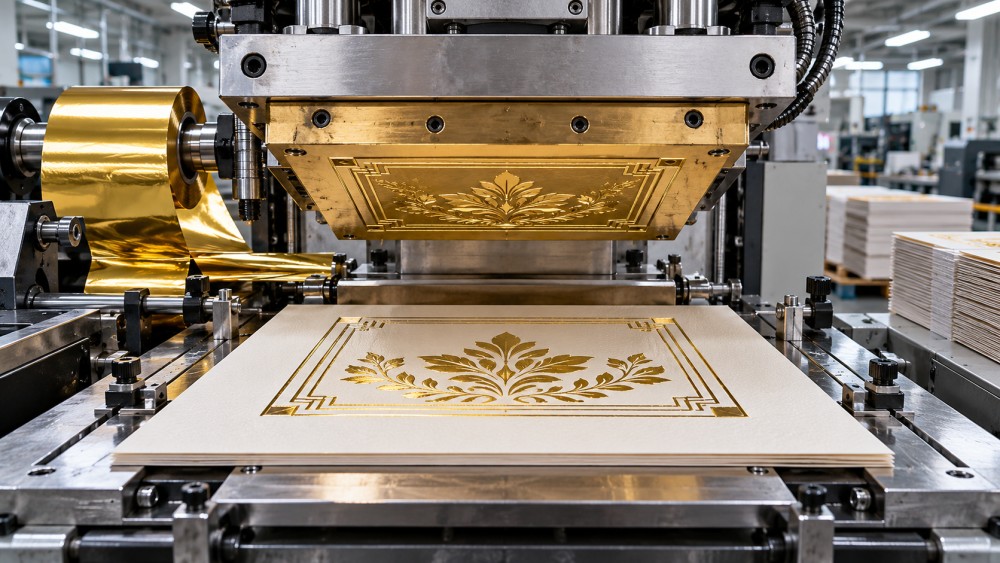
The counterplate is the support surface against which the heated stamping die transfers foil. Its job is not simply to provide resistance. It must distribute pressure in a way that allows the foil adhesive layer to release and bond cleanly without forcing delicate type, halftone detail, microtext, embossing features, or coated board beyond their usable limits. The wrong construction often leads operators to compensate with more pressure or temperature, which can conceal the real mismatch while increasing waste and shortening tool life.
Begin with the image, not the counterplate material
Start by separating the foil image into its demanding features. Large solid areas, reverse type, thin serif lettering, fine rules, textured artwork, broad embossing zones, and close-register elements do not load the counterplate in the same way. A design with broad foil coverage may tolerate a firmer support surface, while a design dominated by small type and hairlines needs more precise local pressure control. When both appear on the same sheet, a single generic counterplate material may produce an uneven result.
Fine detail is often damaged by excessive local pressure rather than insufficient pressure. If small text fills in, edges spread, or counters close, increasing force is rarely the correct first response. Examine the die relief, foil release behavior, stock compression, and counterplate surface condition. Conversely, a foil image that transfers around its perimeter but breaks up in the center can indicate inadequate contact, an uneven counterplate, poor platen parallelism, or a substrate that changes thickness across the sheet.
Ask for the artwork at final production scale, including line weights, type sizes, foil coverage, blind embossing areas, and any regions where foil must register with printed graphics. A counterplate should be evaluated against the most demanding feature of the job, not only the most visible foil block.
Match the construction to the stamping process
Counterplates are available in several constructions, including paper-based make-ready systems, resilient polymer or composite sheets, metal-backed systems, and etched or machined counterparts designed to correspond with a specific die. Each option has a different balance of conformity, durability, setup time, and pressure definition.
Make-ready materials can be practical for simple work, short runs, or jobs that need localized adjustment. They allow selective packing and rapid correction, but their performance depends heavily on disciplined setup. A build-up that is too soft can lose definition as it compresses. A build-up that is too rigid can concentrate force at the edge of the die image. Paper layers also introduce variation when thickness, moisture condition, cutting accuracy, or placement changes between setups.
Resilient counterplate materials provide controlled compression and can improve contact on stocks with slight surface irregularity. Their response must be matched to the impression depth and the die design. A soft material may be useful for broad foil areas on textured or uncoated board, yet it can reduce edge sharpness on fine lettering. A harder grade holds detail more firmly but is less forgiving of uneven platen conditions and may mark delicate coated surfaces.
Precision-machined or etched counterparts are strongest when repeatability, close registration, fine detail, and recurring work justify dedicated tooling. Because the surface geometry is made to interact with the die, these systems can reduce dependence on manual packing. Their value is lost if the die drawing, mounting reference, substrate, or press conditions change without being reflected in the tool specification. A precisely made counterpart cannot correct an inaccurate die position or a platen that is out of parallel.
Read hardness and compression as a system
Hardness values alone do not identify the right material. Two counterplates with a similar nominal hardness can behave differently because of thickness, backing construction, surface finish, heat exposure, and compression recovery. The relevant question is how the material responds under the real dwell time and impression load of the press.
A counterplate that recovers slowly can create a misleading setup. Early sheets may look clean, then detail begins to weaken as the surface retains compression or heats up. A surface with poor recovery may also cause inconsistent results during stop-start production. This is especially relevant where short runs involve repeated restarts and sheet inspection after adjustments.
Thickness affects more than packing height. A thicker resilient layer spreads force over a larger area and changes the effective impression profile. That may improve coverage on a coarse stock, but it can make fine foil edges less crisp. A thinner, firmer construction gives a more defined pressure response, provided the press and die mounting are sufficiently even. The selection should therefore specify both material grade and finished working thickness rather than treating them as separate decisions.
Substrate behavior changes the correct answer
Foil stamping on smooth coated paperboard, uncoated folding carton stock, laminated sheet, metallized board, and textured specialty material calls for different counterplate behavior. The substrate does not merely receive the foil; it deforms under heat and pressure. Surface texture, coating strength, caliper consistency, grain direction, moisture condition, and lamination construction all affect contact.
Coated stocks can show scuffing, gloss disturbance, coating cracks, or an impression halo when force is concentrated too sharply. The resulting defect may resemble poor foil quality, although the underlying issue is counterplate hardness or excessive packing. Uncoated and textured materials often need more conformability to reach low points in the surface, but the added compression must not blur fine artwork.
Laminated substrates need particular care. The foil may transfer cleanly while the laminate shows whitening, edge stress, or poor adhesion after folding. A counterplate assessment should include downstream handling where the foiled area lies near a score, fold, glue flap, or window patch. A result that looks correct at the delivery pile may fail once the carton is converted.
Do not approve a counterplate against a substitute board unless the substitute matches the final stock in surface finish, caliper, coating, and laminate structure. A small change in board construction can alter the required pressure window enough to invalidate a previous make-ready.
Pressure uniformity is often mistaken for pressure level
Uneven foil transfer is frequently described as “not enough pressure.” That description is incomplete. A light area can be caused by insufficient total force, but it can also result from platen tilt, uneven packing, die warp, adhesive contamination, a damaged counterplate surface, sheet curl, or local thickness variation in the stock. Raising global impression pressure may improve one area while crushing another.
Before selecting a harder or thicker plate, verify the condition of the press. Inspect platen parallelism, mounting plane cleanliness, chase condition, locating system, packing stability, and die seating. A small particle under a backing sheet or a distorted mounting surface can create a localized defect that no counterplate material will solve. When a flaw repeats in the same position on every sheet, its location relative to the press is an important diagnostic clue. When it travels with a particular stock batch or foil roll, the source is likely elsewhere.
For large foil panels, uniformity across the whole image deserves greater attention than peak pressure. Use progressive test pulls and inspect the first signs of transfer rather than setting impression from a fully forced sample. The earliest transfer pattern reveals high and low zones. It is easier to correct those zones through proper setup than to force coverage with a higher blanket setting.
Specify interfaces and tolerances before ordering
A precision counterplate only performs as intended when its physical references match the die and press. The order information should identify the press type, usable chase or platen area, mounting method, direction of feed, die thickness, counterplate thickness, job registration reference, and whether the tool is intended for foil only or a combined foil-and-emboss process. For dedicated counterparts, include approved artwork, die drawing, and the required relationship between the counterplate image and the die image.
Registration language needs to be unambiguous. “Front,” “top,” or “operator side” can be interpreted differently across facilities and press layouts. Use defined reference edges and a marked orientation on both the drawing and the physical tool. A counterpart made to the wrong orientation may be mechanically sound but unusable without remanufacture.
For repeat work, record the approved packing stack, foil grade, die temperature range used during approval, dwell setting, impression reference, and stock identity. These are not universal settings; they document the production window in which the counterplate was proven. Without that record, a repeat order may be judged against a different process condition and wrongly attributed to tool variation.
Evaluate setup time and run stability separately
A counterplate that reaches an acceptable first sheet quickly is not automatically the most economical option. Review how much intervention is needed after the press warms up, after a foil roll change, after a pause, and near the end of the run. Stable performance reduces the need to re-open the press, add local packing, or accept marginal sheets because the setup is drifting.
Dedicated tooling can reduce manual correction on recurring jobs, but it should be assessed against the real repeat pattern. If artwork changes frequently, board caliper varies, or the press is routinely used for mixed work with different die conditions, a highly specific counterpart may require more control than the workflow can maintain. Flexible systems can be more appropriate when controlled adjustment is part of normal production.
Tool life should be judged by surface integrity, dimensional stability, and consistency of transfer, not simply by whether the counterplate remains physically intact. Look for polished spots, dents, permanent compression, edge damage, contamination from adhesive or foil residue, and loss of registration reference. Reusing a worn counterplate often increases setup time gradually before it becomes visibly defective.
Use a controlled approval sample
Approval should include sheets taken after the press has reached stable operating temperature, not only the earliest make-ready pulls. Inspect under lighting that reveals foil skips, pinholes, edge distortion, haloing, and surface marking. View fine text with magnification where necessary, then examine folded or converted samples when the foiled area is close to a crease or structural feature.
Compare samples at the intended production speed and with the actual foil and substrate. A slower test can hide timing and release issues, while a different foil grade can change the pressure and heat response. Where a job contains several designs, approve the most demanding image and retain samples that show both acceptable transfer and the limits where defects first appear.
The best selection is the one that maintains a clear pressure window: enough latitude to produce clean foil consistently, yet enough definition to protect the stock and the image. That balance comes from matching the counterplate construction to the die, substrate, press condition, and repeatability required by the job.
Related News
 How Blanking Machines Remove Carton Waste Without Damaging BlanksDiscover how Blanking Machines remove carton waste without damaging blanks. Learn tooling, alignment, and setup tips to reduce defects, protect print quality, and improve production.Post-Press Kinematics Expert
 When a Custom Embossing Die Delivers Better Packaging DetailDiscover when a custom embossing die adds premium tactile detail, sharper branding, and repeatable packaging quality for cartons that stand out on shelf.Post-Press Kinematics Expert
 What to Compare Before Buying a Luxury Rigid Box Making MachineCompare a luxury rigid box making machine by usable throughput, automation, quality consistency, lifecycle cost, and supplier support to protect premium packaging margins.Post-Press Kinematics Expert
 What Determines Window Patching Machine Price for Packaging LinesWindow patching machine price depends on speed, accuracy, film compatibility, automation, and support. Compare total costs to choose the right packaging solution.Post-Press Kinematics Expert
 What Drives the Cost of a Custom Foil Stamping DieCustom foil stamping die costs explained: compare materials, artwork complexity, die size, run length, and press requirements to choose durable, cost-effective tooling.Post-Press Kinematics Expert
 What to Compare Before Buying Hot Foil Stamping MachinesHot Foil Stamping Machines: compare quality, registration, setup time, foil compatibility, and uptime to choose a press that delivers profitable, repeatable results.Post-Press Kinematics Expert