How to Choose Foil Stamping Dies for Consistent Fine Detail
How to Choose Foil Stamping Dies for Consistent Fine Detail
For procurement teams, selecting foil stamping dies is a critical decision that affects fine-detail consistency, production speed, setup reliability, and long-term finishing costs. A die is often treated as a relatively small part of the job compared with the press, foil, or carton substrate. In practice, it is the tool that translates artwork into a physical impression under heat and pressure. If its material, relief, mounting, or artwork treatment is wrong, a capable foil stamping machine can still produce broken lines, filled-in text, uneven foil coverage, and excessive makeready waste.
The right die must match the artwork, substrate, foil type, press conditions, and expected production volume. That requirement becomes more demanding when packaging includes microtext, fine borders, hairline patterns, detailed logos, or small reverse-out areas. Buyers should therefore evaluate foil stamping dies as part of a finishing system, not as an isolated consumable purchased only on unit price.
Start with the detail that must survive production
The first question is not simply whether the artwork looks sharp in a PDF. It is whether its smallest elements can transfer cleanly and repeatedly on the intended press, board, and foil. A very fine line may reproduce well on a smooth coated carton board but fail on a textured, uncoated, recycled, or uneven substrate. Likewise, a small positive line and a small reversed line do not behave in the same way. Reverse details can fill in when foil release, pressure, temperature, dwell time, or die relief are not properly balanced.
Before requesting quotations, provide suppliers with production-ready vector artwork rather than low-resolution images. The die maker should be told which details are visually critical, which elements can be adjusted, and whether the job requires only flat foil stamping or includes embossing, debossing, holographic foil, multiple foil colors, or registered printing. A supplier that asks about these conditions is not making the process complicated; it is reducing the chance of a costly mismatch.
Artwork review is particularly important for pharmaceutical cartons, cosmetics packaging, premium beverages, gift boxes, and branded retail packs where small decorative details influence perceived quality. It also matters where a foil feature sits close to a crease, die-cut edge, glued panel, barcode, variable code, or other functional packaging element. Fine detail can be visually attractive but operationally fragile if it is placed in an area exposed to folding stress or inconsistent sheet support.
Choose die material by job conditions, not habit
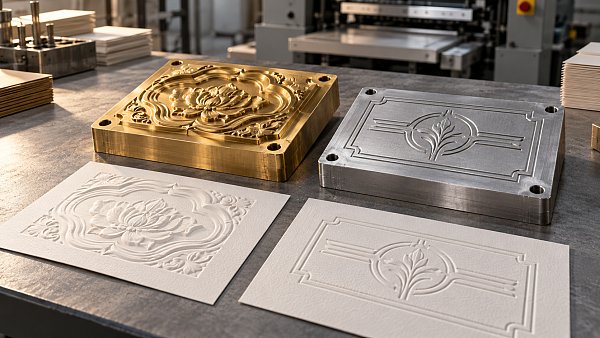
Most foil stamping dies are produced in magnesium, brass, or copper-based materials, although the exact options available depend on the supplier and manufacturing method. Material selection should reflect run length, artwork complexity, required durability, thermal behavior, and budget. There is no universal material that is best for every job.
Magnesium is commonly considered for shorter runs and less demanding designs because it can be produced efficiently and is relatively easy to machine. It may be suitable where the artwork is straightforward and the die will not be exposed to prolonged, high-volume operation. However, buyers should examine whether the finest elements and expected press conditions exceed its practical limits for the particular job.
Brass is frequently selected for longer runs, more detailed artwork, or applications where die durability and stable heat performance are priorities. It is often the more defensible choice when consistent reproduction of fine text, narrow lines, or intricate logos is commercially important. The initial cost may be higher, but the procurement comparison should include expected die life, reduced risk of rework, and fewer interruptions during repeat production.
Copper-based dies may also be considered in some specialist applications, particularly where heat transfer and detailed engraving requirements influence the decision. Rather than specifying a material only because it was used on a previous job, ask the die supplier to explain why the recommended material suits the planned substrate, press, foil, and volume.
Relief depth, bevels, and spacing determine whether fine lines remain open
For detailed foil work, die geometry matters as much as die material. Relief depth creates separation between image areas and non-image areas. Bevel shape influences how the die contacts the sheet and how pressure is distributed around fine features. Spacing between adjacent elements affects whether foil can release cleanly without bridging or filling gaps.
A procurement specification does not need to dictate engraving geometry without technical knowledge. It should, however, require the die maker to review fine-detail feasibility and identify any artwork areas that may need strengthening. This can involve slightly increasing line weight, opening narrow reverse spaces, simplifying very tight corners, or separating closely packed details. Small changes made before die production are usually less disruptive than trying to compensate with more heat or pressure on press.

More pressure is not a cure for an unsuitable die. Excessive pressure can crush carton board, distort nearby printing, broaden fine lines, damage delicate relief, or make foil transfer appear acceptable only at the beginning of a run. A stable result comes from the interaction of tool geometry, foil formulation, substrate surface, and controlled machine settings.
Match the die to the press and the foil, not only to the design
The same die artwork can behave differently across platen presses, cylinder presses, and automated foil stamping equipment. Contact time, pressure build-up, sheet positioning, heating zones, and delivery conditions all influence transfer. When a packaging plant changes equipment or moves a job to a contract finisher, it should not assume that an existing die will deliver the same performance without verification.
Give the die supplier the press manufacturer and model where possible, along with chase dimensions, heating method, operating direction, registration expectations, and any mounting constraints. For repeat work, document the existing die thickness, backing arrangement, packing approach, foil grade, and press settings that produced acceptable results. This record becomes valuable when sourcing replacement dies or qualifying an alternative supplier.
Foil selection deserves the same attention. Different foils are formulated for different substrates, print surfaces, operating temperatures, and release characteristics. A foil suited to smooth coated stock may not transfer consistently to a varnished board, a heavily inked surface, or a substrate with noticeable texture. If the finished carton will receive UV coating, lamination, window patching, creasing, folding, or gluing after stamping, the entire converting sequence should be reviewed. Foil adhesion and appearance can be affected by downstream handling.
Treat registration as a system issue
Fine foil detail makes registration errors more visible. A slight shift may be tolerable in a broad decorative panel but unacceptable when foil outlines printed text, aligns with a logo, or lands close to a cut line. Die accuracy is necessary, but it is only one part of registration performance.
Buyers should check how the artwork references print marks, sheet edges, and die-cut geometry. Ask whether the press uses optical registration, mechanical side and front lays, or another positioning approach. Consider sheet dimensional stability as well. Changes in humidity, board grain, coating, and storage conditions can contribute to movement that no die supplier can fully correct.
For high-value packaging, it is sensible to establish an approved sample and a practical tolerance agreement before volume production. This does not need to be overly formal, but it should clarify what visual standard will be used at press: foil coverage, edge cleanliness, registration position, emboss depth if applicable, and acceptable cosmetic variation. Without this reference, quality discussions can become subjective after production has already started.
Evaluate suppliers beyond the engraving quotation
A low quotation can be attractive when dies appear technically comparable. Yet the commercial difference often emerges in prepress review, proofing discipline, lead-time reliability, packaging for shipment, identification, revision control, and support when the first press trial exposes a problem. Procurement teams should ask how the supplier manages artwork versions and whether the supplied die can be traced to a specific approved file.
Useful supplier questions include:
- Can you identify the smallest feature that may need artwork adjustment for this substrate and process?
- Which die material and engraving method do you recommend, and why?
- Will the die be supplied ready for the specified chase or mounting system?
- How are orientation, job number, revision, and press-side reference points marked?
- Can you provide a proof, drawing, or approval record before manufacturing?
- What handling, cleaning, storage, and inspection practices are recommended for repeat use?
The answer quality is often more informative than a generic capability statement. A supplier should be willing to distinguish between what is technically possible in a sample and what is repeatable at production speed. Those are not always the same thing.
Include die life, setup time, and waste in the cost comparison
The purchase price of foil stamping dies is visible; the cost of unstable production is less visible but can be larger. A die that requires repeated pressure adjustment, produces inconsistent edges, or wears before a repeat order may consume operator time, foil, board, and press capacity. These losses are particularly relevant in short-run environments, where rapid job changes are already placing pressure on setup discipline.
For this reason, compare suppliers using a total-use view: initial die cost, expected number of production cycles, makeready effort, replacement lead time, storage requirements, and the cost of holding a spare for critical jobs. High-volume packaging programs may justify a more robust tool and tighter process documentation. For promotional or seasonal work, a simpler approach may be appropriate, provided the visual requirement is realistic.
This broader evaluation is consistent with how packaging plants increasingly assess equipment and consumables: not only by acquisition cost, but by uptime, material utilization, repeatability, maintenance burden, and order-change efficiency. In finishing departments, a foil die is a small component with a direct connection to those larger operating measures.
Build a specification that production can actually use
A practical purchase specification should bring design, production, and quality expectations into one document. Include approved artwork revision, final substrate description, foil type if already selected, press and chase information, material recommendation or approved material, quantity, required delivery date, identification requirements, and any need for proofing or test stamping. Where repeatability is important, add reference samples and state whether the die is intended for flat stamping, embossing, or a combined effect.
Do not leave responsibility for critical assumptions entirely with the purchasing team. The converter, press operator, packaging designer, foil supplier, and die maker each see a different part of the process. Early alignment is usually the fastest way to prevent a die from arriving correctly manufactured but poorly suited to the real production environment.
CPCS examines finishing decisions in this wider production context, alongside foil stamping machines, flatbed die-cutters, folder gluers, inspection systems, and packaging plant automation. For buyers, the useful question is rarely “Which die costs least?” It is “Which die-and-process combination can hold the required detail through the planned run with predictable setup and acceptable waste?” That is the standard against which a sourcing decision should be tested.
Related News
 How to Compare Laminating Machines for Packaging ApplicationsCompare Laminating Machines for packaging by material compatibility, bond quality, production speed, and operating cost. Find the right fit for your application.Post-Press Kinematics Expert
 What to Consider When Buying a Film Window Patching MachineBuying a film window patching machine? Compare material compatibility, usable output, changeovers and total costs to make a confident investment.Post-Press Kinematics Expert
 How Brass and Magnesium Embossing Dies Compare for PackagingCompare brass and magnesium Embossing Dies for packaging. Discover how detail, durability, and total tooling costs affect your choice—and find the right fit for your next project.Post-Press Kinematics Expert
 What to Check Before Buying a Steel Chase Frame for Foil StampingBuying a steel chase frame? Discover key checks for press fit, precision, heat stability, and supplier quality to avoid costly downtime and buy with confidence.Post-Press Kinematics Expert
 How Male Female Dies Create Clean Embossed Details on PaperboardMale Female Dies create crisp embossed paperboard details. Discover how die clearance, board selection, and press alignment reduce defects and deliver consistent packaging quality.Post-Press Kinematics Expert
 Why Does a Precision Embossing Die Produce Uneven Relief on Cartons?Is your precision embossing die producing uneven carton relief? Discover how to fix alignment, pressure, and board issues to reduce waste and achieve consistent results.Post-Press Kinematics Expert