How Foil Stamping Dies Affect Detail, Durability, and Production Cost
Foil stamping dies determine whether a premium finish looks precise and repeatable or merely expensive. The die is the tool that transfers heat and pressure into a controlled image; its material, engraving quality, relief depth, mounting condition, and compatibility with the press, foil, and substrate all affect the result. A visually complex design can fail not because the foil is poor or the press is inaccurate, but because the die cannot hold the required detail at production speed.
The commercial effect is equally important. Die choices influence makeready time, foil consumption, rejected sheets, replacement frequency, and the practical production window available to an operator. A lower-cost die can be economically sound for a short campaign with broad artwork. It can become the costly option when the job requires microtext, fine reverse lines, deep embossing, abrasive stock, or repeat production over a long period.
The die is a heat-and-pressure tool, not just an engraved image
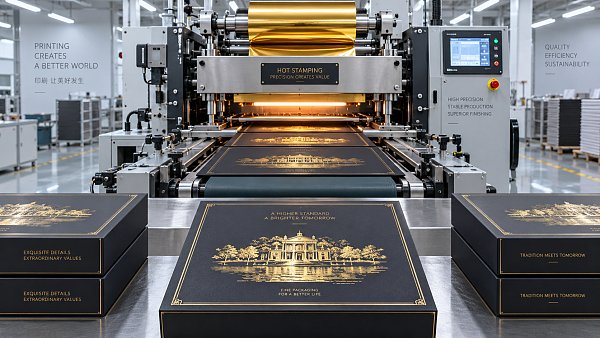
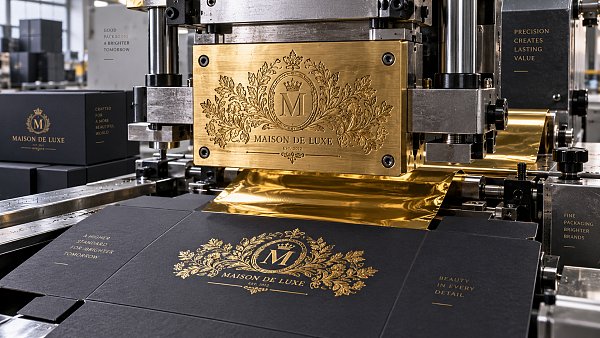
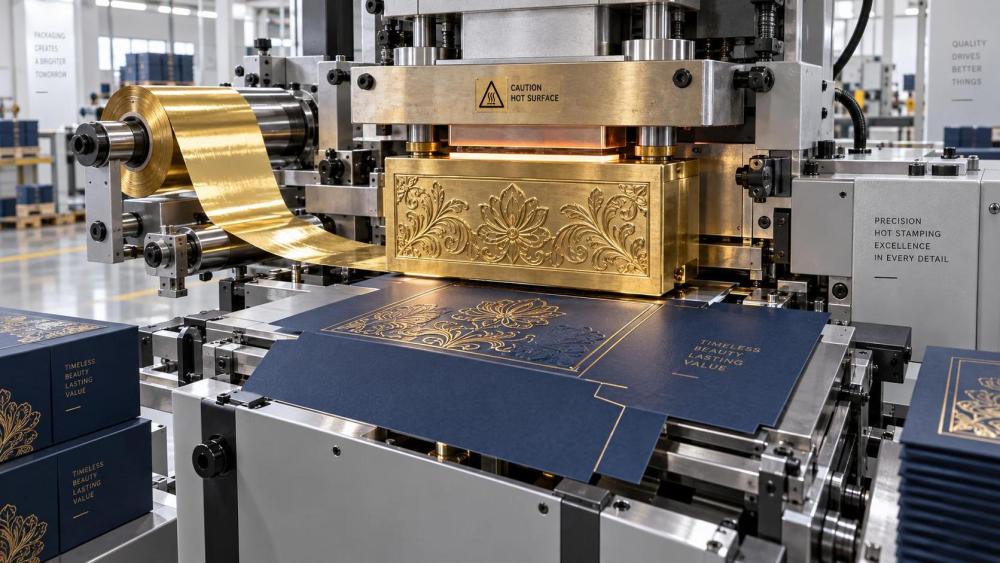
During hot foil stamping, a heated die presses the carrier foil against the substrate. Heat activates the foil’s release and adhesive layers; dwell time and pressure allow the metallic, pigmented, holographic, or special-effect layer to bond to the sheet. The carrier film then separates, leaving the image behind.
This mechanism makes the die more consequential than a conventional printing plate. It must transfer enough thermal energy across the image while maintaining dimensional stability under repeated heating cycles. Its raised image must also create pressure evenly enough to release foil on large solid areas without crushing delicate lines or deforming the substrate.
A die that is technically accurate at room temperature may behave differently after mounting and heating. Thermal expansion, uneven heating, insufficient backing support, or an incorrectly prepared counterforce can change the pressure distribution. Therefore, foil stamping quality cannot be assessed from artwork and die engraving alone. It is a system outcome involving the die, press platen, heating arrangement, foil grade, substrate surface, packing, and production speed.
Material selection changes the balance between detail, life, and cost
Brass, magnesium, copper, and steel are all encountered in foil stamping applications, although brass and magnesium remain the most common choices for conventional packaging and commercial print work. The right material depends less on a generic quality hierarchy than on image geometry, expected impressions, operating temperature, substrate characteristics, and whether stamping is combined with embossing or debossing.
Magnesium is often treated as the “cheap” option and brass as the “premium” option. That simplification is misleading. Magnesium can be the rational choice when artwork is open, the run is limited, and replacement risk is low. Brass earns its higher cost when its greater strength and engraving stability prevent downtime, rework, and replacement. The decision should be tied to the job’s total conversion requirement, not simply the purchase price of the die.
For long-lived packaging programs, the relevant question is not whether a brass die costs more at the start. It is whether the die can sustain approved quality through the planned number of impressions without edge rounding, loss of small elements, or recurring setup correction. A die cost that is small relative to a large-volume carton order can still determine whether the finishing stage remains predictable.
Fine detail is governed by geometry, not artwork resolution alone
Design files may contain extremely fine lines, small type, sharp corners, and tight negative spaces. Whether these elements can be reproduced in foil depends on the physical geometry of the die and the behavior of the foil transfer process. The smallest feature in a digital file is not necessarily a stampable feature.
Fine positive lines require sufficient strength at the base of the raised die image. Fine reverse lines require sufficient clearance between raised areas so foil does not bridge across the gap. Small serif text, delicate scripts, narrow counters, and closely spaced rules are particularly sensitive. If the relief is too shallow, the foil may transfer into areas intended to remain blank. If individual elements are too fragile, they can wear, bend, or fail to receive uniform pressure.
Solid foil areas create a different problem. Large blocks need uniform contact across the die face. Small variations in platen parallelism, packing, substrate caliper, or heat distribution can produce pinholes, incomplete release, mottled coverage, or excessive pressure marks. A design containing both broad solids and hairline lettering is often more difficult than either feature by itself because the process window needed for one element may damage the other.
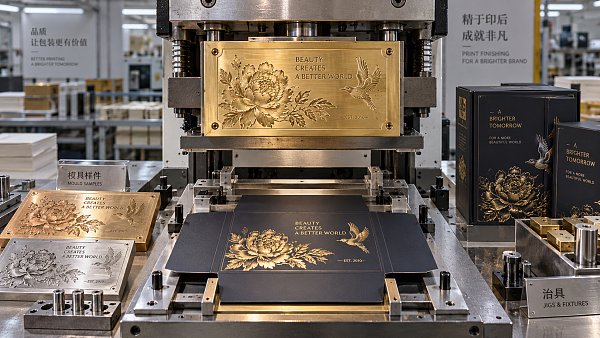
Engraving method matters here. Chemical etching can be suitable for many magnesium dies and relatively straightforward artwork, while CNC engraving or machining offers greater control for complex brass dies, sculptured surfaces, and combination dies. The relevant issue is not the name of the process but whether the die maker can create stable shoulders, appropriate relief, clean transitions, and consistent depth for the selected design.
Relief depth and sidewall design affect release quality
Die relief is the height difference between the raised stamping image and non-image areas. It must be adequate to prevent unintended foil contact while retaining enough structural support for fine features. Deep relief can improve separation around open areas, but excessive depth may weaken narrow image elements or increase engraving complexity. Shallow relief can be sufficient for broad, uncomplicated artwork, yet it raises the risk of foil pickup in non-image zones when pressure or packing is not tightly controlled.
Sidewall form is also important. Well-supported shoulders help fine characters withstand repeated impressions. Steep, poorly supported walls may be vulnerable when the job includes hard board, textured paper, or high-pressure embossing. In combination dies, where foil stamping and embossing occur in one pass, the geometric requirements become stricter because the die must create both a clean foil image and a controlled three-dimensional deformation of the sheet.
The counterforce system must match the die design. Depending on the work, this may include a counter-die, make-ready board, resin counter, or other prepared backing arrangement. A high-quality die paired with an inaccurate counter setup can still create weak foil coverage, broken detail, or distorted embossing. Cost evaluation should therefore include the preparation required to achieve a stable production condition, not just the engraved tool.
Durability is a production-stability issue
Die wear is not always dramatic. It may appear gradually as softened corners, reduced sharpness in small type, declining definition in textured elements, or a growing need to increase pressure and temperature to maintain coverage. Raising process settings can temporarily conceal wear, but it may create new defects: paper crushing, board cracking, excessive foil spread, or loss of edge clarity.
Several conditions accelerate degradation:
- High impression counts, especially when fine features carry concentrated pressure.
- Abrasive or heavily coated substrates that wear exposed die edges.
- Repeated heating and cooling cycles that place stress on the die and mounting system.
- Combination embossing work requiring higher forming loads.
- Improper cleaning, handling, or storage that damages raised detail.
- Attempts to compensate for poor foil, unsuitable stock, or press misalignment by adding pressure.
Durability should be assessed against usable life, not theoretical survival. A die that remains physically intact but requires frequent adjustment or delivers inconsistent coverage has already lost much of its economic value. In repeat-order environments, retaining approved setup data, foil references, temperature ranges, packing details, and die condition records can reduce the uncertainty of subsequent runs.
Production cost extends well beyond die fabrication
The visible price of foil stamping dies is only one component of finishing cost. The larger cost exposure often sits in setup time, foil waste, spoilage, lost press capacity, and interruptions caused by quality instability. This is why two dies with similar artwork can produce very different economic results.
A die with poor heat uniformity or inadequate surface finish may demand slower running speeds to achieve acceptable transfer. A die with marginal relief can increase waste because operators need repeated pressure adjustments to eliminate foil pickup. A worn die may generate intermittent defects that are difficult to detect until sheets reach inspection, folding, or shipment. Where foil stamping is positioned before other high-value converting operations, defects introduced at this stage can consume the value already added by printing, lamination, or coating.
Foil utilization also deserves closer attention. Foil width, image layout, repeat spacing, and registration requirements determine how much carrier material is consumed for each usable image. The die does not set foil consumption alone, but die geometry affects whether a job can run with a stable registration and pressure window. A broad die face with uneven contact may force conservative press settings and increase spoilage during startup and changeover.
For commercial evaluation, a practical cost model should separate:
- Die design, engraving, proofing, and replacement cost.
- Mounting and makeready labor.
- Expected press speed under approved quality conditions.
- Foil waste during setup and production.
- Substrate spoilage and downstream rework exposure.
- Maintenance, storage, and the value of retaining dies for repeat orders.
This approach prevents a common error: comparing die quotations while ignoring the cost of operating each die in the intended production environment.
Artwork and substrate should be reviewed before the die is ordered
The most economical correction is usually made before engraving. Artwork review should identify small isolated details, very narrow knockout lines, large solids adjacent to microtext, tight registration dependencies, and features that combine foil with embossing, tactile varnish, lamination, or textured stock.
Substrate selection can change the answer. Smooth coated board generally presents a different foil-transfer condition from uncoated paper, recycled board, soft-touch laminated material, heavily textured stock, or plastic film. Surface energy, coating chemistry, roughness, stiffness, moisture condition, and compressibility all influence adhesion and visual continuity. Foil suppliers provide grades designed for different substrates and press conditions; a die cannot compensate indefinitely for a foil grade that does not release or bond correctly on the chosen surface.
Where premium packaging is specified across multiple production sites or markets, approved standards should define more than artwork. They should include the accepted foil reference, substrate construction, die material and engraving specification where appropriate, visual acceptance criteria, and a controlled process range. Without that discipline, the same logo may appear materially different across batches even when the nominal design is unchanged.
There is no single universal quality standard for a “good” die
Foil stamping die specifications are usually developed through the equipment supplier, die maker, foil supplier, converter, and brand owner rather than through one universal standard that sets every engraving dimension and operating parameter. Press architecture, heating zones, platen size, substrate, foil chemistry, and design complexity vary too widely for a single rule to guarantee performance.
That does not mean specifications should remain informal. A workable technical purchase document can state the artwork version, image orientation, die dimensions, material, mounting requirement, relief expectation, intended press type, substrate, foil reference, planned application, and acceptance criteria. For combination work, the embossing depth, counter arrangement, and permitted distortion around critical text or codes should be defined.
Acceptance should focus on production-relevant outcomes: edge definition, coverage consistency, absence of unintended foil pickup, readability of fine text, registration tolerance, and performance at the intended operating range. A single hand-pulled proof may confirm basic feasibility, but it does not necessarily prove stable behavior across a production run.
The most defensible selection is application-specific
Foil stamping dies should be evaluated as production assets with a defined operating duty. Simple short-run work may justify a lower-cost material and straightforward engraving. Detailed premium cartons, recurring programs, combination embossing, or high-volume applications typically justify more attention to die material, engraved geometry, counter preparation, and durability records.
The key commercial distinction is between a die that can produce an attractive sample and one that can hold approved quality efficiently over the required run. When that distinction is built into specification and cost evaluation, detail reproduction, die life, and production economics stop being separate concerns. They become parts of the same finishing decision.
Related News
 When a Custom Embossing Die Delivers Better Packaging DetailDiscover when a custom embossing die adds premium tactile detail, sharper branding, and repeatable packaging quality for cartons that stand out on shelf.Post-Press Kinematics Expert
 What to Compare Before Buying a Luxury Rigid Box Making MachineCompare a luxury rigid box making machine by usable throughput, automation, quality consistency, lifecycle cost, and supplier support to protect premium packaging margins.Post-Press Kinematics Expert
 What Determines Window Patching Machine Price for Packaging LinesWindow patching machine price depends on speed, accuracy, film compatibility, automation, and support. Compare total costs to choose the right packaging solution.Post-Press Kinematics Expert
 What Drives the Cost of a Custom Foil Stamping DieCustom foil stamping die costs explained: compare materials, artwork complexity, die size, run length, and press requirements to choose durable, cost-effective tooling.Post-Press Kinematics Expert
 What to Compare Before Buying Hot Foil Stamping MachinesHot Foil Stamping Machines: compare quality, registration, setup time, foil compatibility, and uptime to choose a press that delivers profitable, repeatable results.Post-Press Kinematics Expert
 How to Choose Foil Stamping Dies for Consistent Fine DetailFoil Stamping Dies: learn how to select the right material, relief, and press compatibility for crisp fine detail, reliable registration, lower waste, and consistent packaging quality.Post-Press Kinematics Expert