How Chase Frames Improve Foil Stamping Setup Accuracy and Uptime
A foil stamping press can have sound heating, good foil control, and a capable feeder, yet still lose time at makeready because the die is not held in a stable, repeatable position. That is where Chase Frames make a practical difference. A properly matched and maintained chase frame gives the stamping die a reliable mounting reference, so operators can register the image faster, apply pressure more evenly, and return to a proven setup with less adjustment.
The frame itself does not correct an inaccurate die, worn platen, poorly conditioned stock, or unsuitable foil. Its value is more fundamental: it prevents the die mounting system from becoming an additional source of variation. When foil coverage, registration, or emboss definition changes unexpectedly during a run, the chase and its mounting condition should be checked before repeatedly changing temperature, dwell, or pressure.
Why die mounting affects more than setup time
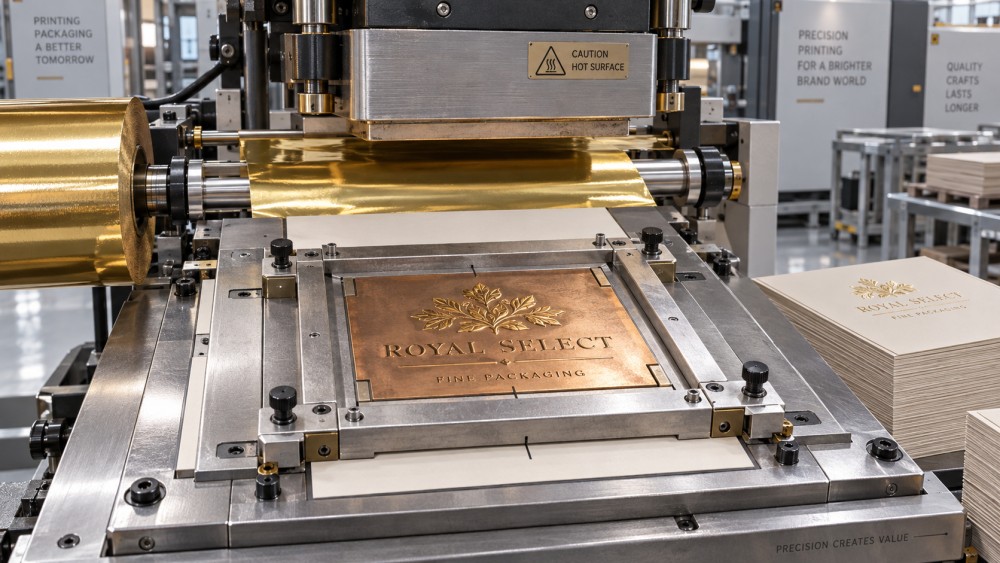
In hot foil stamping, the die must meet the sheet with controlled heat, pressure, and dwell. The result depends on the combined behavior of the platen, counterforce or make-ready surface, stock, foil, and die. A chase frame sits at the center of this system by securing the die in the press and locating it relative to the machine’s working area.
If the chase is distorted, loosely seated, incorrectly sized, or inconsistently packed, the die plane may not remain parallel to the impression surface. An operator may then see a familiar sequence of problems: one area stamps cleanly while another has weak transfer; a fine rule breaks down at one edge; the image shifts after an adjustment; or a setup that looked correct at slow speed becomes unstable in production.
These faults are often treated as pressure problems. Increasing pressure may improve a weak area temporarily, but it can also crush textured board, fill in fine detail, mark the reverse side, or accelerate wear on the die and counter. A stable chase frame supports a better approach: establish mechanical accuracy first, then make controlled adjustments to the process settings.
How Chase Frames create repeatable registration
Registration begins with a fixed relationship between the die image and the press reference points. A chase frame provides the structure that carries this relationship from die mounting through makeready and into production. When its outside dimensions, locating features, and clamping surfaces fit the press correctly, the frame can be seated in the same position each time.
This matters particularly for carton work with narrow borders, small type, metallic logos, windowed areas, or foil positioned close to printed graphics. Minor movement may not be visible on a large solid block, but it becomes obvious when the foil must align to offset or digital print. A frame that returns accurately reduces the amount of trial-and-error movement needed after a repeat job is loaded.
Repeatability also improves the usefulness of job records. Notes about pressure, foil grade, temperature, dwell, packing, and feeder settings are only valuable when the die assembly returns to a comparable mechanical position. If each remount begins with a different chase location or clamping condition, operators are forced to rebuild the setup rather than reuse proven information.
A rigid frame preserves the die plane
Chase rigidity is not simply a durability feature. It helps preserve a flat, supported die plane under heat and impression load. A frame that flexes or has damaged contact surfaces can make pressure correction unpredictable. The operator may compensate at one location, then create excessive pressure elsewhere.
Flatness should be considered alongside rigidity. A robust frame with burrs, accumulated adhesive, dents, or a warped seating face is still a poor reference. The contact faces that locate the chase in the press need to be clean and undamaged, because debris under a frame can introduce a small angular error across the full die area.
For large-format work, long dies, or jobs combining foil with embossing, this issue becomes more visible. The larger the working area, the more difficult it is to hide an uneven die plane through local packing. In those situations, a suitable chase frame reduces the need for excessive make-ready correction and makes the final pressure pattern easier to interpret.
Uptime comes from fewer corrective cycles
Machine uptime is often discussed as a maintenance issue, but a significant amount of lost productive time occurs during avoidable setup correction. A weak die mount can lead to repeated cycles of stopping the press, opening the chase, moving or re-securing the die, altering packing, and pulling more sheets for inspection. Each step consumes time, foil, and board, while increasing the chance of introducing a new variable.
A well-prepared chase frame shortens this loop. It allows the operator to mount the die squarely, lock it with a consistent method, and make changes that are traceable. The goal is not to eliminate makeready; foil stamping always requires material-specific adjustment. The goal is to ensure that makeready is spent tuning the actual process rather than compensating for a shifting mechanical foundation.
Short-run carton and commercial-print jobs benefit most clearly because changeovers happen often and the value of a repeatable setup is high. But longer runs also gain from stability. A die that remains securely supported is less likely to require mid-run correction after heat cycles and normal press vibration. Stable mounting helps the team maintain output without chasing marginal defects late in production.
Choose for press compatibility before convenience
Not every chase frame is interchangeable, even when two frames appear close in size. The press requires a specific external format, thickness, locating arrangement, clamping relationship, and clearance around the heating or impression area. A frame that requires shims, improvised stops, or nonstandard clamping to fit the press is likely to undermine the accuracy it is meant to provide.
The first selection check is therefore the machine requirement, not the die size alone. Confirm the press manufacturer’s chase dimensions and locking method, then match the usable internal area to the die layout and mounting method. The frame should support the planned die without forcing fastening points too close to a critical image area or leaving a large unsupported section.
Material and construction also matter, but they should be assessed in the context of the job mix. A frame used repeatedly on compact, standard carton work has different demands from one used for broad cosmetic cartons, deep embossing, or complex multi-level dies. The appropriate choice is the one that remains stable in the intended press, accepts the planned die assembly, and can be handled safely during frequent changeovers.
Quick-change systems can reduce changeover time, but only when their locating and locking elements are kept in good condition. Their advantage is not that they remove the need for registration; it is that they make a validated position easier to repeat. A worn locating pin, contaminated magnetic surface, or damaged lock point can eliminate that advantage quickly.
Mounting practice determines whether the frame delivers its value
A quality chase cannot compensate for uncontrolled mounting habits. Operators should use a defined setup sequence that keeps the die, frame, and press references consistent from job to job. The exact method depends on the press and die system, but several principles apply widely.
- Inspect before mounting. Remove foil debris, tape residue, loose packing, and dust from the chase and its seating surfaces. Check for visible dents, distortion, cracks, damaged threads, or worn location points.
- Verify the die and job orientation. Confirm the image position against the job layout before fastening. Correct orientation errors at the bench rather than after the assembly is in the press.
- Mount from known references. Use the same datum edges, pins, or registration marks used for the approved job setup. Avoid positioning by eye when repeat registration matters.
- Fasten evenly. Secure the die so it is fully supported and cannot creep under load. Uneven fastening can introduce stress into the die assembly or allow movement after the press reaches operating temperature.
- Check impression progressively. Start with conservative settings and inspect transfer, edge sharpness, and pressure distribution before raising production speed. Do not use high pressure as the first remedy for a mechanical mounting issue.
The most useful setup records identify the physical configuration as well as process settings. Record the chase type, die mounting approach, packing arrangement, counterforce condition, stock grade, foil, and any local correction that was necessary. A note that only says “good at previous settings” does little to support a repeat order.
Problems a chase frame will not solve
It is easy to attribute every foil defect to the die holder because the chase is visible and accessible. That can delay the real correction. Incomplete foil transfer may come from stock surface variation, unsuitable foil release characteristics, insufficient heat, inadequate dwell, contaminated foil, or uneven counterforce. Excessive spread or crushed detail may result from too much pressure, an over-soft counter, or artwork that is too fine for the selected stock and finish.
Similarly, an image that is consistently out of register may originate upstream. Sheet side lay, front lay, feeder timing, gripper control, printed-sheet variation, or distortion in laminated board can all affect where the sheet arrives at the die. A chase frame helps maintain the die’s location; it does not correct inconsistent sheet presentation.
The practical test is to separate fixed faults from variable faults. If the same area of the die repeatedly stamps weakly regardless of sheet position, inspect the die plane, frame seating, packing, and counterforce. If the entire image moves relative to printed artwork from sheet to sheet, investigate feeding and register control. This distinction prevents unnecessary adjustment of the wrong part of the process.
Maintenance is part of accuracy control
Chase frames are often treated as passive tooling, then stored with tape residue, loose hardware, and damaged edges until the next job. That approach makes repeatability dependent on operator recovery work. Cleaning after use, protecting locating faces in storage, and keeping frames organized by press and format preserve their function as references.
A periodic inspection should focus on the conditions that affect location and support: flat seating surfaces, intact clamping points, undamaged corners, secure handles where fitted, and freedom from distortion. Frames that have been dropped, forced into a press, or repeatedly used with improvised packing deserve closer attention. Continuing to use a suspect frame can waste more time in makeready than replacing or repairing the tooling properly.
For packaging plants managing frequent job changes, chase condition belongs in the same conversation as feeder setup, foil inventory, die storage, and job data. CPCS covers foil stamping and other converting systems through this operational lens: equipment performance is not only a machine specification, but the result of tooling condition, process control, maintenance discipline, and the way repeat work is prepared.
What to confirm before the next foil stamping job
Before loading a die, verify that the chase is the correct one for the press, that its seating and locating faces are clean, and that the die can be supported without improvised fitting. Then confirm the approved registration reference, mounting arrangement, packing record, and expected sheet condition. These checks take less effort than recovering from an unstable setup after foil and board have already been consumed.
Chase Frames improve setup accuracy and uptime because they make the mechanical side of foil stamping repeatable. Their benefit is strongest when they are correctly matched, cleanly maintained, mounted from defined references, and used alongside disciplined control of sheet feed, temperature, dwell, pressure, and counterforce. Under those conditions, operators spend less time correcting the tool and more time producing cartons with clean, consistent foil application.
Related News
 How Blanking Machines Remove Carton Waste Without Damaging BlanksDiscover how Blanking Machines remove carton waste without damaging blanks. Learn tooling, alignment, and setup tips to reduce defects, protect print quality, and improve production.Post-Press Kinematics Expert
 When a Custom Embossing Die Delivers Better Packaging DetailDiscover when a custom embossing die adds premium tactile detail, sharper branding, and repeatable packaging quality for cartons that stand out on shelf.Post-Press Kinematics Expert
 What to Compare Before Buying a Luxury Rigid Box Making MachineCompare a luxury rigid box making machine by usable throughput, automation, quality consistency, lifecycle cost, and supplier support to protect premium packaging margins.Post-Press Kinematics Expert
 What Determines Window Patching Machine Price for Packaging LinesWindow patching machine price depends on speed, accuracy, film compatibility, automation, and support. Compare total costs to choose the right packaging solution.Post-Press Kinematics Expert
 What Drives the Cost of a Custom Foil Stamping DieCustom foil stamping die costs explained: compare materials, artwork complexity, die size, run length, and press requirements to choose durable, cost-effective tooling.Post-Press Kinematics Expert
 What to Compare Before Buying Hot Foil Stamping MachinesHot Foil Stamping Machines: compare quality, registration, setup time, foil compatibility, and uptime to choose a press that delivers profitable, repeatable results.Post-Press Kinematics Expert