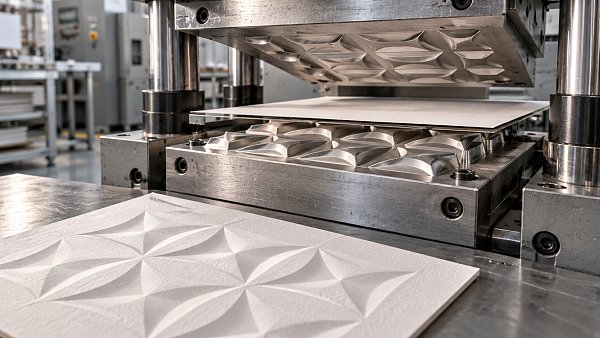
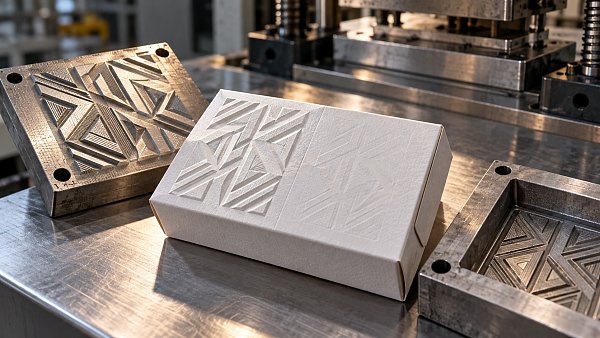
How Brass and Magnesium Embossing Dies Compare for Packaging
Brass is generally the stronger choice for packaging embossing dies when the design requires sculpted detail, repeat production, or demanding relief. Magnesium can offer better value for shorter runs with straightforward artwork, especially when the tooling budget is tight. The decision becomes less clear when a short order carries a difficult design, or when an inexpensive launch carton is likely to become a recurring product.
For buyers, the useful comparison is the cost of producing acceptable cartons across the expected life of the artwork. Die price matters, but so do the matching counter, press setup, substrate behavior, replacement tooling, and the consequences of an interrupted run. Neither material guarantees a successful result without a suitable die profile and a production trial on the intended packaging stock.
Start with the relief the packaging actually needs
A simple raised logo and a sculpted brand emblem place different demands on tooling. Before comparing quotations, establish whether the job requires a single raised level, several distinct levels, or a contoured surface with gradual transitions. Also identify small lettering, narrow gaps, fine borders, and areas where the emboss sits close to a crease or cut edge.
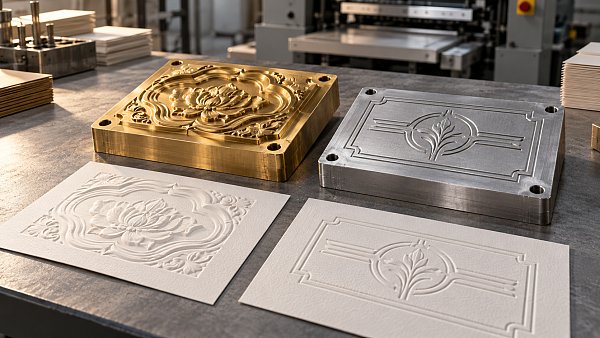
Brass supports machining and engraving approaches suited to controlled shoulders, multiple levels, and sculpted forms. It is therefore a strong candidate when the buyer needs the die maker to shape how light moves across an emblem or how different parts of a design rise from the board. Its value comes from both durability and the control available over the working profile.
Magnesium is often supplied through photoengraving processes and can reproduce suitable line artwork effectively. A relatively simple logo, lettering, or decorative pattern may not need the additional tooling work associated with brass. However, the ability to reproduce a line in the die does not establish that the same line will emboss cleanly into the chosen board. Relief depth, spacing, paper structure, and counter geometry still govern the finished result.
Fine detail alone is therefore an incomplete reason to specify brass. A shallow, single-level design may be feasible in magnesium, while a visually simple but deeply sculpted feature may favor brass. Buyers should ask the die maker to assess the required relief and the substrate together, rather than selecting material from the artwork preview.
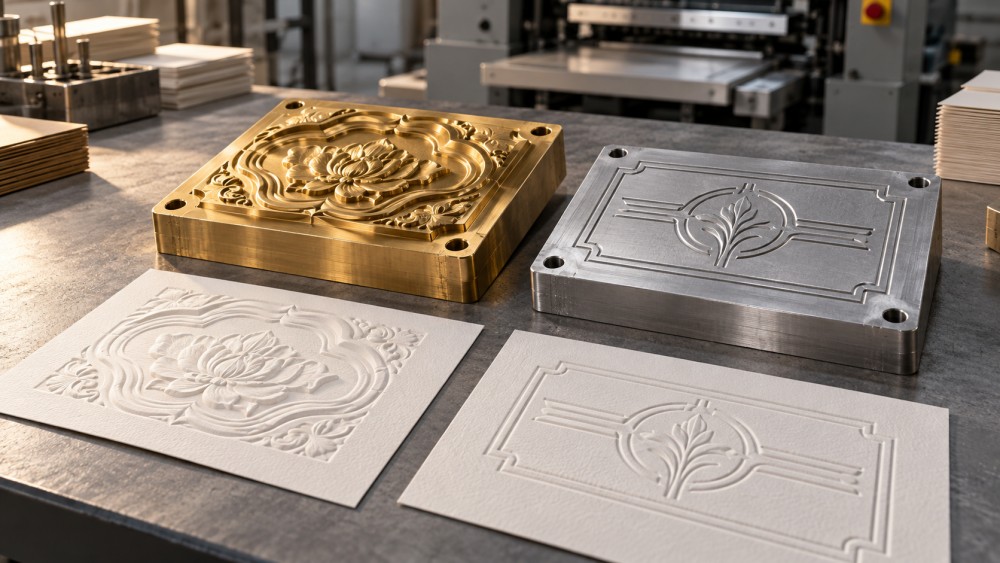
The matching counter deserves equal attention. In a matched embossing system, the board is formed between complementary surfaces. Their clearance, alignment, and profile influence definition and material strain. An expensive brass die paired with an unsuitable counter can still produce weak edges, cracking, or inconsistent relief. Quotations should identify what counter system is included and whether it is intended for the specified board caliper.
How the two materials compare under production conditions
Brass generally provides greater resistance to wear and mechanical damage than magnesium. This makes it attractive for recurring packaging orders, extended production, and designs whose appearance depends on maintaining a precise profile. Magnesium’s lower tooling cost can be compelling when the design is simple and the expected service requirement is limited.
There is no reliable universal impression count separating the two. Tool life changes with die geometry, working area, press conditions, substrate, handling, and the standard used to judge wear. A broad, shallow feature and a narrow, highly loaded ridge can experience very different stresses even within the same artwork.
Ask suppliers to discuss expected service life against the actual job specification. A statement such as “suitable for this quantity on this stock, with this relief” is more useful than an isolated claim about maximum impressions. Clarify whether the supplier’s assessment covers one uninterrupted order or repeated installation, storage, and reuse.
Repeat orders can change the economics
A short first order does not necessarily justify short-life tooling. If the carton will be reordered without artwork changes, the purchasing decision should include those likely repeats. Replacing a die adds more than another tooling invoice: it can require a new setup and renewed approval of the embossed appearance.
Conversely, brass may provide little financial benefit if the artwork will change after a promotion, seasonal release, or packaging redesign. Paying for durability that the program will never use ties up budget without improving the finished pack. The expected life of the design is often as relevant as the size of the first order.
Handling and installation also affect reliability
Magnesium tooling warrants care during cleaning, mounting, removal, and storage because damage to a working edge can affect the impression. Brass also requires protection; durability does not make engraved surfaces immune to scratches or impacts. For repeat work, ask how the die and counter will be identified, protected, and stored as a matched set.
Mounting compatibility should be settled before ordering. Overall tooling thickness, backing, fastening method, and the press’s available working clearance must suit the installation. A material upgrade will not correct an incompatible mounting arrangement or uneven pressure across the sheet.
The board can limit the result before the die does
Embossing pushes packaging material into a new shape. The achievable result depends on the board’s ability to deform without unacceptable surface damage or structural loss. Thickness alone is insufficient: fiber composition, coating, grain direction, moisture condition, and laminations can all influence the response.
A thick board does not automatically support a deeper, cleaner emboss. A stiff or brittle surface may crack around an aggressive shoulder, while another stock may form more readily but show less sharply defined detail. Increasing pressure can worsen damage once the material has reached its practical forming limit.
Brass gives the die maker useful options for shaping profiles, but it cannot remove these substrate constraints. If a proposed design requires deep relief on a sensitive coated board, the solution may involve easing the shoulders, reducing depth, opening small gaps, or changing the stock. Specifying a stronger die material alone leaves the main risk unresolved.
Printed and converted samples need particular care. Ink coverage, varnish, film lamination, and other surface treatments may respond differently from bare board. An emboss that looks acceptable on an unprinted sample can develop visible cracking, whitening, or distortion on the finished construction. Trials should therefore use material representative of the production pack.
For corrugated packaging, distinguish embossing a separate paperboard component from pressing a feature into assembled corrugated board. The latter introduces a compressible fluted structure and a risk of local crushing. A tooling recommendation established for folding cartons should not be transferred directly to corrugated material without an application-specific assessment.
When heat or foil is involved
For heated embossing or combined foil stamping and embossing, the comparison also includes thermal behavior, foil release, and registration. Brass is often considered for detailed combination tooling, but the tooling package must be designed around the press, foil, substrate, and required effect. Separate foil stamping and embossing operations create a different setup from a purpose-designed combination die.
Do not transfer temperature, pressure, or dwell settings directly between tooling materials and expect an identical result. Both metals conduct heat, but the operating response also depends on tool mass, thickness, mounting, heater contact, and production speed. The supplier should establish a workable process window through trials rather than promise a result from material choice alone.
Compare the full tooling package and the cost of accepted cartons
Magnesium generally has a lower initial tooling price for suitable simple work. Brass typically requires a larger investment, particularly where machining or sculpting is involved. The size of that difference depends on artwork, dimensions, relief, finishing, and supplier capability; a generic price ratio is a poor basis for an order.
Request comparable scopes. One quotation may cover only the male die, while another includes the counter, backing, mounting preparation, and a proof. Those offers are not directly comparable until the missing items are priced. Also establish who owns the tooling and where it will be stored if production is handled by an outside converter.
A practical cost comparison should include:
- The complete tooling package: die, counter, backing, mounting preparation, and any artwork engineering.
- Approval and setup: trial sheets, press time, adjustments, and approval samples.
- Expected reuse: repeat quantities, likely artwork changes, and replacement tooling.
- Production exposure: spoilage, reapproval, and downtime if tooling deteriorates or needs correction.
These costs should be weighed against accepted output. A cheaper die can be the better purchase when it delivers the required appearance with manageable setup and sufficient service life. Brass earns its premium when its geometry, durability, or repeatability removes costs that matter to the job. Neither conclusion requires assuming that one material always runs faster or produces less waste.
Lead time also needs a job-specific quotation. Simple magnesium tooling may offer an attractive route for urgent work, but supplier capacity, counter preparation, artwork approval, and shipping can dominate the schedule. Intricate brass tooling may require additional engineering. Compare the date when a production-ready set will be available, including any proofing and revision allowance.
Make the supplier prove the proposed choice against the job
A useful request for quotation gives both suppliers the same production brief: final-size artwork, required relief, board specification and caliper, surface treatments, press details, initial quantity, and expected reorders. Include registration requirements where the emboss aligns with printing or foil, and flag nearby creases or cut edges.
Ask the supplier to identify design features that may need adjustment before cutting the tooling. This is especially valuable for small enclosed spaces, tightly grouped lettering, deep relief, and broad embossed areas. An early recommendation to soften a shoulder or increase spacing can be more valuable than a confident material recommendation without a profile review.
Approval should address the finished carton’s appearance and function. Check edge definition, relief consistency, surface damage, reverse-side marking, and alignment. Where the embossed feature is near a fold or glue area, confirm that the converted carton still folds, closes, and presents correctly. A loose embossed sheet cannot demonstrate all of those conditions.
The purchasing decision can then be made on clear grounds. Choose magnesium when the artwork is suitable, the production requirement is limited, and a representative trial supports the required finish. Favor brass when sculpted geometry, repeated use, or resistance to wear justifies the additional investment. If the samples expose cracking, poor definition, or unstable registration, resolve the profile, substrate, or press conditions before committing to production. The most useful approval is an acceptable carton made with the proposed tooling package on the intended material.
Related News
 How to Compare Laminating Machines for Packaging ApplicationsCompare Laminating Machines for packaging by material compatibility, bond quality, production speed, and operating cost. Find the right fit for your application.Post-Press Kinematics Expert
 What to Consider When Buying a Film Window Patching MachineBuying a film window patching machine? Compare material compatibility, usable output, changeovers and total costs to make a confident investment.Post-Press Kinematics Expert
 How Brass and Magnesium Embossing Dies Compare for PackagingCompare brass and magnesium Embossing Dies for packaging. Discover how detail, durability, and total tooling costs affect your choice—and find the right fit for your next project.Post-Press Kinematics Expert
 What to Check Before Buying a Steel Chase Frame for Foil StampingBuying a steel chase frame? Discover key checks for press fit, precision, heat stability, and supplier quality to avoid costly downtime and buy with confidence.Post-Press Kinematics Expert
 How Male Female Dies Create Clean Embossed Details on PaperboardMale Female Dies create crisp embossed paperboard details. Discover how die clearance, board selection, and press alignment reduce defects and deliver consistent packaging quality.Post-Press Kinematics Expert
 Why Does a Precision Embossing Die Produce Uneven Relief on Cartons?Is your precision embossing die producing uneven carton relief? Discover how to fix alignment, pressure, and board issues to reduce waste and achieve consistent results.Post-Press Kinematics Expert