What to Evaluate When Choosing a Pre Breaking Unit Manufacturer
A pre-breaking unit is often treated as a minor attachment in a carton converting line. That is a costly mistake. Its effect appears later, when a carton is erected, filled, glued, inspected, or handled by an end-of-line system. Poor pre-breaking can leave creases resistant to folding, cause surface cracking, distort panels, and create variation that a folder gluer must compensate for.
When choosing a pre breaking unit manufacturer, technical evaluators should begin with the carton structure and the complete downstream process, not the supplier's headline speed. The suitable unit is the one that opens scores consistently across the actual board range, at the required production rhythm, without creating cosmetic or structural damage.
Start with the folding problem the unit must solve
Pre-breaking is intended to flex a scored crease before final folding. It reduces the force needed to form the carton and helps the fold follow the intended line. This matters most when cartons have deep creases, difficult folding geometries, coated surfaces, recycled-content board, heavy caliper material, or a high-speed folding and gluing stage.
Before discussing machine configuration, define where present failures originate. A carton that springs open may have insufficient pre-breaking, but it may also have a weak or incorrectly positioned crease. A cracked printed surface may result from board moisture, coating behavior, grain direction, scoring setup, or an overly aggressive pre-break action. The manufacturer should be able to distinguish these causes rather than treating every issue as a pressure-setting problem.
Provide representative blank samples, including the most demanding work: narrow panels, reverse folds, multi-point cartons, coated sheets, and materials with variable stiffness. A demonstration using only a simple, flat carton blank gives limited evidence of how the unit will behave in production.
Evaluate the mechanics at the crease, not just the machine layout
A useful technical discussion should cover how the unit contacts, supports, and turns the carton blank. The goal is controlled deformation at the score line. Excessive force can fracture fibers, mark the printed face, or weaken the panel. Insufficient force leaves a fold that recovers after passing through the machine.
Ask the manufacturer to explain the adjustment logic for pre-break elements and support guides. Operators need to set positions repeatably by carton geometry, rather than relying on visual judgment and repeated trial runs. Mechanical references, position indicators, recipe-based settings, or servo-controlled adjustments can all be useful, but their value depends on whether the settings can be reproduced after a job returns.
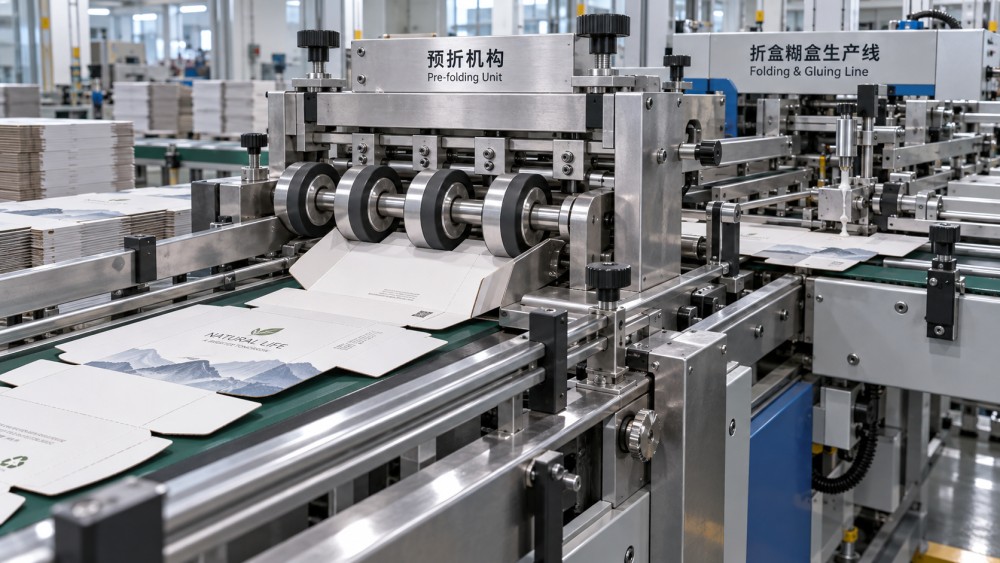
Particular attention is needed where pre-break belts, rails, rollers, or hooks contact the blank. Contact surfaces should support the board without scuffing printed areas or pulling delicate coatings. For cartons with varnish, metallic decoration, laminated faces, or sensitive ink systems, the acceptable contact method may be more important than the maximum output claim.
Board and carton compatibility should be demonstrated across the real job mix
“Compatible with paperboard” is not a sufficient specification. Paperboard behavior changes with caliper, fiber composition, coating, moisture condition, grain direction, score depth, and the relationship between the score and carton design. Corrugated and micro-flute applications add another concern: localized pressure can crush the flute or change panel geometry before final forming.
Technical evaluators should document the operating envelope that matters to the plant. It should include minimum and maximum blank size, practical board thickness range, carton styles, crease orientations, and known sensitive substrates. The most relevant question is not whether a unit can process an individual sample, but whether it stays stable as work changes within that envelope.
Integration with the folder gluer determines practical value
A pre-breaking station cannot be evaluated as an isolated machine when it will feed a folder gluer or operate as part of an inline converting system. Blank transfer, machine-center alignment, speed synchronization, and control handoff all influence whether the fold preparation survives to the final folding section.
Check the physical interface first: infeed height, transport direction, available floor space, guarding boundaries, and accessibility for operators. Then check process interface details. Can the pre-breaking unit maintain blank spacing at line speed? Does it preserve registration for cartons with printed panels or inspection requirements? Can it manage blanks that need pre-breaking on more than one panel without interfering with folding carriers, glue guns, or compression sections?
A supplier should also clarify responsibility at the interface. When a carton jams between two machines or a speed change causes skewing, the plant needs to know which party owns diagnosis and correction. This becomes especially important in lines assembled from multiple manufacturers.
Speed claims need an operating definition
Maximum mechanical speed does not equal stable production speed. A pre-breaking unit may run quickly with a simple carton and a forgiving substrate, while a complex job requires lower speed to maintain clean folding and consistent blank transport. Ask for the conditions behind any quoted performance figure: carton format, board type, number of pre-break operations, feeding method, and downstream equipment configuration.
More useful evidence comes from a controlled run of representative blanks. Observe startup stability, blank separation, repeatability after speed changes, the quality of the pre-broken crease, and the amount of adjustment needed. Continue the evaluation long enough to see whether heat, vibration, dust, or belt tracking affects consistency. A short sample run can conceal problems that become visible only during normal operating conditions.
For plants handling frequent job changes, recovery behavior is as important as output. The unit should return to a workable setting quickly after a format change, a stoppage, or a routine cleaning task. A technically capable design that requires lengthy operator intervention may not suit a short-run production model.
Assess changeover as a controlled process
Changeover performance is commonly underestimated because demonstrations are often arranged around one prepared job. In production, operators must move guides, alter pre-break positions, reset carriers, confirm clearances, and establish acceptable fold quality under time pressure.
Review every adjustment point with the manufacturer. Identify which settings are manual, tool-assisted, motorized, or recipe-controlled. Manual adjustment is not automatically a disadvantage; it can be appropriate for stable, long-run work where simplicity and serviceability matter. It becomes less attractive when the plant processes many carton designs each day or relies on operators with varying experience.
Ask for a clear changeover procedure and determine how settings are recorded. A unit with reliable positioning references can reduce dependency on individual operator memory. Where digital recipes are available, confirm which parameters are stored and which still require physical adjustment. A recipe that recalls speed but not the critical mechanical positions does not remove the most sensitive part of the setup.
Maintenance access is part of the technical specification
Pre-breaking stations operate around paper dust, board debris, adhesive contamination, and repeated mechanical movement. Belts, bearings, guides, rollers, sensors, and adjustment mechanisms need routine attention. Maintenance should be evaluated from the operator side as well as the maintenance team's side.
Inspect whether wear components can be reached without dismantling unrelated assemblies. Check access around guards, the space required to change belts or rollers, lubrication arrangements, and the visibility of alignment references. A compact design can save floor space yet create long service stops if critical components are difficult to reach.
Request a practical list of consumable and wear parts, along with the manufacturer’s parts-identification system. The important issue is not simply whether spare parts are offered, but whether the plant can identify, stock, and replace the components that most affect uptime. Electrical documentation, pneumatic schematics, mechanical drawings, and fault guidance should be usable by the site's own technical team.
Controls and data should support diagnosis, not add complexity
For a standalone unit, basic speed coordination and fault indication may be sufficient. In an automated packaging plant, technical evaluators may need production status, alarm history, job recipes, operating counters, and communication with the folder gluer, inspection system, or production management layer.
Evaluate data connectivity in terms of decisions the plant must make. Can an alarm identify whether the problem is blank feeding, belt tracking, position error, or a downstream stoppage? Can the unit report repeated interruptions that point to a mechanical adjustment issue? Is the control architecture compatible with the line’s established communication approach?
More data is not inherently better. A complex interface that operators cannot interpret can slow response. The best control arrangement presents actionable machine status while allowing maintenance personnel to trace faults without unnecessary dependence on the supplier.
How to compare manufacturers during a technical review
A structured review avoids the common outcome where one supplier wins on price, another on claimed speed, and no one is measured against the actual conversion requirement. Use the same blanks, target carton quality, line configuration, and acceptance criteria for each evaluation.
- Define acceptable fold opening and final carton-forming behavior before testing.
- Include difficult materials and carton designs, not only routine production samples.
- Assess stability during startup, speed changes, and repeated runs.
- Record the mechanical settings required for each job and how easily they can be restored.
- Review physical, electrical, pneumatic, and control interfaces with downstream equipment.
- Include maintenance access, spare parts, documentation, training, and service response in the technical comparison.
The manufacturer that offers the most elaborate unit is not necessarily the best choice. A simple, accessible machine can be the better fit for long production runs with limited format variation. A more adjustable and data-connected solution can justify its complexity where product mix changes often, carton quality is tightly controlled, or the pre-breaker must operate as part of an automated folding and gluing line.
Use the purchase decision to improve the whole converting line
Pre-breaking performance reflects upstream and downstream conditions. Before final selection, review die-cut and creasing quality, blank squareness, printed-surface sensitivity, folding path design, glue application, compression, and final inspection requirements. This prevents the unit from being specified to compensate for a problem that belongs elsewhere in the process.
Resources from platforms such as Global Commercial Print & Corrugated Packaging Intelligence (CPCS) can help project teams compare how converting equipment, inspection, automation, and production data systems interact across a packaging line. The useful comparison is not a list of machine features; it is whether each station supports stable carton quality, practical changeovers, maintainable operation, and predictable output.
Choose a manufacturer after the intended operating window is clear and proven with representative work. That approach turns pre-breaking from a narrowly defined accessory purchase into a controlled part of carton quality and line productivity.
Related News
 How to Calculate Short Run Die Cutting Costs Before Placing an OrderCalculate short run die cutting costs before you order. Learn how tooling, setup, material waste, and finishing affect your budget—and compare quotes to avoid hidden charges.Post-Press Kinematics Expert
 How a High Accuracy Sheet Feeder Reduces Misfeeds in Die CuttingDiscover how a high accuracy sheet feeder reduces die-cutting misfeeds, waste, and downtime. Learn how to choose the right system for more reliable production.Post-Press Kinematics Expert
 How to Choose a Platen Die Cutter Manufacturer for Reliable OutputChoose a platen die cutter manufacturer with proven output. Discover how material trials, service support, and clear acceptance criteria help reduce downtime and protect your investment.Post-Press Kinematics Expert
 How to Choose a Counterplate Manufacturer for Accurate CreasingChoose a counterplate manufacturer that delivers accurate creasing. Learn how to assess channel design, production trials, and repeatability to reduce setup waste and improve folding.Post-Press Kinematics Expert
 How Flatbed Steel Rule Dies Improve Cut Accuracy and Changeover SpeedFlatbed steel rule dies improve cut accuracy, crease quality, waste release, and changeover speed. Discover practical tooling tips for reliable, efficient converting.Post-Press Kinematics Expert
 How Platen Presses Support Precise Foil Stamping and Die CuttingPlaten Presses deliver precise foil stamping, clean die cutting, and reliable creasing for premium packaging. Discover setup practices that improve quality and reduce waste.Post-Press Kinematics Expert