What to Check When Choosing a Creasing Die Manufacturer
What to Check When Choosing a Creasing Die Manufacturer
Choosing a creasing die manufacturer is not simply a tooling purchase. For procurement teams, the decision directly affects setup time, carton quality, material waste, production stability, and delivery performance.
The best supplier is rarely the one offering the lowest quoted price. Buyers should compare technical capability, die construction, material control, compatibility knowledge, service responsiveness, and total lifecycle cost.
This guide helps carton converters, commercial printers, and packaging plants assess suppliers with practical questions before approving a creasing die manufacturer for routine or strategic production work.
Start With the Actual Converting Application
Before comparing suppliers, define the application clearly. A creasing die for lightweight folding cartons has different requirements from one used for corrugated display packaging or rigid paperboard components.
Procurement teams should provide substrate type, board thickness, flute profile, coating condition, fiber direction, sheet size, print process, run length, and expected production speed.
These details allow the manufacturer to recommend appropriate rule height, rule thickness, channel geometry, ejection material, and base construction instead of supplying a generic configuration.
Ask whether the supplier has experience with similar cartons. A manufacturer familiar with pharmaceutical cartons may not automatically understand the challenges of recycled corrugated board or heavily coated retail packaging.
Job complexity also matters. Designs with narrow panels, reverse creases, small locking tabs, multiple fold directions, or precise registration requirements need more engineering attention than simple shipping cases.
Buyers should request examples of comparable jobs, especially where board quality varies or production speeds are high. Relevant application experience reduces trial-and-error during make-ready.
A capable creasing die manufacturer should ask detailed technical questions before quoting. Suppliers that quote immediately without reviewing drawings, material specifications, and machine conditions may create avoidable risk.
Check Creasing Accuracy and Rule Quality
Creasing performance depends heavily on the quality and consistency of the rule. Variations in rule height, hardness, edge condition, or bending accuracy can create uneven folds and cracking.
Ask suppliers what crease rule grades they use and whether materials are sourced from established tooling steel producers. Quality rule should maintain stable dimensions throughout demanding production runs.
The supplier should explain how it controls bending accuracy, cutting precision, joint quality, and rule placement. Minor dimensional errors can become visible defects when cartons are folded automatically.
For premium packaging, ask how the manufacturer manages fine detail, tight radii, short crease segments, and close spacing between cutting and creasing rules.
Crease lines must be positioned accurately relative to printed graphics, windows, embossing, foil areas, and glued panels. This is especially important for brand packaging with strict visual standards.
Request measurable tolerances rather than broad statements about precision. A reliable supplier should be able to describe expected positional accuracy and identify factors that can affect final performance.
Where possible, evaluate a sample die or test run. Physical inspection often reveals issues that specifications alone cannot show, including uneven rule seating, poor joints, or inconsistent ejection design.
Evaluate Die Board Construction and Material Selection
The die board provides the structural foundation for every cutting and creasing rule. Poor board quality can reduce registration accuracy, shorten die life, and create instability during repeated production cycles.
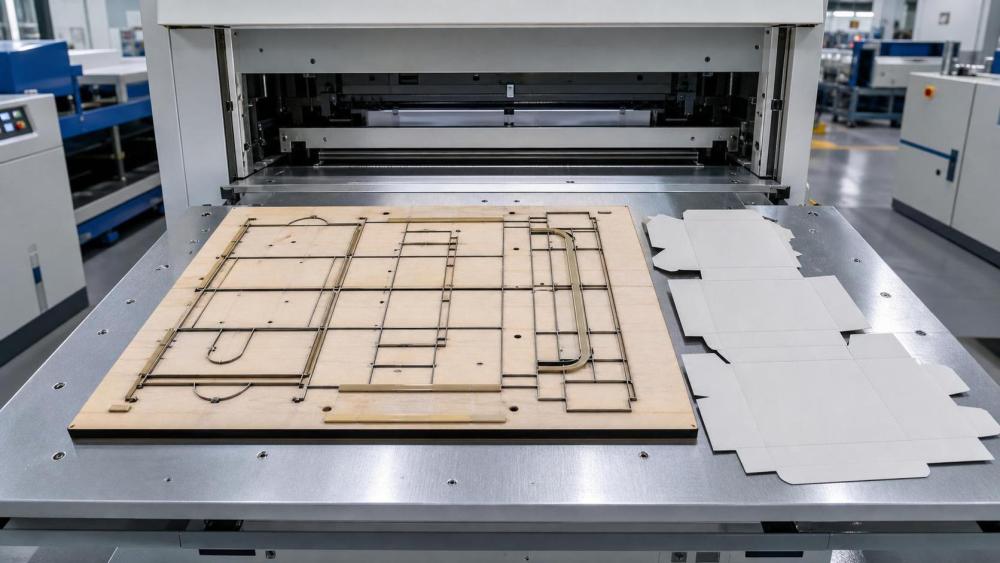
Ask whether the manufacturer uses plywood, composite boards, or other engineered base materials. The suitable choice depends on press type, job complexity, humidity conditions, and required service life.
High-quality die boards should have consistent thickness, stable moisture content, and clean laser-cut slots. Weak or inconsistent boards may warp, loosen rules, or create registration problems.
Laser cutting quality deserves specific attention. Slots should fit the rules securely without excessive force, looseness, burning, or damage that weakens the board structure.
Buyers should also ask how the supplier handles large-format dies. Bigger formats create greater risk of board distortion, transport damage, and uneven pressure distribution during cutting and creasing.
For repeat orders, confirm whether the manufacturer retains approved production files and material records. Consistent board selection improves repeatability when the same carton design returns months later.
If dies operate in humid or variable factory environments, discuss protection and storage requirements. Tool stability can be affected by climate, cleaning methods, and handling practices on site.
Confirm Compatibility With Existing Equipment
A technically sound die can still perform poorly if it does not match the factory’s die-cutting equipment, stripping system, delivery section, and production workflow.
Provide the machine model, format, chase type, cutting pressure range, feeder arrangement, stripping configuration, and delivery requirements during the supplier evaluation process.
Flatbed die-cutters, rotary die-cutters, platen presses, and corrugated converting machines have different tooling demands. The manufacturer must understand the operational limits of the intended equipment.
Ask whether the supplier designs dies for automated stripping, blanking, waste removal, or downstream folder gluer requirements. Tooling decisions should support the entire converting sequence.
For high-speed work, ejection rubber selection is important. Poor ejection design can cause sheet sticking, waste accumulation, missed stripping, delivery jams, and reduced operating speed.
Check how the supplier manages stripping pin placement, bridge design, nick size, and waste retention. These details can influence blank quality and operator intervention rates.
Compatibility should include digital workflow readiness. Suppliers that accept production-ready CAD files and provide structured approval drawings can reduce communication errors before manufacturing begins.
Assess Crease Quality, Not Only Cutting Performance
Many purchasing reviews focus on cutting quality because it is easier to inspect immediately. However, poor creasing often creates the more expensive problems during folding and final packing.
A good crease must create a controlled fold line without cracking printed surfaces, breaking fibers excessively, weakening panels, or distorting carton geometry after folding.
Ask how the manufacturer selects crease channels, counterplates, matrix materials, and rule profiles for specific board grades. These components must work together as a system.
Different substrates require different creasing approaches. Coated paperboard, recycled board, laminated sheets, microflute corrugated board, and rigid board each react differently under pressure.
Request recommendations for make-ready materials and creasing matrix selection. A manufacturer that only supplies the die without advising on the counter system may leave the buyer with incomplete support.
Crease quality should be tested through actual folding, not only flat-sheet inspection. Evaluate folding resistance, panel alignment, corner condition, glue flap behavior, and performance on automatic packaging lines.
For sensitive products, define acceptance criteria in advance. This may include limits for cracking, fold deviation, score depth, dust generation, or damage to printed and coated surfaces.
Review Durability, Maintenance, and Lifecycle Cost
The cheapest die may cost more over time if it needs frequent repair, produces inconsistent blanks, causes extended setup, or fails before planned production volumes are completed.
Ask the creasing die manufacturer to estimate expected life based on material, design complexity, machine type, maintenance practice, and anticipated number of impressions.
Die life varies significantly across applications. Short-run promotional cartons may need a different tooling strategy from recurring food packaging, e-commerce mailers, or high-volume retail cartons.
Buyers should compare more than initial die price. Include make-ready time, downtime risk, replacement frequency, waste rates, operator adjustments, repair charges, and potential shipment delays.
Ask whether damaged rules can be repaired efficiently and whether spare components are available. Fast repair support matters when a production schedule depends on a single critical die.
Storage conditions also influence lifespan. The supplier should provide practical guidance for cleaning, labeling, transporting, and storing dies to avoid moisture damage, bent rules, and missing accessories.
For recurring designs, consider a supplier that maintains revision history and tool identification. Clear traceability makes future replacement, repair, and performance investigation much easier.
Compare Lead Times and Supplier Capacity
Lead time is a purchasing risk, especially for packaging plants managing urgent brand launches, seasonal demand, short-run orders, and frequent customer artwork revisions.
Ask for standard lead times by die format, complexity, and order quantity. Also ask how the supplier handles urgent orders without sacrificing drawing approval or inspection quality.
A supplier’s advertised turnaround time may not reflect peak-season conditions. Procurement teams should discuss capacity planning, production bottlenecks, material availability, and shipping arrangements directly.
Check whether design, laser cutting, rule bending, assembly, inspection, and dispatch are managed internally. Greater process control can improve delivery reliability and accountability.
For international sourcing, calculate the full delivery window. Customs clearance, packaging protection, freight variability, and possible repair shipments can outweigh a lower offshore unit price.
Ask how the supplier packages finished dies. Large dies require strong protection against impact, moisture, rule damage, and movement during transport to the converting facility.
Reliable suppliers communicate early when delivery risks arise. Procurement should treat transparent schedule management as a measurable part of supplier performance, not merely a customer-service preference.
Examine Technical Support and Problem-Solving Ability
Tooling problems often appear during setup rather than during purchasing. The real value of a creasing die manufacturer becomes clear when a difficult job needs rapid diagnosis.
Ask who provides technical support and what information they require to investigate defects. Effective support should connect die design, substrate behavior, machine settings, and converting conditions.
Common issues include carton cracking, incomplete creasing, uneven fold lines, poor stripping, excessive nicks, sheet distortion, waste buildup, and inconsistent delivery performance.
A capable supplier should help distinguish between a die issue and a process issue. Incorrect pressure, worn counterplates, unsuitable matrix, variable board moisture, or machine wear can cause similar symptoms.
Review the supplier’s response process for urgent quality cases. Confirm contact channels, expected response times, replacement procedures, and responsibility for corrective actions when tooling defects are confirmed.
For important packaging programs, involve production staff in supplier evaluation. Operators, die-cutting supervisors, and quality teams often identify practical concerns that purchasing teams may not see.
Suppliers that provide setup recommendations, troubleshooting guidance, and feedback after trial runs can help reduce the time required to stabilize new carton designs.
Use a Structured Supplier Evaluation Process
A structured comparison prevents purchasing decisions from being driven by unit price alone. Create a scorecard that reflects the commercial and operational importance of each evaluation factor.
Useful scorecard categories include technical suitability, creasing accuracy, material quality, machine compatibility, lead time, support capability, quality documentation, durability, and total operating cost.
Weight the categories according to the application. High-volume food cartons may prioritize consistency and uptime, while short-run premium packaging may prioritize detail accuracy and fast changeovers.
Request formal quotations based on the same technical specification. Comparing incomplete or differently configured quotes can make a lower-priced offer appear more competitive than it really is.
Before approving a new supplier, begin with a controlled trial order. Monitor setup time, running speed, crease quality, waste level, folding performance, and operator feedback.
Document trial results in measurable terms. This creates evidence for supplier selection and provides a reference point when future production conditions or die performance change.
For strategic suppliers, establish regular performance reviews. Track delivery reliability, defect rates, response quality, repeatability, and improvement actions across multiple jobs rather than isolated orders.
Conclusion: Select for Converting Reliability
The right creasing die manufacturer helps a packaging plant achieve more than clean cuts. It supports stable creases, smoother setup, stronger carton formation, lower waste, and dependable output.
Procurement teams should evaluate the supplier’s engineering discipline, material choices, equipment knowledge, quality control, responsiveness, and lifecycle value before making price-driven comparisons.
When die selection is based on real production requirements and verified through structured trials, buyers can reduce converting risk while improving productivity across recurring packaging programs.
Related News
 How Flatbed Steel Rule Dies Improve Cut Accuracy and Changeover SpeedFlatbed steel rule dies improve cut accuracy, crease quality, waste release, and changeover speed. Discover practical tooling tips for reliable, efficient converting.Post-Press Kinematics Expert
 How Platen Presses Support Precise Foil Stamping and Die CuttingPlaten Presses deliver precise foil stamping, clean die cutting, and reliable creasing for premium packaging. Discover setup practices that improve quality and reduce waste.Post-Press Kinematics Expert
 How Pre-Breaking Units Reduce Cracking in Die-Cut Carton FoldsPre-Breaking Units help reduce cracking in die-cut carton folds by easing bend stress, improving fold accuracy, and supporting high-speed carton production.Post-Press Kinematics Expert
 How a High Pile Feeder Reduces Downtime in Die-CuttingHigh pile feeder solutions reduce die-cutting downtime, improve sheet supply stability, and help packaging plants increase throughput with fewer interruptions.Post-Press Kinematics Expert
 Carton Die Cutting for Folding Cartons That Reduces Setup WasteCarton die cutting for folding cartons reduces setup waste with stable registration, reliable creasing, smarter tooling, and repeatable production control.Post-Press Kinematics Expert
 How to Choose Hardened Die Cutting Knives for Longer Production RunsHardened die cutting knives for longer runs: learn how to balance hardness, edge profile, consistency, and total conversion cost for reliable results.Post-Press Kinematics Expert