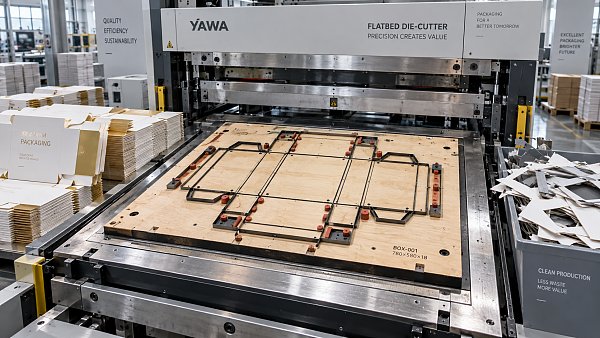
How to Choose a Platen Die Cutter for Corrugated Board in 2026
Why platen die-cutter selection got harder in 2026
In corrugated converting, a bad equipment choice rarely fails on day one. It usually shows up six months later as unstable creasing on heavy board, too much setup spoilage on short runs, feeder sensitivity with mixed sheet quality, or an OEE number that looks acceptable on paper but never holds across a real production week.
That is why choosing a platen die cutter for corrugated board in 2026 is less about headline speed and more about whether the machine fits the plant’s board mix, order structure, labor reality, and quality expectations. For technical evaluators, the machine should be judged as part of the whole converting chain: corrugator stability, print registration, die quality, stripping requirements, downstream folder gluer behavior, and inspection demands all matter.
This is also where many comparisons go wrong. Buyers compare maximum sheets per hour, platen pressure, and format size, but ignore how the intermittent motion system behaves at speed, how quickly the machine returns to saleable output after changeover, and how much waste it creates while doing so. In a market shaped by e-commerce volume swings, paper-based packaging growth, and tighter compliance expectations around material efficiency, that is no longer a minor oversight.
Start with the job mix, not the machine brochure
Before comparing suppliers, define the work the die-cutter must actually survive. A plant focused on regular slotted containers and medium-volume transit packaging needs a very different setup from one handling retail-ready packs, shelf-ready displays, or more complex e-commerce geometries with tighter crease and slot tolerances.
Three questions usually expose the real requirement:
- What board grades dominate the schedule: E, B, C, BC, or mixed flute production?
- Are you mainly running long repeat orders, or frequent short runs with many changeovers?
- How much of the output needs clean stripping, tight folding behavior, or downstream glue-line consistency?
If the plant regularly shifts between light microflute and heavier double-wall structures, the machine’s usable range matters more than a top-end spec. Not every platen die cutter handles board compression, crease recovery, and sheet transport equally well across that range. Some machines look strong on heavy board but are less forgiving on thin material where marking, cracking, or inconsistent nick break can become a problem.
Registration stability and motion design matter more than advertised speed
A flatbed die-cutter for corrugated board lives or dies by motion control. The feeder, register section, gripper system, and platen timing all have to cooperate through a violent stop-start cycle. Anyone who works around these machines knows the issue is not whether a builder can quote high output. The issue is whether the machine still holds registration and sheet integrity when the board is less than perfect, humidity changes, or print-to-cut tolerances get tighter.
This is where experienced evaluators spend time on cam kinematics, gripper-bar design, sheet deceleration behavior, and side/front register logic. CPCS often looks at die-cutting equipment through that wider mechanical lens, because the hidden losses in corrugated converting are frequently born in motion transitions rather than in obvious breakdowns.
When assessing registration performance, ask to see:
- Performance on printed corrugated sheets, not only plain board
- Repeatability after multiple job changes
- Behavior at realistic running speeds, not just demonstration pace
- Results on board with normal plant variation, including warp or slight caliper inconsistency
A machine that is slightly slower but less sensitive to sheet variation can produce more saleable output over a month than a faster line that spends too much time chasing register drift.
Board handling is where the real differences show up
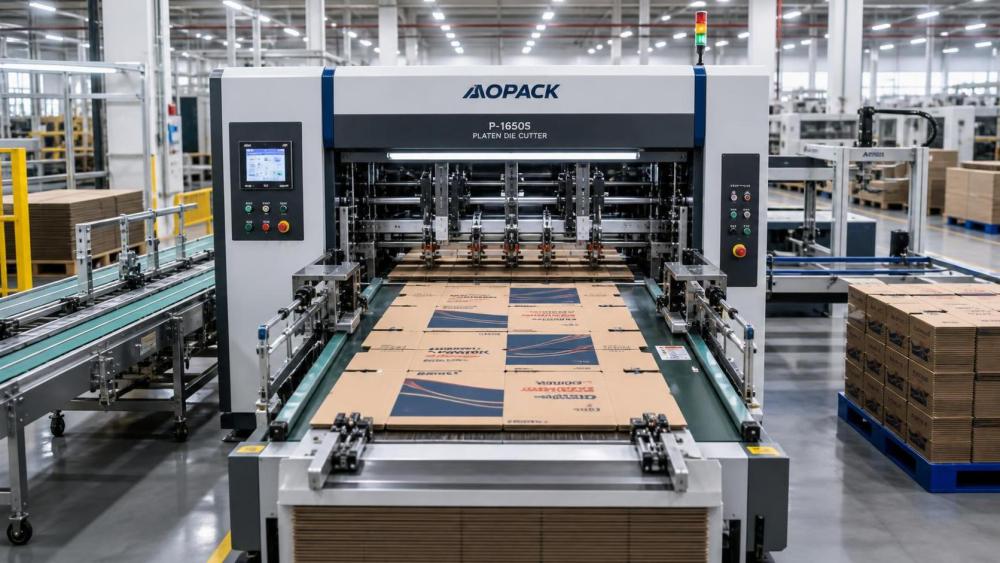
Many selection mistakes come from evaluating the cutting section while underestimating feeding and transfer. Corrugated is not a dimensionally perfect substrate. It carries memory from corrugation, moisture variation, flute direction effects, and handling damage. A platen die cutter may look excellent on ideal sheets but become temperamental with edge crush, warp, or uneven sheet flatness.
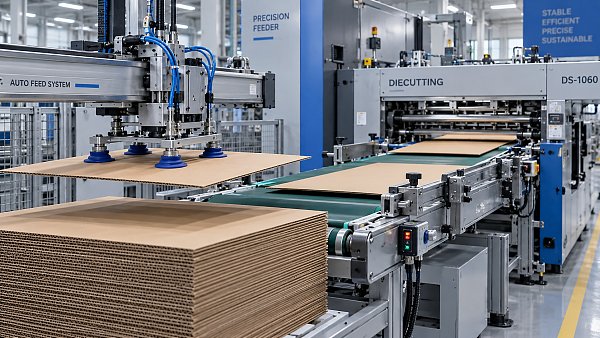
For that reason, ask how the machine manages sheet separation, double-sheet detection, skew correction, non-stop feeding, and waste removal. If your upstream corrugator and printing process are already pushing high throughput, the die-cutter should not become the point where substrate inconsistency turns into chronic stoppages.
This is especially important in plants trying to reduce setup spoilage. Across corrugated operations, material loss often comes not from catastrophic failure but from repeated small losses during feeder tuning, register correction, stripping adjustment, and delivery instability. A robust platform with better automation can be justified simply because it wastes fewer sheets during each transition.
Automation should be evaluated in minutes saved, not features counted
In 2026, nearly every supplier will present automation as a standard story: quick setup, recipe recall, motorized adjustment, job memory, automatic non-stop systems, and optional inspection. That is not enough. The real question is which automation functions remove the bottlenecks your operators fight every day.
If you run many short orders, focus on makeready compression. How long does it take to move from the last good sheet of job A to the first consistently good sheet of job B? Can register settings, pressure zones, stripping positions, and delivery parameters be recalled reliably? Does the HMI help operators diagnose faults quickly, or does it simply look modern?
If labor skill levels vary by shift, intuitive controls become more valuable than another marginal increase in nominal speed. The same applies to remote diagnostics and maintenance support. For globally distributed packaging groups, service response and spare parts logic can influence uptime more than small mechanical spec differences.
Do not separate die-cut quality from downstream converting
A clean blank is not automatically a good blank. What matters is how it behaves in folding, gluing, packing, and filling. Poor crease geometry, excessive board cracking, hanging nicks, or unstable stripping can create trouble later at the folder gluer or customer packing line.
This is why serious technical evaluation should involve downstream stakeholders. If the finished blank has to run through high-speed folder gluers, precision in crease depth and consistency matters. In some applications, especially retail-ready or display packaging, visual quality around cut edges and score lines can be as important as productivity. In others, structural performance under logistics load is the bigger concern.
A practical test is to follow trial samples beyond the die-cutter. Fold them, glue them, erect them, and if relevant, test them in the actual packing format. Problems that are invisible at the delivery pile often become obvious one process later.
Waste control, OEE, and compliance are now part of the same conversation
Material efficiency has become a harder business issue, not just an environmental talking point. Paper costs, board availability, and packaging regulations are pushing converters to look more seriously at waste generated during setup and unstable production. In Europe especially, discussions around PPWR have reinforced the need to think beyond machine speed toward total material yield and process discipline.
That broader view is one reason intelligence-led platforms such as CPCS pay close attention to the link between kinematics, spoilage, and overall line economics. A die-cutter that reaches target output faster, holds quality with fewer interventions, and integrates with inspection logic can materially improve OEE even if its top spec is not the highest in the tender.
When suppliers discuss waste reduction, push for operational clarity. Ask where waste typically occurs, what machine functions are intended to reduce it, and which assumptions depend on die quality, operator training, or board consistency. That keeps the conversation grounded.
Questions worth asking during a technical comparison
Common buying mistakes
One is assuming more pressure equals better corrugated performance. Tonnage matters, but excessive force without proper control can damage board structure or hide weak process settings rather than solve them.
Another is treating the die-cutter as a standalone island. In reality, its performance depends heavily on sheet quality coming from the corrugator and printing stage. If starch application, moisture balance, or print registration is inconsistent upstream, even a very good machine will spend more time compensating.
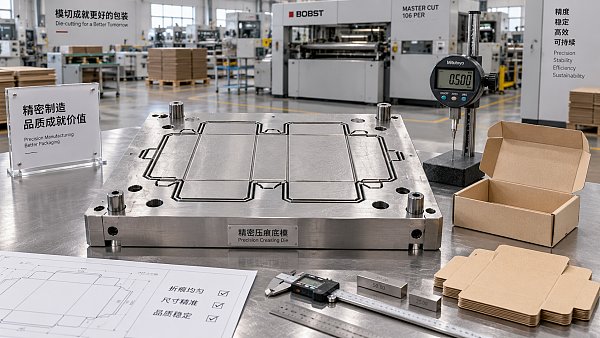
The third is underestimating tooling discipline. No machine compensates forever for poor die condition, weak stripping design, or inconsistent make-ready practice. During evaluation, it helps to separate machine capability from tooling capability, otherwise the trial tells you very little.
What a good decision usually looks like
A good choice is rarely the most impressive machine in a showroom. It is the one that fits the plant’s real production profile, protects board quality across a usable operating range, shortens the path to stable output, and stays maintainable under local service conditions.
If you are narrowing suppliers, ask for a trial plan built around your own board structures and job types. Include printed work if registration matters. Review waste during setup, not only final running speed. Trace sample blanks into folding and gluing. And when discussing ROI, build the model around uptime, spoilage, and labor dependence rather than brochure maximums.
That approach is less dramatic than buying on top speed, but in corrugated converting it is usually the difference between owning a fast machine and owning a productive one.
Related News
 How to Calculate Short Run Die Cutting Costs Before Placing an OrderCalculate short run die cutting costs before you order. Learn how tooling, setup, material waste, and finishing affect your budget—and compare quotes to avoid hidden charges.Post-Press Kinematics Expert
 How a High Accuracy Sheet Feeder Reduces Misfeeds in Die CuttingDiscover how a high accuracy sheet feeder reduces die-cutting misfeeds, waste, and downtime. Learn how to choose the right system for more reliable production.Post-Press Kinematics Expert
 How to Choose a Platen Die Cutter Manufacturer for Reliable OutputChoose a platen die cutter manufacturer with proven output. Discover how material trials, service support, and clear acceptance criteria help reduce downtime and protect your investment.Post-Press Kinematics Expert
 How to Choose a Counterplate Manufacturer for Accurate CreasingChoose a counterplate manufacturer that delivers accurate creasing. Learn how to assess channel design, production trials, and repeatability to reduce setup waste and improve folding.Post-Press Kinematics Expert
 How Flatbed Steel Rule Dies Improve Cut Accuracy and Changeover SpeedFlatbed steel rule dies improve cut accuracy, crease quality, waste release, and changeover speed. Discover practical tooling tips for reliable, efficient converting.Post-Press Kinematics Expert
 How Platen Presses Support Precise Foil Stamping and Die CuttingPlaten Presses deliver precise foil stamping, clean die cutting, and reliable creasing for premium packaging. Discover setup practices that improve quality and reduce waste.Post-Press Kinematics Expert